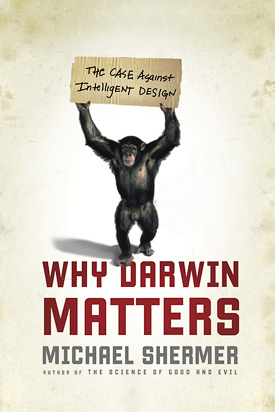
In this week’s eSkeptic, we announce Dr. Michael Shermer’s latest book Why Darwin Matters: The Case Against Intelligent Design. Shermer is the founding publisher of Skeptic magazine, the Director of the Skeptics Society, a monthly columnist for Scientific American, and the host of the Skeptics Distinguished Lecture Series at Caltech. He is the author of Science Friction, The Science of Good and Evil, How We Believe, Why People Believe Weird Things, In Darwin’s Shadow, Denying History, and The Borderlands of Science.
announcing
Michael Shermer’s NEW book
Michael Shermer is one of America’s necessary minds. A reformed fundamentalist who is now an experienced foe of pseudoscience and superstition, he does us the double favor of explaining exactly what creationists believe, and then of demonstrating that they have no case. With his forensic and polemical skill, he could have left them for dead: instead he generously urges them to stop wasting their time (and ours) and do some real work.
A readable and well-researched book on what is perhaps the most vital scientific topic of our age. Anyone who has been snowed into thinking that there is a real scientific controversy over evolution by natural selection will be enlightened by Why Darwin Matters, which is both genial and intellectually uncompromising.
None writes so fiercely in defense of evolution as Shermer … With the sustained indignation of a former creationist, Shermer is savage about the shortcomings of intelligent design and eloquent about the spirituality of science. In Why Darwin Matters, he has assembled an invaluable primer for anyone caught up in an argument with a well-intentioned intelligent design advocate.
about the book
Evolution happened, and the theory describing it is one of the most well founded in all of science. Then why do half of all Americans reject it? There are religious reasons, such as the fear of atheism and the perceived loss of ultimate meaning; there are psychological reasons, such as the ego-deflating realization that we are mere animals; and there are political reasons, such as the equation of evolution with moral relativism on the right, and the connection of evolution to eugenics and social Darwinism on the left.
In Why Darwin Matters, historian of science and bestselling author Michael Shermer defuses these fears by examining what evolution really is, how we know it happened, and how to test it. Shermer then discusses what science is through a brief history of the evolution-creation controversy from the Scopes “Monkey” trial of 1925, through the U.S. Supreme Court case of 1987, to the ongoing trials today, demonstrating clearly how and why creationism and Intelligent Design theory are not science. Dr. Shermer also builds a powerful case for evolution as the scientific theory that most closely parallels the Christian model of human nature and the conservative model of free market economics.
The most common reason people give for why they believe in God is the good design of the world and the life in it. The question is: who or what is the designer? Why Darwin Matters examines the difference between supernatural design (creationism) v. natural design (evolution) and how evolution can explain complex design.
Dr. Shermer was once an evangelical Christian and a creationist, and is now one of the best-known public intellectuals defending evolutionary theory, so Why Darwin Matters provides readers with an insiders’ guide to the evolution-creation debate, in which he shows why creationism and Intelligent Design are not only bad science, they are bad theology, and why science should be embraced by people of all beliefs.
reviews & interviews
Last week, Salon.com ran as its cover story an interview with Michael Shermer. The article is one in a series of interviews with leading scientists and thinkers on the topics of religion and science. In this interview “Michael Shermer explains why Darwin matters, how believing in God is the same as believing in astrology, and why it doesn’t take divine faith to experience something bigger than ourselves.”
Also of interest, LA Times writer Robert Lee Hotz and Washington Post writer David Brown review Why Darwin Matters along with other books on intelligent design. On the flip side, the liberal media watch group ‘NewsBusters’ presents their critique of the LA Times review.
READ the Salon.com interview >
an excerpt from
Why Darwin Matters
by Michael Shermer
Charles Darwin is back in the news, with Kansas school board members once again shifting seats Left and Right (with liberals this time winning out), leaving us with a perplexing paradox: in science, evolution is one of the half dozen most well supported theories, right up there with the big bang theory of cosmology and the germ theory of disease; yet, a 2005 Pew Research Center poll found that 42 percent of Americans hold strict creationist views that “living things have existed in their present form since the beginning of time” and that 64 percent said they were open to the idea of teaching creationism in addition to evolution in public schools, while 38 percent said they think evolution should be replaced by creationism in biology classrooms.
How can we explain the great divide between what scientists think and what the public accepts? Being that I was once a creationist when I was a born-again Christian student at Pepperdine University, but have since devoted much of my scientific career to defending the teaching of evolution through popular science books and magazines, I think I have an answer in the form of one general and six specific reasons.
The syllogistic reasoning behind the general fear of evolution is as follows: Evolution implies that there is no God, therefore … Belief in the theory of evolution leads to atheism, therefore … Without a belief in God there can be no morality or meaning, therefore … Without morality and meaning there is no basis for a civil society, therefore … Without a civil society we will be reduced to living like brute animals.
This is what bothers people about evolutionary theory, not the technical details of the science. Most people do not know, nor care about, adaptive radiation, allopatric speciation, phenotypic variation, assortative mating, adaptation and exaptation, gradualism and punctuated equilibrium, and the like. What people want to know is this: If my kids learn about evolution in school are they going to become atheists? Will we lose all meaning and morality? Will society go to hell in an immoral handbasket?
This general fear leads to six specific fears about evolution.
- A general resistance to science. This reaction falls under the rubric of what I call the Conflicting Worlds Model of the relationship of science and religion, where one is forced to choose one over the other. In particular, if scientific discoveries do not appear to support religious tenets, believers tend to opt for religion, nonbelievers for science.
- Belief that evolution is a threat to specific religious tenets. Many people attempt to use science to prove certain religious tenets, but when they do not appear to fit, the science is rejected. For example, the attempt to prove that the Genesis creation story is accurately reflected in the geological fossil record has led many creationists to conclude that the Earth was created within the past 10,000 years, which is in sharp contrast to the geological evidence for a 4.6 billion-year old Earth. If one insists on the findings of science squaring true with religious doctrines, this can lead to conflict between science and religion.
- Misunderstanding of evolutionary theory. A significant problem is that most people know so little about the theory. In a 2001 Gallup poll, for example, a quarter of the people surveyed said they didn’t know enough to say whether they accepted evolution or not, and only 34 percent considered themselves to be “very informed” about the theory. Because evolution is so controversial, public school science teachers typically drop the subject entirely rather than face the discomfort aroused among students and parents.
- The fear that evolution degrades our humanity. After Copernicus toppled the pedestal of our cosmic centrality, Darwin delivered the coup de gr¬ace by revealing us to be “mere” animals, subject to the same natural laws and historical forces as all other animals. Yet, Copernicus no longer generates controversy because his theory of heliocentrism is fully embraced, whereas Darwin’s theory remains controversial because people of faith have been told that it is a threat to their religion.
- The equation of evolution with ethical nihilism. This sentiment was expressed by the neo-conservative social commentator Irving Kristol in 1991: “If there is one indisputable fact about the human condition it is that no community can survive if it is persuaded—or even if it suspects—that its members are leading meaningless lives in a meaningless universe.” Similar fears were raised by Nancy Pearcey, a fellow of the Discovery Institute in a briefing on Intelligent Design before a House Judiciary Committee of the United States Congress. She cited a popular song urging “you and me, baby, ain’t nothing but mammals so let’s do it like they do on the Discovery Channel.” Pearcey went on to claim that since the U.S. legal system is based on moral principles, the only way to generate ultimate moral grounding is for the law to have an “unjudged judge,” an “uncreated creator.”
- The fear that evolutionary theory implies we have a fixed human nature. The first five reasons for the resistance to evolutionary theory come almost exclusively from political conservatives. This last reason originates from liberals who fear that the application of evolutionary theory to human thought and action implies that political policy and economic doctrines will fail because the constitution of humanity is stronger than the constitutions of states.
All of these fears are baseless. If one is a theist, it should not matter when God made the universe—10,000 years ago or 10,000,000,000 years ago. The difference of six zeros is meaningless to an omniscient and omnipotent being, and the glory of divine creation cries out for praise regardless of when it happened. Likewise, it should not matter how God created life—whether it was through a miraculous spoken word or through the natural forces of the universe that He created. The grandeur of God’s works command awe regardless of what processes He used.
As for meanings and morals, it is here where our humanity arises from our biology. We evolved as a social primate species with the tendency of being cooperative and altruistic within our own groups, but competitive and bellicose between groups. The purpose of civilization is to help us rise above our hearts of darkness and to accentuate the better angels of our nature.
Believers should embrace science, especially evolutionary theory, for what it has done to reveal the magnificence of the divinity in a depth never dreamed by our ancient ancestors. We have learned a lot in 4,000 years, and that knowledge should never be dreaded or denied. Instead, science should be welcomed by all who cherish human understanding and wisdom.


New episode featuring Dr. Phil Plait
The one and only Bad Astronomer gives hosts Derek & Swoopy the lowdown on the ultimate taxonomic fate of the “planet” Pluto. Phil also takes a swing at sensational new claims regarding “over-unity” free energy devices. (Perpetual motion claims: the only thing that does go on forever!)
also of interest…
ORDER Phil Plait’s classic lecture at Caltech,
Bad Astronomy (audio cassette or VHS) >