
To Boldly Go Where Few Skeptics Have Gone Before

stormtroopers at Dragon*Con (courtesy of Official Dragon*Con Photography Staff)
It seems for any particular social or interest group, there is a convention — including skepticism. The danger is that niche meetings may speak best to those who have already heard the message.
For over a decade, Dragon*Con (based in Atlanta, Georgia) has been integrating factual science and space programming with science fiction material from popular literature, film, television and gaming (such as Star Wars and Star Trek). This year, Skepticality’s Derek & Swoopy worked alongside the directors of Dragon*Con’s Space and Science content to bring a contingent of notable skeptics to the world’s largest culture convention.
On this week’s episode of Skepticality, Jeff Wagg (general manager of the James Randi Educational Foundation) and musician and skeptic George Hrab share their Dragon*Con experiences — and discuss how skeptics can promote their views at conventions to help the skeptical movement find a broader audience.
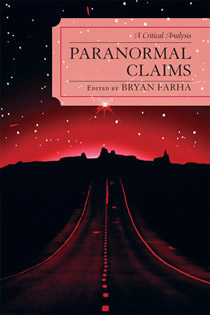
In this week’s eSkeptic Angelo Stagnaro reviews Paranormal Claims: A Critical Analysis (University Press of America, 2007, ISBN 0761837728), edited by Bryan Farha with a foreword by Michael Shermer.
Angelo Stagnaro (“Erasmus”) performs as a stage mentalist and divides his time between Europe and North America. He has authored six books on mentalism/cold reading including Conspiracy, Something from Nothing and The Other Side. His upcoming book on psychic and occult charlatanism is due to be released in late 2007.
Paranormal Claims
a book review by Angelo Stagnaro
Paranormal Claims is a collection of classic articles written by the pioneers of the critical thinking and debunking communities. Bryan Farha, the editor of this collection, is Professor of Behavioral Studies in Education at Oklahoma City University and a scientific and technical consultant to the Committee for Skeptical Inquiry and a consulting editor for The Scientific Review of Mental Health Practice. Considering the recent onslaught of pseudoscientific, pseudoreligious and pseudomystical nonsense in our bookstores and television, this book is a refreshingly logical breath of fresh air.
Coincidently, the day I received this book in the mail, a friend alerted me to the imminent publication of the most self-serving and self-congratulatory piece of twaddle I’d ever come across. The author chronicled the “channeled conversations” of twenty long since dead celebrities in what I can only describe as an afterlife version of a supermarket tabloid; an “after-loid,” if you will. If I might quote Carl Sagan’s article, “The Fine Art of Baloney Detection,” which sets the tone for Farha’s book:
How is it, I ask myself, that channelers never give us verifiable information otherwise unavailable? Why does Alexander the Great never tell us about the exact location of his tomb, Fermat about his Last Theorem, John Wilkes Booth about the Lincoln assassination conspiracy, Hermann Goring about the Reichstag fire? Why don’t Sophocles, Democritus and Aristarchus dictate their lost books? Don’t they wish future generations to have access to their masterpieces?
In contrast to sensationalist drivel, Bryan Farha’s book is a compilation of serious, scientifically and logically grounded articles; balm for the mind. The importance of this book should not be underestimated. It’s a concise vade mecum in our struggles against those who refuse to see logic. Those who falsely claim the mantle of science, religion and/or mysticism in order to intentionally dupe others for personal gain.
The critical thinking articles contained in this book outline arguments designed to confound and refute the exaggerated claims of cryptozoologists, ufologists, astrologers, psychics, medical charlatans, numerologists and other clerics of occultism. In the struggle to help bring about clarity of thought to the unwilling or incapable, this informative and convenient collection of the most important articles in critical thinking serves as a refresher to those who hope to debunk charlatanism and junk science. For those unfamiliar with some of these articles, this collection is a good introduction to the topic. Ray Hyman’s classic article on cold reading, “How to Convince Strangers You Know All About Them” is one of my favorite pieces in the collection. It’s not always easy to find classic articles on critical thinking. Considering my own recent misadventures in searching for such articles, I’m grateful for this collection.
Admittedly, it would have been wonderful to have included an article by Martin Gardner, the gray eminence of the critical thinking community, but this anthology easily stands upon its own merits with contributions from scholars including Susan Blackmore, Michael Shermer, Stephen Barrett, and Geoffrey Dean. The editor includes three of his own articles and several more from James Randi.

lecture reminder
The Stuff of Thought:
Language as a Window into Human Nature
with Dr. Steven Pinker
Sunday, September 30th, 2pm
Beckman Auditorium, Caltech
One of the most influential thinkers of our time, Dr. Steven Pinker marries two of the subjects he knows best — language and human nature — into his new book on how words can help explain our nature…