Two Michael Shermer audio books now on CD
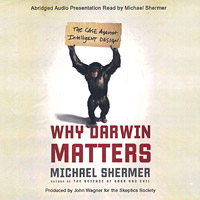
Why Darwin Matters
(abridged audio presentation)
Evolution happened. In Why Darwin Matters, historian of science and bestselling author Michael Shermer defuses fears by examining what evolution really is, how we know it happened, and how to test it. (Read by the Author) READ more…
ORDER the CD | ORDER the book
NOTE This is a pocket mini-book. 3.5″ x 5.5″ (35 pages)
The Soul of Science
(unabridged audio presentation)
In The Soul of Science Michael Shermer asks, “Can we find spiritual meaning and purpose in a scientific worldview?” Anything that generates a sense of awe may be a source of spirituality. Science does this in spades. (Read by John Wagner) READ more…
ORDER the CD | ORDER the book
In this week’s eSkeptic, Priscilla Sakezles discusses the famous words most often attributed to Socrates, “All I know is that I know nothing.” claiming that it is indeed a misquote.
Dr. Priscilla Sakezles is an Associate Professor of Philosophy at the University of Akron. She earned her doctoral degree in Philosophy from Florida State University in 1993. She has published numerous articles in philosophical journals, and specializes in ancient Greek philosophy, including ancient skepticism. In her spare time she is active in her faculty union, defending the integrity of academia.
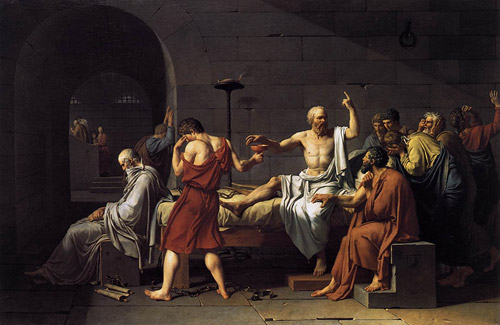
The Death of Socrates, by Jacques-Louis David
Socratic Skepticism
by Priscilla Sakezles
It is frequently claimed that Socrates said, “All I know is that I know nothing.” For instance, Skeptic magazine makes this claim in its self-defining article in the front matter of the magazine, “What is a Skeptic?” It uses this quote to justify a long historical tradition for skepticism, but it then castigates Socrates for making this claim, saying: “this pure position is sterile and unproductive and held by virtually no one. If you are skeptical about everything, you would have to be skeptical of your own skepticism.” This is a misquote that I would like to correct the record for the readers of Skeptic magazine.
The source of this misquote is Plato’s dialogue the Apology, and there are five different Socratic claims that may superficially appear to justify it. I will go through the relevant parts of the Apology, reviewing these claims to prove that they are not equivalent to, nor do they imply, the infamous quote.
The Apology is Plato’s record of Socrates’ trial on the charges of impiety and corrupting the youth of Athens. In it we hear the story of Chaerephon asking the Delphic oracle at the temple of Apollo, “Is there anyone wiser than Socrates?” The priestess replies that there is no one. Thus, Apollo himself proclaims, “no one is wiser than Socrates.” Socrates cannot believe that this is literally true, because, he says, “I know very well that I am not wise, even in the smallest degree” (21b4–5). The Delphic oracle has a reputation for speaking in riddles that require interpretation, so Socrates sets out to discover what the oracle really means.
Attempting to find someone wiser than himself, Socrates goes to those people reputed to be wise, questioning each about his area of expertise. A military general, for instance, should know “what courage is” (the subject of Laches). A religious zealot prosecuting his father for impiety certainly should know “what piety is” (the subject of Euthryphro). What Socrates discovers, time after time, is that each man is not in fact wise, although he is thought by many people — especially himself — to be so. Under Socratic cross-examination each man fails to define the concept he claims to know so much about. Socrates hopes to prove to each man how ignorant he really is.
This process of repeated public humiliation of well-known citizens makes Socrates very unpopular and is what ultimately results in his trial and execution, at least as Plato tells the story. Socrates says he regrets this effect, but he thinks that the oracle’s message is meant as a divine command to expose the ignorance of his fellow citizens. He is thus morally bound to devote his life to this noble, if annoying, cause. He is confident that Apollo has commanded him to spend his life searching for wisdom, examining both himself and others. In fact, he claims to be a “gift from the god” to the Athenian people, acting as a “gadfly” to the large and well-bred but sluggish horse that is Athens (30de).
Socrates’ final conclusion after years of such examination is this: “I am wiser than this man: neither of us knows anything that is really worth knowing, but he thinks that he has knowledge when he has not, while I, having no knowledge, do not think that I have. I seem, at any rate, to be a little wiser than he is on this point: I do not think that I know what I do not know” (21d7).
Socrates is not claiming that all knowledge is impossible. For instance, his examination of the artisans shows that they know many things related to their skills that he does not, and so in a sense they are wiser than he. He says of his own artisan knowledge: “for I knew very well that I possessed no knowledge at all worth speaking of” (22c9–d1). However, having this specialized knowledge or skill makes the artisans think they are also wise in “matters of the greatest importance.” Socrates proves they are not. Again, he decides that he is better off in his current condition, possessing neither their wisdom nor their ignorance.
Socrates ultimately interprets the meaning of the oracle to be that human wisdom is worth little or nothing. The oracle merely uses Socrates as an example, “as though he would say to men, ‘he among you is the wisest who, like Socrates, knows that his wisdom is really worth nothing at all’” (23b3–4). So Apollo is right after all: no one is wiser than Socrates because only Socrates admits his own ignorance.
Socrates, of course, is found guilty and sentenced to death. But he is not afraid of death, because to fear death is to think oneself wise without really being so, “for it is to think that we know what we do not know” (29a6). Socrates does not know what will happen when he dies, although he does suggest two alternatives (40c–41c). He may cease to exist and so lose consciousness, which would be like a long dreamless sleep. Or his soul may relocate to another place, where he could spend eternity cross-examining other dead people. Either option would be fine with Socrates, he does not know which is correct, and so he is not afraid.
We have seen five Socratic quotes that may appear to mean or imply “All I know is that I know nothing.” They are:
- (S1) I know very well that I am not wise, even in the smallest degree (21b4–5).
- (S2) I do not think that I know what I do not know (21d7).
- (S3) I knew very well that I possessed no knowledge at all worth speaking of (22c9–d1).
- (S4) He among you is the wisest who knows that his wisdom is really worth nothing at all (23b3–4).
- (S5) To fear death is to think that we know what we do not know (29a6).
Are any of these statements really equivalent to “All I know is that I know nothing?” No. (S1) does say that Socrates knows something: that he is not wise. (S2) makes no positive knowledge claim, but rather says quite the opposite: he does not think that he knows anything that he does not really know. He lacks the false pretensions to knowledge of his interlocutors. (S3) may come close to saying “I know that I know nothing” if it is removed from its context and universalized. But within its context it is obviously limited to saying that Socrates knows that he has no knowledge of the artisan’s special skills (for instance, he does not know how to build a house). (S4) does make a positive knowledge claim: the wisest person knows that his wisdom is worthless. (S5) says that to fear death is to suppose that one really does know something that one in fact does not know. Socrates does not fear death precisely because he does not suffer from this epistemological delusion.
“All I know is that I know nothing” is not an expression of skepticism, but of dogmatism. It asserts that I do in fact have positive knowledge of one and only one truth: that I do not have knowledge of any truths. This is obviously self-contradictory, and is a mistake often falsely attributed to Socrates. What Socrates does say is that he does not think or claim that he knows anything that he does not in fact really know. He has the “human wisdom” (20d) of recognizing his own ignorance, unlike his many unfortunate interlocutors. This is the attitude of an honest and sincere skeptic: he does not proclaim knowledge to be impossible, but merely is humble about his own and continues the search, always critically examining any knowledge claim.
Socrates never says that he knows nothing at all, and he certainly does not say that he knows that he knows nothing. Rather, he says neither he nor anyone else “knows anything that is really worth knowing” (21d). The meaningful knowledge that Socrates seeks, but never finds, is the real definitions of ethical concepts such as courage, piety, moderation, and justice. As it turns out (at least as we can interpret from Plato’s development), he cannot find them because he is looking in the wrong place — the true answers are to be found in the realm of “forms,” which his student Plato discovers. And with that discovery, the philosophical tone of Plato’s dialogues shift from skeptical to dogmatic.
We must conclude that the attribution of this famous quote to Socrates is wrong. He is skeptical in a certain sense, but he is not the sort of dogmatic and self-contradicting skeptic that he is often made out to be. To return to Skeptic magazine’s self-definition, skepticism is “the application of reason to any and all ideas … it is a method, not a position.” It is the Socratic method, always vigilant to expose false pretensions to knowledge, whether about the real meaning of piety or virtue, the nature or existence of God, ghosts, or UFO’s. Socrates should be given the credit he deserves as the pioneer of this form of skepticism.
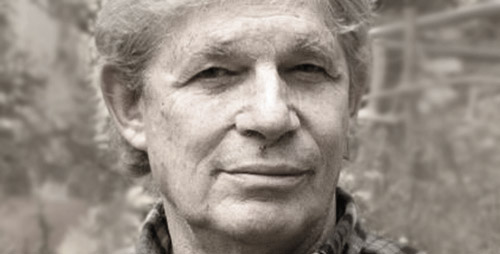
Dr. Stuart Kauffman will be speaking on Thursday, June 26, 2008 at 7:00 pm.
lecture tomorrow!
Reinventing the Sacred:
a New View of Science, Reason & Religion
with Dr. Stuart Kauffman
SPECIAL DATE: Thursday, June 26, 2008 at 7:00 pm
Baxter Lecture Hall, Caltech
In this controversial lecture based on his new book, the world-renowned complexity theorist Dr. Stuart Kauffman argues that people who do not believe in God have largely lost their sense of the sacred and the deep human legitimacy of our inherited spirituality, and that those who do believe in a Creator God, no science will ever disprove that belief. Kauffman believes that the science of complexity provides a way to move beyond both reductionist science and dogmatic theology to something new…
READ MORE about this lecture >
Important ticket information
Tickets are first come first served at the door. Sorry, no advance ticket sales. Seating is limited. $8 Skeptics Society members & Caltech/JPL Community; $10 General Public.

new this week on MichaelShermer.com
Stay up-to-date with new additions to MichaelShermer.com
by subscribing to the RSS feed.