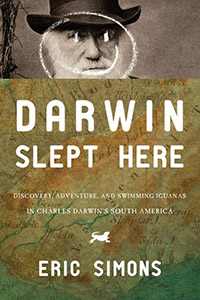
In this week’s eSkeptic, Darryl E. Brock reviews Darwin Slept Here: Discovery, Adventure, and Swimming Iguanas in Charles Darwin’s South America, by Eric Simons.
Brock is a Ph.D. student at Fordham University. His dissertation will focus on the influence of Darwinian evolution on Latin American intellectual and social development. Concurrent with his past career as a regulatory scientist in the agrochemical industry, he has published extensively on science, latin and confederate history.
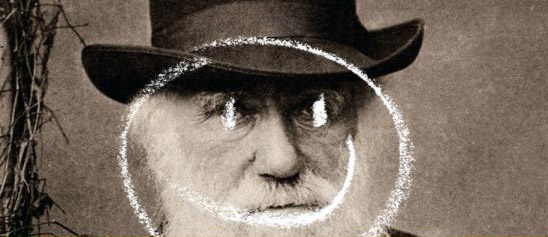
Darwin Slept Here (detail of cover)
Drowning Toads by
20-something Naturalists
by Darryl E. Brock
A book of this title, Darwin Slept Here, might be dismissed as mere travelogue, or worse, a tongue-in-cheek lampooning of the eminent Sage at Down. While not intended as a work of original scholarship, the volume has much to commend it, even as an exploration of evolution. It presents a valuable perspective on young Darwin the adventurer, chronicled by Eric Simons, a similarly-aged 20-something environmental journalist. Simons’ work, then, is a travelogue of sorts, but is also an introspection into Darwin as a young man, and an exploration of Darwin in South American.
Just before pursuing graduate work at U.C. Berkeley, Simons stumbled across a copy of Darwin’s The Voyage of the Beagle at an English language bookstore in Ushuaia, Tierra del Fuego. There Simons had been on a jaunt of escape from a graveyard shift as a Bay area newspaper copy editor. Transfixed by the adventure of a lifetime that young 22 year-old Darwin had experienced at a time of his own quarterlife uncertainty, Simons (then 24) identified with the British naturalist. Struck by how Darwin’s accounts sounded just like the stories he had been hearing in hostel bunk rooms, Simons committed himself to deepen his understanding of people and legends that had fascinated Darwin; he decided to retrace some of the naturalist’s path.
item of interest…

The Evolution of God
In this engaging and sweeping story that takes us from the Stone Age to the Information Age, bestselling author Robert Wright unveils an astonishing discovery: there is a hidden pattern that the great monotheistic faiths have followed as they have evolved…
ORDER the lecture
on DVD and CD
Simons poignantly notes the similarity of his approach to that of Darwin’s wife Emma, of Wedgwood family fame. In the years after her husband’s death, Emma would wish to reconnect with Charles, so she too sought out her youthful love in the pages of the Beagle account. There she imagined herself at his side saving toads from drowning, and tossing iguanas to see if they could swim. Like Simons, she wished to ask Charles “so many questions.”
In fact, Simons poses a question to himself — and to Darwin — as to how much the scientist’s mental powers contributed to conceiving evolution, as opposed to travel itself catalyzing the conceptual leap. Simons reminds us that Thomas Huxley recalled the clear logic of evolution: “How extremely stupid not to have thought of that!” Simons is interested in the diverse experiences of travel, wondering if these in toto somehow contributed to Darwin putting all the pieces into context. It is a conundrum, one that Darwin himself never quite nailed down, despite his musings on the nature of his own particular plodding intellect.
Granted it is entertaining, even illuminating to read of the adventurous young Darwin, but Simons manages to convey some good scientific perspective along the way. One cannot help but be impressed at how South America has commemorated Darwin, keeping alive his scientific spirit. At Chile’s Cerro la Campana (Bell Mountain), Darwin’s ascent is honored by “The Scientific Society of Valparaiso, the British Colony and his admirers” with a bronze plaque. In some cases the celebration is farcical, as with the Ushuaia musical “The Adventure of the Beagle” at the touristy Centro Beagle. There a frail, bearded, Argentine-accented Darwin morphs into a younger version, replete with synthetic muttonchops, singing “All across the Seven Seas the Beagle will succeed.”
In critiquing the historical errors of the Ushuaia play, Simons takes pains to correct the science. Darwin had not set out to discover evolution, any more than Captain Robert Fitzroy had intended to straightjacket science with the shackles of religion. In fact, Simons reminds that Fitzroy had equipped the Beagle with modern scientific equipment and had sought a scientific person to accompany him. During the voyage Fitzroy had not been overly religious, but it was Darwin whom the sailors laughed at for quoting biblical scripture on morality.
Simons examines Darwin’s writings on the Brazilian rain forests, noting the young scientist’s infatuation with the earlier German Alexander von Humboldt. In the spirit of Darwin, Simons also sought out local experts at Rio’s Tijuca National Park. Hiking with a guide, Simons learned that the jungle is now significantly denser than when Darwin visited in 1832. Soon after Darwin’s departure, subsequent deforestation impacted local water supply such that a massive 1861 environmental engineering program eventually reforested the area, with 72,000 native trees planted by a team of slaves.
There are many other examples of science in Darwin’s South America that Simons brings alive. The contest over priority in claiming Darwin’s rhea as a new species, the science behind Nixon’s gold mine in Chile, the discussion of Concepcion’s massive earthquake, the Senda Darwin biological station in Chile’s Emerald Island, Chiloé, and Simon’s ascent of Darwin’s favorite peaks, earlier chronicled by the scientist’s letter to John Henslow, recounts the geological beauty of the Andes.
Simons tells a great yarn of young Darwin’s travels, yet imperceptively manages to imbue the account with local color, history — and science. There are occasional lapses. He speculates that had Darwin never written On the Origin of Species, that Gregor Mendel could have taken up the mantle in introducing evolution. Extremely unlikely considering Mendel remained satisfied to publish his results so obscurely. The lapses, though, are few, and as an introduction to evolution via the highly satisfactory vehicle of young Darwin’s scientific travels, Simons has hit the mark. A new generation of 20-somethings and aging 20-something wannabees may be drawn to Darwin via this charming and unexpected source.

NEW ON MICHAELSHERMER.COM
Confessions of a Former Environmental Skeptic
Michael Shermer shares with readers how came to understand that anthropogenic global warming is real and that we must do something about it. This article was first published in an edited volume as a Festschrift for David Suzuki by Greystone Books, Canada.
• READ the blog post •
NEW ON SKEPTICBLOG.ORG
The Revolution will be Tweeted
Although the Skeptics Society is apolitical, Michael Shermer sometimes explores political and economic issues in his blog posts. This week Shermer discusses the internet and the free exchange of products, services, and ideas between people anywhere in the world anytime they want.
• READ the blog post •

Dr. Alison Gopnik will be speaking on Sunday, October 18, 2009 at 2:00 pm
upcoming lecture…
The Philosophical Baby
What Children’s Minds Tell Us About Truth, Love, and the Meaning of Life
with Dr. Alison Gopnik
Sunday, October 18, 2009 at 2:00 pm
Baxter Lecture Hall, Caltech
Leading child psychologist and philosopher Alison Gopnik examines children’s imaginations, their consciousness, and their ideas about love and morality, and finds that the way they play, pretend, and explore are actually part of the most profound and fundamental aspects of human nature. It is through play and imagination that children solve problems of morality, learn about the world around them, and create bonds with other people. Dr. Gopnik, a professor of psychology at the University of California at Berkeley, is the author of The Scientist in the Crib.
READ MORE about this lecture >
VIEW all upcoming lectures >
Important ticket information
Tickets are first come first served at the door. Sorry, no advance ticket sales. Seating is limited. $8 Skeptics Society members & Caltech/JPL Community; $10 General Public.