Follow Us on Facebook, Twitter, and YouTube

Skeptic: Examining Extraordinary Claims and Promoting Science

top navigation:

Wednesday, June 27th, 2012 | ISSN 1556-5696

eSkeptic: the email newsletter of the Skeptics Society

Got something to say about this week’s eSkeptic? Leave your comments at the bottom of this page. If you enjoy the content we deliver each week in this free newsletter, show your support by making a tax-deductible donation to the Skeptics Society and subscribe to Skeptic magazine.

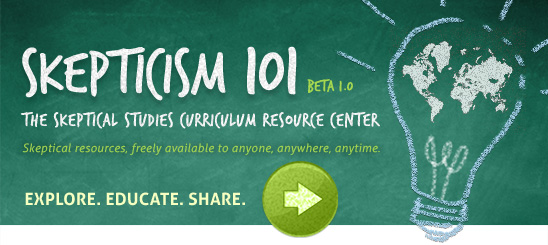
Announcing Skepticism 101: The Skeptical Studies Curriculum Resource Center

Michael Shermer Announces Skepticism 101

I am exceptionally proud to announce today the beta launching of Skepticism 101: The Skeptical Studies Curriculum Resource Center, where we provide skeptical resources, freely available to anyone, anywhere, anytime. Brought to you by the Skeptics Society and under the direction of Anondah Saide and William Bull, Skepticism 101 is a resource center for educators, teachers, administrators, students, and skeptics in all fields and walks of life to provide you with the resources you need to teach people how to think skeptically and critically about any and all claims.

We Are All Teachers. We Are All Educators.

Every time you talk to someone anywhere about anything you have an opportunity to teach skepticism and critical thinking, both of which are at the core of science. We want to change the world. Ideas and how to think about them is at the foundation of all change, especially beliefs. To that end we have launched Skepticism 101 and invite you to get involved by contributing any materials that you think might be relevant, interesting, and important to our cause of making the world a better place through reason and science. We are looking for suggested readings, course syllabi, PowerPoint presentations, student projects, papers, and videos that you have written and/or produced, and anything else you can think of that might be relevant. You can browse resources by topic (e.g. psychics), resource type (e.g. course syllabi), academic discipline (e.g. biology), or academic level (e.g. college).

Explore The 101 Resource Center

Thank you to everyone who has contributed thus far—in both educational materials and financial support—and I invite you all to make a contribution in any way you can. Think of this as the launching of a Skeptical Library of Alexandria! To participate contact the Skepticism 101 Resource Center Director Anondah Saide: skepticism101@skeptic.com

In addition to those who contributed teaching materials we are especially grateful to our significant supporters in last year’s fundraising campaign on behalf of Skepticism 101: Bill Nye, Steven Ridley, Robert Engman, Richard Epstein, Jones Hamilton, James Alexander, Jean Bettanny, Arnold Lau, David Kaloyanides, Jeff Kodosky, Marvin Mueller, and Michael Roberts. Special thanks go to Tyson Jacobsen, who also attended Michael Shermer’s first official course in skepticism last fall, “Skepticism 101: How to Think Like a Scientist Without Being a Geek.”


7 Comments »

7 Comments

  1. Roy Edmunds says:

    I would like the Skeptics to address the most pressing issues such as debt. Please address the concepts of money and the historic differences in America in which money has been viewed.
    There is no other issue which is more important to address and produce some objective assessments. Such as the mathematical law of exponential change.
    Should a country control the issuance of its own money and how best might the base money supply be controlled.
    Although these are political questions I think it is time to address political issues in as clear and objective manner as any other issue concerning human activities might be approached.

    • Bad Boy Scientist says:

      Interesting idea.

      I’m concerned that jumping into such a politically charged issue while Skeptics 101 is trying to get its feet under itself might be premature. I’d say it needs to build some ‘street cred’ before tackling ‘hot button’ issues – regardless of which side it takes. Another topic that’s perhaps too hot to touch is abortion. Even discussing “What are the biological considerations of deciding when is a fetus a ‘person’?” is liable to draw venomous attacks no matter how sensitive – and objective – the treatment.

  2. Kent M Shade says:

    I started to look for the same information. So far, I have a sense that debt is the amount of money in circulation. Beyond that assertion, I too, want the objective truths about debt, money and poverty. How are they related to each other?. Is there a better way for civilization to account for our apparently universal need to own things?….especially money. Should there be a world wide currency, that is not based on winners and losers, but rather the equitable sharing of this global spacecraft’s resources? We all are looking for tough answers. We are not looking to be made comfortable.

  3. c. glenn says:

    What we have in the USA is called fiat currency – the treasury prints more paper dollars any time it’s ordered to (by the Federal Reserve) devaluing all existing money in circulation. And even though they can print more money any time they want, they still have us multi-trillions in debt. Books such as Ron Pauls “End the Fed” explain the entire corrupt system in detail.

  4. bob pease says:

    I would be very disappointed if the former direction and format were downplayed or changed to an Economics 101 blog.
    We need a central venue for resources combating the prevalence of Antiscence and Magickal thinking, which appears to be a losing battle at present.

    Dr S.

  5. Bad Boy Scientist says:

    I have a question for Dr Schermer and his dedicated staff – which relates to the Skepticism 101 resource:

    Is there any possibility of a venue for *serious* popular science writers to submit drafts of texts for *serious* critiques? Since it would be to get feedback on works in progress, it would not be a public forum. The Skeptic could host it, but the labor comes from the community of members who read and provide feedback in exchange for receiving the same.

    This workshop would be dual purpose: it would produce quality writings about science for Skepticism 101 and it would improve the quality and quantity of science writers.

  6. Richard Rasp says:

    Thank you so much for making the excellent Skepticism 101 resources available. Great food for the mind.

Leave a comment

get eSkeptic
our free newsletter

Science in your inbox every Wednesday!


eSkeptic is our free email newsletter. Delivered once a week, you’ll receive fascinating articles, announcements, podcasts, book reviews, and more…

Watch Live Broadcasts from Caltech for free!

Lectures Live Streamed from Caltech

Can’t make it to Caltech for a Skeptics Distinguished Science Lecture? Watch the live stream of our lectures for free online, right here, broadcast live from Caltech!

Popular Articles
on skeptic.com

Here are the articles that people have been sharing over the last few days.

Help the
Skeptics Society
at no cost to you!

Planning on shopping at Amazon.com? Start your shopping by clicking the button below, and the Skeptics Society will receive a commission. Your prices for all Amazon products will remain exactly the same, yet you’ll provide essential financial support for the work of the nonprofit Skeptics Society.

amazon.com

See our affiliate links page for Amazon.ca, Amazon.co.uk, Amazon.de, and iTunes links.

Tweets from Shermer

The Believing Brain
(now in paperback)

The Believing Brain (paperback cover)

Get the autographed paperback

In this, his magnum opus, Dr. Michael Shermer presents his comprehensive theory on how beliefs are born, formed, nourished, reinforced, challenged, changed, and extinguished. Sam Harris calls The Believing Brain “a wonderfully lucid, accessible, and wide-ranging account of the boundary between justified and unjustified belief.” Leonard Mlodinow calls it “a tour de force integrating neuroscience and the social sciences.”

FREE PDF Download

Top 10 Myths About Evolution

Top 10 Myths About Evolution (and how we know it really happened)

This concise pamphlet provides answers to common objections to evolution, such as: If humans came from apes, why aren’t apes evolving into humans?; Only an intelligent designer could have made something as complex as an eye; The second law of thermo-dynamics proves that evolution is impossible; Evolution can’t account for morality; and more…

FREE PDF Download

Top 10 Things You Should Know About Alternative Medicine

Top 10 Things You Should Know About Alternative Medicine

Harriet Hall, MD (aka the SkepDoc), shares her wit and wisdom about alternative medicine including: chiropractic, the placebo effect, homeopathy, acupuncture, and the questionable benefits of organic food, detoxification, and ‘natural’ remedies.

FREE PDF Download

Learn to be a Psychic in 10 Easy Lessons

Learn to be a Psychic in 10
Easy Lessons

Psychic readings and fortunetelling are an ancient art — a combination of acting and psychological manipulation. While some psychics are known to cheat and acquire information ahead of time, these ten tips focus on what is known as “cold reading” — reading someone “cold” without any prior knowledge about them.

Copyright © 1992–2013 Skeptic and its contributors. For general enquiries regarding the Skeptics Society or Skeptic magazine, email skepticssociety@skeptic.com or call 1-626-794-3119. Website-related matters: webmaster@skeptic.com. Enquiries about online store orders: orders@skeptic.com. To update your subscription address: subscriptions@skeptic.com.
See our Contact Information page for more details. This website uses Google Analytics, Google AdWords, and AddThis tracking software.