

Fix Wikipedia
Is it Worth Paying Attention to Wikipedia?
Yes, it absolutely is. This is a shining opportunity for the skeptical movement. Wikipedia is among the most important public sources for almost any scientific, pseudoscientific, or paranormal topic. A Wikipedia article is almost always the number one Google hit for that subject.
Amazingly, any grassroots skeptic can make responsible improvements to that source at any time, easily and for free.
As you learn the ropes, move slowly & cautiously. Start small. Be bold, but edit carefully. Make a meaningful contribution to science & skepticism.
You can personally correct any Wikipedia article. As long as you can cite references, you can add the best available skeptical information to any article that needs it. When you add footnote references, you can even link directly to skeptical websites. You don’t need anyone’s permission. For simple text edits, you don’t even need web coding skills. Best of all, it’s rewarding and fun to use your skeptical knowledge to enhance an essential public resource.
Furthermore, we know from our internal traffic statistics that people really do follow up on the skeptical resources cited in Wikipedia articles. (More people find Skeptic.com through Wikipedia than through Google!)
For an in-depth primer, see “Why Skeptics Should Pay Close Attention to Wikipedia,” by Tim Farley.
How to Get Started
As a free encyclopedia anyone can edit, Wikipedia is an almost-utopian project — but it works. Why? Wikipedia has a culture of rules, and a vast community of editors who care about those rules. It’s easy for beginners to make mistakes, but (luckily!) the culture of Wikipedia is also easy to learn.
The key is that Wikipedia is an encyclopedia. It’s not a soapbox for you personally, for the skeptical movement, or for any other interest group. The standard for Wikipedia articles is therefore a “Neutral Point of View” or NPoV. (Wikipedia does have a special policy on pseudoscience that relaxes this NPoV standard, but Wiki editors should always strive for the highest degree of objectivity and rigor.)
To help maintain this, Wikipedia requires reliable third-party citations for opinions and statements of fact. It also requires that notable criticism of any group or concept be described (with citations), and that topics be accurately placed in context against the prevailing current of expert opinion. (Wikipedia’s NPoV policy requires that articles not give “undue weight” to fringe positions.)
These responsible policies open great opportunities for skeptics to contribute. When paranormal assertions are made without support from reliable references, these statements can be flagged for citation — or, where appropriate, removed. Where a paranormal article fails to acknowledge scientific criticism, or fails to place a fringe position in its proper context, this criticism or context can be added. Furthermore, citations can link to relevant skeptical resources.
Before getting started, please familiarize yourself Wikipedia’s formatting rules and Manual of Style.
Then, just go to the Wikipedia article for your favorite paranormal topic and see what needs fixing!
Edit Boldly — But Be Careful!
Wikipedia has a policy called Be Bold! If you see something wrong, fix it! Your corrections are not an imposition — they are the engine that drives Wikipedia.
But editing Wikipedia is still editing. By its nature, editing other people's hard work calls for extreme care. As you learn the ropes, move slowly and cautiously. Start small.
Stick to the NPoV wherever possible. When a topic is “generally considered pseudoscience by the scientific community,” Wikipedia’s policy on pseudoscience allows the article to state that scientific verdict and label the topic as “pseudoscience.” Nevertheless, you should strive to remain objective and to avoid loaded statements. Avoid statements like “Astrology is fraudulent nonsense.” Instead, find relevant sources and cite them, as in this example:
Astrology is generally considered a pseudoscience by the scientific community. Skeptics argue that the concept is implausible,1,2 unintelligible,3 and unsupported by evidence.4,5 Notably, large scale tests such as (describe one) have failed to reveal any astrological effect.6 There is also strong disagreement within the community of astrologers. Some proponents contend that X,7 while others believe Y8 or Z.9
See a typo? Don’t even hesitate: hit the “edit” or “edit this page” buttons and make the change. Likewise, if you find vandalism (such as random obscenities) or obvious nonsense (“Uri Geller is a pterodactyl”) remove these immediately.
As you get the hang of it, you may wish to start adding “citation needed” flags, adding relevant references for disputed or unsupported assertions, or inserting new material. Take your time, and remember that Wikipedia has an error-correction mechanism: if you make a mistake (or push too hard) another editor is liable to reverse your edits.
You may eventually work your way up to more ambitious efforts, such as adding new articles. In the meantime, you have an opportunity to make a meaningful contribution to science and skepticism — right now, today. Wikipedia is only a click away, so get started!
Why Haven’t Skeptics Acted on this Before?
Actually, many skeptics are already working to ensure that skeptical subject matter is discussed responsibly on Wikipedia. In addition to the thousands of individual skeptics who make an occasional edit, there are also organized efforts underway.
One effort you may wish to join is the Wikiproject Rational Skepticism, a voluntary association of skeptical Wikipedia editors. These editors keep a watchlist of articles of interest, cooperating to keep an eye on those for improvement and ongoing maintenance.
This sort of vigilance is very important. Like you, paranormal proponents (or even deliberate con men) can change anything they like at any moment. An article that was fine yesterday might be crazy today — and it will stay crazy until an editor like you checks it and fixes it.
You may also be interested in a lower-traffic project external to Wikipedia, called Skepticwiki. This is a standalone, explicitly skeptical encyclopedia project that shares the format of Wikipedia.
Topics to Tackle — or Avoid
Many skeptical Wiki editors tackle topics about skepticism: pages for various skeptical organizations and publications, or for prominent skeptics. Those efforts are very useful, but you may wish to concentrate on the areas where a skeptical eye is really needed — articles for paranormal topics.
When people turn to Wikipedia for information on iridology or “reptoids” or chiropractic, that article may often be the only source they consult. Or, if they do consult further sources, these may often be the sources cited in the Wikipedia article. Either way, paranormal proponents have been quick to load Wikipedia with content and citations that are friendly to their own claims. Sometimes, these articles are virtual commercials for paranormal industries. In those cases, skeptics can perform a valuable public service by bringing paranormal articles up to the NPoV standard with descriptions of skeptical criticism and references to relevant skeptical sources.
Oddly, the best Wikipedia topics for beginners are the most obscure. High-profile topics (like “CSICOP,” or “homeopathy”) attract lots of attention and edits from proponents and critics alike, leading to relatively neutral articles. That’s Wikipedia’s error correction mechanism in action: lots of critical eyes. Often, those topics stabilize to a tense compromise, watched like a hawk by opposed editors, with long arguments over small changes.
On lesser-known subjects, paranormal proponents have the freedom to make sweeping, biased, and wildly unsupported claims. These low-quality articles stand unchallenged until a skeptic eventually happens to review them. Finding and fixing these is fun and satisfying for skeptical editors. Because those articles are so bad, they are easy to improve — and edits will tend to stand for a longer time.
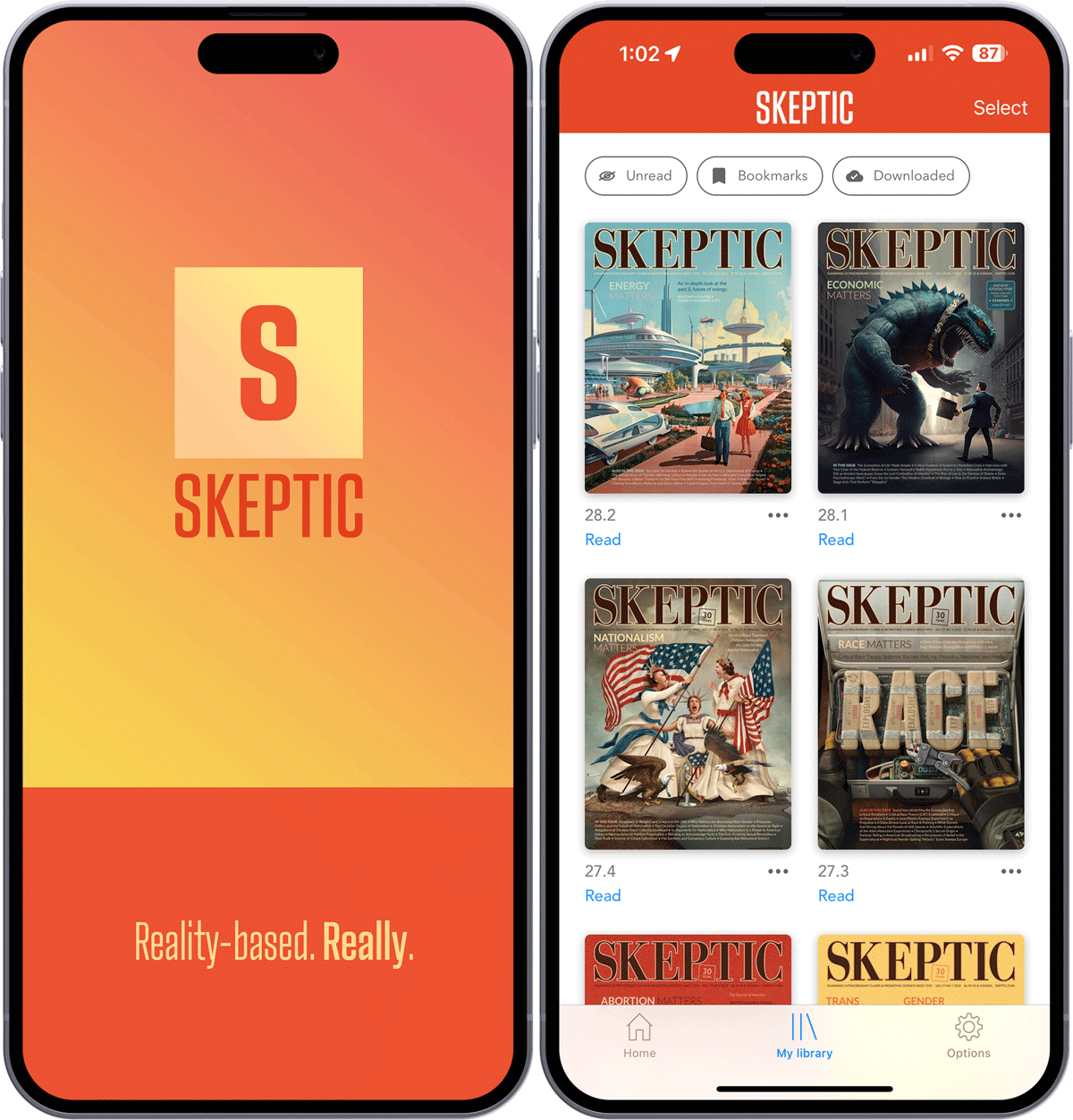
SKEPTIC App
Whether at home or on the go, the SKEPTIC App is the easiest way to read your favorite articles. Within the app, users can purchase the current issue and back issues. Download the app today and get a 30-day free trial subscription.




Magazine
Contact


