






Dr. Tapio Schneider discusses the science behind human-induced climate change. He is a climate scientist and Professor of Environmental Science and Engineering at the California Institute of Technology.
BUY this issue >
DOWNLOAD this article in PDF >
The Science Behind Human-induced Climate Change
Atmospheric carbon dioxide concentrations are higher today than at any time in at least the past 650,000 years. They are about 35% higher than before the industrial revolution, and this increase is caused by human activities, primarily the burning of fossil fuels. Carbon dioxide is a greenhouse gas, as are methane, nitrous oxide, water vapor, and a host of other trace gases. They occur naturally in the atmosphere. Greenhouse gases act like a blanket for infrared radiation, retaining radiative energy near the surface that would otherwise escape directly to space. An increase in atmospheric concentrations of carbon dioxide and of other greenhouse gases augments the natural greenhouse effect; it increases the radiative energy available to Earth’s surface and to the lower atmosphere. Unless compensated for by other processes, the increase in radiative energy available to the surface and the lower atmosphere leads to warming. This we know. How do we know it?
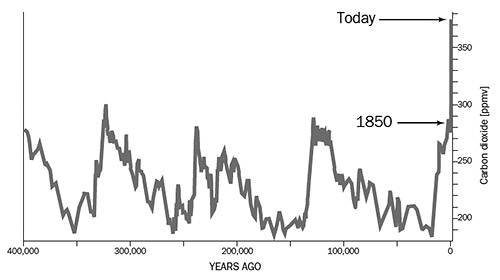
Figure 1. Carbon dioxide concentrations in Antarctica over 400,000 years. “The graph combines ice core data with recent samples of Antarctic air. The 100,000-year ice age cycle is clearly recognizable.” (Data sources: Petit et al. 1999; Keeling and Whorf 2004; GLOBALVIEW-CO2 2007.)
How do we know carbon dioxide concentrations have increased?
The concentrations of carbon dioxide and other greenhouse gases in atmospheric samples have been measured continuously since the late 1950s. Since then, carbon dioxide concentrations have increased steadily from about 315 parts per million (ppm, or molecules of carbon dioxide per million molecules of dry air) in the late 1950s to about 385 ppm now, with small spatial variations away from major sources of emissions. For the more distant past, we can measure atmospheric concentrations of greenhouse gases in bubbles of ancient air preserved in ice (e.g., in Greenland and Antarctica). Ice core records currently go back 650,000 years; over this period we know that carbon dioxide concentrations have never been higher than they are now. Before the industrial revolution, they were about 280 ppm, and they have varied naturally between about 180 ppm during ice ages and 300 ppm during warm periods (Fig. 1). Concentrations of methane and nitrous oxide have likewise increased since the industrial revolution (Fig. 2) and, for methane, are higher now than they have been in the 650,000 years before the industrial revolution.
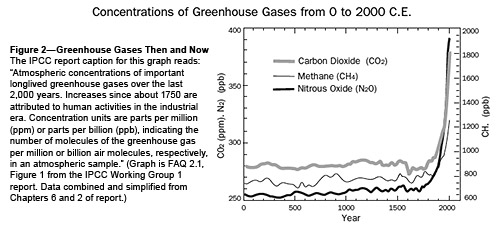
Figure 2. Greenhouses gases then and now.
How do we know the increase in carbon dioxide
concentrations is caused by human activities?
There are several lines of evidence. We know approximately how much carbon dioxide is emitted as a result of human activities. Adding up the human sources of carbon dioxide — primarily from fossil fuel burning, cement production, and land use changes (e.g., deforestation) — one finds that only about half the carbon dioxide emitted as a result of human activities has led to an increase in atmospheric concentrations. The other half of the emitted carbon dioxide has been taken up by oceans and the biosphere — where and how exactly is not completely understood: there is a “missing carbon sink.”
Human activities thus can account for the increase in carbon dioxide concentrations. Changes in the isotopic composition of carbon dioxide show that the carbon in the added carbon dioxide derives largely from plant materials, that is, from processes such as burning of biomass or fossil fuels, which are derived from fossil plant materials. Minute changes in the atmospheric concentration of oxygen show that the added carbon dioxide derives from burning of the plant materials. And concentrations of carbon dioxide in the ocean have increased along with the atmospheric concentrations, showing that the increase in atmospheric carbon dioxide concentrations cannot be a result of release from the oceans. All lines of evidence taken together make it unambiguous that the increase in atmospheric carbon dioxide concentrations is human induced and is primarily a result of fossil fuel burning. (Similar reasoning can be evoked for other greenhouse gases, but for some of those, such as methane and nitrous oxide, their sources are not as clear as those of carbon dioxide.)
How can such a minute amount of carbon dioxide
affect Earth’s radiative energy balance?
Concentrations of carbon dioxide are measured in parts per million, those of methane and nitrous oxide in parts per billion. These are trace constituents of the atmosphere. Together with water vapor, they account for less than 1% of the volume of the atmosphere. And yet they are crucially important for Earth’s climate.
Earth’s surface is heated by absorption of solar (shortwave) radiation; it emits infrared (longwave) radiation, which would escape almost directly to space if it were not for water vapor and the other greenhouse gases. Nitrogen and oxygen, which account for about 99% of the volume of the atmosphere, are essentially transparent to infrared radiation. But greenhouse gases absorb infrared radiation and re-emit it in all directions. Some of the infrared radiation that would otherwise directly escape to space is emitted back toward the surface. Without this natural greenhouse effect, primarily owing to water vapor and carbon dioxide, Earth’s mean surface temperature would be a freezing -1°F, instead of the habitable 59°F we currently enjoy. Despite their small amounts, then, the greenhouse gases strongly affect Earth’s temperature. Increasing their concentration augments the natural greenhouse effect.
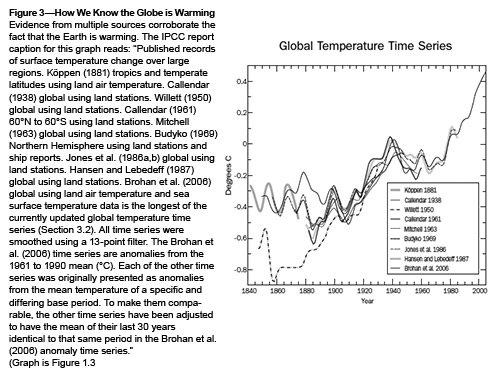
Figure 3. How We Know the Globe is Warming.
How do increases in greenhouse gas concentrations
lead to surface temperature increases?
Increasing the concentration of greenhouse gases increases the atmosphere’s “optical thickness” for infrared radiation, which means that more of the radiation that eventually does escape to space comes from higher levels in the atmosphere. The mean temperature at the level from which the infrared radiation effectively escapes to space (the emission level) is determined by the total amount of solar radiation absorbed by Earth. The same amount of energy Earth receives as solar radiation, in a steady state, must be returned as infrared radiation; the energy of radiation depends on the temperature at which it is emitted and thus determines the mean temperature at the emission level. For Earth, this temperature is -1°F — the mean temperature of the surface if the atmosphere would not absorb infrared radiation. Now, increasing greenhouse gas concentrations implies raising the emission level at which, in the mean, this temperature is attained. If the temperature decreases between the surface and this level and its rate of decrease with height does not change substantially, then the surface temperature must increase as the emission level is raised. This is the greenhouse effect. It is also the reason that clear summer nights in deserts, under a dry atmosphere, are colder than cloudy summer nights on the U.S. east coast, under a relatively moist atmosphere (Figs. 4 and 5).
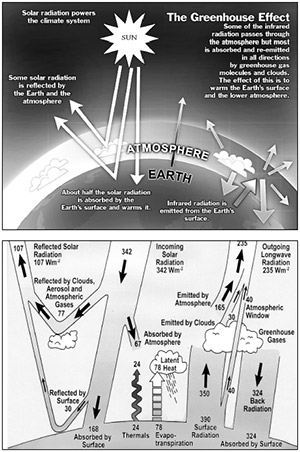
Figure 4 and 5. Two Cheers for the Greenhouse Effect. Some global warming is necessary in order to make the Earth habitable for creatures like us. These two graphics show how it works. The IPCC caption reads: “Estimate of the Earth’s annual and global mean energy balance. Over the long term, the amount of incoming solar radiation absorbed by the Earth and atmosphere is balanced by the Earth and atmosphere releasing the same amount of outgoing longwave radiation. About half of the incoming solar radiation is absorbed by the Earth’s surface. This energy is transferred to the atmosphere by warming the air in contact with the surface (thermals), by evapotranspiration and by longwave radiation that is absorbed by clouds and greenhouse gases. The atmosphere in turn radiates longwave energy back to Earth as well as out to space.” Source: Kiehl and Trenberth (1997). (Graphics are FAQ 1.1, 1.3, Figure 1 from the IPCC Report.)
In fact, Earth surface temperatures have increased by about 1.3°F over the past century (Fig. 3). The temperature increase has been particularly pronounced in the past 20 years (for an illustration, see the animations of temperature changes). The scientific consensus about the cause of the recent warming was summarized by the Intergovernmental Panel on Climate Change (IPCC) in 2007: “Most of the observed increase in global average temperatures since the mid-20th century is very likely due to the observed increase in anthropogenic greenhouse gas concentrations… The observed widespread warming of the atmosphere and ocean, together with ice mass loss, support the conclusion that it is extremely unlikely that global climate change of the past 50 years can be explained without external forcing, and very likely that it is not due to known natural causes alone.”
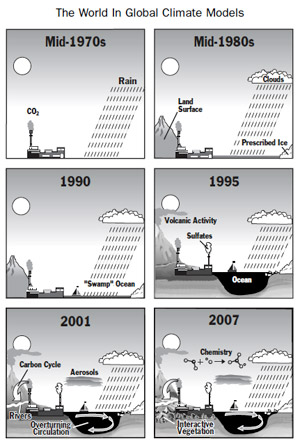
Figure 6. The History of Climate Models. The IPCC caption reads: “The complexity of climate models has increased over the last few decades. The additional physics incorporated in the models are shown pictorially by the different features of the modelled world.” (Graphic is Figure 1.2 from the IPCC Report.)
The IPCC conclusions rely on climate simulations with computer models (Fig. 6). Based on spectroscopic measurements of the optical properties of greenhouse gases, we can calculate relatively accurately the impact increasing concentrations of greenhouse gases have on Earth’s radiative energy balance. For example, the radiative forcing owing to increases in the concentrations of carbon dioxide, methane, and nitrous oxide in the industrial era is about 2.3 Watts per square meter. (This is the change in radiative energy fluxes in the lower troposphere before temperatures have adjusted.) We need computer models to translate changes in the radiative energy balance into changes in temperature and other climate variables because feedbacks in the climate system render the climate response to changes in the atmospheric composition complex, and because other human emissions (smog) also affect climate in complex ways. For example, as the surface and lower atmosphere warm in response to increases in carbon dioxide concentrations, the atmospheric concentration of water vapor near the surface increases as well. That this has to happen is well established on the basis of the energy balance of the surface and relations between evaporation rates and the relative humidity of the atmosphere (it is not directly, as is sometimes stated, a consequence of higher evaporation rates).
Water vapor, however, is a greenhouse gas in itself, and so it amplifies the temperature response to increases in carbon dioxide concentrations and leads to greater surface warming than would occur in the absence of water vapor feedback. Other feedbacks that must be taken into account in simulating the climate response to changes in atmospheric composition involve, for example, changes in cloud cover, dynamical changes that affect the rate at which temperature decreases with height and hence affect the strength of the greenhouse effect, and surface changes (e.g., loss of sea ice). Current climate models, with Newton’s laws of motion and the laws of thermodynamics and radiative transfer at their core, take such processes into account. They are able to reproduce, for example, Earth’s seasonal cycle if all such processes are taken into account but not, for example, if water vapor feedback is neglected. The IPCC’s conclusion is based on the fact that these models can only match the observed climate record of the past 50 years if they take human-induced changes in atmospheric composition into account. They fail to match the observed record if they only model natural variability, which may include, for example, climate responses to fluctuations in solar radiation (Fig. 7).
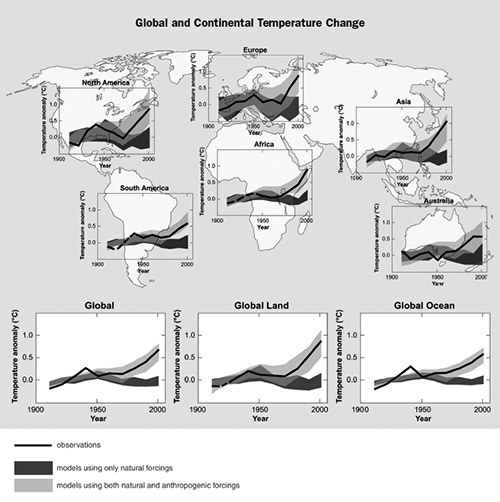
Figure 7. Global and Continental Temperature Change. The IPCC caption reads: “Comparison of observed continental — and global — scale changes in surface temperature with results simulated by climate models using either natural or both natural and anthropogenic forcings. Decadal averages of observations are shown for the period 1906–2005 (black line) plotted against the center of the decade and relative to the corresponding average for the period 1901–1950. Lines are dashed where spatial coverage is less than 50%. Darker shaded bands show the 5 to 95% range for 19 simulations from five climate models using only the natural forcings due to solar activity and volcanoes. Lighter shaded bands show the 5 to 95% range for 58 simulations from 14 climate models using both natural and anthropogenic forcings.” (Graphic is Figure SPM.4 from the IPCC Report.)
Climate feedbacks are the central source of scientific (as opposed to socio-economic) uncertainty in climate projections. The dominant source of uncertainty are cloud feedbacks, which are incompletely understood. The area covered by low stratus clouds may increase or decrease as the climate warms. Because stratus clouds are low, they do not have a strong greenhouse effect (the strength of the greenhouse effect depends on the temperature difference between the surface and the level from which infrared radiation is emitted, and this is small for low clouds); however, they reflect sunlight, and so exert a cooling effect on the surface, as anyone knows who has been near southern California’s coast on an overcast spring morning. If their area coverage increases as greenhouse gas concentrations increase, the surface temperature response will be muted; if their area coverage decreases, the surface temperature response will be amplified. It is currently unclear how these clouds respond to climate change, and climate models simulate widely varying responses. Other major uncertainties include the effects of aerosols (smog) on clouds and the radiative balance and, on timescales longer than a few decades, the response of ice sheets to changes in temperature.
Uncertainties notwithstanding, it is clear that increases in greenhouse gas concentrations, in the global mean, will lead to warming. Although climate models differ in the amount of warming they project, in its spatial distribution, and in other more detailed aspects of the climate response, all climate models that can reproduce observed characteristics such as the seasonal cycle project warming in response to the increases in greenhouse gas concentrations that are expected in the coming decades as a result of continued burning of fossil fuels and other human activities such as tropical deforestation. The projected consequences of the increased concentrations of greenhouse gases have been widely publicized. Global-mean surface temperatures are likely to increase by 2.0 to 11.5°F by the year 2100, with the uncertainty range reflecting scientific uncertainties (primarily about clouds) as well as socio-economic uncertainties (primarily about the rate of emission of greenhouse gases over the 21st century). Land areas are projected to warm faster than ocean areas. The risk of summer droughts in mid-continental regions is likely to increase. Sea level is projected to rise, both by thermal expansion of the warming oceans and by melting of land ice.

Less widely publicized but important for policy considerations are projected very long-term climate changes, of which some already now are unavoidable. Even if we were able to keep the atmospheric greenhouse gas concentration fixed at its present level — this would require an immediate and unrealistically drastic reduction in emissions — the Earth surface would likely warm by another 0.9–2.5°F over the next centuries. The oceans with their large thermal and dynamic inertia provide a buffer that delays the response of the surface climate to changes in greenhouse gas concentrations. The oceans will continue to warm over about 500 years. Their waters will expand as they warm, causing sea level rise. Ice sheets are thought to respond over timescales of centuries, though this is challenged by recent data from Greenland and Antarctica, which show evidence of a more rapid, though possibly transient, response. Their full contribution to sea level rise will take centuries to manifest. Studies of climate change abatement policies typically end in the year 2100 and thus do not take into account that most of the sea level rise due to the emission of greenhouse gases in the next 100 years will occur decades and centuries later. Sea level is projected to rise 0.2–0.6 meters by the year 2100, primarily as a result of thermal expansion of the oceans; however, it may eventually reach values up to several meters higher than today when the disintegration of glaciers and ice sheets contributes more strongly to sea level rise. (A sea level rise of 4 meters would submerge much of southern Florida.)
Certainties and Uncertainties
While there are uncertainties in climate projections, it is important to realize that the climate projections are based on sound scientific principles, such as the laws of thermodynamics and radiative transfer, with measurements of optical properties of gases. The record of past climate changes that can be inferred, for example, with geochemical methods from ice cores and ocean sediment cores, provides tantalizing hints of large climate changes that occurred over Earth’s history, and it poses challenges to our understanding of climate (for example, there is no complete and commonly accepted explanation for the cycle of ice ages and warm periods). However, climate models are not empirical, based on correlations in such records, but incorporate our best understanding of the physical, chemical, and biological processes being modeled. Hence, evidence that temperature changes precede changes in carbon dioxide concentrations in some climate changes on the timescales of ice ages, for example, only shows that temperature changes can affect the atmospheric carbon dioxide concentrations, which in turn feed back on temperature changes. Such evidence does not invalidate the laws of thermodynamics and radiative transfer, or the conclusion that the increase in greenhouse gas concentrations in the past decades is human induced.
This article can be found in

volume 14 number 1
A Climate of Belief
How We Know Global Warming is Real: The Science Behind Human-induced Climate Change; How to solve the global warming problem by 2020…
BROWSE this issue >
ORDER this issue >
This article was published on February 23, 2011.











The articles references the Vostok ice core data (Petit et all, 1999) but fails to mention that for 420000 years air temperature and CO2 levels moved in step with the CO2 level lagging the temperature by 800 years. To say that increased CO2 levels cause a rise in temperature is akin to saying that lung cancer causes smoking.
As ocean temperatures rise dissolved CO2 is released and when the oceans cool CO2 is reabsorbed.
I know you want it
Two things:
1. being a skeptic -means being reasonably skeptical – not ridiculously skeptical of everything. Eg. I know that smoking causes lung cancer, I have done no reading into this but it seems so completely accepted – why waste my time. I might as well try to prove that solid walls are not actually solid and can be walked through but I am also not skeptical of this.
2. A lot of the criticism seems to be on weather measurements, surely one can easily model the impact of extra carbon in the atmosphere in very controlled greenhouse conditions. And one can easily get carbon levels through ice core examples. So we know that humans have put extra carbon in the atmosphere. Extra carbon causes the earth to heat. If I drop a rock into a well – I know what will happen even though I can’t see it.
Nice models!
How is the fund raising going?
At least the faux skeptics protesting their disappoint have half a chance of convincing a few genuine skeptics, but most buffoons posting crud here are deluding themselves.
Trolls! A pox on all your mother’s basements!
shut yer mouths u sicle cell havin cock goblins
pickle bob shit stain u a lyin snake foh
take a look, nigga. in a book, mah nigga.
thank you for this article. we really enjoyed this thank you.
This article never even talks about the very thing I was just looking for: proof!
I have been looking all over the web, and every article that is supposed to “convince” me that GHGs are causing global warming have completely failed. Every one of them, including this one, use “Post Hoc Ergo Propter Hoc” fallacies (after which therefore because of which). Yes, global average temperatures are increasing. Yes, GHGs are increasing. However, what proof do we have that temps are rising BECAUSE GHGs are rising? None at all!
This article does a very good job of telling how GHGs COULD POTENTIALLY cause warming, but if you want to convince a “skeptic”, you need better evidence.
I think the article would be better if it provided examples of repeatable experiments that showed elevated CO2 and temperature are harmful to biodiversity, then framed the global warming controversy in terms of risk management to avoid damage to local biodiversity. The remote sensing temperature data available from the US government does not go back far enough to show any clear trend.
Your selected user name says enough.
Niggers are ugly
I am terribly sorry for my horrific behaviour i am very very sorry for my stupidity
“lol” you’re comments are most immature. Please stop posting silly comments in future.
u load of jammy cunts
lol, lol, lol, lol, lol.
are your graphs accurate?!
Global Warming is a case of mistaken identity!
Global warming should not have been called global warming at all.This misnomer has confused many, and has added to its development as such a controversial subject in the world today.
“If global warming exists, why is it so darn cold outside?”
You may have heard these kind of retorts quite often. Globally, the Earth has warmed about 2 degrees Celsius. This is number is really not very big,and should not raise our eyebrows. What we should really be talking about is the climactic effect this raise in temperature has rather than the warming itself. Many of us do not know how delicately our atmosphere is balanced. Wind speeds and rain patterns are heavily dependent on the global temperature gradient. Our easterly and westerly winds are so well set that we have a very well defined climate geography. Even if there is a slight change in the global temperature gradient, be it half a degree, it will affect global wind patterns which in turn affects rain patterns. This is why many places that used to receive regular rainfall are now suffering from drought, and many formerly dead-dry places are flooded. Colder regions are becoming milder and some hot regions are getting surprise snowfalls. It is hard to comprehend that all this abnormal weather behavior is because of a 2 degree temperature hike.
Global warming is not heating up our neighborhood. The localrise in temperature is because the disturbed wind pattern, which actually is caused by the 2 degree rise in global temperature, circulates warm air from hotter regions to colder regions and vice-versa where it did not used to before. To make it moreclear, if you see an unusual rise of 20 degrees in the winter, it is the side effect of disturbed weather patterns because of the 2 degree global temperature rise.
The orientation of forests and grass lands are fully dependent on global rain patterns. It is the stability of this system that keeps our ecosystems consistent, which is something that we all depend on. Anychange in rain patterns will have disastrous effects.
We are very dependent on mother nature, and this dependency will be heavily challenged in the days to come. Whether we believe in global warming or not, the underlying issue is that we should not be living under the mercy of a delicately balanced ecosystem. Throughout man’s history, Mother Nature has provided for us, and we had no other alternative but todepend on her. But now with all our technological developments, we have the tools necessary to break our umbilical cord with Mother Nature. However, it is not happening fast enough, and the reason for this is pureand simple – money. Anything that Mother Nature gives us is free (e.g.food, water,air,light).This has made us develop environmentally dependent technologies (irrigation, fresh water utilization) and stuck to this system. Now as the same ecosystem is changing, it is throwing us a challenge. Rain is not dependable any more. Fresh water supply is changing. The economics of food supply is being rewritten. Floods, hurricanes, and twisters are happening more frequently and are causing billions of dollars in damages. These challenge from global climate change are forcing us to move away from our dependency on the ecosystem and control our own world.
Even without man-made global warming, climate change would have been inevitable as our atmosphere is delicately balanced. The world climate has historically gone through a cyclic pattern of climate shifts and ice ages. It is a great relief that climate change is happening in this current age, when we are ready with technology. Surviving thru the ice age and preserving the human race is something our ancestors have proved is possible, but if it had happened just two hundred years ago, we would have lost all the marvels of human civilization and survived with only with the bare necessities. But now the scenario is different. It is just a matter of time before we integrate robotics and automation in our lives and evolve towards an advanced future. We have the technology to protect us,and free us from our dependency on nature.
– R.S. Amblee
Author “The Art of Looking Into the Future: The Five Principles of Technological Evolution”
Even if this is all true, and it probably all is, this says nothing about whether or not it will be catastrophic and warrants any action to be taken whatsoever. THAT has not been proven. This seems to be attacking a strawman. I don’t know many people, even so called global warming denialists, who would disagree that warming is occurring and yet they still would be against any carbon emissions reductions because it hasn’t been proven global warming will be harmful. Or, even if it will in fact be harmful, that it will be more harmful than cutting industry would be. So even if it is proven someday that the warming that we are certain is occurring is going to be horrible, scientists would still need to confer with economists in order to ensure that the “cure” of cutting emissions and thus hurting the energy industry upon which all of our lives depend would not in fact be worse than the disease.
Another standard denier talking point, either the third or fourth goal post position as they keep getting moved.
I learned more from the comments than the article. Thank you for helping me understand my world a little better.
here is what I learned
There is no solid evidence that c02 is linked to global warming
There is solid evidence that the the world is warming
there is solid evidence that there was a ice age and that man was existed during it.
There is solid evidence that many animals have gone extinct because of climate change and because of humans.
There is solid evidence we are hurting the environment.
There is solid evidence that there are too many humans for the environment to take.
There is solid evidence that there is not enough oil for everyone and we will run out.
The more I learn about the world confused and awed I get.
You know what I think we should do about global warming? Give ice cream to the whole world so that everybody cools down and thus, the world. :D
You know why nobody cares what you think?
Why is it that everyone is now a scientist and at that a MUCH MORE INTELLIGENT scientist than Mr. Schneider…who is an actual Professor at a prestigious university–Cal Tech. P.S. that means he has a degree, in fact two + cuz you cant teach this stuff if you dont have a Master’s. you all pick at what you want but ask yourself this: how can you convince yourself that the world’s most studied scientists (with degrees in REAL atmospheric, oceanographic, physical, chemical science and math) are secretly plotting against you. WHAT WOULD FUEL THEM TO LEAD YOU TO FALSE CLAIMS? what do they get out of faking this stuff? Then ask yourself this: why are oil companies and politicians involved with oil/natural gas/coal companies against it?what do THEY have to gain from denouncing climate change?
you guys are seriously stupid. stupid stupid stupid. luck for you! stupid can be educated! at least… that’s what they keep telling me…
this is to long.
Your ‘to’ is too short.
The temperature going up or down, the accuracy of the readings, or the manifestations of a change in temperature on this planet are all irrelevant to an extent.
Just because one thing happens and another thing happens at the same time does not mean they are necessarily related. So carbon goes up and temperatures go up. Linked or a coincidence? What gasses are going down at this time? Linked or coincidence.
Most of the ‘science’ and articles say ‘the increase in GHG’s is blah blah’ inferring that its a given that CO2 is responsible, but where is the evidence that GHG’s exist?
Where is the science that CO2 holds heat? How can it, it is an inert gas!!! It is a gas, essential to plants and provides an important function. Show me the science.
Most of the ‘science’ and articles say ‘the increase in GHG’s is blah blah’ but where is the evidence that GHG’s exist? Water vapour I can understand might hold heat, but this disburses rapidly.
Extrapolating a graph into the future is a guess, not absolute fact. If we extrapolate the worlds population 50 years into the future it might show we will have 100 billion people on the planet. This can’t possibly occur, so extrapolations are meaningless, or at least can’t be cited as ‘absolute truth’
I read somewhere (yes, its only heresy until its proved, but it might be worth checking) that the planet is at present colder than it has been for 83% of its recorded and ascertainable history. Food for thought.
The other danger in making carbon dioxide the bogeyman is that attention is taken off all the other chemical and gases that are polluting the planet, some of which may indeed be effecting the atmosphere.
I do agree, however, that we can’t keep shitting in our own nest and expect our children to have happy, healthy lives, so as a permaculturalist I work towards creating a cleaner planet by minimising my footprint. Not my carbon footprint necessarily but my energy, waste, resource footprint.
This experiment in capitalism, consumerism and fiat currencies is almost over. Bring it on I say. Only then can we rebuild using sustainable, ethical practices.
Thank you very much for writing this fine, concise article, and having the patience to fend off record number of trolls and delusional people.
I second the motion.
Can someone please explain to me why someone that questions a skeptic is a denier? If you know and we’re wrong – please enlighten us with your wisdom. As it is you’re just burning intelligent people at the stake.
The surest way to ensure that dialog will not take place is to denigrate and castigate anyone who deigns to question one’s views. More than taking away some lucid arguments or facts, that was the unfortunate take-away that I had in reading this article in Skeptic magazine.
No matter what your understanding of the science behind the models for global warming, simply attaching labels to your adversaries does nothing to support your position and, for me, it simply makes me tired. I have seen articles bashing all AGW supporters as ‘leftists’, ‘liberals’ and ‘hoaxers’ in it only for the grant monies. Then there is this article which, while purporting to directly answer questions in a scientific manner, describes any person who has questions with labels that include (and I quote from the magazine article): Deniers (of course!), anti-science (but there are legitimate scientists who question aspects of AGW), right wing, referenced the ‘denialist Heartland Institute’ without mentioning the forged document created by Peter Glieck, linking anyone who questions AGW with creationists and virtually equating them with Holocaust deniers (at least creating the illusion that they might be similar) and cites Mueller as shocking his ‘GOP sponsors’.
All in an article that theoretically was to focus on clear answers.
So, what one is left with is that if your political persuasion is to the left of center, you are on the sides of god and the environment and the truth of AGW, whereas those that differ or still think we need to learn more are on the side of God, Big Oil, Creationists and Holocaust deniers. So much for dealing in facts, science and leaving the politics and polemics to Fox and MSNBC. So much for letting those of us who neither fit into the left or right, and who enjoy understanding as much as we can on issues, thirsting for actual substance without the diatribes.
Very sad. And I am so tired of this crap. From both sides.
Thanks for a well written article, understandable by the layman.
This article is flawed in that, as boring as it may be, it really needs to go into more depth regarding how the computer models are validated.
It is not enough to merely say, the models only predict the right temperatures when man made global warming is included. Because this part of the global warming argument relies on man made computer models instead of provably correct mathematics, or scientifically testable theories, you need to go into much greater detail about how the computer models are verified and tested.
It’s so saddening that in the face of overwhelming evidence, even when presented in all corners, are more eager to put their heads in the sand and insist that the science is never good enough. This reminds me of the old stories of Vatican bishops and “scientists” claiming there was never enough evidence to conclude the world was round, even after presented with all of the observational evidence of the time. They kept insisting that it was impossible to measure with current technology, and threatened anyone who claimed otherwise, and anyone who wanted to begin teaching or treating the world as such. They did so in the guise of “skepticism,” and when even their own minds began to come around, they threatened them with marginalization, and pointed to their own private dissention as being somehow indicative of overall dissention with the issue.
Sound familiar? Read some of the comments here. You’ll see the similarities. Take little stock in anyone who says things like “I was going to subscribe but now I won’t because you disagree with me!” or “I don’t believe the science” while ignoring the actual science, or even better, those people who choose to poke very specific holes in very specific things, “temperature stations have errors” does not invalidate the mass of evidence, nor does it invalidate the readings of those stations. One hole does not swiss cheese make, and one hole does not destroy conclusive evidence – especially when it’s not even a hole.
It saddens me that people who claim to support science are so willing to dismiss it when their political agenda insists they march in step. Especially when our homes, societies, and future depend on our clear-headedness.
I am assuming that you realise the irony of your post?
It would seem that the authorities are on your side and that “deniers” are asking questions – only to be villified rather than answered. Have you studied environmental science?
This is funny since it was universally accepted that the Earth was a sphere since Eratsothenes measured it’s circumference in 240 BC. In fact the Vatican never denied the Earth was a sphere. It is a common misconception that anyone other than completely uneducated people thought the Earth was flat after the Roman era.
Universally accepted? Where is your evidence that Earth had a world-wide civilisation during those times?
Well, if nothing else, at least the Dunning-Kruger effect has been thoroughly witnessed on this thread…
Now where was that subscription link…
Anecdotal as that is, the evidence is indeed most compelling.
I have an admission to make.
I no longer believe that CO2 has anything to do with global warming.
I now think it might be the Sun.
Excellent analysis on Global Warming and Climate Change and its causes and consequences.
Dr.A.Jagadeesh Nellore(AP),India
E-mail: [email protected]
Peer reviewed and publish in your email. Wow! So authoritative!
i think global warming is real because mother nature hates us i mean we are cutting down her trees for paper that 50% of people throw away for nothing so i think it is mother nature is melting all the glachers and she is the one that is doing all the damage but we just half to realise that she is doing all of what we blamed on are selfs so dont blale it on our slefs blame it on mother nature THANK YOU ANG GOOD NIGHT!
Just like Global Cooling in the 70’s, here is another rediculous governmental idea for us to all freak out over. By 2030, we going to talking about “Global Just Right”. You heard it from me. Too cold, too hot, just right.
This forum in hilarious….
Rather than this being a calm intellectual debate on climate change, it seems it is a battle of ego’s. Take a step back from fighting each other about who is an authentic skeptic and address the actual issue of whether we are responsible for increasing global climatic temperatures.
I am no climatologist or geochemist but I do have enough intellectual horsepower to study the world in which I live and the current way in which we treat it and realise that change is required….we simply cannot go on polluting to this level and expect that future generation will not be affected.
We have to reduce our demand for fossil fuels and transition to renewable energies..we have no choice in this. By flying the flag of climate denial further ads doubt and confusion into the public domain and stalls any progress to reduce our insatiable appetite for oil and gas…
That’s my two cents….
Look Here!
An Alien Story by an Astronaut!!!!!!
http://www.youtube.com/watch?v=wvvgdxBocfc
You’d think he would know more than he is saying?
Fuck Global Warming Kooks!
Have you met a logical fallacy you didn’t like?
Please try to stay within at least 5 nautical miles of the topic.
http://www.godlikeproductions.com/forum1/message1770322/pg1
Dear Bammster,
We in Australia are recording levels of Fukushima fallout in the wind and rain. I was reading this article here and have become truly shocked and saddened after reading this. While I’m not shocked that the University of Otago has had plutonium accidents and death of its workers, it does shock me that this is going on in violation of your governments Anti-Nuclear legislation?!
My heartfelt prayers and wishes go out to the families of these poor students that have died of radiation poising in your country.
Yours,
Paul Smith
Canberra
Australian Capital Territories
GLOBAL WARMING IS REAL, AND EFFECTIVE. IF YOU DON’T BELIEVE YOU ARE A LIIIIARRR!!!!!!!!!!!!!!!!!!
Global warming is bullshit
Hi Everyone!
I’m Big Keith’s Left Testicle.
Keith like Gary a lot because he likes boats and rocks and is a publicity whore even before his Big talk.
I get depressed a lot because the rest of my body thinks that CO2 causes global warming. But who believes me? I’m just a Testicle.
I sit down in a smelly confined space all day and never see the Light.
Just as well.
Everyone else is freezing their Balls Off, but I’m still nice and warm being heated by the funding of global warming.
http://www.canadafreepress.com/index.php/article/44602
Yours,
Keith’s Left Testicle
Now there is genuine scientific reasoning! (as taught in Logic 101 at Trolling University)
i do not think global warming is real because the worled has not changed a bit over like a period of like 200 years
This is hilarious.
A radio active cloud is reported passing over Dunedin bringing contamination and fallout to the people below. It passes over New Zealand’s leading research University and no one notices!
http://www.odt.co.nz/news/your-news/196344/weird-light-seen-taieri-beach-otago
Are these the particles in the air that were radioactive Bammy?
The evacuation level for Chernobyl is set at 110 micro-Roentgens.
Look at this
http://sccc.org.au/archives/2517
You all are not going to be alive long enough to see climate change!
Vera
And why do ‘Skeptics’ have a UFO in their header??
C’mon people – get with the 21st Century. According to the Interior Ministry, and the Russian Government, UFOs are real phenomena. Take a look at this video.
http://www.youtube.com/watch?v=LVquycLqAaE
It’s a UFO! There you go – you no longer have to be a sceptic!
Now for a quick Quiz. Which man mad objects move above M6+ at 80,000 ft? Tovarish? Voprossi e Otvii?
Those other slow moving dots are commercial flights out of and into Yakutsk.
Of course, whom would I believe, the Russian Interior Ministry whom say UFOs are real phenomena, or a bunch of under educated ‘sceptics’ masquerading as ‘Climate Religious Zealots?
You can’t even prove that global warming from CO2 is theoretically real … or even possible.
Move along people … nothing to see here …
Yes Julie. I wouldn’t be surprised if these ‘deniers’ are bots, sock-puppets or some other form of artificial ‘opinion-generators’. There is money to be had in this kind of thing now.
Deniers?
Hardly. We’re realists!
You go do the research, take the measurements, and learn Real Science. Then if you are qualified, rational and sane – you should be able to comment on it.
There are certain professors and academics whom make too much money off milking the fat cow of climate change.
Look at Bob Lloyd! “The Oceans Will Boil” – the most outrageous comment ever, and as a physicist – he knows he’s lying!
I propose that the man is tested for Syphilis … because that’s the most demented statement that anyone can make.
Wow, just because you disagree with someone means that they aren’t a skeptic. Interesting concept.
Anyone who argues that the planet is not warming has their head in a hole. Anyone who argues that CO2 is not increasing also has their head in a hole. More than a decade ago, it was shown that the isotopic carbon ratio of the additional CO2 matches the prediction made by the anthropomorphic hypothesis. This is mentioned in the article, but not with enough fanfare. This really is the silver bullet to deniers and I don’t know why it’s not mentioned more often.
This is my first visit to Skeptic via a Richard Dawkins video. I’m a sceptical layman but am also a bit… gullible. So what to conclude? The article is not independently analytical as I would have hoped and the sceptic comments and links have not really convinced me against AGW.
I’ll remain on the fence for now since I get the best view from here.
How would you cite this article? In MLA newest addititon?
If the deniers who have posted were honest, they would admit that they were never interested in subscribing to Skeptic Magazine. They are trolls who keep a lookout for any mention that global climate change has anything to do with human activity, and then they blast the comments with scientific-sounding garbage to confuse the issue of what skepticism is really all about – the quote by Penn Jillette above being right on the money.
I experienced this when my husband had the gall to post an article about the professional climate science denier who was funded by the Kotch brothers (I don’t recall his name) which mentioned the London Fog that existed back at the hight of the industrial revolution’s spewing of pollutants into the air unabated on a website about expatriation. Suddenly, our readership was filled with experts on how wrong all the other scientists were and that global warming is obviously due to sunspots. We were also instructed to not bring up the matter again because it is “too controversial.”
I am not a climate scientist myself, but someone who has been familiar with satellite studies of arctic ice flows because a good friend from engineering school was writing software for programs that do this for Jet Propulsion Labs decades ago (long before Al Gore or the attempt to find a market solution through carbon trading because convincing the powerful dirty oil, gas, and coal companies to spend a small proportion of their vast profits on cleaner technology was like talking to, well, a climate denier about real science came onto the scene) and I studied just enough physics, engineering, and math to understand how science works, as opposed to how the deniers keep claiming that it works.
So when a climate scientist weighed in about core samples, and I see the same point being made here, it really makes me wonder what climate science deniers have to say about the unrefutable evidence that is gleaned from these core samples. They never address this issue. Hmmm, I wonder why.
Oh dear! Farce not farse
Sea levels are rising. You can see the changes in Dunedin and along the Otago coastline. The increase is not huge but it magnifies the surges. Glaciers are receding in NZ. I should know. I have been tramping and climbing for 50 years. Temperatures are rising. Frosts and snows are now unusual events in Dunedin. Yet solar output has not changed significantly. It is deeply disturbing but denial (a common response) is not the answer.
G’Day Stewy!
Firstly, let me say CO2 man made global warming is a FRAUD. CO2 is not responsible for climate change. Show me the warming! There isn’t any!
Secondly, not one researcher has provided any mechanism to illustrate how CO2 actually ‘taps heat’ in the Earth’s atmosphere. Simply put – it can’t.
You should be more worried about fallout in Dunedin – that will kill you before ‘Climate Change’ ever will! lol!
Google ‘Radiation Cloud Dunedin’ – I’d be more concerned about sucking in Plutonium, Strontium and Iodine than exhaling CO2.
How do I know that there is fallout in Dunedin? Because someone I know has been measuring it!
As for sea level change in Dunedin, well. One end of the Peninsula is rising, the other end is sinking, and it is moving more than any ‘natural’ sea level change!
Please people, go learn some science, and do some measurements!
May I suggest, that you start with Radiation – and start taking your Iodine!
Stew is one of the largest personal emitters of CO2 in Dunedin!
He emits somewhere in the order of 120-150 kgs of CO2 per week!
Well done Stewy!
I’m not going to claim to be the skeptic’s skeptic, but I still have trouble with just swallowing the AGW pill. I think several things are being “missed” or ignored by those to pushing the GW issue as solely man’s fault.
We still do not know all the facts and intricacies of our biosphere. Do we have an impact? Yes. Is it to the scale that they say? Hmm?
The largest object in the solar system is the sun at a mere 99%, it goes through cycles. I’ve read in astronomy articles that the average temperature on mars has increased ay a degree or two. Man? CFCs whipped into space and pushed out to the martian orbit? In open space, exposure to direct sunlight will subject you to 250 degrees F. It’s nowhere near that anywhere on earth. (Even if it might feel like it sometimes.) Obviously the atmosphere blocks a lot of that radiation as well.
There is too much vested interest by scientists and universities to get funding; a sad fact in a society that venerates sports and media more than science. There is also too much arrogance and elitism within the science community to be ignored, many scientists hated Carl Sagan for “dumbing down” science so that the layman can understand it and become excited. At one time the world was flat, and the center of the universe. (I guess that’s true in an infinte universe, but then so is everywhere.) Einstein once backed the static earth view, turns out, like the meteor that wiped out the dinosours (also thought a myth), plate tectonics does exist. If one of the more brilliant men in science can be mistaken, can’t the “experts” be as well?
“Climategate” clearly demonstrated that some scientists won’t share the data. Why? If you fully believe what you say, then share. People have had to sue (and won) to get the data released under the UK’s FOIA. Again, why? If you’re so confident, then make the data available. It’s called peer review, not “pal review.” That’s the only way science improves. Douglas Adams’ character, Wanko the Sane, said it best, “If a scientist sees something, he must say he sees it. Otherwise he will only see what he expects.”
Reading Superfreakonomics puts a new light on what’s going on. A volcano explodes and the world’s temperature drops by a couple of degrees. I think mother nature has a far larger impact than we do.
Back to Climategate, comments in the code on what to change to produce the desired results is a clear indication of the faulty thinking of AGW pushers. Finding one anomalous tree in 10,000 that produces the “hockey stick,” then basing your entire thesis on it takes a leap of faith. For faith I look to religion, for truth I look to philosophy, for facts I look to science.
For those surprised by this article, I encourage you to overlook a “mistake” and subscribe. It is a very good society.
‘Climategate’ clearly demonstrated that the anti-science crowd associates with computer criminals when it suits them, which does not say anything good about credibility.
What a joke. I was going to subscribe until I read this. Sounds like the “real skeptics” have commented and rejected your blog post.
At first I thought that this was an april 1st post.
For an honest attempt at pointing some obvious flaws, check out
http://lrak.net/globalwarming.htm
Its a brilliant article, IMO.
Also, NASA refutes much of the models’ assumptions on humidity:
http://www.nasa.gov/centers/goddard/news/topstory/2004/0315humidity.html
More likely, you were looking for something that supports your ideology-driven views and have no interest in genuine skepticism. You confused the adopted distortion of the term used to confuse with what it actually is, or are here to promote confusion.
I was as shocked as most of the above respondents at seeing this totally unscientific article on a skeptic web-site. Is skepticism so selective? I too am very disillusioned.
The article just makes claims with no evidence, no references, no mention of contrary evidence, no mention of alternative arguments, no mention of model prediction failings etc. IOW it contravenes entirely the scientific requirements expressed elsewhere on this blog.
Bye, bye. Murray
For just a moment, put aside all the science, all the counter-arguments, rants and ravings. We, as a race, simply cannot continue pouring billions of tons of refuse into the environment without consequence. Have you ever visited your local dump? It does give an incredible sense of perspective on how poorly we have acted and continue to act as a species. There is absolutely no doubt that pouring so much garbage about, consequence of our galloping consumerism, impacts our environment. You can trot out models and counter-models but the message is simple and clear: we are destroying ourselves. While too many of you are busy closing your eyes and refusing to work toward a more sustainable future, some of us are pointing fingers at you saying: “Where is your contribution to making things better?” Counter-arguments serve an effective purpose in science however where is your proof that what we are doing to the planet, all of actions, causes no harm?
Perhaps missing the point Gil…
Is CO2 classifiable as refuse, or not? That’s perhaps where the whole argument about its role in global warming becomes important.
Remember, all this CO2 we are putting into circulation, was once in circulation ..
Does CO2 really cause warming to the extent claimed (bring on the added forcing of water vapor please ….hang on,…is water vapor dangerous…?
There are certainly things we shouldn’t be putting into atmosphere … but is the focus n CO2 going to be counterproductive in relation to regulating those..?
A magazine named Skeptic on board with AGW? This is a joke, right? I’m supposed to plop down 70 dollars for 3 years of this drivel. Change the name to “Sucker” magazine.
Skepticism doesn’t mean you never believe in things, it means you don’t believe in things without good reason.
Penn Jillette put it this way: “‘Nobody can convince me?’ Bells should go off in your head when you hear those words. That’s his bullshit idea of skepticism. A real skeptic *demands* to be convinced – with evidence.”
I don’t have any problem with the science if AGW turns out to be false, but it has to be backed with good evidence. It’s dangerous to fall back on the null hypothesis that if current climate science on AGW is bad, then there’s no problem.
“If the local weatherman can’t be a hundred percent accurate for 5 days, what makes you think the bureaucrats at the IPCC can do it in a hundred years?”
I can’t say if you might die in the next 5 days, but I’m sure you won’t be around in 2111. Looking at short-term and long-term are 2 totally different things.
To forecast weather, you need to know what’s happening right now to temperature, moisture, wind, etc. You can project that forward, but that current information has less and less relevance as time progresses. To forecast climate in a world where greenhouse gases are increasing in 2011, all you need to know (or estimate) is “How much more of those gases will there be in year 2011+X?” Double? Triple? Quadruple? or Worse?
Thank you. People don’t seem to realize that climate and weather are two completely different things. Climate is a trend. Weather is instantaneous.
Climate is composed of a series of weather events.
They can not separated from each other.They can not exist without the other.
Climate is about trends. It’s like looking at the stock market and saying “the Dow can’t be up, all my stocks are down!”
The question debated has never been is AGW legitimate, but rather how much do humans contribute to the warming trend. Is it negligible? Is it the majority? 20 percent? 80 percent? Or somewhere in between? Obviously, I agree with the latter statement, but where does it fall? That is what the argument is all about.
Hello ladies. AGW is on the line.
You know how bad it is out there? After days of recognition:
— Forum closed beacuse of abuse.
— Discussions with long rails of arguments with links leading nowhere.
— Arguments so low, I would insult even the worst of us here even spelling one single letter of it.
— This website seems a fair one. Thank you.
SUBJECT
Tom H, Don, and all (above) others observed in »the Quiet Hot, Discarded, Forgotten Desert» out there:
— Your questions are just;
— Provided we accept the given measured NASA temperature curve (link below) as the only adequate proof of global warming: You are mislead:
— Deniers, skeptic, claim THIS (short illustration to you, with already well known given established sources)
http://www.universumshistoria.se/AAAPictures/AGW1.htm
NASA-CURVE COMPONENT EQUIVALENT
— the dotted (industry + sea period) over the solid measure
— matching any precise PREDICTIVE POWER we need, all the way from 1860 till now, and hence further, [small] additive components from the effect itself omitted
doesn’t hold — that it is a »hoax» and a »scam»:
— The reason asked by Tom H and Don, and others, is easy to see directly;
— It is the periodic part from the sea period that gives smaller troughs and crests; these smaller deviations (now a cooling one until ca 2016) are the reason why the layman is confused, favoring analogies to »a warming trend»: any »warming trend» seems to have vanished.
— Fatally (due to »many friends») the skeptic becomes a denier, collecting a tail of »screamers» having their own industry on »hoax», »scam» and »fraud» — until truth is revealed: AGW holds in exceptional detail.
As you can see from the match — same power of predictability as can be seen all the way from 1860:
— About two decades ahead, the climate will level about the same as it is now (2011): two minor troughs follow at 2018 and 2038 with one minor crest in-between at 2025 (the preceding at 2005); From 2038 a steep rise will follow (up to ca 2070) of the same nature as the one 1972-2005 (called »The Great Pacific Climate Shift»*), which apparently will speed up the global warming — perhaps beyond all further achievable rejective control.
IF people will witness such a global climate history (which I hope they will not), those in our special concern today compared with theirs will (most probably) be a play in the teagarden (also given in an answer on Yahoo).
*page 1 bottom of
http://icecap.us/docs/change/OceanMultidecadalCyclesTemps.pdf
ADDITION — SHORT BACKGROUND
— On the preciseness of the percept of the equality of components (dotted compared to solid), making up the measured NASA global warming curve, I must (only on my account), in some sense, give you skeptics (but not deniers) right (»emotionally») — by strict mathematics:
— The mathematical analogy to the shown equal (by two, industry Fossil-Carbon + sea period) components
— including the set of seven (7) functional curves (derivatives, integrals) that must fit into the total picture
(including a final Carbon-Dioxide table with values matching the measured to within 98%)
— has nowhere, at no place, an expression for the Planck radiation law.
— It’s not there — but the established models all build upon that one (they are also included by comparison and examples in the general description of the match, [possibly] explaining why the Planck law is not needed there).
— Planck radiation law math has nothing to do with explaining the global warming phenomena — as measured during the 20th century: Its calculation is never used in the above exemplified match. Its formula is never mentioned nor consulted.
— Why is that? That is because the industrially (Anthropogenic) triggered Global Warming (AGW) has no such mathematical-physical connection to explain for the net effect: Not at the driving energy side, not at the distributing effective side — even if such components exist along (these are negligible).
— The complex shows a pure thermodynamic resistive picture of a (complex) heat dump [with Solar interference] of industrial energy-temperature into the oceans by a net height of just 50 meters (calculated result) above land-marine geography, taken during a longer period (150 years) by small daily amounts of additional carbon emissions: steady minute by minute. It’s all caused by man made industry from fossil carbon, as you can see from (the two component equivalent) the dotted predictive match to the solid measured NASA-curve.
— Carbon-Dioxide concentrations resulting from the calculations agree with the measured values within 98%; Every atom of this global warming story during the 20th century is industrial fossil carbon. Exact, precise, clear.
wkg/Guinnevere
I also came here looking at whether I would subscribe to an organization that otherwise seems to make a lot of sense.
I was shocked with a simple search to see that there appears to be no skepticism here about AGW!
I want go into the detailed arguments repeated by many here, but surveys of climate skeptics and AGW proponents show consistently higher IQ levels amongst skeptics. It is unclear why an organization like this would allow the clearly less intelligent post such biased and badly documented arguments.
Shame. Time for someone to found a real society for skeptics.
The evidence has been debunked. The many models do not produce the same results. This was admitted in a recent (may 10) study concerning tree ring records.
If the models cannot predict El Nino effects which “cause climate extremes” with absolutely no confidence: “Current models diverge in their projections of its future behavior, with some showing an increase in amplitude, some no change, and some even a decrease.” They are absolutely 100% invalid.
“Since El Nino causes climate extremes around the world, it is important to know how it will change with global warming,” says co-author Shang-Ping Xie.
“Current models diverge in their projections of its future behavior, with some showing an increase in amplitude, some no change, and some even a decrease. Our tree-ring data offer key observational benchmarks for evaluating and perfecting climate models and their predictions of the El Nino-Southern Oscillation under global warming.”
one of many appearances of the article:
http://www.terradaily.com/reports/Tree_rings_tell_a_1100_year_history_of_El_Nino_999.html
It is very unfortunate that the term skeptic has been co-opted by people who are in denial of the evidence for anthropogenic climate change.
The modern climate-“skeptic” movement is being driven by extreme conservative ideologues. This movement is incredibly dangerous, as it is stridently opposed to building a more resilient society. These types of people have been at the core of civilizational decline since the earliest states and empires.
The un-adaptability of societies has been identified by a number of historians as one of the key reasons for societal collapse. If we refuse to even accept the idea of adaptation to a rapidly changing environment, then we are in for some serious trouble.
In any event, it is clear that many, even among those who consider themselves “skeptics” in the sense promoted by this society, have no intention of looking at the scientific evidence for the high certainty of anthropogenic climate change, so there’s no use discussing it.
This sounds like one of those logical fallacies that Shermer cautions his readers to watch out for. Don’t try to discredit the people on one side of the arguement from a political perspective. This is about evidence.
You are a funny guy Frank.
You badmouth people who are Skeptics.But ignore posted comments right here in THIS thread.That are based on climate science.My posts 7 and 8 was based on the authors own data and the IPCC.I was able to show why they were wrong.Using their own favored data.
I run a climate skeptic forum,probably the largest in the internet.I never got any of that much blabbed about “oil” funding.Or be awarded a bogus big dollar prize.Maybe YOU can send me some money?
There,AGW believers are too chicken to join or even post in the guest forum.I KNOW that Joe Romm,Gavin Schmidt and a few warmists have visited.Ok So John Cook did make a guest post.But never comes back to make replies.To our comments.
Anyone who thinks CO2 “Traps” is really seriously out of their minds.The demonstrated fact is that CO2 molecule absorbs and emits in a very narrow frequency in less than a tenth of a second.Or conducts the energy in molecular collisions (which is more common than radiating it away) with other atmosphere gases.Most commonly N2 and O2.
Again there is no compelling evidence of any AGW going on.
Because peer review doesn’t happen in a comment thread where anonymous postings are allowed.
If we go to http://scienceandpublicpolicy.org/
we can find, among other things, this: http://scienceandpublicpolicy.org/images/stories/papers/originals/10_major_consensus_failures.pdf
Quote from introduction:
“””We are going to ignore all the many ‘gates’ that were uncovered like the Himalayan glaciers, Amazon rain forests, how many real scientists there were who authored the key summaries and all the issues as to whether the summaries truly reflected the scientific information in the chapters and despite claims to the contrary, how a significant percentage of citations were not peer reviewed.
We will not attempt to address the issues of sensitivity for CO2 or solar and cloud and water vapor feedbacks relative to the models. We will also ignore the many model shortcomings – like inability to forecast regional patterns, ocean oscillations, etc. We will focus on how actual data compares to the consensus science, model based virtual world view of climate.”””
And it shows simple DATA from REAL world!
After reading this data, one most definitely starts to question if Skeptic magazine takes sides issues if it involves politics. Human-induced warming equals Carbon Taxes, right?
Skeptic, you do good work with debunking witches and ghosts, and supernatural. Unfortunately, you seem to be mislead about global warming. Real skeptics know that they may be wrong at times. Real skeptics look closer at their own believes, question them, and print “sorry, I was wrong”.
No critical thinking in this article, just regurgitating the same rubbish that the IPCC, Wikipedia & the likes have been putting out
Let’s say for a hypothetical moment that we accepted AGW, what are the consequences of the projected temperatures rises? We’ve heard a lot from the ‘cataclysmics’ because bad news makes better press but surely there are positives too. If we accpet the inevitability of change surely we should be focusing on adapting to it, whatever its cause, and looking to take advantage for all life forms.
Good take as humans have an abysmal track record for predicting, forecasting, projecting, etc. (all euphemisms for “guessing”) and are much more adroit at adaptation.
In the aviation world, manufacturing to tight tolerances of +/- .0002″ is not uncommon. The ability to accurately and repeatedly measure a part required to meet this tolerance is of paramount importance. Quality control personnel need to select a gauge capable of measuring the part to the required tolerance while simultaneously assuring a discrepant part is not erroneously identified (through measurement) as being conforming and vice-versa. Welcome to the world of gauge capability studies.
Absent in ANY forum I have ever heard or read on the topic of global warming is any discussion about gauge capability. For example, let’s consider the temperature measurements taken in the 1840’s as presented in the Global Temperature Time Series chart included with the “How We Know Global Warming is Real” article and begin to ask basic questions. Keep in mind that we are trying to measure a small fraction of one degree Celsius (this seems to be important in the global warming theory):
1) Exactly what gauges were used to make the recorded observations and how were they maintained?
2) What were their respective tolerances?
3) Were the gauges all within calibration when their readings were recorded?
4) How was each gauge calibrated?
5) By whom were they calibrated and what standard was used to calibrate each gauge? (unlike today, I am unsure there was an agreed upon international standard for calibration like NIST for example, in the mid 19th century)
6) What was the calibration interval for each gauge and how was this determined to be adequate?
7) If from one calibration interval to the next a particular gauge was found to be out of tolerance, what procedure was used to call into question data recorded during the interval between the last known good calibration and the non-conforming calibration?
8) Was it the same operator recording the same data the same way every time? How repeatable and reproducible are the results and how was this validated?
9) As individuals who recorded data were rotated out, either through relocation, death, boredom, etc., how was the new operator technique verified and validated and how was any variation in technique factored into recorded values?
10) If training was required to accurately utilize a specific measuring device, did the recorder of the data displayed on a particular gauge receive that training? How do we know?
What I am driving at here is to question what has been accepted as axiomatic in global warming discussions; that the methods and procedures used to measure the data presented to support the theory is valid.
Dan, seemly legitimate questions, but have you ever heard of ice cores?
Sure, we’ve all heard of ice cores I think..
…but they show pretty clearly that today’s temperature is nothing remarkable, and probably currently about 1 degree C cooler than the early holocene…
OMG. I used to have a great deal of respect for this site. How can you publish such a one-sided article?
I see that sunsetommy has completely destroyed this article.
For shame, Michael Schermer….you should know better.
Your very statement destroys your claim that CO2 is driving temperatures upward.I quote you,
“Atmospheric carbon dioxide concentrations are higher today than at any time in at least the past 650,000 years.”
But the chart you used to bring it up shows temperature range from the bottom the ice age phases to the warmest interglacial phases.While not shown on YOUR misleading chart.It is in the range of 15+C.
Not only that several peer reviewed papers published since 1999 (you never point out) shows that major CO2 trends changes FOLLOWS major temperature changes.The range is commonly 400 + years lagging.This means significant temperature changes goes first and CO2 follows later.
This takes away the unverified idea that CO2 drives up temperatures.It has also been shown that when temperatures are in a sustained downward trend,CO2 is still trending upward for a long while.
You also show an undue reliance in modeling simulations for supporting the AGW hypothesis.This is not valid science research.Not only that the IPCC allowed a lot of Grey literature or unpublished papers to be added in.This website covers it well:
http://nofrakkingconsensus.wordpress.com/2010/04/14/climate-bible-gets-21-fs-on-report-card/
The IPCC 2007 report did make a testable prediction that we would find the Tropospheric “hotspot” and a cooling trend in the Stratosphere.All based on modeling runs of course.
Unfortunately despite the pretty modeling runs that were supposed to make it real.Was not supported by Radio Sonde balloons and Satellite temperature data.
The Stratosphere stopped cooling in 1993.
It is a serious failure of the AGW hypothesis.Why did you not bring it up?
Here is my brand new report I just published on my forum that discussed it:
http://www.globalwarmingskeptics.info/forums/thread-1158.html
Here is a reply at my forum on particular point in my simple counterpoint against this blog entry.It only covers on a small part.
http://www.globalwarmingskeptics.info/forums/thread-1153-post-8155.html#pid8155
It is a common error,that never seems to be noticed by those who embrace the AGW hypothesis.
That’s an excellent article, Anthony.
Water vapor is always ignored by these people, because taking it into account will always destroy their “science”.
Until they can reconcile how carbon dioxide can be a pollutant, when it’s a nutrient fertilizer, they have no argument.
Steve, your comment, “Until they can reconcile how carbon dioxide can be a pollutant, when it’s a nutrient fertilizer, they have no argument.” is completely absurd.
Lots of things that are “healthy” in “moderate” quantities can be poisonous/deleterious at higher levels.
You comment is similar to saying: “How can someone argue that oxygen can kill you when it’s essential for survival?”
Easily….try breathing in pure O2. You won’t be able to tell me the outcome of that experiment.
“Easily….try breathing in pure O2. You won’t be able to tell me the outcome of that experiment.”
That is really dumb Greg.
The subject is CO2 concentration.
Most of the existing plants today EVOLVED in much higher levels of CO2 than today.Have you even thought about that?
This forum in hilarious….
Rather than this being a calm intellectual debate on climate change, it seems it is a battle of ego’s. Take a step back from fighting each other about who is an authentic skeptic and address the actual issue of whether we are responsible for increasing global climatic temperatures.
I am no climatologist or geochemist but I do have enough intellectual horsepower to study the world in which I live and the current way in which we treat it and realise that change is required….we simply cannot go on polluting to this level and expect that future generation will not be affected.
We have to reduce our demand for fossil fuels and transition to renewable energies..we have no choice in this. By flying the flag of climate denial further ads doubt and confusion into the public domain and stalls any progress to reduce our insatiable appetite for oil and gas…
That’s my two cents….
And for those interested in the REAL science, you might try this:
“Although carbon dioxide is capable of raising the Earth’s overall temperature, the IPCC’s predictions of catastrophic temperature increases produced by carbon dioxide have been challenged by many scientists. In particular, the importance of water vapor is frequently overlooked by environmental activists and by the media. The above discussion shows that the large temperature increases predicted by many computer models are unphysical and inconsistent with results obtained by basic measurements. Skepticism is warranted when considering computer-generated projections of global warming that cannot even predict existing observations. ”
From here: http://brneurosci.org/co2.html
” While there are uncertainties in climate projections, it is important to realize that the climate projections are based on sound scientific principles, such as the laws of thermodynamics and radiative transfer, with measurements of optical properties of gases. ”
The laws of thermodynamics are, it is plain to see for all,
mangled beyond recognition and reality in K&T and computer climate models.
ONLY in “greenhouseland physics” are such “laws” obeyed.
Somewhere between (real world) observation (and a lot of guesses)
a “mother of all averages” approach has been applied to an unphysical reality.
(Somewhere = incorrect / invalid conversion of Joules to W/m2)
“Certainties and Uncertainties” – you are having a patently divorced from reality laugh at our expense are you not.
Playstations and that type of virtual reality are for racing cars and mock battles,
NOT climate science.
Patently absurd.
Temperature stations are known to be flawed, due to where they have been erected.
We now know that the data has been manipulated, via the HADCRUT emails and data sets contained in those emails.
Given the events that took place on December 26, 2004 and most recently in Japan, to even think that the modern human industrial population can cause the earth’s climate to change is patently absurd.
Computer climate models are fundamentally flawed, in that “scientists” are placing worst case scenarios into the software. Isn’t it obvious what the results will be? It’s called GIGO (Garbage In, Garbage Out).
Science demands that data is to be reproducible and verifiable in the present, not 10, 15 or 100 years in the future. If the local weatherman can’t be a hundred percent accurate for 5 days, what makes you think the bureaucrats at the IPCC can do it in a hundred years?
After reading this article, which smacks of Al Gore dogma, I fail to see even the slightest bit of skepticism.
“Temperature stations are known to be flawed, due to where they have been erected.”
What rubbish. There are tens of thousands of professionally-sited meteorological stations, plus hundreds of thousands of readings taken by other professional disciplines (e.g. Coastguards, ATC, etc.). Yes, you can find some poorly-sited instruments, but their contributions is *far* outweighed by data from consistently-reliable sites.
“Computer climate models are fundamentally flawed, in that “scientists” are placing worst case scenarios into the software.”
Can we see some proof of this accusation? If you understood weather and climate models, you’d know that models are constrained by climatology – e.g. if the rainfall in (say) Inverness had *never ever* totalled 500mm, then models won’t predict 500mm, even though that really would be a very damaging worst case. That is why forecasting centres still keep human forecasters. Models are accurate, but humans can improve on them just where we need it most – the worst-case scenarios. Climate change models, if anything, are not pessimistic enough, with regards to what is happening to the world’s climate.
My fundamental problem with the Climate Change hypothesis is the Temperature measurement :
1) Weather stations are very sparsely located throughout the world, and are often put nearby densely populated areas (that’s where the day-to-day weather reports are economically interesting)
2) As any respectable meteorological scientist is well aware, weather around cities, due to localized pollution (NOx, SOx, smelly exhaust fumes), is usually hotter than in the country side … technical term for it being the Thermal Pocket Effect
3) What about 100m up in the air ? No tree-harvested CO2 isotopes there, or 18th century weather balloons temperature records
4) What about 100m down in the sea ? Even less tree-harvested CO2 isotopes can be found, or 18th century oceanic weather stations
5) Let’s also not forget that the very accuracy of weather measurement is at best doubtfull until standardized & homogenous weather station’s placement around the *whole* planet (that point is still lacking for most parts of the world)
So, all in all, what the current *measurements* point to is that VERY CLOSELY around densely populated areas, one can see that there is such a thing as Thermal Pocket Effect (ie. localized temperature increase).
Another side issue is the (hidden in plain sight) political agendas for financing C-C research :
1) Most of the so-called solutions to AGW involves creating new broad-based Taxes, creating new financing for said political bodies (conflict of interest ?)
2) Every once in a while, there is a bloom of Malthusian thinking (whose theories have been already proven wrong); AGW provides a comfortable home for those
3) Of course, the Western part of the World has caused massive over-consumption of ressources, along with widespread pollution of land, air and sea … AGW is providing a single-cause, easy to make the public focus on, instead of multiplying the causes for concern (which, psychologically speaking, makes people stop bothering : “Oh, just another man-made destruction cause, why even bother counting them all ?”)
So, what the current research papers point to is that there is a research-granting agenda for AGW, due to either of the previous point (please point to ANY Climate researcher who DOES NOT DEPEND upon a political body ?).
I was going to subscribe to your site and newsletter, but I see you have no more rational way of dealing with belief-driven drivel than do people like Graham Hancock or Billy Graham.
Where’s your skepticism when we, the consuming public, need it the most? Why do you accept the test data as factual, when so many of the testing stations have been PROVEN to give fundamentally flawed readings? Why are you just accepting, as dogma, the IPCC reports? Where’s your healthy skepticism of the data?
By your standards, David Copperfield has harnessed the real power of magic because video cameras don’t lie.
How incredibly disappointing to see an article like this on a site that prides itself on its rational thinking.
Deniers attack the science by saying it’s flawed. Please point to the science that says their science is wrong. Please indicate where I can read the peer reviewed science that says the planet is not warming and that humans are not responsible.
Hi Steve,
Why is it that you attack skeptical people on a skeptic website, labelling anyone that questions popularly held views on science as a “Denier?” Have you watched this? Being a skeptic I’m sure you’ll have the patience and intelligence to watch it:
http://www.youtube.com/watch?v=iMQk-q8SpBU
I await your answers to all the points raised by these Scientists. I hope they are wrong and you can show me why rather than dismissing my skeptical attitude as denial. Thank you in advance.
Canadian Senate Climate Science and Economics Hearing – 15/12/11
Ian Clark has no peer-reviewed publications on anthropogenic climate change. This video is an embrassment to all Canadians. The fact that hard questions that were not asked should raise alarms. Maybe you think its okay to to allow someone to bring scientfic misinformation to Canadians.
It’s your blatant use of two distinct standards for evidence that supports your ‘skepticism’ and the evidence which suggests otherwise. Stating you are willing to be convinced isn’t enough when you insist on applying an ever-moving standard of proof to those who don’t believe what you want to be true.
I share Anthony’s disappointment in your lack of skepticism concerning the global warming issue. I just got done watching your admirable refutation of reincarnation on CBS’s “Sunday Morning” 15 May 11 show. Excitedly, I said to myself, “Here’s an organization/magazine that finally gets it, by using science to crush ridiculous hypotheses. Here’s a magazine that will look at the quality and weight of evidence on both sides of the argument, then make a logical decision. This is a magazine that I would buy.”
But before I was willing to purchase a subscription to Skeptic Magazine, I wanted to see what your stance was on my personal “litmus test,” which is the man-made global warming farse. The fact that you embrace the flimsy evidence of what is actually a “redistribution of wealth” scheme is very disappointing. I have studied the man-made global warming issue deeply, including the reading of the IPCC’s current and past reports. The “science” in their reports is very sloppy, and they actually undermine their own arguments in the earlier versions of their reports. For instance, they cannot adequately explain why the average global temperature was going down (not up) during the 1940-1975 period, when CO2 was rising sharply. They also claim that there was a warming period during the Middle Ages (when CO2 concentrations were obviously lower due to a less-populated, less-industrialized world). Interestingly, these two references were removed from subsequent IPCC reports.
Therefore, I will not be purchasing your magazine at this time.
“Extraordinary claims require extraordinary evidence.” — Carl Sagan
I agree and I am no longer going to subscribe to the magazine.
My MIT professor, Richard Lindzen was on the IPCC committee and disagreed with its conclusions. IPCC is dominated by politics, which is obvious given that it is Intergovernmental. The UN loves anything where it can get more power.
My personal question is: If the CO2 has risen so sharply, why hasn’t the temperature also risen sharply? If it had risen sharply between 2001 and 2011, it would be so obvious that we wouldn’t be having this discussion.
The increase in the temperature caused by CO2 happens over a timescale of a few decades, the change is moderate and not spread out evenly, the increased pressure in the north pole has sent cold air surging southward, cooling the areas around it and heating itself up.
There is no evidence that the slight warming trend since the 1850’s is accelerating or deviating from the long term trendline.
wow, you must be a scientist lol
This- my friend- is a pile of poo. And wow.. look at me, I can write long-winded sentences that make no sence at all but it’s okay because if I use loooong words like thermodynamics and carbondioxide people will think i’m smart. AND BREATH. You know what the problem is with you skeptics? You can’t accept the fact that things are really what they seem sometimes. You disagree with the fact that global warming is real? Well f*** you! Polar Bears die just so you can get to work you bastards! I hope you spend all eternity in hell, which is extra hot now. Do you now why? Global warming…….
If global warming is true, then why do the weather people make comments like, “This is the hottest it’s been in 25 years.” That means 25 years ago it was hotter. I would also want to know why there has been record snow fall, record cold in most parts of the world, even in countries that never had snow, it’s been snowing and colder. Take all the temperatures around the entire world from every source, for the full year. Add them all up and get an average temperature. Now do this for every year from 1800 on, oops can’t be done because until the 1960s, we were not keeping such accurate data. You can’t use a small sample from a few areas on the planet and make claims like they are doing. Records prove that it has been warming for 10,000 years due to the ice age we had. We will have another Ice Age for that is the natural cycle of this planet.
This- my friend- is a pile of poo. And wow.. look at me, I can write long-winded sentences that make no sense at all but it’s okay because if I use loooong words like thermodynamics and carbondioxide people will think i’m smart. AND BREATH. You know what the problem is with you skeptics? You can’t accept the fact that things are really what they seem sometimes. You disagree with the fact that global warming is real? Well f*** you! Polar Bears die just so you can get to work you bastards! I hope you spend all eternity in hell, which is extra hot now. Do you now why? Global warming…….
<>
Where’s YOUR skepticism you are not following right wing lies?
#1 Weather Station Data:
\
Here are the weather station temperature data == per NASA. And one can see the rise.
http://data.giss.nasa.gov/gistemp/graphs_v3/Fig.A2.gif
The satellite data (UAH and RSS) shows roughly the same trend (but only goes back to the 1970s); Same with weather balloons.
Recently the land weather station data was independently reviewed AND found comparable to NASA’s results.
— Here is where Judith Curry notes that Dr. Richard Muller’s independent results were similar with NASA’s
Prof.JudithCurry says of the project discussing it with MULLER:
<>
http://judithcurry.com/2011/10/30/discussion-with-rich-muller/#more-5540
Which is where the science is. YOU appear to be get getting your “facts” from ideological sources.