The following is Tim Callahan’s review of “Resurrection,” an ABC Television 20/20 special that aired on May 20th, 2005. Tim Callahan is the Religion Editor of Skeptic magazine and the author of Bible Prophecy and Secret Origins of the Bible. His next book is on the origin and purpose of myths.
The accompanying images are from Andon Lang’s Passion Plays in Oberammergau, circa 1920, (scanned from the personal collection of Daniel Robert Loxton).
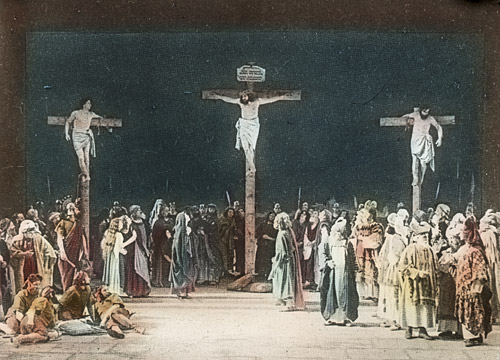
from Passion Play in Oberammergau, circa 1920
Left Below
a review by Tim Callahan
of the ABC Television 20/20 Special ‘Resurrection’
One would think that a television show examining a belief as important to worshipers of the world’s largest religion as the Resurrection of Jesus would be capable of generating at least some controversy; but, of course, such a presupposition assumes that hard questions will be asked and opposing opinions aired. This being network TV, however, one can assume beforehand that controversy will be avoided at all costs. So, when ABC’s 20/20 looked at the Resurrection, the range of opinions certainly did not include any that were either atheist or even agnostic.
In considering the ‘historical’ background of the Resurrection, the gospel accounts were tacitly assumed to be history, at least to some degree. This includes the assumption that the body of Jesus had to be swiftly buried before sunset to avoid violating religious prohibitions against working on the Sabbath. That there were twelve disciples was also accepted. In fact, the number twelve would reflect the traditional division of the Jews into twelve tribes, and the only literature saying there were twelve is the Bible itself.
The closest the show came to any dispute worth considering was the contention of some that Jesus might not have been buried in a tomb, but rather thrown into a communal pit reserved for those condemned to death. This really wasn’t explored in any detail, however. Instead, the show quickly moved on to the debate over whether the real tomb of Jesus was the garden tomb or the Church of the Holy Sepulcher. Whichever it was, the show said that nobody disputed that the tomb of Jesus was empty. Well, by all accounts it was empty. What wasn’t mentioned is that the only accounts dealing with the issue are in the New Testament, so, of course, they all say the tomb was empty.
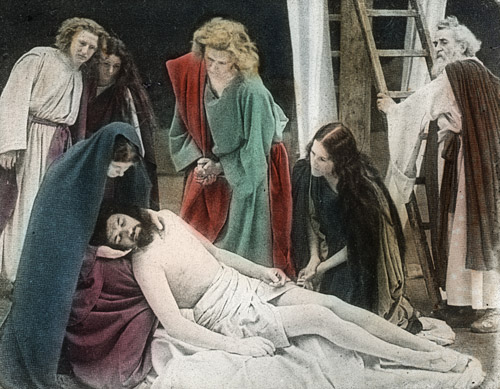
from Passion Play in Oberammergau, circa 1920
While the show did point out that the Church of the Holy Sepulcher was built by Constantine in the fourth century, and that before then nobody had a clue as to where the tomb of Jesus might be, the impossibility of locating the burial chamber that briefly held the corpse of Jesus was ignored. In fact, since the tomb would, if it were within the city, most likely be an above-ground chamber for internment, it probably no longer exists. The Jewish historian Josephus, who was an eyewitness to the destruction of Jerusalem by the Romans in the year 70, said that their devastation was so thorough that if they hadn’t deliberately left a few towers standing nobody passing by would ever know there had once been a city there. The Romans leveled the place, and that leveling would have included whatever tomb housed the body of Jesus.
Another point the show failed to make is that even if Jesus did not rise from the dead the tomb would have most likely been empty. The reason for this involves the peculiar burial customs of the Jews of that day. The chamber Jesus would have been laid out in would have had a slab upon which the body was allowed to decay and dessicate. Months after the internment the relatives of the deceased would open the chamber, gather up the now disjointed bones and place them in a limestone box called an ossuary. The ossuaries were stored in side chambers of the main tomb, which was a family sepulcher. So if Jesus was laid out in the family tomb of Joseph of Arimathea, one of two things could have happened to his bones. They might have been put into an ossuary in the tomb, or the ossuary might have been taken back to Galilee for final internment. If they were left in Jerusalem, how would we know? Even assuming we could find the tomb after two Roman sackings (the one in 70 and one at the end of the Bar Kochba revolt in 134, followed by later sackings by Moslems and crusaders), how would we know the identity of any skeleton interred there?
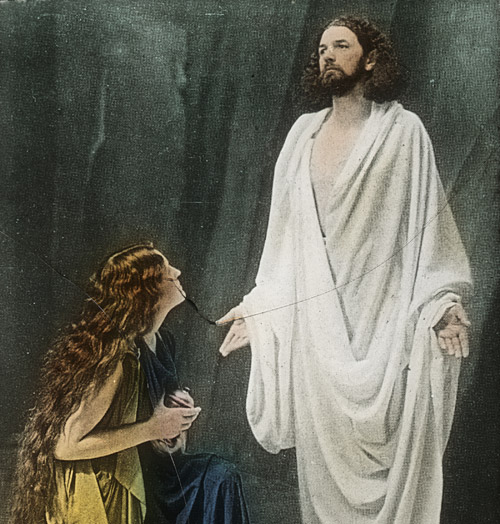
from Passion Play in Oberammergau, circa 1920
When dealing with the various appearances of Jesus to his disciples after his death the show did mention the story of Thomas, the doubting apostle Jesus directs to search his wounds, and the story of the apostles meeting Jesus on the road to Emmaeus, but carefully skirted the fact that none of the gospel accounts agree on the particulars of who first saw the empty tomb, whether Jesus first met the disciples as a group in Jerusalem or Galilee or what precisely he said to them. The account of Jesus’ post-Resurrection appearances given by Paul in 1 Corinthians 15:3–8, which was written earlier than the gospels, differs from all of their accounts. Paul says that Jesus “appeared to” or “was seen by” — depending on the English translation — first Cephas (Peter), then the 12 disciples (apparently including Judas), then over 500 people, then by James, then all of the apostles and, finally, Paul. The word variously translated as “was seen by” or “appeared to” is in the original Greek optanomai, a word that is rather neutral with respect to whether these appearances were visions or involved a resurrected body. However, a few verses later (1 Corinthians 15:12, 13) Paul refers to the resurrection, using the Greek word anastasis, which means either to stand up or stand again, strongly implying physicality.
As to the nature of the Resurrection, the only contention in this program, other than the nature of Jesus’ burial, was between those who thought that the Resurrection was physical, those who thought it was spiritual, and those who thought that it was a visionary experience on the part of Jesus’ followers. Of course, the idea that it was a mix of calculated fiction and human credulity was not explored.
One point that was strongly made was that the followers of Jesus were willing to die for their beliefs, implying thereby that there must be some truth in them. Yes, they were willing to die for what they believed; then, so too were the terrorists who crashed jets into the World Trade Center.