
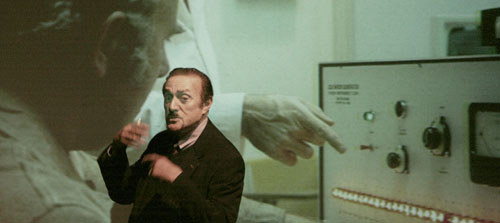
Philip Zimbardo shows a slide during his lecture at Caltech of the apparatus used to convince volunteer “teachers” that they were delivering powerful shocks to people playing the role of “learners”. (photograph courtesy of David Patton)

Dr. Michael Shermer interviews
Dr. Philip Zimbardo
We are honored to present this special edition of our Skepticality podcast, featuring an extended interview with the legendary Stanford psychologist Philip Zimbardo. Dr. Zimbardo is famous for his landmark Stanford Prison Experiment, one of the most important experiments ever conducted in the history of the social sciences (and one that could not be run today).
Long at work on other problems to solve in his field, Dr. Zimbardo was jolted back into the study of the human capacity for evil when he saw the horrific photographs of the prisoner abuse at Abu Ghraib and noticed the striking similarities to what happened in the basement of the psychology building at Stanford decades earlier — bags over prisoner’s heads, nudity, sexual poses, and the like. On the eve of his national book tour for his new book, The Lucifer Effect: Understanding How Good People Turn Evil, Dr. Zimbardo speaks to Skeptic magazine’s Michael Shermer about the lessons learned (and not learned) from his prison experiment — and what the research since that time shows about the power of circumstances that allow human evil to surface and express itself.
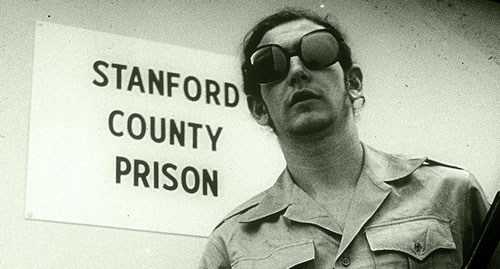
A Stanford Prison Experiment guard in uniform with symbols of power and anonymity. (photograph courtesy of LuciferEffect.org)
Also of interest…
In this week’s eSkeptic David Ludden reviews Victor J. Stenger’s book entitled God: The Failed Hypothesis — How Science Shows that God Does Not Exist (Prometheus Books, 2007, 1591024811). David Ludden is an assistant professor of psychology at Lindsey Wilson College in Columbia, Kentucky, where he teaches courses in research methods, cognitive neuroscience and evolutionary psychology.
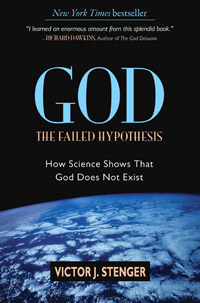
God: The Failed Hypothesis (detail of cover)
Conspicuous by His Absence
book review by David Ludden
There’s good news for readers of Richard Dawkins’ latest bestseller, The God Delusion (Houghton Mifflin, 2006) whose appetites were whetted for more. Physicist Victor Stenger has just served up a second course of delectable arguments for the non-existence of God. In his latest book God: The Failed Hypothesis, Stenger runs through the standard rational and biological arguments against any sort of meaningful deity, but he does much more. In plain, easily understood language, Stenger lays out the evidence from cosmology, particle physics and quantum mechanics showing that the universe appears exactly as it should if there is no creator.
Stenger does not agree with those who maintain that science has nothing to say about the existence of god. He soundly rejects Steven Jay Gould’s NOMA (Non-Overlapping Magisteria) argument (Rock of Ages: Science and Religion in the Fullness of Life, Ballantine, 1999), which posits that science and religion are independent fields of knowledge and that there can be no conflict between the two. Furthermore, he dismisses the notion that science is limited to studying the natural world. If there is a deity that interacts with the world — such as the standard Judeo-Christian-Islamic god — then the effects of divine intervention are observable within the natural world, and so they are under the purview of naturalistic science. Hence, Stenger argues, although science cannot directly test the existence of a supreme being, it can make inferences about a deity based on the observable behavior of the universe. This is exactly the same approach physicists have taken to the study of quarks and black holes, which cannot be directly observed either.
In a sense, every science experiment is a test of the God hypothesis. This is because of the assumption of methodological naturalism, that is, the null hypothesis that God does not affect the outcome of experiments. If scientists ever obtained consistent data that could not be explained by any known natural processes, this would lend support to the hypothesis that God exists, and scientists would eagerly pursue this line of research. But the assumption of methodological naturalism holds; that is, we find no evidence of God’s intervention in the natural world. Hence, we conclude that a god of the Judeo-Christian-Islamic type does not exist. While it is true, as the apologist will argue, that absence of evidence is not evidence of absence, it is nevertheless reasonable grounds for an assumption of non-existence, at least until reasonable evidence to the contrary is provided.
Stenger considers a number of arguments from physics that point to the non-existence of God. Curiously, these are often the same arguments proffered by theists for the existence of a creator. However, Stenger turns each argument on its head. Consider, for example, the first law of thermodynamics, or the conservation of energy. Some theists argue that the universe could not have come into existence without a violation of the first law because energy was created at the beginning of the universe. However, Stenger shows that inflationary big bang theory, which is amply supported by the data, predicts a “close balance between positive and negative energy” so that “the total energy of the universe is zero”. Thus, no violation of conservation was required to bring the matter and energy of the universe into being.
Another favorite of the theists is the second law of thermodynamics, or entropy. Savvy creationists have given up this as an argument against evolution, but it is still pulled out to argue for the existence of a creator. According to the second law, the total entropy, or disorder, of a closed system must increase over time. If the universe started as chaos, the theist argues, a miracle was needed to impose order upon it. On the other hand, if the universe was maximally ordered at the beginning of time, this could be interpreted as the signature of a perfect creator. But the cosmological evidence indicates that the universe began in a state of maximum entropy — and that the total entropy of the universe has been increasing ever since! This apparently contradictory state of affairs is explained by the fact that the universe is expanding, with the maximum possible entropy of the universe growing faster than the total actual entropy. Thus, the universe only appears to be getting more ordered, but this is only because there is more room to spread out the clutter. In short, no miracle, and hence no creator, is needed to explain the origin or current state of the universe.
Stenger even takes on one of the biggest mysteries of all — why is there even a universe in the first place? Intuition tells us that nothingness is the normal state of affairs. Hence, the theist argues that the mere existence of a universe is evidence for a creator, because without a creator there would be nothing. But Stenger argues that something, rather that nothing, is the normal state of affairs. The laws of physics tell us that nothingness is an unstable state and will soon “undergo a spontaneous phase shift” to a state of somethingness. Indeed, Stenger argues, a state of continuous nothingness is so improbable that it could only be maintained through divine intervention. Hence, the existence of a universe is no evidence for the existence of a creator.
Probably the most commonly-used theistic argument that Stenger challenges is the anthropic principle. The crux of this argument is that a number of constants in the universe are finely tuned to allow for the existence of life as we know it, and this fine tuning implies a benevolent creator. Stenger notes that the apparent precision in the values of many of these constants is nothing more than an artifact of the units used to measure them. Furthermore, computer modeling shows that something like our universe would have developed under a wide range of values for these constants. Stenger points out that those making this argument mistakenly assume that each of these values is independent of the others, when in fact they are tightly interrelated. Again, no creator is required to explain the features of the universe.
God: The Failed Hypothesis shares a common central theme with Dawkins’ The God Delusion, namely that the universe looks exactly as we would expect it to look if there were no supreme being. However, while Dawkins’ language is more eloquent, Stenger’s is less abrasive, and so somewhat less likely to offend. Nevertheless, the two books complement each other, with Dawkins focusing more on biological evidence and Stenger on physical evidence. All freethinkers should have both volumes, side by side, on their bookshelves.
The Atlas Society interviews Michael Shermer
Recently, Ed Hudgins, the executive director of The Atlas Society, interviewed Michael Shermer about “a wide-ranging interview on reason, science, pseudo-science, politics, and much more”. READ the interview >