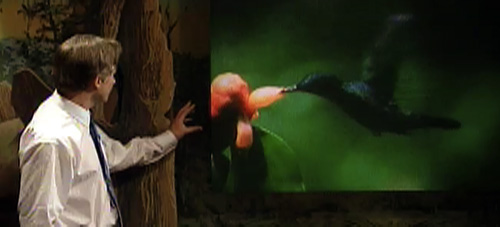
screenshot from Growing Up in the Universe
Growing Up in the Universe DVD
The Richard Dawkins Foundation has announced that you can pre-order copies of Dawkins’ 1991 Royal Institution Christmas Lectures for Children that were originally broadcast by the BBC and are now available for the first time. In Growing Up in the Universe (to be officially released April 30th, 2007) Richard Dawkins presents a series of lectures on life, the universe, and our place in it. With brilliance and clarity, Dawkins unravels an educational gem that will mesmerize young and old alike. Illuminating demonstrations, wildlife, virtual reality, and special guests (including Douglas Adams) all combine to make this collection a timeless classic.
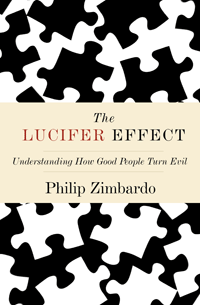
In this week’s eSkeptic Jennifer McKevitt reviews by Philip Zimbardo’s book entitled The Lucifer Effect: Understanding How Good People Turn Evil (Random House, 2007, ISBN 1400064113). Jennifer McKevitt is a freelance writer with an interest in science. She attended Northwestern University and the University of Iowa Writer’s Workshop.
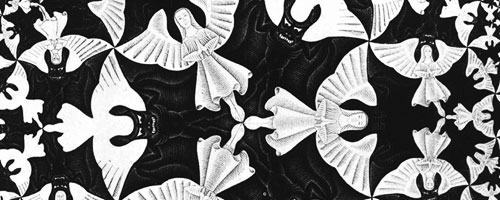
MC Escher’s illusion of angels and devils
Bad Apples or Bad Barrels?
book review by Jennifer McKevitt
Stanford Psychology Professor Emeritus Philip Zimbardo stumbled into fame with his 1971 Stanford Prison Experiment, in which he unwittingly learned how systems, situations, and roles involving power or passivity influences human behavior. In The Lucifer Effect, he brings it all back in a modern context, expanding on the results garnered in that long-ago prison simulation experiment, and connecting it to the prison abuses at Abu Ghraig.
The central metaphor of The Lucifer Effect is “no bad apples, only bad barrels.” That is, situations and systems, not individuals, transform behavior and personality. In exhaustive detail, including a day-by-day, sometimes hour-by-hour, description of the psychological decline of student volunteers and those conducting the Stanford Prison Experiment, Zimbardo details countless shameful examples of human behavior, from the alleged banality of Adolph Eichmann to the brutal Rwandan and Nanking rapes, ultimately ending with the offenses performed by our very own forces in Abu Ghraib.
The assessment of the Abu Ghraib prison is the book’s zenith. Zimbardo himself served as expert witness for Staff Sergeant Ivan “Chip” Frederick, former military policeman in charge of the night shift on Tiers 1A and 1B, notorious for being the most abusive of cellblocks in that most abusive of prisons. Making the argument that a dysfunctional, negligent military system bears the ultimate responsibility for the torture, abuse, and humiliation imposed on the prisoners there, Zimbardo’s defense of Frederick, who is now serving an eight-year sentence at Fort Leavenworth, is impassioned and convincing, and leaves our hearts wrenched by the knowledge of the failures and downright despicability of some of our own military policies, for which misguided, overwhelmed low-level officers like Frederick are paying with their freedom in the short term, and with their military careers in the long term.
Zimbardo also condemns such figures as Donald Rumsfeld in condoning methods of torture at Abu Ghraib. President George Bush and Vice President Dick Cheney are charged with culpability as well. He denounces any connection between the discoveries made during his Stanford experiment and the techniques, disguised as intended outcomes, approved by Rumsfeld in his role as former Secretary of Defense. Zimbardo wanly notes how the observations made during the experiment have been transformed from warning and analysis to torture instruction manual.
At 551 pages, including the index, the book is overlong, oft repeating its message and heavy-handedly applying the lessons learned at Stanford to all manner of situations. Zimbardo cites numerous examples of behavior abuse experiments, including Stanley Milgram’s “obedience to authority” experiments, in which average people failed to heed the pleas of a suffering electric shock recipient; and the Solomon Asch “conformity” experiments, in which individuals who initially formed independent opinions eventually yielded to group perception. Included as well is a mock “final solution” seemingly endorsed by the students at the University of Hawaii, in which a full 91 percent agreed with the conclusion that “under extreme circumstances it is entirely just to eliminate those judged most dangerous to the general welfare”. And what would any chronicle of the full spectrum of human behavior be without the Holocaust? Zimbardo frequently cites the countless examples of horror endorsed by the Nazis, including the “final solution” of the Jews, in which ordinary German citizens proved not only willing to serve in mobile death squads, but also came to relish their work to the extent that they “posed proudly for photographs of their up-close and personal killing of Jews”.
Zimbardo, known to be an engrossing speaker, has as his subject a riveting theme. Who among us has not surprised and shamed himself with acts of minor cruelty, or fails to recall the social hierarchy of his own primary and secondary school experience? The Lucifer Effect presents data that is far from inconceivable or unconvincing, and readers who remain doubtful of the extremes of human behavior after reading it must be determined to submerge their capacity for reason in the sands of denial.
Instead of condemning humanity, however, the close of the book shows Zimbardo most kindly offering not only an escape hatch for our own culpability in committing acts of cruelty, but also, in his concluding chapter, tenders a template of suggestions for resisting temptation in the form of a behavioral paradigm shift: “I can oppose unjust systems” and “I am responsible for my own decisions and behavior”. Therefore, while awareness of the full range of human behavior may appall some more idealistic readers, recognition of the well-proven facts presented by Zimbardo is an excellent step toward preventing its shocking recurrence. Let’s hope that our leaders are listening.
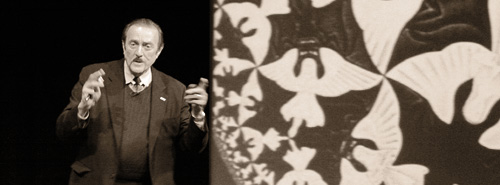
Dr. Philip Zimbardo speaking at our Skeptics Distinguished Lecture Series at Caltech (photograph by David Patton)
new Lectures at Caltech released on DVD
- The Lucifer Effect, by Dr. Philip Zimbardo
- How is it possible for ordinary, average, even good people to become perpetrators of evil? Dr. Zimbardo, Professor of Psychology at Stanford University, ran the famous “Stanford Prison Experiment” in the late 1960s that randomly assigned healthy, normal intelligent college students to play the roles of prisoner or guard in a projected 2 week-long study that he was forced to terminate after only 6 days because it went out of control, with pacifists becoming sadistic guards, and normal kids breaking down emotionally. READ more…
- The Gospel of Food, by Dr. Barry Glassner
- In his latest debunking project (after The Culture of Fear), sociologist Glassner argues that frequent sensational headlines and scientific controversies about obesity, fast food, and food safety have left many Americans bewildered about what to eat. Glassner’s well-researched and wide-ranging commentary on American eating habits and food-related beliefs offers a welcome antidote to such confusion by examining the veracity of numerous food myths. READ more…