





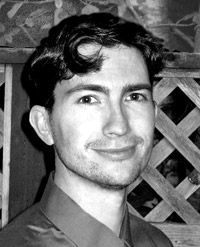
C. Pearson Solen is happily married with two wonderful children, and resides in Bellingham, Washington. He currently works as an MRI Technologist.
I was born and brought up as a member of the Church of Jesus Christ of Latter-day Saints. As a Mormon I devoted considerable amounts of time and material in furthering the purposes of the church, including serving a two-year mission to Okinawa, Japan. Those who live the church’s teaching of integrity and honesty, discipline and moderation, and pursuit of education often enjoy a great deal of personal success. I was no exception. In my many years as a member I had wonderful experiences and made many great friends. Mormons are generally good-hearted and wellmeaning.
Nevertheless, there was a growing problem — I wasn’t happy. As I grew older, became more educated, and experienced more of the outside world, I was encountering cognitive dissonance. The world I was coming to know did not match the world I thought to exist. At first, I tried to separate and balance two different worldviews, but as time passed they pulled closer and eventually collided, forcing me to work ever harder to keep them separate. With each new idea that challenged my sacredly held religious worldview I became frantic. Ultimate confrontation was drawing near and the world seemed very dark and lonely.
In what can only be described as a very difficult choice I opted to leave the church, risking everything. For members, leaving the church is unthinkable. Those who do leave often face confusion, self-loathing, doubt, emotional scarring, and loss of friends, family, and even jobs. Mormonism is not just a way of thinking; it is a way of life. It encompasses every aspect of one’s life from what you eat or drink to what books and movies you see. As an active member my entire world was the church. Reinforcement of beliefs, no matter how absurd, came at every turn. At one point I dropped out of law school, going on a religious quest to try and harmonize my heartfelt faith with my mind. Every answer I could devise or find to assuage my anxiety and fears only made things spin further out of control. Mental gymnastics were required to make the church’s teachings fit with everything from evolution to Native American history; archeology to philosophy; linguistics to genetics; the list seemed endless. It became an impossible balancing act. Everything I studied wore me down and challenged my faith. The demons seemed to be everywhere; all was dark and confusing.
Enter Carl Sagan. I discovered The Demon- Haunted World on the library shelf one day. I had heard of Sagan, of course, but knew little of him. At a time when friends had left me, where I could not confide with my own family, the book’s dedication invited me toward the candle (“To Tonio, my grandson. I wish you a world free of demons and full of light.”). Sagan’s book became a way for me to talk out my thoughts; thoughts I could not share with anyone else. When my first child on the way there was nothing more that I desired than a world free of demons for him. I felt trapped, as if I were chained in Plato’s cave — I was tired of the shadows the Church projected on the wall. I realized that what I had believed in for so long was not real. The chains were unlocked. My commitment to the truth was stronger than my commitment to the church. I became convinced that the truth is worth searching for — it is “the most precious thing” Sagan speaks of.
Sagan provided me the mirror that showed that my shackles were self chosen and that my collaboration and complacency were furthering the very things causing me so much trouble. I wanted easy answers. Sagan promoted an attitude of questioning and openness that required evidence. Science as presented by Sagan is liberating — it is there for all to enjoy irrespective of race, gender, creed, or citizenship. Science could be used by all equally and effectively. The Church demanded faith, labeling doubt as weakness. To Sagan, even doubt is useful. Doubt was not to be feared, but embraced. Doubt is humbling and so I was humbled. I learned to be comfortable with not knowing all the answers.
The Church told me to trust in prayers, fasting, priesthood blessings, and revelation based on feelings. Reason and evidence were secondary; and in cases where they did not support faith, they were irrelevant, or worse. On the surface much of The Demon-Haunted World seems preoccupied with science and the debunking of such wild notions as Atlantis, Bigfoot, and alien abductions — things I had already outgrown. The demons of the world, however, are more subtle and hidden, yet more threatening and menacing. At a deeper level Sagan was championing reason. He illustratively showed that knowledge is always useful, even if we are wrong. Failure, which is inevitable, is and can be instructive.
After reading Carl Sagan’s The Demon- Haunted World I realized I could master the demons. For Sagan, illusions require collaborators. No longer a collaborator, I changed and exorcised my own demons. No longer silent, I voiced my thoughts to my family. To my utter astonishment, they confessed to having similar struggles with the same ideas, but like me, they were afraid to share them. Talking with them the door of dialogue, examination, and honesty opened. Carl Sagan provided the key.
This article can be found in
volume 13 number 1
The Legacy of Carl Sagan
this issue includes: An Interview with Ann Druyan; Science, Religion & Human Purpose; An excerpt from Conversations with Carl; Tributes to Carl Sagan…
BROWSE this issue >
This issue is sold out.
This article was published on October 29, 2009.










It is amazing how much Sagan’s ‘A Demon Haunted world’ has had an impact not only on myself but by so many I have met and read about, including the writers who have almost imortilized him. But Carl would caution us all not to ever hold him up to a cult leader hero. We must remember that he was human and made mistakes just like us all. But yes oh yes, I certainly miss the man that I never met!!!! Great article. It really hit home and is one reason why i left the Catholic Church. I always remember a quote I can only paraphrase at this time from Dr. Sagan, i.e., “If one is too skeptical one might miss something, but if one is too openminded then one’s brain falls out.”
I think Carl Sagan helped me arrive at my world view too, though for me it started with the Cosmos series on PBS. It inspired me with its wonder, its sense of scale and perspective, and with the idea that we learned what we know through science. At the time, I was a religious child in religious family (in Utah as a matter of fact, but not Mormon), but I saw no contradiction initially. The seeds were planted though, and by the time I read Demon-Haunted World as an adult, it confirmed views I had already adopted.
As a result, I have a great fondness for Carl Sagan, flawed human that he was. I don’t think I miss anyone whom I’ve never met as much.
“Daemon Haunted World” was also, for me, the book that “set the world right”. Through it’s simple, sensible, truth-inspiring principles, I too was able to shed the last of the cognitive dissonance and uncertainty that my Mormon upbring brought me!
And yes, leaving the Church IS difficult. I really cannot have a close relationship with my family members except on the most superficial level because of this disagreement.
Anybody who disagrees with the idea that Mormons aren’t a cult has never tried to leave it.
Pearson,
I celebrate Sagan’s birthday every year. Demon Haunted World is an amazing and humbling book. What a great story you tell. It would have made Sagan smile.