Resource added on:
Friday, March 27, 2020 at
12:00 am
Produced by: Michael Shermer
Dr. Michael Shermer reviews the many ways that our attempts to understand the truth about the world are derailed by cognitive biases, including the anchoring bias, the representative bias, the availability bias, the confirmation bias, the hindsight bias, the self-serving bias, and even the bias bias.
This lecture is part of a course that Dr. Shermer teaches at Chapman University called Skepticism 101: How to Think Like a Scientist which covers a wide range of topics, from critical thinking, reasoning, rationality, cognitive biases and how thinking goes wrong, and the scientific methods, to actual claims and whether or not there is any truth to them, e.g., ESP, ETIs, UFOs, astrology, channelling, psychics, creationism, Holocaust denial, and especially conspiracy theories and how to think about them.
If you missed Dr. Shermer’s previous Skepticism 101 lectures watch them now.
Resource added on:
Wednesday, August 7, 2013 at
2:27 pm
Submitted by: Rob Martin and Maria Oehler
This course was taught at Florida State College at Jacksonville during the spring 2013 semester.
Excerpt from Syllabus
An interdisciplinary study of selected topics in the biological and physical sciences and their impact upon man and society, with the course format including seminar, discussion and projects. Topics will vary…. genetics, tissue culture, space, Malthusian theory, light, sound, and mechanics. This course will provides students with a unique opportunity to examine many common pseudoscientific fallacies, learn how the human brain has evolved to encourage paranormal beliefs, and challenge the students to confront their own biases as they apply the scientific method to their own beliefs through in-class activities, experiments, and research projects.
Resource added on:
Wednesday, April 17, 2013 at
11:39 am
Submitted by: Michael Shermer & Brian Dalton
Volume 1: Advertising the Con Academy
This is the first video in a series featuring Michael Shermer and Brian Dalton (aka: Mr. Deity). The mission of these videos is to promote critical thinking through the use of humor, wit, and satire.
In this faux commercial for The Con Academy you’ll see how psychics count on the confirmation bias to convince people that their powers are real when, in fact, they are just remembering the hits and forgetting the misses. We also demonstrate how psychic “organizations” con people by taking their money for services that are not real.
—Michael Shermer
Help Us Make More Videos Like This
If you would like to support The Con Academy Videos, please make a tax-deductible donation to the Skeptics Society. With your support, we hope to produce these instructional, educational, and entertaining videos regularly throughout the year for free viewing and use by everyone everywhere to spread the message of the power of science and skepticism to make the world a saner, safer place.
CREDITS: Special thanks to David Cowan, Daniel Mendez, and Jim Robinson for their support in launching this new series of Skeptic videos.
Written and Produced by: Brian Keith Dalton, Pat Linse, Michael Shermer. Featuring: Michael Shermer, Brian Keith Dalton, John Rael, Jen Brown, Matt David, Eduard Pastor, Emery Emery, and Wendy Hughes. Production assistance: Eduard Pastor, Matt David, and John Rael. Shot, Edited, and Directed by: Brian Keith Dalton. Special thanks to: Russell Friedman and everyone at the Grief Recovery Institute in Sherman Oaks, CA. Music by: Videoblocks.com and Final Cut Production music. Shot on Panasonic AF100, Gh2, and Gh3 cameras. The Con Academy is not, in any way, affiliated with The Khan Academy.
Resource added on:
Saturday, October 27, 2012 at
7:42 pm
Submitted by: Mark Gifford
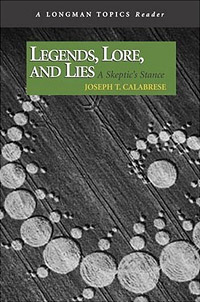
Written by: Joseph Calabrese
This book was required reading for the following course: “Composition” taught by Mark Gifford during the fall 2011 semester.
Legends, Lore, and Lies: A Skeptic’s Stance presents intriguing readings in five sections–urban legends, alternative medicine, the media’s role in public gullibility, psychics and the paranormal, and pseudo science–to demonstrate the importance of critical examination and the differences between an opinion or assertion and a supported claim. Legends, Lore, and Lies offers a wealth of features, including: (1) Explorations of the powers and limits of skepticism in understanding topics like urban legends and pseudoscience that often are awarded uncritical acceptance in our culture. (2) An excellent explanation of skepticism, along with a number of tools that every reader can use to become a critical consumer of information. (3) A handful of “believers” point-of-view readings, which students are encouraged to examine with the tools they acquire throughout the text. (4) A variety of pedagogical tools including brief author biographies and questions preceding and following the readings that function as writing and discussion prompts. (5) End-of-chapter synthesis questions that provide writing suggestions for longer research and inquiry papers. —Amazon
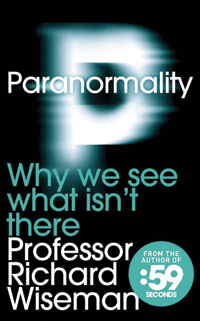
“People are emotionally drawn to the supernatural. They actively want weird, spooky things to be true … Wiseman shows us a higher joy as he deftly skewers the paranormal charlatans, blows away the psychic fog and lets in the clear light of reason.”—Richard Dawkins
Richard Wiseman is clear about one thing: paranormal phenomena don’t exist. But in the same way that the science of space travel transforms our everyday lives, so research into telepathy, fortune-telling and out-of-body experiences produces remarkable insights into our brains, behaviour and beliefs. Paranormality embarks on a wild ghost chase into this new science of the supernatural and is packed with activities that allow you to experience the impossible. So throw away your crystals, ditch your lucky charms and cancel your subscription to Reincarnation Weekly. It is time to discover the real secrets of the paranormal. Learn how to control your dreams—and leave your body behind. Convince complete strangers that you know all about them. Unleash the power of your unconscious mind. —Amazon
Resource added on:
Tuesday, June 19, 2012 at
5:10 pm
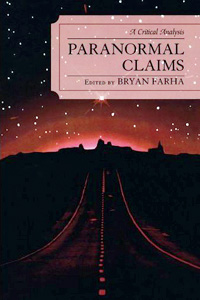
Edited by: Bryan Farha
Suggested by: Bryan Farha
This book was required reading for Dr. Bryan Farha’s course, “Sociology of Belief” taught at Oklahoma City University during spring 2011.
Published in April of 2007, this academic text features articles regarding paranormal, extraordinary, or fringe-science claims. It logically examines the claims of astrology; psychic ability; alternative medicine and health claims; after-death communication; cryptozoology; and faith healing, all from a skeptical perspective. Paranormal Claims is a compilation of some of the most eye-opening articles about pseudoscience and extraordinary claims that often reveal logical, scientific explanations, or an outright scam. These articles, steeped in skepticism, teach critical thinking when approaching courses in psychology, sociology, philosophy, education, or science. —Amazon
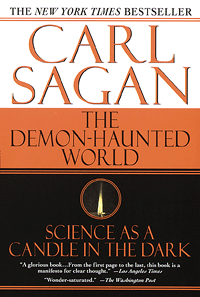
“The great astronomer and science writer challenges New Agers and explains social phenomena like UFOs, alien abductions, recovered memories, satanic cults, witch crazes, hallucinations, and how to detect baloney. This is Sagan’s most popular book among skeptics, filled with quotable maxims, popular among college professors as a supplemental text for students, but a classic for everyone who cares about living in a sane and safe world without superstition.” —Skeptic
“Eminent Cornell astronomer and bestselling author Sagan debunks the paranormal and the unexplained in a study that will reassure hardcore skeptics but may leave others unsatisfied. To him, purported UFO encounters and alien abductions are products of gullibility, hallucination, misidentification, hoax and therapists’ pressure; some alleged encounters, he suggests, may screen memories of sexual abuse. He labels as hoaxes the crop circles, complex pictograms that appear in southern England’s wheat and barley fields, and he dismisses as a natural formation the Sphinx-like humanoid face incised on a mesa on Mars, first photographed by a Viking orbiter spacecraft in 1976 and considered by some scientists to be the engineered artifact of an alien civilization. In a passionate plea for scientific literacy, Sagan deftly debunks the myth of Atlantis, Filipino psychic surgeons and mediums such as J.Z. Knight, who claims to be in touch with a 35,000-year-old entity called Ramtha. He also brands as superstition ghosts, angels, fairies, demons, astrology, Bigfoot, the Loch Ness monster and religious apparitions. (Feb.)” —Publishers Weekly
Resource added on:
Saturday, March 3, 2012 at
11:38 am
Submitted by: Michael Shermer
This course was taught at Chapman University during the fall 2011 semester.
Excerpt from Syllabus
This comprehensive course on science and skepticism will address the most mysterious, controversial, and contentious issues in science and skepticism from a quarter century of research involving: science and pseudoscience, science and pseudohistory, science and religion, science and morality, the psychology and neuroscience of belief, science and politics, science and economics, evolution and intelligent design creationism, the Baloney Detection Kit, how beliefs can be changed, how science works (and sometimes doesn’t work) from the history of science, and many specific examples of the power of belief.
Using numerous examples from three decades of research on this subject, students will learn how to think scientifically and skeptically, and he will show how to be open-minded enough to accept new ideas without being so open-minded that their brains fall out. This course meets once a week for three hours and includes lectures accompanied by in-class demonstrations, videos, magic, illusions, and examples from pop culture, along with rigorous scientific research, plus student discussions and presentations.
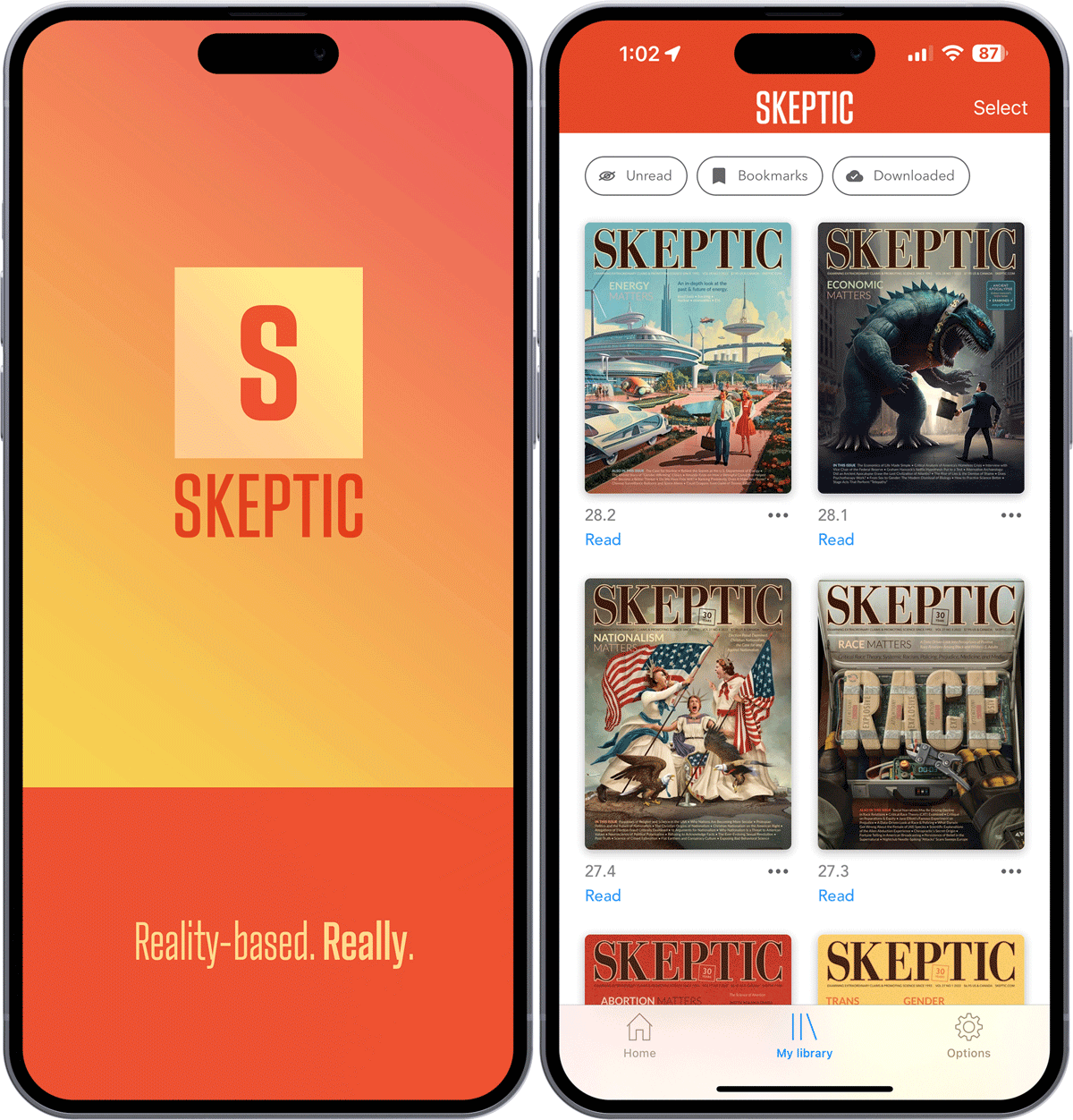
Whether at home or on the go, the SKEPTIC App is the easiest way to read your favorite articles. Within the app, users can purchase the current issue and back issues. Download the app today and get a 30-day free trial subscription.