Resource added on:
Friday, July 3, 2020 at
12:00 am
Produced by: Michael Shermer
In this, the final lecture of his Chapman University Skepticism 101 course, Dr. Michael Shermer pulls back to take a bigger picture look at what science and reason have done for humanity in the realm of moral progress. That is, applying the methods of science and principles of reason since the Scientific Revolution in the 17th century has solved not only problems in the physical and biological/medical fields, but in social and moral realms as well. How should we structure societies so that more people flourish in more places more of the time? Science can answer that question, and it has for centuries. Learning how to think like a scientist can make the world a better place, as Dr. Shermer explains in this lecture based on his 2015 book, The Moral Arc.
Watch the entire 15-lecture Chapman University Skepticism 101 series for free!
Learn how to think like a scientist! Click the button below to browse through the entire course lecture series 1 through 15, and watch all lectures that interest you, for free!
Resource added on:
Friday, June 26, 2020 at
12:00 am
Produced by: Michael Shermer
In this lecture Dr. Michael Shermer addresses one of the deepest questions of all: what is truth? How do we know what is true, untrue, or uncertain? Given that none of us are omniscient, all claims to knowledge carry a certain level of uncertainty. Given that fact, how can we determine what is true? Included: subjective/internal vs. objective/external truths, Hume’s theory of causality, correlation and causation, the principle of proportionality (or why extraordinary claims require extraordinary evidence), how to think about miracles and the resurrection, mysterian mysteries, post-truth, rational irrationalities, the man who saved the world, Bayesian reasoning, and why love depends on evidence.
Skepticism 101: How to Think Like a Scientist covers a wide range of topics, from critical thinking, reasoning, rationality, cognitive biases and how thinking goes wrong, and the scientific methods, to actual claims and whether or not there is any truth to them, e.g., ESP, ETIs, UFOs, astrology, channelling, psychics, creationism, Holocaust denial, and especially conspiracy theories and how to think about them.
If you missed Dr. Shermer’s previous Skepticism 101 lectures watch them now.
Resource added on:
Friday, June 12, 2020 at
12:00 am
Produced by: Michael Shermer
This lecture, traditionally the first in the series for the Skepticism 101 course, is based on the first couple of chapters from Dr. Michael Shermer’s first book, Why People Believe Weird Things, presenting a description of skepticism and science and how they work, along with a discussion of the difference between science and pseudoscience, and some very practical applications of how to test claims and evaluate evidence. The image for this lecture is the original oil painting for the first cover of Why People Believe Weird Things, commissioned by the publisher and painted by the artist Lawrence Berzon.
Skepticism 101: How to Think Like a Scientist covers a wide range of topics, from critical thinking, reasoning, rationality, cognitive biases and how thinking goes wrong, and the scientific methods, to actual claims and whether or not there is any truth to them, e.g., ESP, ETIs, UFOs, astrology, channelling, psychics, creationism, Holocaust denial, and especially conspiracy theories and how to think about them.
The audio is out of sync with the video in “What is a Skeptic?” Here’s the link to view it. If you missed Dr. Shermer’s previous Skepticism 101 lectures watch them now.
Resource added on:
Friday, June 5, 2020 at
12:00 am
Produced by: Michael Shermer
Dr. Michael Shermer continues the discussion of evolution and creationism, focusing on the history of the creationism movement and the four stages it has gone through: (1) Banning the teaching of evolution, (2) Demanding equal time for Genesis and Darwin, (3) Demanding equal time for creation-science and evolution-science, and (4) Intelligent Design theory. Shermer provides the legal, cultural, and political context for how and why creationism evolved over the 150 years since Darwin published On the Origin of Species in 1859, thereby providing a naturalistic account of life, ultimately displacing the creationist supernatural account. Finally, Shermer reviews the best arguments made by creationists and why they’re wrong.
Skepticism 101: How to Think Like a Scientist covers a wide range of topics, from critical thinking, reasoning, rationality, cognitive biases and how thinking goes wrong, and the scientific methods, to actual claims and whether or not there is any truth to them, e.g., ESP, ETIs, UFOs, astrology, channelling, psychics, creationism, Holocaust denial, and especially conspiracy theories and how to think about them.
If you missed Dr. Shermer’s previous Skepticism 101 lectures watch them now.
Resource added on:
Friday, May 29, 2020 at
12:00 am
Produced by: Michael Shermer
Dr. Michael Shermer takes viewers to the Galápagos Islands to retrace Darwin’s footsteps (literally — in 2006 Shermer and historian of science Frank Sulloway hiked and camped all over the first island Darwin visited) and show that, in fact, Darwin did not discover natural selection when he was there in September of 1835. He worked out his theory when he returned home, and Shermer shows exactly how Darwin did that, along with the story of the theory’s co-discoverer, Alfred Russel Wallace. Then Shermer outlines what, exactly, the theory of evolution explains, how it displaced the creationist model as the explanation for design in nature (wings, eyes, etc. as functional adaptations), and why so many people today still misunderstand the theory and how that sustained the creationist model.
Skepticism 101: How to Think Like a Scientist covers a wide range of topics, from critical thinking, reasoning, rationality, cognitive biases and how thinking goes wrong, and the scientific methods, to actual claims and whether or not there is any truth to them, e.g., ESP, ETIs, UFOs, astrology, channelling, psychics, creationism, Holocaust denial, and especially conspiracy theories and how to think about them.
If you missed Dr. Shermer’s previous Skepticism 101 lectures watch them now.
About the photograph above
Charles Darwin described of what he called the “craterized district” on San Cristóbal, Galápagos Islands thusly:
The entire surface of this part of the island seems to have been permeated, like a sieve, by the subterranean vapours: here and there the lava, whilst soft, has been blown into great bubbles; and in other parts, the tops of caverns similarly have fallen in, leaving circular pits with steep sides. From the regular form of the many craters, they gave to the country an artificial appearance, which vividly reminded me of those parts of Staffordshire, where the great iron-foundries are most numerous.
The photograph was taken on 21 June 2004 by Dr. Frank Sulloway. Darwin hiked this area in September, 1835.
Resource added on:
Friday, May 22, 2020 at
12:00 am
Produced by: Michael Shermer
In this lecture on Holocaust Denial, Dr. Michael Shermer employs the methods of science to history, showing how we can determine truth about the past. Many scholars in the humanities and social sciences do not consider history to be a science. Instead, they treat it as a field of competing narrative stories, no one of which has a superior claim to truth values than any others. But as Dr. Shermer replies to this assertion, are we to understand that those who assert that the Holocaust never happened have equal standing to those who assert that it did? Of course not! It is here where most cultural relativists get off the relativity train, acknowledging that, in fact, we can establish certain facts about the past, no less than we can about the present.
Skepticism 101: How to Think Like a Scientist covers a wide range of topics, from critical thinking, reasoning, rationality, cognitive biases and how thinking goes wrong, and the scientific methods, to actual claims and whether or not there is any truth to them, e.g., ESP, ETIs, UFOs, astrology, channelling, psychics, creationism, Holocaust denial, and especially conspiracy theories and how to think about them.
If you missed Dr. Shermer’s previous Skepticism 101 lectures watch them now.
Resource added on:
Friday, May 15, 2020 at
12:00 am
Produced by: Michael Shermer
In Pathways to Evil, Part 2, Dr. Michael Shermer fleshes out the themes of Part 1 by exploring how the dials controlling our inner demons and better angels can be dialed up or down depending on circumstances and conditions. Are we all good apples but occasionally bad barrels turn good apples rotten, or do we all harbor the capacity to turn bad?
Skepticism 101: How to Think Like a Scientist covers a wide range of topics, from critical thinking, reasoning, rationality, cognitive biases and how thinking goes wrong, and the scientific methods, to actual claims and whether or not there is any truth to them, e.g., ESP, ETIs, UFOs, astrology, channelling, psychics, creationism, Holocaust denial, and especially conspiracy theories and how to think about them.
If you missed Dr. Shermer’s previous Skepticism 101 lectures watch them now.
Resource added on:
Friday, May 1, 2020 at
12:00 am
Produced by: Michael Shermer
Dr. Michael Shermer examines the claims about the Bermuda Triangle using the tools of skepticism, science, and rationality to reveal that there is no mystery to explain. Selective reporting, false reporting, quote mining, anecdote chasing, and mystery mongering all conjoin to create what appears to be an unsolved mystery about the disappearance of planes and ships in this triangular shape region of the ocean. But when you examine each particular case, as did the U.S. Navy, Coast Guard, and especially insurance companies who have to pay out for such losses, it becomes clear that almost all have natural explanations, and the remaining unsolved ones are lying on the bottom of the ocean beyond our knowledge.
Skepticism 101: How to Think Like a Scientist covers a wide range of topics, from critical thinking, reasoning, rationality, cognitive biases and how thinking goes wrong, and the scientific methods, to actual claims and whether or not there is any truth to them, e.g., ESP, ETIs, UFOs, astrology, channelling, psychics, creationism, Holocaust denial, and especially conspiracy theories and how to think about them.
If you missed Dr. Shermer’s previous Skepticism 101 lectures watch them now.
Resource added on:
Tuesday, April 7, 2020 at
12:00 am
Produced by: Michael Shermer
Dr. Michael Shermer distinguishes between two questions: (1) Are extraterrestrial intelligences (ETIs) out there somewhere in the cosmos? and (2) Have aliens come here? Evidence for both questions is considered in the larger context of why the issue so compels us to answer it almost religiously.
Skepticism 101: How to Think Like a Scientist covers a wide range of topics, from critical thinking, reasoning, rationality, cognitive biases and how thinking goes wrong, and the scientific methods, to actual claims and whether or not there is any truth to them, e.g., ESP, ETIs, UFOs, astrology, channelling, psychics, creationism, Holocaust denial, and especially conspiracy theories and how to think about them.
If you missed Dr. Shermer’s previous Skepticism 101 lectures watch them now.
Resource added on:
Friday, April 3, 2020 at
12:00 am
Produced by: Michael Shermer
Dr. Michael Shermer considers the characteristics of cults, how they differ from sects, religions, and myths, the role that myths and religions play in culture and people’s lives, and what Scientologists really believe.
Skepticism 101: How to Think Like a Scientist covers a wide range of topics, from critical thinking, reasoning, rationality, cognitive biases and how thinking goes wrong, and the scientific methods, to actual claims and whether or not there is any truth to them, e.g., ESP, ETIs, UFOs, astrology, channelling, psychics, creationism, Holocaust denial, and especially conspiracy theories and how to think about them.
If you missed Dr. Shermer’s previous Skepticism 101 lectures watch them now.
Resource added on:
Friday, March 27, 2020 at
12:00 am
Produced by: Michael Shermer
Dr. Michael Shermer reviews the many ways that our attempts to understand the truth about the world are derailed by cognitive biases, including the anchoring bias, the representative bias, the availability bias, the confirmation bias, the hindsight bias, the self-serving bias, and even the bias bias.
This lecture is part of a course that Dr. Shermer teaches at Chapman University called Skepticism 101: How to Think Like a Scientist which covers a wide range of topics, from critical thinking, reasoning, rationality, cognitive biases and how thinking goes wrong, and the scientific methods, to actual claims and whether or not there is any truth to them, e.g., ESP, ETIs, UFOs, astrology, channelling, psychics, creationism, Holocaust denial, and especially conspiracy theories and how to think about them.
If you missed Dr. Shermer’s previous Skepticism 101 lectures watch them now.
Resource added on:
Tuesday, March 17, 2020 at
12:00 am
Produced by: Michael Shermer
Dr. Michael Shermer explains the difference between conspiracies and conspiracy theories, who is more likely to believe which conspiracy theories, the social, political, cultural, and psychological conditions in which conspiracy theories flourish, real conspiracies, and who really killed JFK.
This lecture is part of a course that Dr. Shermer teaches at Chapman University called Skepticism 101: How to Think Like a Scientist which covers a wide range of topics, from critical thinking, reasoning, rationality, cognitive biases and how thinking goes wrong, and the scientific methods, to actual claims and whether or not there is any truth to them, e.g., ESP, ETIs, UFOs, astrology, channelling, psychics, creationism, Holocaust denial, and especially conspiracy theories and how to think about them.
Note: There was a technical glitch at the end of the lecture, cutting out most of the points of the final slides of my Conspiracy Detection Kit. Here are those slide as expanded text:
Conspiracy Detection Kit
Parallel to my Baloney Detection Kit, I have put together a 10-point list for a Conspiracy Detection Kit. The more that a conspiracy theory manifests the following characteristics, the less likely it is to be a real conspiracy.
Patternicity. Proof of the conspiracy supposedly emerges from a pattern of “connecting the dots” between events that need not be causally connected. When no evidence supports these connections except the allegation of the conspiracy, or when the evidence fits equally well to other patterns—or to randomness—the conspiracy theory is likely false.
Agenticity. The agents behind the pattern of the conspiracy would need nearly superhuman power to pull it off. Most of the time in most circumstances, people, agencies, and corporations are not nearly so powerful as we think they are. If the conspiracy theory involves super powerful agents it is likely false.
Complexity. The conspiracy theory is complex and its successful completion demands a large number of elements coming together at just the right moment and in the proper sequence. The more elements involved and the more delicate the timing of the sequence in which they must come together, the less likely the conspiracy theory is to be true.
People. The more people involved in the conspiracy theory the less likely it is to be true. Conspiracies involving large numbers of people who would all need to keep silent about their secrets typically fail. People are incompetent and emotional. They screw up, chicken out, change their minds, have moral scruples. Conspiracy theories treat people like programmed robots carrying out their commands. That is unrealistic.
Grandiosity. If the conspiracy theory encompasses some grandiose ambition for control over a nation, economy, or political system, and especially if it aims for world domination, it is almost certainly false. The bigger the conspiracy the more likely it is to fail for the reasons of complexity and people that I’ve just given.
Scale. When the conspiracy theory ratchets up from small events that might be true to much larger events that have much lower probabilities of being true, it is very likely false. Most real conspiracies involve very specific events and targets, such as insider trading on Wall Street, price fixing in an industry, tax evasion by a corporation, and, yes, the assassination of a political leader, but always for a narrow goal of making money, grabbing power, or ending tyranny.
Significance. If the conspiracy theory assigns portentous and sinister meanings and interpretations to apparently innocuous or insignificant events, it is most likely false. Again, most conspiracies are narrowly focused and significant only to those who will benefit or be hurt. Most real conspiracies do not change the world.
Accuracy. If the conspiracy theory commingles facts and speculations without distinguishing between the two, it is likely to be false. Conspiracists are notorious for sprinkling in a handful of verifiable facts amidst a vast array of conjectures and suppositions, which blur reality and confuse listeners into thinking there is more to the theory than there actually is.
Paranoia. If a conspiracy theorist is extremely and indiscriminately suspicious of any and all government agencies or private corporations, this suggests a lack of nuance in understanding how the world works. Yes, sometimes “they” really are out to get you, but usually not.
Falsifiability. Conspiracy theorists typically refuse to consider alternative explanations, rejecting all disconfirming evidence for the theory, and blatantly seeking only confirming evidence to support what has a priori been determined as the truth. To return to Karl Popper, if a conspiracy theory cannot be falsified, it is probably false.
Resource added on:
Thursday, April 6, 2017 at
2:49 pm
Produced by: Deanna & Skylar (High Tech High Media Arts, San Diego, CA)
Submitted by: Daniel Peluso (student teacher)
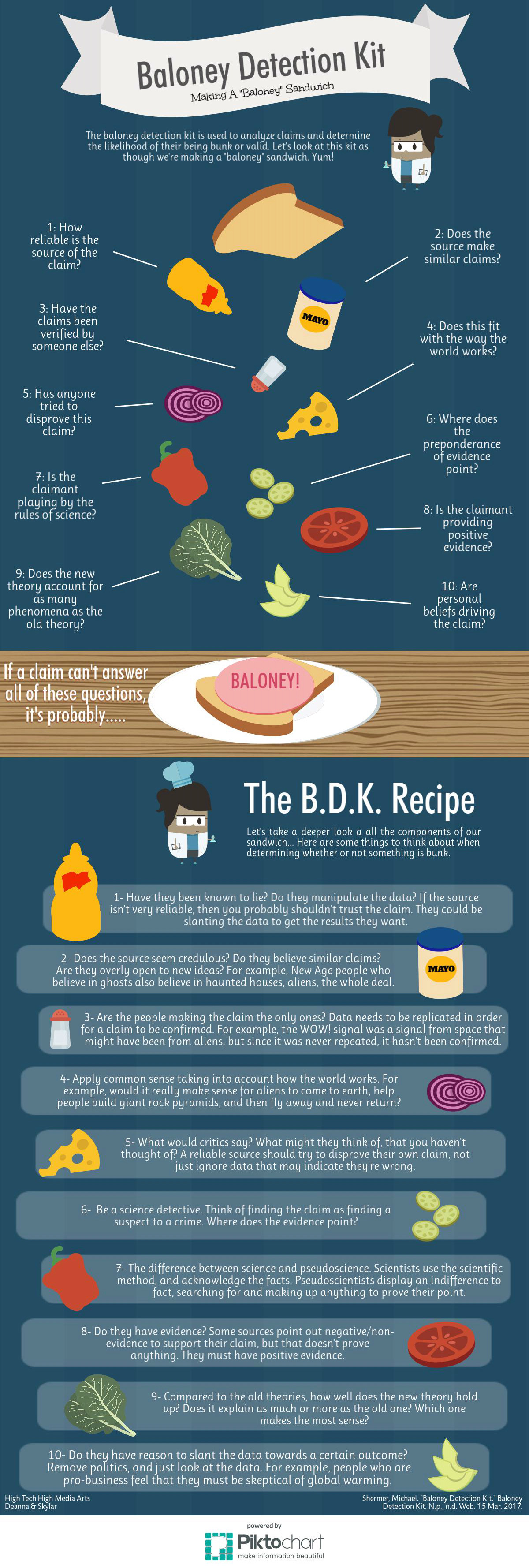
For a class project, a pair of 11th grade physics students created the infographic shown below, inspired by Michael Shermer’s Baloney Detection Kit: a 16-page booklet designed to hone your critical thinking skills. It includes suggestions on what questions to ask, what traps to avoid, specific examples of how the scientific method is used to test pseudoscience and paranormal claims, and a how-to guide for developing a class in critical thinking.
Resource added on:
Wednesday, February 10, 2016 at
10:42 am
Produced by: The James Randi Educational Foundation
The James Randi Educational Foundation has produced a superb 10-part video lecture series in which Harriet Hall, M.D., contrasts science-based medicine with so-called “complementary and alternative” methods. The topics include: What is CAM?; acupuncture; chiropractic; energy medicine; homeopathy; miscellaneous “alternatives”; naturopathy and herbal medicines; pitfalls in research; science based medicine vs. evidence-based medicine; science-based medicine in the media and politics. The lectures range from 32 to 45 minutes. A companion course guide is also available. Listen to the audio advertisement for the course. Listen to the audio advertisement for the course.
Resource added on:
Thursday, September 19, 2013 at
11:41 am
In this video — the fourth in our series of videos that promote science and critical thinking through the use of humor, wit, and satire — we present a fun and informative look at the principles of Skepticism.
Help Us Make More Videos
If you would like to show your support for these videos, please make a tax-deductible donation to the Skeptics Society. With your support, we hope to produce these instructional, educational, and entertaining videos regularly throughout the year for free viewing and use by everyone everywhere to spread the message of the power of science and skepticism to make the world a saner, safer place.
CREDITS: Special thanks to David Cowan, Daniel Mendez, and Jim Robinson for their support in launching this new series of Skeptic videos.
Written and Produced by: Brian Keith Dalton, Michael Shermer, Pat Linse. Directed, lensed, and edited by: Brian Keith Dalton. Executive Producers: David Cowan, Daniel Mendez, Jim Robinson. Starring: Amy Rohren, Lily Catherine, Michael Shermer, Brian Keith Dalton. Music by: Videoblocks.com and Final Cut Pro. Additional Video from: Videoblocks.com. Shot on: a Canon C100 and an iPhone 5
Resource added on:
Wednesday, August 7, 2013 at
2:45 pm
Submitted by: William London
This course was taught at California State University, Los Angeles during the spring 2013 semester.
Excerpt from Syllabus
The course will emphasize principles of skeptical inquiry, scientific reasoning, and scientific evidence to prepare students to critically analyze promotional claims made in the health marketplace for products, services, and practices. The course is designed to help students distinguish health-related fact from fiction and to spot health-related schemes, scams, superstitions, sensationalism, fads, fallacies, frauds, bunk, and bunco. Students will engage in critical thinking as they discuss how consumers can get good value for their health-related financial expenditures.
Learning Outcomes
Students should be able to:
Explain why consumer vigilance is important in the health marketplace and summarize the various problems consumers face in the health marketplace.
Describe the scope of deception in the health marketplace, its significance as a population health problem, why people are vulnerable to it, and how consumers can avoid it.
Describe relevant consumer protection laws and agencies and their limitations and how consumers can utilize consumer protection resources.
Apply strategies for consumers to distinguish fact from fiction regarding health products, services, and practices.
Identify trustworthy and untrustworthy sources of consumer health information.
Describe the strengths and limitations of government regulation and industry self-regulation of advertising for health products and services.
Explain considerations for consumer decision-making regarding selection, utilization, and avoidance of health-related products, services, and practitioners.
Distinguish responsible from irresponsible practices, products, and services related to mental health, dental health, major chronic diseases, nutrition, weight control, physical fitness, skin care, aging, care of the dying, care of the bereaved, personal image enhancement, and human sexuality.
Analyze the “complementary and alternative medicine” movement in terms of its common themes, scientific examination of its theories, its impact on the health marketplace, and its impact on the health of the public.
Identify priorities and pitfalls for economical medical self-care and caring for one’s family.
Resource added on:
Wednesday, August 7, 2013 at
11:10 am
We are pleased to present the third in our series of videos that promote science and critical thinking through the use of humor, wit, and satire. In this video, You Can’t Handle the Truther, CIA Agents plot the 9/11 attack on the Twin Towers and Pentagon. If you missed our first two videos, check them out: The Con Academy and B.Y.T.H Busters: The Secret Law of Attraction.
Help Us Make More Videos
If you would like to show your support, please make a tax-deductible donation to the Skeptics Society by clicking the button below. With your support, we hope to produce these instructional, educational, and entertaining videos regularly throughout the year for free viewing and use by everyone everywhere to spread the message of the power of science and skepticism to make the world a saner, safer place.
CREDITS: Special thanks to David Cowan, Daniel Mendez, and Jim Robinson for their support in launching this series of Skeptic videos.
Written and Produced by: Brian Keith Dalton, Michael Shermer, Pat Linse. Directed, lensed, and edited by: Brian Keith Dalton. Executive Producers: David Cowan, Daniel Mendez, Jim Robinson. Starring: Sean Douglas, Amy Rohren, Michael Shermer, Brian Keith Dalton. Production Assistants: Matthew David, Gediminas Schuppenhauer, Pat Linse. Music by: Videoblocks.com and Brian Keith Dalton. Additional Video from: Videoblocks.com. Shot on: a Canon C100
Resource added on:
Wednesday, June 26, 2013 at
11:20 am
We are pleased to present the second in a series of videos that promote science and critical thinking through the use of humor, wit, and satire. In this video, B.Y.T.H. Busters: The Secret Law of Attraction, Adam Average and Jamie Imtheman put the “Law of Attraction” to the test. If you missed our first video, The Con Academy, watch it now!
Help Us Make More Videos
If you would like to show your support, please make a tax-deductible donation to the Skeptics Society by clicking the button below. With your support, we hope to produce these instructional, educational, and entertaining videos regularly throughout the year for free viewing and use by everyone everywhere to spread the message of the power of science and skepticism to make the world a saner, safer place.
CREDITS: Special thanks to David Cowan, Daniel Mendez, and Jim Robinson for their support in launching this new series of Skeptic videos.
Written and Produced by: Brian Keith Dalton, Michael Shermer, Pat Linse. Directed, lensed, and edited by: Brian Keith Dalton. Executive Producers: David Cowan, Daniel Mendez, Jim Robinson. Featuring: Brian Keith Dalton, Michael Shermer, Gingi Yee, Beyla Burke, Tom Vilot. Production Assistants: Eduard Pastor, Gediminas Schuppenhauer. Music by: Videoblocks.com and Final Cut Pro Production music. Additional Video by: Videoblocks.com. Shot on: Panasonic AF100, Gh2, and Gh3 cameras.
Myths. Conspiracy Theories. Illusory Correlation. Do these things have an evolutionary basis in common? What type of thinking enables conspiracy theorists to correlate ideas that in truth have nothing to do with each other? In his book, The Believing Brain, Michael Shermer refers to these types of thinking as patternicity — finding meaningful patterns in meaningless noise.
In this video project by Christopher Griffin, a senior Graphic Design student at the California College of the Arts (San Francisco), these pattern-seeking ideas are visually illustrated, as if diving head-first into the mind of a true believer.
This project was designed in Adobe After Effects and Maxon Cinema 4D, with assets built in Adobe Illustrator.
Resource added on:
Wednesday, April 17, 2013 at
11:39 am
Submitted by: Michael Shermer & Brian Dalton
Volume 1: Advertising the Con Academy
This is the first video in a series featuring Michael Shermer and Brian Dalton (aka: Mr. Deity). The mission of these videos is to promote critical thinking through the use of humor, wit, and satire.
In this faux commercial for The Con Academy you’ll see how psychics count on the confirmation bias to convince people that their powers are real when, in fact, they are just remembering the hits and forgetting the misses. We also demonstrate how psychic “organizations” con people by taking their money for services that are not real.
—Michael Shermer
Help Us Make More Videos Like This
If you would like to support The Con Academy Videos, please make a tax-deductible donation to the Skeptics Society. With your support, we hope to produce these instructional, educational, and entertaining videos regularly throughout the year for free viewing and use by everyone everywhere to spread the message of the power of science and skepticism to make the world a saner, safer place.
CREDITS: Special thanks to David Cowan, Daniel Mendez, and Jim Robinson for their support in launching this new series of Skeptic videos.
Written and Produced by: Brian Keith Dalton, Pat Linse, Michael Shermer. Featuring: Michael Shermer, Brian Keith Dalton, John Rael, Jen Brown, Matt David, Eduard Pastor, Emery Emery, and Wendy Hughes. Production assistance: Eduard Pastor, Matt David, and John Rael. Shot, Edited, and Directed by: Brian Keith Dalton. Special thanks to: Russell Friedman and everyone at the Grief Recovery Institute in Sherman Oaks, CA. Music by: Videoblocks.com and Final Cut Production music. Shot on Panasonic AF100, Gh2, and Gh3 cameras. The Con Academy is not, in any way, affiliated with The Khan Academy.
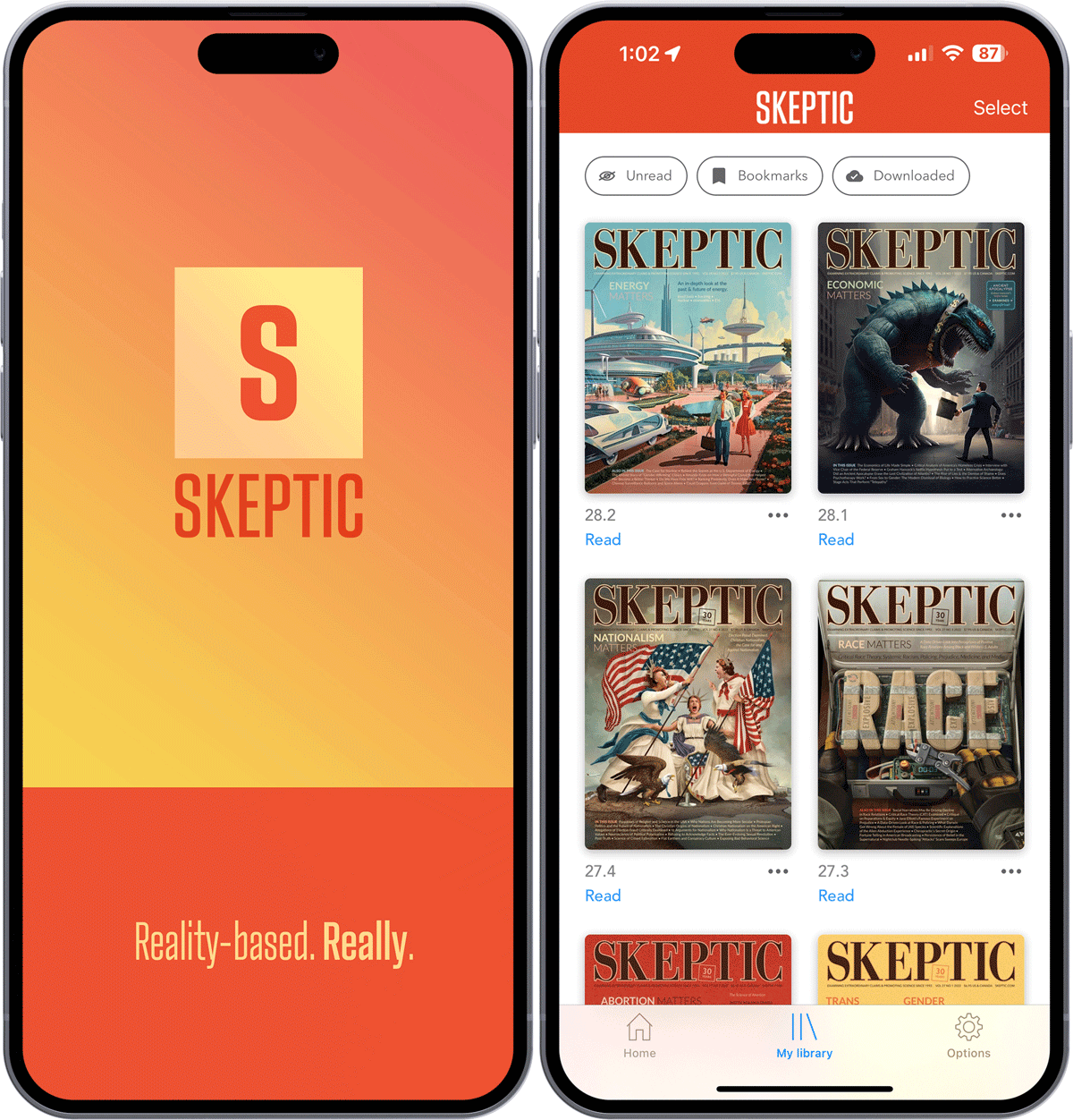
Whether at home or on the go, the SKEPTIC App is the easiest way to read your favorite articles. Within the app, users can purchase the current issue and back issues. Download the app today and get a 30-day free trial subscription.