Resource added on:
Thursday, April 6, 2017 at
2:49 pm
Produced by: Deanna & Skylar (High Tech High Media Arts, San Diego, CA)
Submitted by: Daniel Peluso (student teacher)
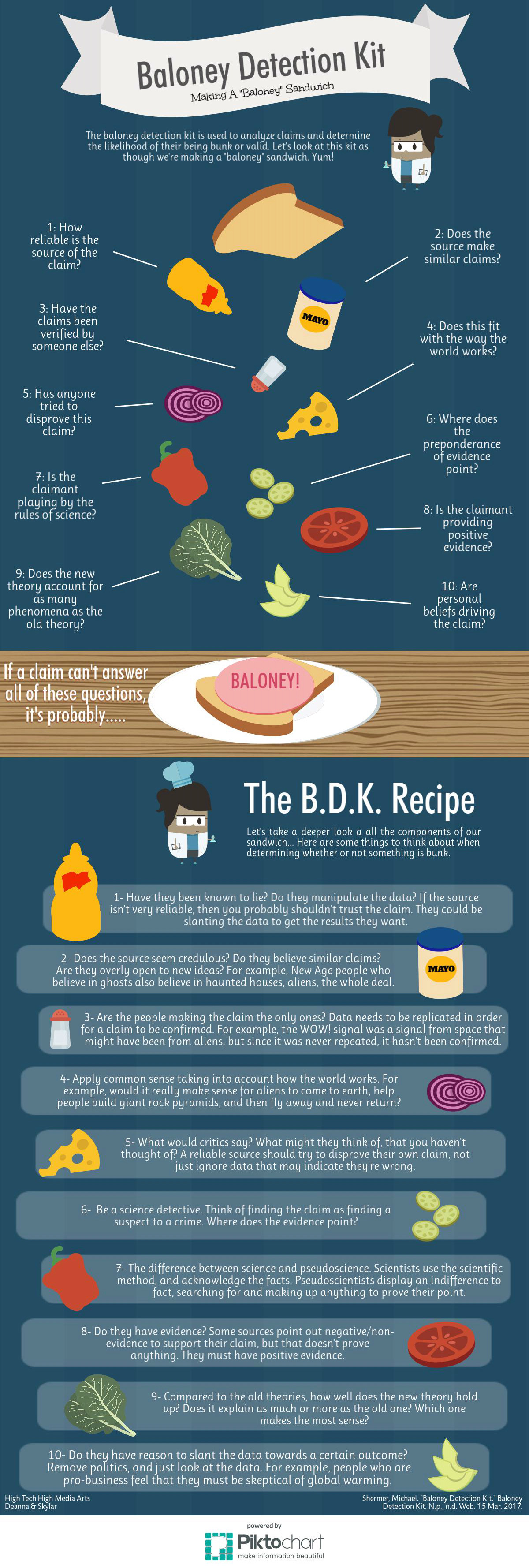
For a class project, a pair of 11th grade physics students created the infographic shown below, inspired by Michael Shermer’s Baloney Detection Kit: a 16-page booklet designed to hone your critical thinking skills. It includes suggestions on what questions to ask, what traps to avoid, specific examples of how the scientific method is used to test pseudoscience and paranormal claims, and a how-to guide for developing a class in critical thinking.
Resource added on:
Wednesday, December 12, 2012 at
5:39 pm
Submitted by: Randy Ludwig
This is an overview of the biological influences on sex, love, and attraction. It includes research on the types of “love” and which brain areas and chemicals are involved in those subjective experiences. This presentation was created by Randy Ludwig for Dr. Michael Shermer’s course, “Evolution, Economics & the Brain” taught at Claremont Graduate University during the spring 2011 semester.
Resource added on:
Friday, June 22, 2012 at
8:06 am
Submitted by: Charles DeLoach, Paarth Trivedi, Eli Goodman, Brady Serwitz, & Sara Owens
Does superstitious behavior affect your luck? In this presentation students use their knowledge of the scientific method to answer that question. For their final research project, the following superstitions are tested: (1) walking under a ladder, (2) opening an umbrella indoors, and (3) spilling salt. This presentation was created by Charles DeLoach, Paarth Trivedi, Eli Goodman, Brady Serwitz, and Sara Owens for Dr. Michael Shermer’s course, Skepticism 101: How to Think Like a Scientist (Without Being a Geek) at Chapman University during the fall 2011 semester.
Resource added on:
Friday, June 22, 2012 at
7:43 am
Submitted by: Michael Mermelstein
This presentation depicts the history of academic thought on voter turnout and shows how recent neuroscience has changed the prevailing wisdom on the subject. While political science scholars of the 70’s and 80’s believed voters were rational calculators, neuroscience has shown that emotion and narrative play a strong role in this process. This presentation was created by Michael Mermelstein for Dr. Michael Shermer’s course, “Evolution, Economics & the Brain” taught at Claremont Graduate University during the spring 2012 semester.
Resource added on:
Friday, June 22, 2012 at
7:41 am
Submitted by: Amanda Limongi
The presentation explores the evolutionary basis for the creation and consumption of art in all forms. It discusses art’s adaptive function; as well as, its role in natural and sexual selection. The universality and evolutionary basis of aesthetic tastes in art is also discussed. This presentation was created by Amanda Limongi for Dr. Michael Shermer’s course, “Evolution, Economics & the Brain” taught at Claremont Graduate University during the spring 2012 semester.
Resource added on:
Friday, June 22, 2012 at
7:38 am
Submitted by: Veronika Alexander
We all know the cliché “To err is human.” To most extent, this is true – human error is the cause of 70% of airplane crashes, 90% of car-wrecks, and 90% of workplace accidents. We love telling people that they (not us) are wrong and happily point out their oversights. But is there another side of making mistakes? This PowerPoint presentation explores why human beings are so prone to making errors and why it is sometimes quite good to make them. After all, as Kathryn Schulz also pointed out in her book “Being Wrong,” embracing error can lead to some transformative results – healed relationships and fascinating discoveries. This presentation was created by Veronika Alexander for Dr. Michael Shermer’s course, “Evolution, Economics & the Brain” taught at Claremont Graduate University during the spring 2012 semester.
Resource added on:
Friday, May 18, 2012 at
11:57 am
Submitted by: Kile Jones
This PowerPoint presentation emphasizes the need to counteract false stereotypes about atheists and provides reasons why atheists and liberal religious persons should work together for the common-good. It contains demographics of religion and unbelief in America and encourages religious persons to reevaluate how they understand atheism. This PowerPoint was used for an in-class presentation (in TEDTalk format) to promote inter-faith and atheist dialogue. This presentation was created by Kile Jones for Dr. Michael Shermer’s course, “Evolution, Economics & the Brain” taught at Claremont Graduate University during the spring 2012 semester.
Resource added on:
Thursday, March 29, 2012 at
12:44 pm
Created by: Connor Lambert, Charles DeLoach, Chenelle Delgadillo, and Karli Shill
Submitted by: Michael Shermer
This is a student-made video created for Dr. Michael Shermer’s course, Skepticism 101: How to Think Like a Scientist (Without Being a Geek) at Chapman University during the fall 2011 semester. In the style of Brian Dalton’s Mr. Deity, students show the audience the types of difficulties God may experience in answering his mail.
Resource added on:
Friday, February 10, 2012 at
1:47 pm
Submitted by: Anondah Saide
Does higher education systemically reduce belief? What do we know about this so far? This PowerPoint was used for an in-class presentation (in TEDTalk format) to discuss the correlation between higher education and belief in the paranormal. The presentation was created by Anondah Saide for Dr. Michael Shermer’s course, “Evolution, Economics & the Brain” taught at Claremont Graduate University during the spring 2011 semester.
Resource added on:
Friday, February 10, 2012 at
1:03 pm
Created by: Daniel Levy, Rachel Deering, Cristiana Wilcoxon, and Nikolai Eiteneer
Submitted by: Michael Shermer
This is a student-made, educational video on the psychological phenomenon of “change blindness,” created for Dr. Michael Shermer’s course, “Skepticism 101: How to Think Like a Scientist (Without Being a Geek)” at Chapman University during the fall 2011 semester.
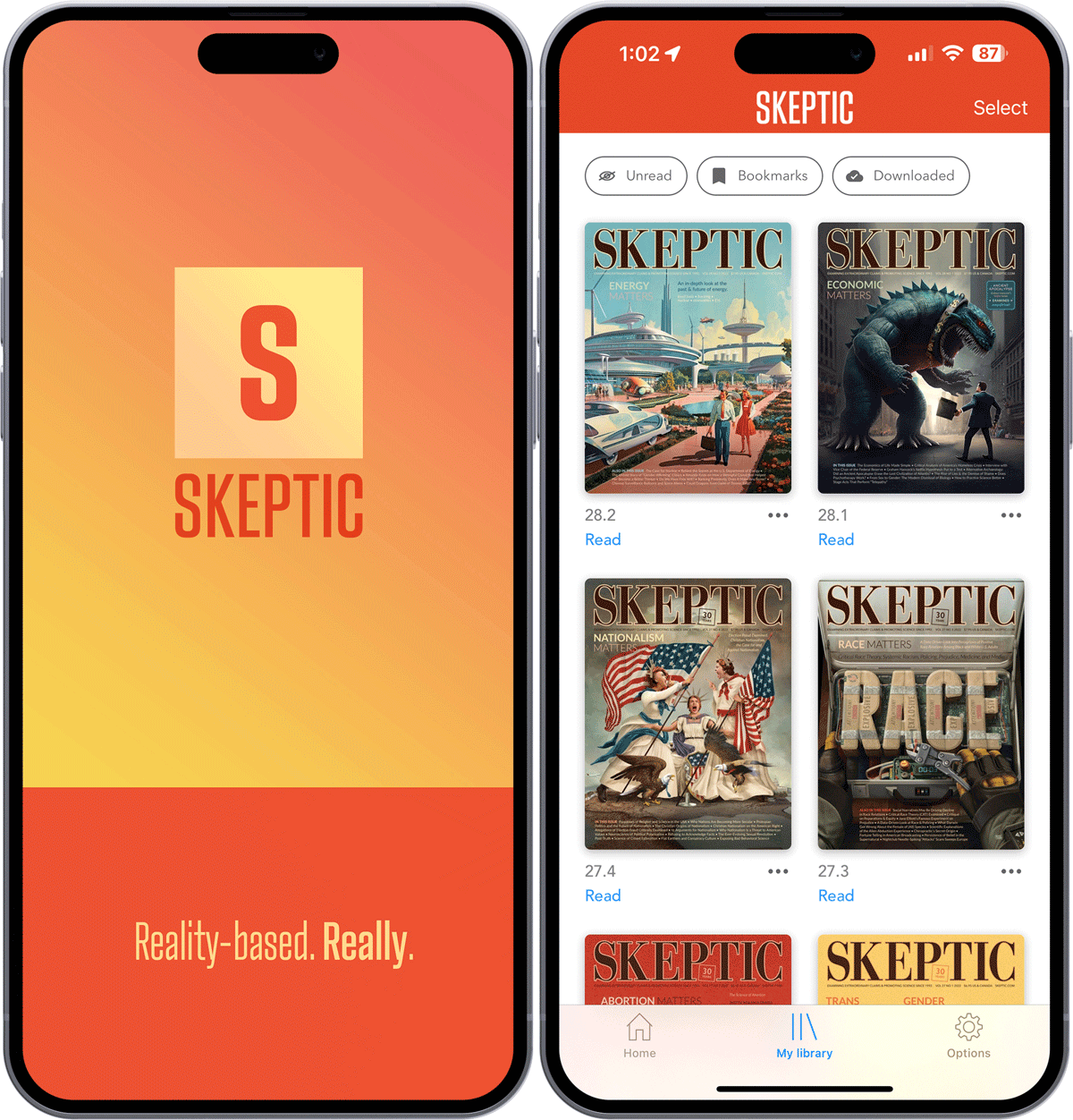
Whether at home or on the go, the SKEPTIC App is the easiest way to read your favorite articles. Within the app, users can purchase the current issue and back issues. Download the app today and get a 30-day free trial subscription.