You Are Browsing:
book recommendations
Although the other resources in this Resource Center are free, we cannot make these books available at no cost. We recommend them to you based on the required readings for the many course syllabi professors have shared with us.
This book was required reading for “Why We Believe Weird Things: Science and Pseudoscience in Psychology” taught by Dr. Jeffrey Brookings and for “Parapsychology & the Occult” taught by Dr. Terence Hines.
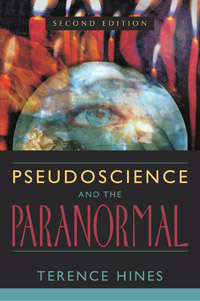
Popular culture fills the mind with a steady diet of fantasy, from tales of UFO landings and alien abductions, haunted houses, and communication with the dead to claims of miraculous cures by spiritual healers and breakthrough treatments in ‘alternative’ medicine. The paranormal – and the pseudoscience that attempts to validate it – is so ubiquitous that many people lose sight of the distinction between the real and the imaginary, and some never learn to make the distinction in the first place. In this updated and expanded edition of “Pseudoscience and the Paranormal”, the most comprehensive and up-to-date work of its kind, psychologist and neuroscientist Terence Hines explores the question of evidence for the paranormal and delves beyond it to one that is even more puzzling: Why do people continue to believe in the reality of the supernatural despite overwhelming evidence that it does not exist? Devoting separate chapters to psychics, life after death, parapsychology, astrology, UFOs, faith healing, alternative medicine, and many other topics, Hines examines the empirical evidence supporting these popular paranormal and pseudoscientific claims. New to this edition are extended sections on psychoanalysis and pseudopsychologies, especially recovered memory therapy, satanic ritual abuse, and facilitated communication. Also included are new chapters on ‘alternative’ medicine and environmental pseudoscience. Critiquing the whole range of current paranormal claims, this carefully researched, thorough review of pseudoscience and the paranormal in contemporary life shows readers how to carefully evaluate such claims in terms of scientific evidence. This scholarly yet readable volume is an invaluable reference work for students and general readers alike. —Amazon
BUY THIS BOOK
from Amazon
This book was required reading for the following courses: (1) “Science & Global Change Colloquium” taught by Thomas Holtz & John Merck, and (2) “Science & Pseudoscience in Psychology” taught by Jeffrey Brookings. This book was also used by Michael Dean with his high school students, you can find more information on his course here.
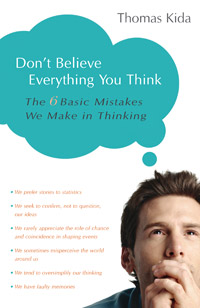
This enlightening book discusses how to recognize faulty thinking and develop the necessary skills to become a more effective problem solver. Author Thomas Kida identifies “the six-pack of problems” that leads many of us unconsciously to accept false ideas: 1. We prefer stories to statistics. 2. We seek to confirm, not to question, our ideas. 3. We rarely appreciate the role of chance and coincidence in shaping events. 4. We sometimes misperceive the world around us. 5. We tend to oversimplify our thinking. 6. Our memories are often inaccurate.
Kida vividly illustrates these tendencies with numerous examples that demonstrate how easily we can be fooled into believing something that isn’t true. —Shop Skeptic
BUY THIS BOOK
from Shop Skeptic
This book was required reading for Stephen Sekula, John Cotton, and Randall Scalise’s course, “The Scientific Method: Critical & Creative Thinking” taught at Southern Methodist University.
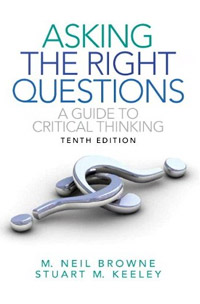
Used in a variety of courses in various disciplines, Asking the Right Questions helps students bridge the gap between simply memorizing or blindly accepting information, and the greater challenge of critical analysis and synthesis. Specifically, this concise text teaches students to think critically by exploring the components of arguments–issues, conclusions, reasons, evidence, assumptions, language–and on how to spot fallacies and manipulations and obstacles to critical thinking in both written and visual communication. It teaches them to respond to alternative points of view and develop a solid foundation for making personal choices about what to accept and what to reject. —Publisher
BUY THIS BOOK
from Amazon
This book was required reading for Dr. Innes Mitchell’s course, “Perspectives on Atheism” taught at St. Edwards University during spring 2012.
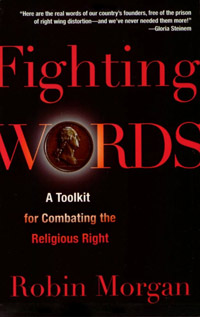
The religious right is gaining enormous power in the United States, thanks to a well-organized, media-savvy movement with powerful friends in high places. Yet many Americans — both observant and secular — are alarmed by this trend, especially by the religious right’s attempts to erase the boundary between church and state and re-make the U.S. into a Christian nation. But most Americans lack the tools for arguing with the religious right, especially when fundamentalist conservatives claim their tradition started with the Framers of The Constitution. Fighting Words is a a tool-kit for arguing, especially for those of us who haven’t read the founding documents of this nation since grade school. Robin Morgan has assembled a lively, accessible, eye-opening primer and reference tool, a “verbal karate” guide, revealing what the Framers and many other leading Americans really believed — in their own words — rescuing the Founders from images of dusty, pompous old men in powdered wigs, and resurrecting them as the revolutionaries they truly were: a hodgepodge of freethinkers, Deists, agnostics, Christians, atheists, and Freemasons — and they were radicals as well.—Amazon
BUY THIS BOOK
from Amazon
This book was required reading for Dr. Innes Mitchell’s course, “Perspectives on Atheism” taught at St. Edwards University during spring 2012.
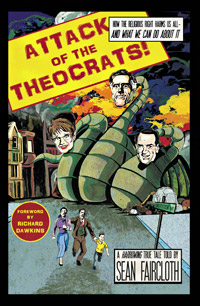
While much of the public debate in the United States over church-state issues has focused on the construction of nativity scenes in town squares and the addition of “under God” to the Pledge, Faircloth, who served ten years in the Maine legislature and is now Director of Strategy & Policy for the U.S. Richard Dawkins Foundation, moves beyond the symbolism to explore the many ways federal and state legal codes privilege religion in law.
Faircloth speaks around the nation on the Constitution, separation of church and state, and secular strategy. Faircloth also served for a decade in the Maine legislature, successfully spearheading over thirty laws. In his last term in office, Faircloth was elected Majority Whip by his caucus colleagues. —Amazon
BUY THIS BOOK
from Amazon
This book was required reading for Dr. Innes Mitchell’s course, “Perspectives on Atheism” taught at St. Edwards University during spring 2012.
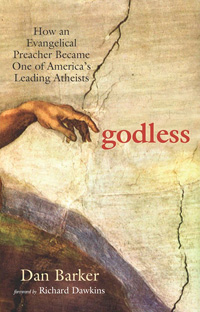
Conversions on the road to Damascus are for those who hear voices and fall prey to delusions and who would be better off seeking professional help. Much more valuable in the human story are the reflections of intelligent and ethical people who listen to the voice of reason and who allow it to vanquish bigotry and superstition. This book is a classic example of the latter. —Christopher Hitchens
My kids are in the process of learning about literature, and a rule of thumb they’ve picked up concerns how to recognize the protagonist of a Story: it’s the character who undergoes the greatest transformation. This makes sense, because one of the hardest things we confront is the need to change. By this criterion, in the enormous story of what we all do with our lives, Dan Barker is one of the most interesting and brave protagonists I know. Godless is a fascinating memoir, a tour of one distressing extreme of religiosity, a handbook for debunking theism. But most of all, it is a moving testimonial to one man’s emotional and intellectual rigor in acclaiming critical thinking.—Robert Sapolsky
BUY THIS BOOK
from Amazon
This book was required reading for the following course: “Critical Thinking: Reason & Evidence” taught by Pete Boghossian.
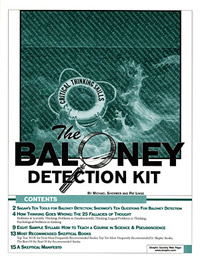
This 16-page booklet is designed to hone your critical thinking skills. It includes suggestions on what questions to ask, what traps to avoid, specific examples of how the scientific method is used to test pseudoscience and paranormal claims, and a how-to guide for developing a class in critical thinking.
Plus, you’ll also find: (1) Sagan’s Ten Tools for Baloney Detection and Shermer’s Ten Questions For Baloney Detection. (2) How Thinking Goes Wrong: The 25 Fallacies of Thinking Problems in Scientific Thinking. (3) Eight Sample Syllabi: How to Teach a Course in Science & Pseudoscience. (4) The Most Recommended Skeptical Books. (5) Science and Skepticism: Science, Scientific Method and Skepticism — How They Contribute to Rational and Critical Thinking. —Skeptic
BUY THIS BOOK
from Shop Skeptic
This book was required reading for the following course: “Atheism” taught by Pete Boghossian.
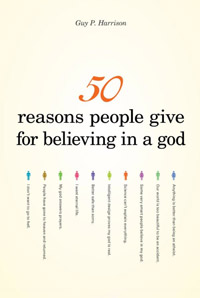
Many books that challenge religious belief from a sceptical point of view take a combative tone that is almost guaranteed to alienate believers or they present complex philosophical or scientific arguments that fail to reach the average reader. Journalist Guy P Harrison argues that this is an ineffective way of encouraging people to develop critical thinking about religion. In this unique approach to scepticism regarding God, Harrison concisely presents fifty commonly heard reasons people often give for believing in a God and then he raises legitimate questions regarding these reasons, showing in each case that there is much room for doubt.Whether you’re a believer, a complete sceptic, or somewhere in between, you’ll find Harrison’s review of traditional and more recent arguments for the existence of God refreshing, approachable, and enlightening.
From religion as the foundation of morality to the authority of sacred books, the compelling religious testimony of influential people, near-death experiences, arguments from “Intelligent Design”, and much more, Harrison respectfully describes each rationale for belief and then politely shows the deficiencies that any good sceptic would point out.As a journalist who has travelled widely and interviewed many highly accomplished people, quite a number of whom are believers, Harrison appreciates the variety of belief and the ways in which people seek to make religion compatible with scientific thought. Nonetheless, he shows that, despite the prevalence of belief in God or religious belief in intelligent people, in the end there are no unassailable reasons for believing in a God. For sceptics looking for appealing ways to approach their believing friends or believers who are not afraid to consider a sceptical challenge, Harrison’s book makes for very stimulating reading.—Amazon
BUY THIS BOOK
from Amazon
This book was required reading for the following course: “Atheism” taught by Pete Boghossian.
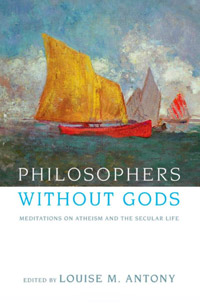
Atheists are frequently demonized as arrogant intellectuals, antagonistic to religion, devoid of moral sentiments, advocates of an “anything goes” lifestyle. Now, in this revealing volume, nineteen leading philosophers open a window on the inner life of atheism, shattering these common stereotypes as they reveal how they came to turn away from religious belief.
These highly engaging personal essays capture the marvelous diversity to be found among atheists, providing a portrait that will surprise most readers. Many of the authors, for example, express great affection for particular religious traditions, even as they explain why they cannot, in good conscience, embrace them. None of the contributors dismiss religious belief as stupid or primitive, and several even express regret that they cannot, or can no longer, believe. Perhaps more important, in these reflective pieces, they offer fresh insight into some of the oldest and most difficult problems facing the human mind and spirit. For instance, if God is dead, is everything permitted? Philosophers Without Gods demonstrates convincingly, with arguments that date back to Plato, that morality is independent of the existence of God. Indeed, every writer in this volume adamantly affirms the objectivity of right and wrong. Moreover, they contend that secular life can provide rewards as great and as rich as religious life. A naturalistic understanding of the human condition presents a set of challenges–to pursue our goals without illusions, to act morally without hope of reward–challenges that can impart a lasting value to finite and fragile human lives.
Collectively, these essays highlight the richness of atheistic belief–not only as a valid alternative to religion, but as a profoundly fulfilling and moral way of life. —Amazon
BUY THIS BOOK
from Amazon
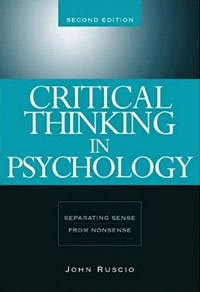
This book was required reading for the following course: “The Psychology of Scientific Thinking” taught by Monica Greco.
Do your students have the tools to distinguish between the true science of human thought and behavior from pop psychology? John Ruscio’s book provides a tangible and compelling framework for making that distinction. Because we are inundated with “scientific” claims, the author does not merely differentiate science and pseudoscience, but goes further to teach the fundamentals of scientific reasoning on which students can base their evaluation of information. John Ruscio is Associate Professor of Psychology at Elizabethtown College, where he teaches courses in Research Methods and Statistics, and Research Methods in Social Psychology. His research interests include decision-making, classification and diagnosis and taxometric methods. —Amazon
BUY THIS BOOK
from Amazon
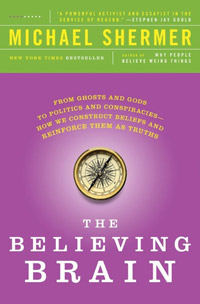
This book was required reading for the following courses: (1) “Skepticism 101: How to Think Like a Scientist (Without Being a Geek)” taught by Michael Shermer during the fall 2011 and (2) “Evolution, Economics, and the Brain” taught by Michael Shermer during the spring 2012.
In this, his magnum opus, Dr. Michael Shermer presents his comprehensive theory on how beliefs are born, formed, nourished, reinforced, challenged, changed, and extinguished. This book synthesizes Dr. Shermer’s 30 years of research to answer the questions of how and why we believe what we do in all aspects of our lives, from our suspicions and superstitions to our politics, economics, and social beliefs. In this book Dr. Shermer is interested in more than just why people believe weird things, or why people believe this or that claim, but in why people believe anything at all. His thesis is straightforward:
“We form our beliefs for a variety of subjective, personal, emotional, and psychological reasons in the context of environments created by family, friends, colleagues, culture, and society at large; after forming our beliefs we then defend, justify, and rationalize them with a host of intellectual reasons, cogent arguments, and rational explanations. Beliefs come first, explanations for beliefs follow.”
Dr. Shermer also provides the neuroscience behind our beliefs. The brain is a belief engine. From sensory data flowing in through the senses the brain naturally begins to look for and find patterns, and then infuses those patterns with meaning. The first process Dr. Shermer calls patternicity: the tendency to find meaningful patterns in both meaningful and meaningless data. The second process he calls agenticity: the tendency to infuse patterns with meaning, intention, and agency.
We can’t help believing. Our brains evolved to connect the dots of our world into meaningful patterns that explain why things happen. These meaningful patterns become beliefs. Once beliefs are formed the brain begins to look for and find confirmatory evidence in support of those beliefs, which adds an emotional boost of further confidence in the beliefs and thereby accelerates the process of reinforcing them, and round and round the process goes in a positive feedback loop of belief confirmation. Dr. Shermer outlines the numerous cognitive tools our brains engage to reinforce our beliefs as truths and to insure that we are always right.
Interlaced with his theory of belief, Dr. Shermer provides real-world examples of belief from all realms of life, and in the end he demonstrates why science is the best tool ever devised to determine whether or not a belief matches reality. —Shop Skeptic
BUY THIS BOOK
from Shop Skeptic
Michael Shermer gave a lecture on this book at the California Institute of Technology.
BUY THE DVD
from Shop Skeptic
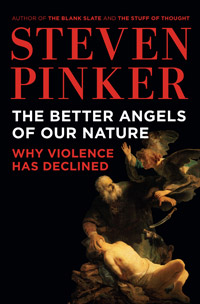
This book was required reading for the following course: “Evolution, Economics, and the Brain” taught by Michael Shermer during the spring 2011 and 2012 semesters.
Faced with the ceaseless stream of news about war, crime, and terrorism, one could easily think we live in the most violent age ever seen. Yet as New York Times bestselling author Steven Pinker shows in this startling and engaging new work, just the opposite is true: violence has been diminishing for millennia and we may be living in the most peaceful time in our species’s existence. For most of history, war, slavery, infanticide, child abuse, assassinations, pogroms, gruesome punishments, deadly quarrels, and genocide were ordinary features of life. But today, Pinker shows (with the help of more than a hundred graphs and maps) all these forms of violence have dwindled and are widely condemned. How has this happened?
This groundbreaking book continues Pinker’s exploration of the essence of human nature, mixing psychology and history to provide a remarkable picture of an increasingly nonviolent world. The key, he explains, is to understand our intrinsic motives- the inner demons that incline us toward violence and the better angels that steer us away-and how changing circumstances have allowed our better angels to prevail. Exploding fatalist myths about humankind’s inherent violence and the curse of modernity, this ambitious and provocative book is sure to be hotly debated in living rooms and the Pentagon alike, and will challenge and change the way we think about our society. —Amazon
BUY THIS BOOK
from Amazon
This book was required reading for the following course: “Evolution, Economics, and the Brain” taught by Michael Shermer during the spring 2011 and 2012 semesters.
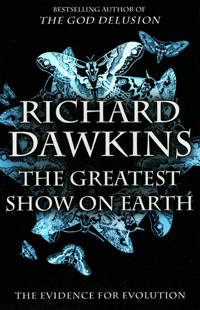
Richard Dawkins transformed our view of God in his blockbuster, The God Delusion, which sold more than 2 million copies in English alone. He revolutionized the way we see natural selection in the seminal bestseller The Selfish Gene. Now, he launches a fierce counterattack against proponents of “Intelligent Design” in his latest New York Times bestseller, The Greatest Show on Earth. “Intelligent Design” is being taught in our schools; educators are being asked to “teach the controversy” behind evolutionary theory. There is no controversy. Dawkins sifts through rich layers of scientific evidence—from living examples of natural selection to clues in the fossil record; from natural clocks that mark the vast epochs wherein evolution ran its course to the intricacies of developing embryos; from plate tectonics to molecular genetics—to make the airtight case that, “we find ourselves perched on one tiny twig in the midst of a blossoming and flourishing tree of life and it is no accident, but the direct consequence of evolution by non-random selection.” His unjaded passion for the natural world turns what might have been a negative argument, exposing the absurdities of the creationist position, into a positive offering to the reader: nothing less than a master’s vision of life, in all its splendor. —Amazon
BUY THIS BOOK
from Amazon
Richard Dawkins gave a lecture on this book at the California Institute of Technology.
BUY THE DVD
from Shop Skeptic
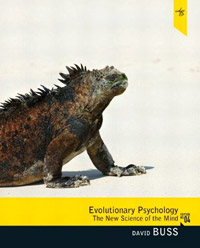
This book was required reading for the following course: “Evolution, Economics, and the Brain” taught by Michael Shermer during the spring 2011 and 2012 semesters.
Beginning with a historical introduction, the text logically progresses by discussing adaptive problems humans face and ends with a chapter showing how the new field of evolutionary psychology encompasses all branches of psychology. Each chapter is alive with the subjects that most occupy our minds: sex, mating, getting along, getting ahead, friends, enemies, and social hierarchies. Why is child abuse 40 times more prevalent among step-families than biologically intact families? Why, according to one study, did 75% of men but 0% of women consent to have sex with a complete stranger? Buss explores these intriguing quandaries with his vision of psychology in the new millennium as a new science of the mind. Anyone with an interest in the biological facets of human psychology will find this a fascinating read. —GoodReads
BUY THIS BOOK
from Amazon
This book was required reading for the following course: “Composition” taught by Mark Gifford during the fall 2011 semester.
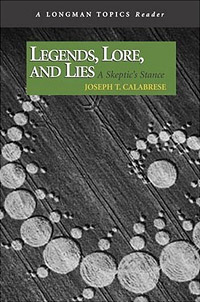
Legends, Lore, and Lies: A Skeptic’s Stance presents intriguing readings in five sections–urban legends, alternative medicine, the media’s role in public gullibility, psychics and the paranormal, and pseudo science–to demonstrate the importance of critical examination and the differences between an opinion or assertion and a supported claim. Legends, Lore, and Lies offers a wealth of features, including: (1) Explorations of the powers and limits of skepticism in understanding topics like urban legends and pseudoscience that often are awarded uncritical acceptance in our culture. (2) An excellent explanation of skepticism, along with a number of tools that every reader can use to become a critical consumer of information. (3) A handful of “believers” point-of-view readings, which students are encouraged to examine with the tools they acquire throughout the text. (4) A variety of pedagogical tools including brief author biographies and questions preceding and following the readings that function as writing and discussion prompts. (5) End-of-chapter synthesis questions that provide writing suggestions for longer research and inquiry papers. —Amazon
BUY THIS BOOK
from Amazon
This book was required reading for Martin Bridgstock’s course, “Skepticism, Science, & the Paranormal” taught at Griffith University.
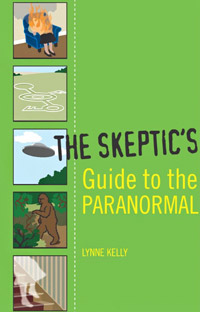
Can a human being really spontaneously burst into flames? Just how deadly is the Bermuda Triangle? And what’s the real story behind all those alien abductions? The answers to these and many other questions lie within the covers of The Skeptic’s Guide to the Paranormal. Guaranteed to liven up any dinner party, this delightful, highly readable book offers color photographs and scientific case-by-case explanations for twenty-seven phenomena that appear to defy known science, including ghosts and poltergeists, the predictions of Nostradamus, and yogic levitation, among many others. Speaking directly to the reader, and always with respect for those who believe, Kelly gives us a bite-size, nonacademic approach to debunking hugely popular superstitions and mysteries. Did you know that you, too, can bend spoons and read minds? This book will show you how. —Publisher
BUY THIS BOOK
from Amazon
This book was required reading for Martin Bridgstock’s course, “Skepticism, Science & the Paranormal” taught at Griffith University during the spring 2011 semester.
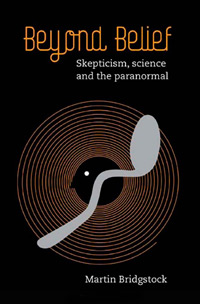
Whether ghosts, astrology or ESP, up to 80 per cent of the population believes in one or more aspects of the paranormal. Such beliefs are entertaining, and it is tempting to think of them as harmless. However, there is mounting evidence that paranormal beliefs can be dangerous – cases of children dying because parents rejected orthodox medicine in favour of alternative remedies, and ‘psychics’ who trade on the grief of the bereaved for personal profit and gain. Expenditure on the paranormal runs into billions of dollars each year. In Beyond Belief: Skepticism, Science and the Paranormal Martin Bridgstock provides an integrated understanding of what an evidence-based approach to the paranormal – a skeptical approach – involves, and why it is necessary. Bridgstock does not set out to show that all paranormal claims are necessarily false, but he does suggest that we all need the analytical ability and critical thinking skills to seek and assess the evidence for paranormal claims. —Amazon
BUY THIS BOOK
from Amazon
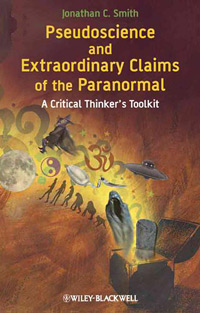
This book was required reading for the following courses: (1) “Weird Science” taught by John Donovan, (2) “The Psychology of Reasoning and Problem Solving” taught by Michael Cassens, and (3) “The Sociology of Belief” taught by Bryan Farha.
“Smith’s work is a valuable contribution to the field. It will certainly be of interest to psychologists interested in the consequences of cognitive errors, and it is no doubt the best textbook on the market for a course on the psychology of paranormal belief. Although Smith explains paranormal thinking in terms of cognitive errors, his presentation of psychological issues is not technical; thus, this text would be especially useful in a freshman seminar, so popular now on American campuses, whose purpose is to help entering college students develop critical thinking skills. Students will either love or hate this text, but they will not be left unchanged by it. And that, after all, is what college is all about.”
—(PsycCRITIQUES, April 2010)
“I am astonished by the excellence of this book. Smith has produced a highly readable and very entertaining yet critical examination of virtually the entire gamut of paranormal claims, and he demonstrates an encyclopedic knowledge of the field in doing so. While drawing extensively from psychology, physics, logical analysis and history, he always manages to keep things clear and straightforward, so that one is never lost in complexity. Moreover, the tone is light-hearted throughout, and never becomes pedantic or condescending. And the book offers much more than an evaluation of extraordinary claims. It provides a refined set of critical thinking tools that the reader will find invaluable in everyday life. I strongly recommend this book to everyone who values the pursuit of truth in all things. And I can only wish that those who know that they already have the truth would read it as well, for they need it the most.”
—James Alcock, Professor of Psychology, York University
BUY THIS BOOK
from Amazon
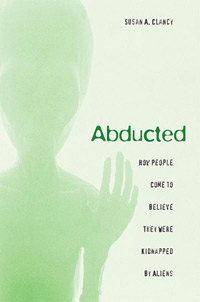
This book was required reading for Jeffrey Brookings’ course, “Why We Believe Weird Things: Science and Pseudoscience in Psychology” taught at Wittenberg University during the fall 2010 semester.
They are tiny. They are tall. They are gray. They are green. They survey our world with enormous glowing eyes. To conduct their shocking experiments, they creep in at night to carry humans off to their spaceships. Yet there is no evidence that they exist at all. So how could anyone believe he or she was abducted by aliens? Or want to believe it?
To answer these questions, psychologist Susan Clancy interviewed and evaluated “abductees”–old and young, male and female, religious and agnostic. She listened closely to their stories–how they struggled to explain something strange in their remembered experience, how abduction seemed plausible, and how, having suspected abduction, they began to recollect it, aided by suggestion and hypnosis.
Clancy argues that abductees are sane and intelligent people who have unwittingly created vivid false memories from a toxic mix of nightmares, culturally available texts (abduction reports began only after stories of extraterrestrials appeared in films and on TV), and a powerful drive for meaning that science is unable to satisfy. For them, otherworldly terror can become a transforming, even inspiring experience. “Being abducted,” writes Clancy, “may be a baptism in the new religion of this millennium.” This book is not only a subtle exploration of the workings of memory, but a sensitive inquiry into the nature of belief. —Amazon
BUY THIS BOOK
from Amazon
Susan Clancy gave a lecture on this book at the California Institute of Technology.
BUY THE DVD
from Shop Skeptic
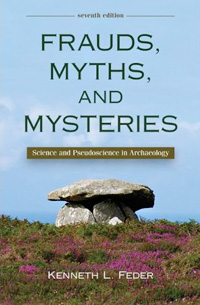
This book was required reading for Jeffrey Behm’s course, “Fantastic Archaeology” taught at the University of Wisconsin, Oshkosh during the fall 2010 semester.
Committed to the scientific investigation of human antiquity, this indispensable supplementary text uses interesting archaeological hoaxes, myths, and mysteries to show how we can truly know things about the past through science.
Examples of fantastic findings support the carefully, logically, and entertainingly described flaws in the purported evidence. By placing wildly inaccurate claims within the context of the scientific method, Frauds, Myths, and Mysteries demonstrates how science approaches fascinating questions about human antiquity and, in so doing, shows where pseudoscience falls short. —Amazon
BUY THIS BOOK
from Amazon
NEXT PAGE →