Did the U.S. Really Use a Sonic Weapon in Venezuela?
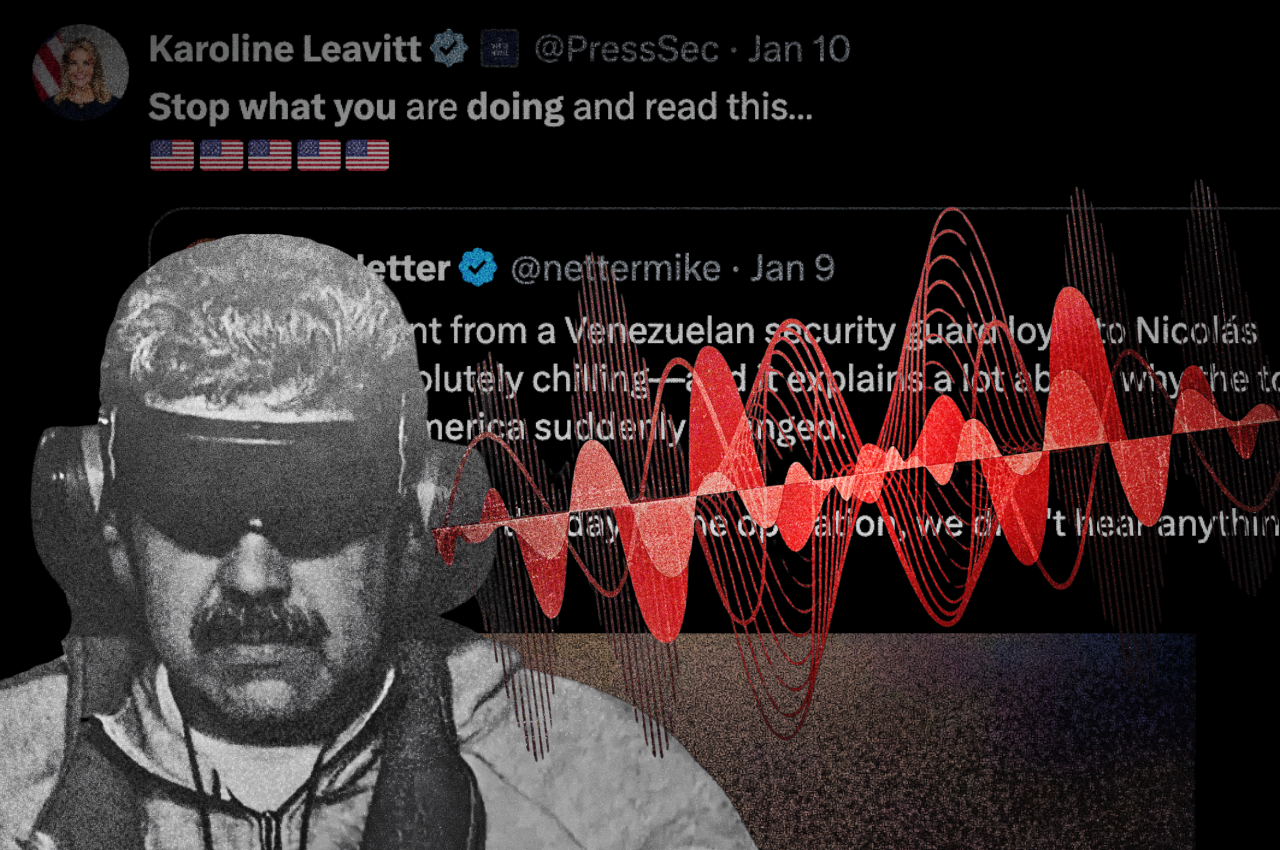
Within days of the U.S. strike on Caracas and the capture of Venezuelan President Nicolás Maduro on January 3, 2026, a remarkable claim was sweeping across social media: American forces had deployed a devastating “sonic weapon” that left Venezuelan soldiers vomiting blood and unable to stand.
The headlines have been dramatic with Forbes proclaiming: “U.S. Secret Weapon May Have Incapacitated Maduro’s Guards.”1 The Economic Times wrote about America’s “Secret Sonic Weapon,”2 while the UK Sun asserted: “US ‘Sonic Weapon’ is REAL after Chilling Claims it Left Captured Maduro’s Guards ‘Vomiting Blood.’”3 The story was dramatic, almost terrifying, but as we shall argue here, almost certainly false.
Within minutes of the first explosions on January 3, conflicting claims were already circulating on social media about the number of missiles fired, ground forces deployed, and helicopters spotted flying over the city of Caracas, the focal point of the attack. The ambiguity and uncertainty that typify the fog of war are ideal breeding grounds for rumors. Ordinarily, such rumors fade as reliable information emerges. But in this case the U.S. military remained silent, while the Venezuelan government, like many authoritarian regimes, is notorious for withholding information.
This is a classic setup for the proliferation of rumors, whose intensity is proportional to both the perceived importance of the event and the level of ambiguity.4 Situations such as this are fertile soil for exaggerations, half-truths, conspiracy theories, and outright fabrications. Even after the situation on the ground stabilized and many early rumors were confirmed or denied, claims about the use of a sonic weapon not only persisted but flourished.
From WhatsApp to the World
One challenge in tracing this story to its origins is that as it began in Venezuela, where the earliest accounts circulated in Spanish. Fortunately, one of us (DZ) is a fluent speaker and was able to examine the primary sources. In the days that followed, audio recordings rapidly spread on WhatsApp, describing events through purported firsthand accounts from soldiers and relatives near the impact zones.
On January 9, one story began circulating widely. In it, a supposed member of colectivo—an armed militia that controls different sections of the city—described how the attack unfolded in the historic 23 de Enero neighborhood of western Caracas.
The audio was posted on the YouTube channel of Emmy Award-winning Venezuelan journalist Casto Ocando, and soon accumulated over one million views.5 In it, an anonymous narrator describes the attack.
“They shut down the entire electrical system, knocked out the radars, knocked out everything.”
He then recounts how a soldier activated a Russian-made anti-aircraft defense system to attack the helicopters.
“When he fired it, a drone immediately detected it and, well, they died, they killed them, all of them [the soldiers] with a single bomb… There are many dead, many people burned, many people wounded. I’ll send you a video, there are approximately 100 military personnel dead,” he adds.6
The narrator’s confidence in precise casualty figures amid the chaos of a nighttime attack, is itself a red flag.
The alleged eyewitness continues:
“There were only eight helicopters and 20 men…who killed 200 men, 32 with a single shot, plus presidential guards of honor and civilians.”
He then describes weapons that “fired more than 300 bullets per minute,” adding,
“a thing that made me bleed, I was bleeding from my nose and didn’t know what it was, it was a whistle that sounded throughout Caracas and made people bleed from their noses and ears. We couldn’t move, that whistle immobilized us, they say it’s what’s called a sonic shockwave. It was something really horrible….”
The clip ends with claims that Americans
“don’t fight fair. They fight from above, with drones. The speeds of those helicopters…. They only sent eight helicopters and destroyed all of Caracas.”
The description of a sound that causes nosebleeds and immobilization across an entire city is physically implausible. While acoustic weapons such as Long Range Acoustic Devices (LRADs) can cause pain and disorientation at close range, their effects diminish rapidly with distance as the sound energy disperses. No known acoustic technology can cause bleeding from the ears and nose at a distance, let alone city-wide.
Enter, Stage Right, Mike Netter
On January 9, the WhatsApp audio recording quickly spread across various social networks. The following day, popular conservative influencer Mike Netter, posted on X a strikingly similar story, which he attributed to a security guard loyal to Nicolás Maduro.
🚨This account from a Venezuelan security guard loyal to Nicolás Maduro is absolutely chilling—and it explains a lot about why the tone across Latin America suddenly changed.
— Mike Netter (@nettermike) January 10, 2026
Security Guard: On the day of the operation, we didn't hear anything coming. We were on guard, but… pic.twitter.com/392mQuakYV
It is reproduced below so readers can judge for themselves:
Security Guard: On the day of the operation…suddenly all our radar systems shut down without any explanation. The next thing we saw were drones, a lot of drones, flying over our positions…. After those drones appeared, some helicopters arrived, but there were very few. I think barely eight helicopters. From those helicopters, soldiers came down, but a very small number. Maybe twenty men. But those men were technologically very advanced…
Interviewer: And then the battle began?
Security Guard: Yes, but it was a massacre. We were hundreds, but we had no chance. They were shooting with such precision and speed... it seemed like each soldier was firing 300 rounds per minute… At one point, they launched something... it was like a very intense sound wave. Suddenly I felt like my head was exploding from the inside. We all started bleeding from the nose. Some were vomiting blood. We fell to the ground, unable to move…. Those twenty men, without a single casualty, killed hundreds of us. We had no way to compete with their technology, with their weapons. I swear, I’ve never seen anything like it. We couldn't even stand up after that sonic weapon or whatever it was.
Interviewer: So, do you think the rest of the region should think twice before confronting the Americans?
Security Guard: Without a doubt. I’m sending a warning to anyone who thinks they can fight the United States. They have no idea what they’re capable of. After what I saw, I never want to be on the other side of that again. They’re not to be messed with.
Interviewer: And now that Trump has said Mexico is on the list, do you think the situation will change in Latin America?
Security Guard: Definitely. No one wants to go through what we went through. Now everyone thinks twice. What happened here is going to change a lot of things, not just in Venezuela but throughout the region.
The story was originally posted in English, itself suspicious for a supposed Venezuelan guard. Had this been a genuine interview with a colectivo member, the original would have almost certainly appeared in Spanish. No Spanish-language version has ever surfaced. The “interview” appears to be a reconstruction of the WhatsApp audio, repackaged in a question-and-answer format.
Another red flag is the distinctly pro-American tone, which is unlikely to have come from a foreign fighter, let alone one sworn allegiance to defend his government. Defeated soldiers do not typically serve as unsolicited recruitment posters for the enemy. The guard also conveniently uses round figures (eight helicopters, twenty men, 300 rounds per minute) and makes no mention of his comrades’ courage or resistance, and ends with a warning directed at Mexico: precisely echoing President Trump’s rhetoric at the time.
Journalists are trained to go to the source. Accordingly, we contacted Netter to request details of the alleged guard and the interviewer, and asked him to share the original Spanish source of this interview with us. He said he couldn’t do so without first asking the source, which he promised to do. At the time of this writing, he never got back to us.
Press Secretary Leavitt Intervenes
Mike Netter’s post could have disappeared into the daily churn of social media had it not been for White House press secretary Karoline Leavitt who shared it on her official account with the dramatic text: “Stop what you are doing and read this...”
Stop what you are doing and read this…
— Karoline Leavitt (@PressSec) January 10, 2026
🇺🇸🇺🇸🇺🇸🇺🇸🇺🇸 https://t.co/v9OsbdLn1q
This endorsement dramatically elevated the story’s perceived credibility, despite the absence of any corroborating evidence. In effect, an anonymous social media claim received a semi-official White House endorsement of an unverified anonymous claim, a departure from the press secretary’s traditional role as a gatekeeper of verified information. As a result, Netter’s post has gained over 30 million views and 10,000 responses.
Ever Increasing Circles
On January 10, the New York Post repeated Netter’s account under the headline: “US used powerful mystery weapon that brought Venezuelan soldiers to their knees during Maduro raid: witness account.”7 The story recounted the most spectacular elements: the sound wave, exploding heads, nosebleeds, and vomiting.
Curiously, the same YouTube channel of Casto Ocando that had released the original audio, later uploaded a new video citing the Post article, the Post’s reconstruction as independent confirmation of its own earlier material. Other media outlets went further, falsely claiming that the Venezuelan guard had been interviewed by the New York Post.8
This process, where secondary reporting is mistaken for a primary source, is a classic example of how media myths are manufactured through journalistic shortcuts.
Notably, none of the Venezuelan soldiers who later appeared on camera—people whose identities and ranks are known, mentioned the use of sonic weapons. Footage aired on the Chavista network Telesur depict young men wounded by shrapnel describing missile strikes, drones, and gunfire. None reported bleeding from the nose, vomiting, or sensations of cranial explosions.9 Nor are there civilian testimonies from Caracas describing a city-wide whistling sound. Some soldiers and civilians did report buzzing sounds, including individuals near Fort Tiuna, one of the attack sites. However, these sounds are readily explained by falling ordnance and whizzing bullets—mundane combat phenomena, not evidence of exotic weaponry.
It is also conspicuous that during President Trump’s exclusive interview with the New York Post, which was published on January 24th, he was asked about the “sonic weapon” rumors. Trump replied that the U.S. has “the discombobulator” that disabled enemy equipment as the American helicopters swooped in to attack in Carcas. But he made no mention of its effects on people.10
It’s Similar to the Havana Syndrome
The symptoms described in the WhatsApp audio are strikingly similar to claims made during the Havana Syndrome scare. Recently, the intelligence community has deemed the involvement of a foreign power “highly unlikely,” attributing the Havana Syndrome causes to psychogenic and environmental factors rather than directed energy weapons.11
The Venezuelan sonic weapon narrative appears to be drawing from the same well of popular mythology. Furthermore, nosebleeds following an explosive military attack are far more likely to be caused by conventional factors such as blast pressure, dust, smoke inhalation—even stress as opposed to a hypothetical sonic weapon.
The narrator in the WhatsApp audio clip may be misattributing ordinary combat effects to an extraordinary cause: a classic pattern in rumor formation.
Under conditions of extreme stress, uncertainty, and sensory overload, people routinely seek out coherent explanations that give meaning to their own experiences. In the context of a sudden nighttime military strike, in a backdrop rife with ambiguity and anxiety, physical symptoms such as nosebleeds, dizziness, ringing in the ears, and temporary immobility, are especially prone to being reinterpreted through the lens of culturally available narratives.
From a rumor and folklore perspective, the sonic weapon story fulfills a familiar psychological function: it collapses complex, confusing events into a single explanatory cause, providing closure amid uncertainty. The sonic weapon narrative transforms uncertainty into conviction and speculation into “fact.” This process reduces anxiety. As philosopher Suzanne Lange once famously observed: humans possess a remarkable ability to adapt—except when confronted with chaos.12
A Familiar Pattern
The sonic weapon story follows a well-worn media myth template: an ambiguous event, an information vacuum, an anonymous account, amplification by politically motivated actors, and validation by authorities who should know better.
What began as a WhatsApp voice message from an anonymous militia member, was transformed into a polished English-language “interview,” boosted by a partisan influencer, and essentially endorsed by the White House. At no stage was a shred of physical evidence produced. The ‘Discombulator,’ as far as the evidence shows, exists only in the fog of war, and in the imaginations of those eager to believe.
It is also worth asking the cui bono question: “Who benefits from the sonic weapon narrative?” First, the U.S. government and military—by projecting overwhelming technological superiority. Second, pro-government Venezuelan sources also benefit from a story that excuses their rapid military defeat.
When both sides gain from a myth, its survival is all but guaranteed.