Family Resemblance: Why Intelligent Extraterrestrials May Look Strangely Familiar
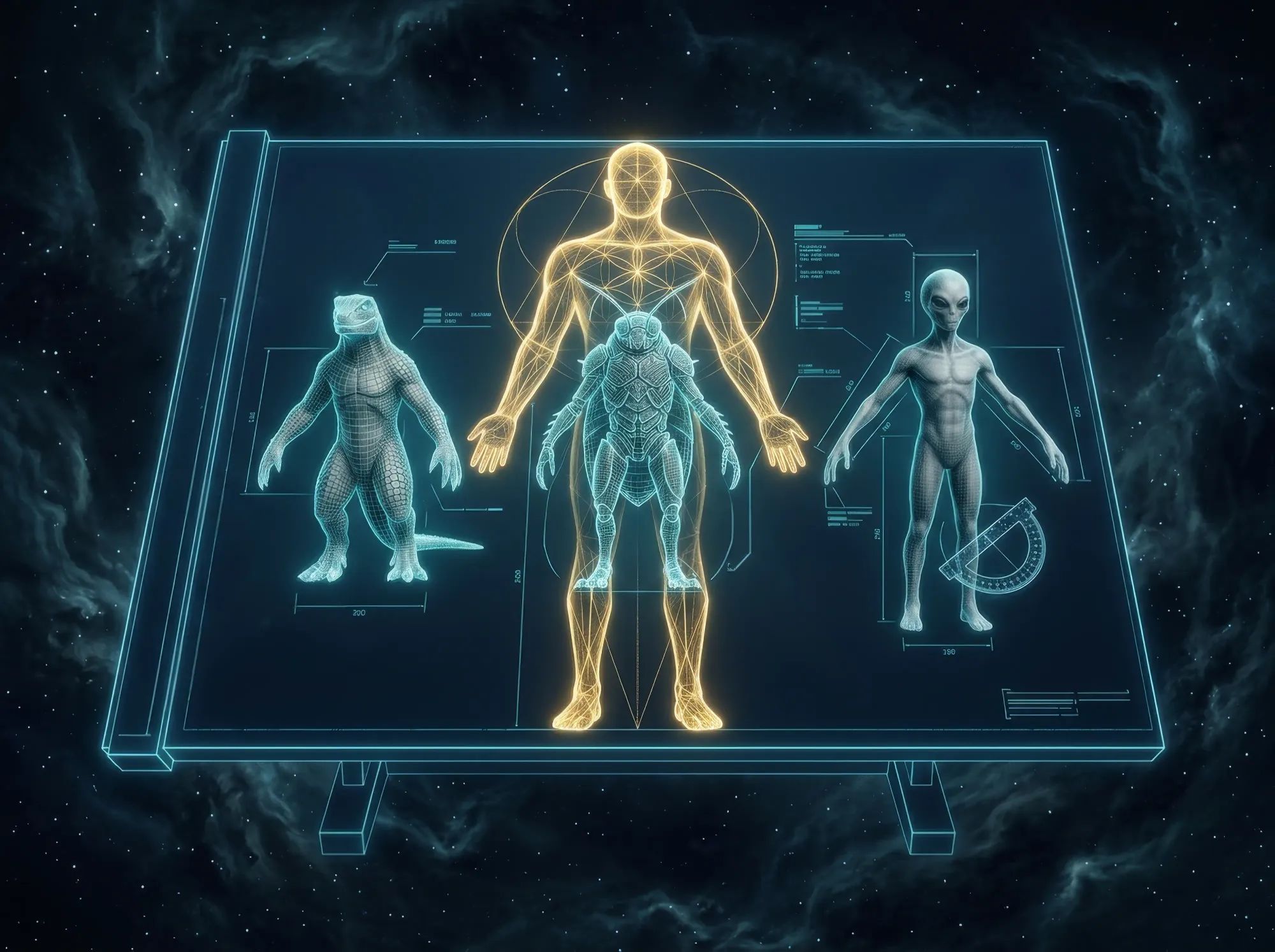
There’s a kind of storytelling tariff that sci-fi thrillers pay: the alien has to be visually—and physiologically—“other.” The more it resembles us, the less it feels like an invasion, and the less it sells popcorn. So, filmmakers crank the dials. Alien is the perfect example: a creature engineered for maximum dread—extra jaws, parasitic reproduction, and even acid for blood, a brilliant idea because it turns injury into a terrifying weapon. Great cinema. Bad biology.

Constraints, Not Monsters
But biology isn’t a special-effects studio. Evolution doesn’t get to pick any chemistry, any anatomy, any habitat, and call it a day. It’s boxed in by constraints: what molecules can build durable, information-rich structures; what solvents allow complex reactions; what temperatures keep chemistry running without shredding it; what gravity and atmosphere allow efficient movement; what energy sources are stable long enough for complexity to accumulate. And here’s the part science fiction usually skips: only a limited range of environments in the universe are likely to be hospitable to the long, fragile process that produces intelligent life at all. If that’s true, then the number of viable “starting conditions” shrinks—and the range of plausible outcomes shrinks with it. In other words, the universe may not be a boundless zoo of monster anatomies. It may be a narrower set of workable habitats repeatedly producing a narrower set of workable body plans—ones that, at a distance, start to look surprisingly familiar.
Carbon is the first and biggest constraint. If you want a system capable of building large, stable molecules that can both store information and do chemistry, carbon is the standout: it forms strong chains and rings, bonds flexibly with common elements (H, O, N, S, P), and supports the kind of combinatorial complexity life seems to require.1 Silicon gets invoked in sci-fi because it sits under carbon on the periodic table, but careful technical reviews conclude that silicon biochemistry faces steep hurdles compared with carbon—especially when you ask for the chemical diversity, solvent compatibility, and long-term stability you’d need for an evolving biosphere rather than a one-off laboratory curiosity.2 Carbon, by contrast, isn’t just “what we have”—it’s what the periodic table offers as good at being life’s scaffolding.
And carbon chemistry, at least as far as we understand it, almost certainly needs a liquid reaction medium. You can think of a solvent as evolution’s workshop: it transports reactants, buffers temperature swings, enables compartmentalization (membranes), and keeps chemistry running long enough for complexity to accumulate. NASA astrobiology treatments make the key point crisply: water is not merely “wet background”; its physical and chemical properties are unusually helpful for life-like chemistry.3 That doesn’t mean life must use water—serious work examines alternatives—but it does mean that when you ask where complex life is most likely to arise, you’re pulled toward a relatively narrow band of worlds with long-lived liquids, stable energy gradients, and conditions that support molecular complexity rather than constantly tearing it down.4
Carbon, by contrast, isn’t just “what we have”—it’s what the periodic table offers as good at being life’s scaffolding.
Once you accept those constraints, the “anything goes” alien starts to look less likely. A restricted set of workable environments tends to funnel evolution toward a restricted set of workable solutions—especially once organisms get big, mobile, and cognitively complex. From there, the argument becomes a cascade: mobility favors efficient body plans; efficient body plans often converge on bilateral symmetry for streamlined, directional movement; and bilateral movers tend to concentrate sensors and processing at the leading end—cephalization—because that’s the part that encounters the world first.5
Finally, any lineage that’s going to build technology needs not just brains, but some way to manipulate the world with precision—one or more appendages capable of fine control. And Earth at least shows that “high intelligence” is not a one-time miracle: complex brains and sophisticated cognition have evolved multiple times in very different lineages, which is exactly what you’d expect if evolution keeps rediscovering similar solutions to similar problems.6
It Takes a Long Time
For most of Earth’s history, life was microbial. There are abundant signs of life by around 3.5 billion years ago, with plausible evidence reaching back toward approximately 3.8 billion years and earlier, meaning single-celled organisms dominated the planet for the overwhelming majority of its existence.7 Complex multicellular life—and especially animals with nervous systems—arrives strikingly late by comparison: the Ediacaran record pushes recognizable multicellular complexity to roughly approximately 600 million years ago, and the Cambrian explosion (around 540 million years ago) is where diverse animal body plans and their organ systems, including nervous systems, become conspicuous in the fossil record.8 Even “brains,” in any familiar sense, are a comparatively recent evolutionary product of animal history.
And yet, despite billions of years of evolutionary “experimentation” across oceans, lakes, microbial mats, reefs, forests, and ice ages, technological intelligence—the kind that builds radios, telescopes, and spacecraft—emerged only once, and only under a narrow set of ecological circumstances. That doesn’t prove intelligence is unique in the universe, but it strongly suggests that it’s constrained: not every habitable world is equally likely to produce it, and not every habitable environment on a given world is equally likely to nurture it. In other words, the universe may contain places where life is possible, but far fewer where the long chain of transitions to technology can reliably occur.
Evolution is repeatedly solving the same engineering problems under similar constraints.
Long before our ancestors spent most of their time on the ground, their life was shaped in trees—an environment that rewards three-dimensional vision, fine depth perception, color discrimination, and exquisitely controlled hands, arms, and digits for climbing, grasping, and precise manipulation. When some of those primates began living in woodland–savanna mosaics, bipedal walking freed the already dexterous hands for carrying and tool use, effectively repurposing “arboreal skills” into a terrestrial, cumulative technology pathway. That transition—tree-built perception and manipulation deployed on open ground—may be a rare ecological combination, and it helps explain why large brains can evolve in many settings, yet only once has intelligence ratcheted up into an industrial civilization.9
If only a limited set of planetary and ecological conditions can support the long chain from chemistry to cognition, then evolution is repeatedly solving the same engineering problems under similar constraints. And once you narrow the environments where intelligence is even plausible, you also narrow the range of bodies that can thrive there. That doesn’t point to identical aliens—but it does make wildly un-Earthlike “monster designs” (think War of the Worlds with Tom Cruise) less likely, and a recognizable family resemblance—convergent, familiar motifs—more likely.
How the Ratchet Turns
As soon as hominins became more committed to life in woodland–savanna mosaics, a new class of problems moved to center stage: social problems. On open ground, survival often depends less on a single clever trick than on navigating alliances, rivalries, status, reciprocity, and betrayal inside a group—and sometimes between groups. That framing goes back to classic arguments that intellect evolved largely to manage social life.10 It’s also the logic behind the “social brain” tradition: as group life becomes more demanding, selection favors minds better at tracking relationships, intentions, and reputations at scale.11
In that world, intelligence isn’t just tool-use; it’s the ability to detect cheaters and liars, anticipate others’ moves, and calibrate cooperation—exactly the kind of psychological machinery psychologists Leda Cosmides and John Tooby argued would be favored in repeated social exchange.12 And once you have minds built for social exchange, you have the psychological preconditions for reciprocal altruism—the willingness to help now in expectation of help later—which is one of the foundations of large-scale human cooperation that builds civilizations.13, 14 And when resources are patchy and competition is real, intergroup conflict can further raise the stakes, selecting for coordination, cohesion, and strategic behavior within coalitions.
Intelligence exists in many lineages; an industrial pathway likely requires intelligence plus a controllable, high-energy lever and a dry-work environment where tools can persist, accumulate, and improve.
Language doesn’t merely label the world; it lets individuals coordinate plans, negotiate alliances, transmit know-how, and build reputations—turning individual cognition into group cognition.15 Most importantly, humans crossed a threshold into cumulative culture: shared intentions, teaching, and high-fidelity social learning allow useful innovations to persist and improve across generations, creating the technological “ratchet” that other smart animals rarely achieve. Humans are distinctive because our know-how doesn’t reset each generation; it accumulates—tools beget better tools in a cultural “ratchet.”16 But brains are expensive tissue, so any species that evolves them must solve an energy-budget problem—through diet quality, provisioning, and other tradeoffs that reliably pay the bill.17, 18
This is where fire and cooking matter: cooking increases the calories you can extract from food and reduces the time and gut investment needed to process it, freeing energy for a larger brain.19 Just as important, controlled fire is a gateway technology—warmth, protection, nighttime sociality, and eventually high-temperature chemistry.20 Intelligence exists in many lineages; an industrial pathway likely requires intelligence plus a controllable, high-energy lever and a dry-work environment where tools can persist, accumulate, and improve.
A skeptic might object that oceans already produce impressive intelligence—dolphins and whales, for example—so why didn’t technology take off there? The point isn’t that marine brains can’t be sophisticated; it’s that an industrial pathway needs more than cognition: it needs persistent tool chains and a controllable high-energy lever.
The decisive step wasn’t just smarter brains—it was solving the problem of memory across generations.
And that points to a subtle filter. Oceans can produce impressive cognition—on Earth in the form of cetaceans and, perhaps, octopus—but water is hostile to the industrial ratchet: fire is hard to control, durable toolkits are harder to store and transport, and metallurgy is effectively off the table.21 On land—especially in variable, resource-patchy habitats—portable tools, teaching, and cooperative planning can compound. That’s why the story is less “savanna created intelligence” than “a particular ecological combination made technology cumulative.”
The decisive step wasn’t just smarter brains—it was solving the problem of memory across generations. Most animals, even very intelligent ones, learn largely within a lifetime. When the individual dies, much of that hard-won knowledge dies with it. Humans broke that bottleneck. We became a species whose best ideas can outlive their inventors, because we can store information—in other minds, in shared practices, and eventually in artifacts and symbols—and then transmit it with unusually high fidelity. That’s the ratchet: innovation that doesn’t evaporate.
This requires more than imitation. It requires teaching, joint attention, and shared goals—what some researchers call “shared intentionality”—so that skills can be transferred efficiently and improvements can accumulate rather than drift. Once a lineage crosses that threshold, technology starts to behave less like a set of clever tricks and more like a compounding system.22
Language then acts as a compression algorithm for culture. It turns “watch me do this” into “here’s the rule,” making know-how portable, scalable, and teachable to people who never saw the original problem. It also enables coordination at scale—plans, roles, promises, reputations—so groups can build things no individual could.23, 24
And on land, cultural memory can be externalized. Tools can be cached, improved, standardized, and inherited. Eventually information migrates into marks, symbols, and writing—literal memory outside the brain. At that point, progress accelerates, because each generation starts not from scratch, but from a platform built by those before it.
So, What Might ET Look Like?
What does all of this imply about the appearance of extraterrestrial intelligence? Not that aliens will be “human,” as if evolution everywhere is destined to reproduce our exact anatomy. Evolution is too contingent for that. But it’s not completely random. If intelligence that builds technology is constrained by chemistry, physics, and ecology – and if similar constraints repeatedly force similar solutions—then truly alien intelligence may come with a surprisingly familiar set of design motifs.
Humans broke that bottleneck. We became a species whose best ideas can outlive their inventors, because we can store information … and then transmit it with unusually high fidelity.
Start with the big one: directional movement in a complex world. Once organisms become large, mobile, and behaviorally flexible, the “engineering problem” of getting around efficiently tends to favor bilateral symmetry—a front and a back, a left and a right—because it streamlines movement and organizes the body around a direction of travel.25 Bilateral movers also tend toward cephalization: concentrating senses and information processing at the leading end, because that’s the part that meets the environment first.26 In plain terms, if something is navigating the world and making decisions quickly, it’s likely to be built around a “front end” where sensing and control are concentrated (and, less glamorously, but no less practically, a “waste end” where, well, waste products are dispensed).
Then comes the key requirement for technology: manipulation. A brain can model the world all day, but technology requires a high-bandwidth interface between mind and matter: appendages capable of precise, repeatable control. On Earth, that role is played by hands and digits—originally honed for climbing and grasping in trees—later repurposed for shaping objects, carrying toolkits, and building cumulative tool traditions. This doesn’t mandate five fingers, or even “arms” in the human sense. But it strongly suggests that technological intelligence will be paired with one or more manipulators—structures evolved for fine control, not just locomotion.
Finally, technological intelligence requires culture that compounds. If each generation must rediscover the basics from scratch, there is no sustained trajectory toward industry. The transition to cumulative culture—high-fidelity social learning, teaching, shared intentions, and the ability to preserve and improve innovations—creates the technological ratchet.27, 28, 29 Once a lineage crosses that threshold, intelligence becomes more than cleverness; it becomes a system that accumulates, and that accumulation eventually externalizes into tools, structures, symbols, and records. In other words: even if the bodies vary, a technological species will likely have something analogous to language, teaching, and external memory—because without those, the ratchet stalls.30, 31
Put those pieces together and a rough “family resemblance” emerges: not humans exactly, of course (there’s contingency again), but mobile, bilateral organisms with front-loaded sensing/processing, manipulators, and a cultural transmission system that lets knowledge outlive individuals. That is the opposite of the cinematic monster. It’s less a nightmare creature and more a familiar engineering solution—built under unfamiliar skies.
Caveats and Conclusions
A skeptic’s first objection is an obvious one, namely that Earth is a sample size of one. Any story about extraterrestrial biology risks generalizing from the particular to the universal. That caution is warranted. Our lineage’s specific path—arboreal heritage, bipedalism, the woodland–savanna mosaic—may be historically contingent. Different worlds could produce intelligence by different routes (although it is not clear how), and even on Earth, high cognition appears in multiple lineages.32 So, the claim here should be modest: not “ET must look like us,” but “constraints bias evolution toward a limited menu of workable solutions.”
The Grey is a popular alien figure because it’s a humanoid distilled to a few cues: bilateral symmetry, a head-dominated body plan, and exaggerated eyes. Those broad motifs actually align with what a constraint-based view would predict. But the specific “Grey” is also a cultural icon with a traceable modern history—especially after Whitley Strieber’s Communion (1987) and its widely reproduced cover image. So, it’s better understood as a modern cultural meme than as a biologically derived prediction.

A second objection is this: what if technology doesn’t require fire and metallurgy? Perhaps some species develop a different high-energy lever or a different materials pathway. That’s possible. But the broader point still holds: industrial-scale technology requires some means of harnessing scalable energy and building durable tool chains. Whatever substitutes exist, they still must operate under the same physical logic: persistent artifacts, repeatable processes, and the ability to store and transmit complex know-how over long spans of time.
For example, we know Earth’s atmosphere didn’t always permit fire because oxygen arrived late—and we can see that transition written in the rocks. For much of the Archean, oceans carried abundant dissolved ferrous iron (Fe²⁺); when oxygen produced by early photosynthesizers (e.g., blue-green algae that scientists call cyanobacteria) began reaching surface waters, it oxidized Fe²⁺ to insoluble ferric iron (Fe³⁺) that precipitated in vast banded iron formations (BIFs), essentially recording oxygen’s first sustained appearance as it was “soaked up” by iron sinks. Around 2.4 to 2.3 billion years ago—during the Great Oxidation Event—atmospheric O2 rose from trace levels to much more significant amounts, while BIF deposition eventually waned as the ocean’s iron sink diminished and broader oxygenation progressed.
That history matters for our argument because recognizable, combustion-driven technology depends not just on brains, but on a planet reaching an oxygen state that reliably supports open-air fire and high-temperature chemistry—the “oxygen bottleneck” for technospheres. That is why the “oxygen bottleneck” argument is useful: it highlights that recognizable, combustion-driven technospheres are not guaranteed by intelligence alone—they depend on planetary conditions that enable certain kinds of energy use.33
So, the claim is not inevitability, but probability. Constrain the environments, and you constrain the solutions. And that means the wildest designs of monster cinema are not the most realistic expectation. They are the least constrained.
Science fiction thrives on the alien as shock: the creature that breaks every rule and looks like nothing that ever walked, swam, or crawled on Earth. Alien is a masterpiece precisely because it is so unconstrained—a physiology engineered for dread. Great theater. But real evolution does not have that freedom. Biology is boxed in by chemistry, by solvents, by energy budgets, by gravity and materials, by the logic of movement and sensing, and by the requirements of cultural accumulation.
The details will be alien. The motifs may not be.
That’s why the best prediction for extraterrestrial intelligence is not a monster, but a constrained organism that has solved a familiar set of problems in a workable way: a body built for efficient movement, sensors and processing concentrated forward, appendages capable of precise manipulation, and a culture that can store and transmit information across generations so that technology compounds. The details will be alien. The motifs may not be.
If we ever detect a true technosignature—or one day meet its makers—the surprise may not be how strange they are. The surprise may be how recognizable the underlying design logic feels.