Gaslighting

Merriam-Webster’s Dictionary announced that 2022 saw a 1740 percent increase in searches for gaslighting “with high interest throughout the year.” Merriam-Webster refines the term:
The idea of a deliberate conspiracy to mislead has made gaslighting useful in describing lies that are part of a larger plan. Unlike lying, which tends to be between individuals, and fraud, which tends to involve organizations, gaslighting applies in both personal and political contexts.1
The term “gaslighting” entered the popular consciousness through a 1944 film, the American psychological thriller Gaslight, in which a husband wants to make his newlywed wife lose her mind to have her locked up in an asylum. His agenda is to steal jewels that he knows are hidden in her late aunt’s house where they are living. The movie’s name is symbolic of the many manipulations the husband undertakes to gaslight his wife into believing she’s insane.
The film is set in London in the late nineteenth century when lamps were fueled by gas. The wife notices that their lamps randomly go dim. One way the husband destabilizes her is by denying that the gaslights are indeed dimming. It really is such a small manipulation. It’s so minor that you might not make much of it. The husband has been showering his new wife with adoration—referred to in abusive relationships as “love bombing”—making it unlikely for her to think he’s being deceptive. When the wife is told that the gaslights are not dimming, she chooses to believe her devoted husband and doubt her own perceptions. This is the beginning of what could be the end.
The wife not only notices that the gaslights are dimming, but also that sounds are coming from the attic. Her husband denies the sounds. She can’t find her brooch even though she knows it was in her purse. He has removed it without her knowing. She finds a letter from one “Sergis Bauer,” and her once-adoring husband becomes furious with her. Later, he explains that he became upset because she was upset (which she wasn’t).
The husband tells his wife that the gaslights are not dimming; there are no sounds from the attic; she lost the brooch as it was not in her purse; she didn’t see a letter from Sergis Bauer. On top of all that, he tells her that she stole a painting, and he has found out that her mother was put in an asylum. He convinces his wife that not only is she fabricating things that don’t exist, but also that she’s a kleptomaniac, too high strung and unwell to be in public. She must be crazy like her mother. Stealing the aunt’s jewels is symbolic of a much more deadly crime: stealing his target’s sanity. The husband is building a case for how his wife is obviously unstable and untrustworthy. Slowly but surely, the wife begins to lose her grip on what’s real and what’s false. She loses faith in her own perceptions.
Luckily for the 1944 wife in the movie Gaslight, it being a Hollywood movie and all, a policeman takes an interest in the unfolding manipulation. It turns out that the wife is merely useful to the husband, and he exploits her for his own means. In the movie, it turns out that the husband is the one who is untrustworthy and who steals, not his destabilized wife.

Gaslighting in a marriage is disturbing. Gaslighting in an institution such as a corporation, church, school, sports club, courthouse, retirement home, government agency, news station, or political party is deeply disturbing. The target in the marriage may lose her mind and come to believe that she is, in fact, corrupt and insane. Her relationship to reality becomes unhinged. As has been demonstrated throughout history, the target in institutional gaslighting leads to whole segments of society losing their minds and coming to believe whatever alternative facts and fabricated events they are being fed by those in positions with power, credibility, and social status. This collective madness can occur in cults, even in nations. We are well-informed by history how incredibly dangerous and destructive this manipulation can be.
In 2022, the term “gaslighting” was published in a United Kingdom High Court judgment for the first time in what is being called a “milestone” hearing in a domestic abuse case. Describing the case, Maya Oppenheim defines the act as follows:
Gaslighting refers to manipulating someone by making them question their very grasp on reality by forcing them to doubt their memories and pushing a false narrative of events.
Although this is being legally identified as manipulation in a marriage, it applies equally well to the workplace. Those who tell the lies of bullying and gaslighting at work make targets question their grasp on reality, force them to doubt their memories, and push a false narrative of events. This false narrative is often believed by higher-ups who have been carefully groomed over time to believe in the power, credibility, and social standing of the one bullying. In this legal ruling, gaslighting is viewed as part of a campaign of psychological abuse that uses coercion and control to destabilize someone.
Controlling the narrative, silencing questions and concerns, forcing the community to adhere to the institution’s fabricated facts all prop up the harms of institutional complicity. Lawyer and workplace bullying expert Paul Pelletier finds that the lies of workplace bullying flourish when the leadership operates from a coercion and control model as identified in the manipulative and dysfunctional marriage under scrutiny in the UK High Court. Coercion and control as a leadership model sets the stage for the drama of bullying, gaslighting, and institutional complicity to unfold. Psychiatrist Dr. Helen Riess discusses leaders who use fear and intimidation to exert their authority: “This type of failed leadership tends to spread across organizations like the plague.”2
A year later, in 2023, a lawsuit was launched in New Jersey. Once again, gaslighting is one of the alleged behaviors that drove Joseph Nyre, former president of prestigious Seton Hall University, from his institution. As reported by Ted Sherman, Nyre alleges violations of the law against the former chairman of the board at Seton Hall, including the sexual harassment of Nyre’s wife. As a whistleblower, Nyre alleges he was targeted with “gaslighting, retaliation, and intimidation,” which led him to resign. Institutional complicity in silencing those who speak up uses textbook methods and gaslighting is long overdue to be understood as one of the weapons in their arsenal. Dr. Dorothy Suskind, an expert in workplace bullying, refers to the specific abuse meted out to those with “high ethical standards” as a “degradation ceremony.”3
The problem is, those who tell the lies of bullying and gaslighting do not experience self-reflection.
Although gaslighting is being recognized in the law, it is not fully understood from a psychological and brain science perspective, and it is rarely applied to workplace culture. Only recently, in 2023, psychologists Priyam Kukreja and Jatin Pandey developed a “Gaslighting at Work Questionnaire” (GWQ) that revealed two key components in workplace gaslighting: trivialization and affliction. According to psychologist Mark Travers, trivialization may take the form of “making promises that don’t match their actions, twisting or misrepresenting things you’ve said, and making degrading comments about you and pretending you have nothing to be offended about.” Victims start down the path of wondering if they’re being “too sensitive.” Affliction may take the form of excessive control, making you self-critical, creating dependence, or being “very sweet to you and then flipp[ing] a switch, becoming hostile shortly after.”4 Again, this kind of maltreatment causes self-doubt. Kukreja and Pandey conclude:
The GWQ scale offers new opportunities to understand and measure gaslighting behaviors of a supervisor toward their subordinates in the work context. It adds to the existing literature on harmful leader behaviors, workplace abuse, and mistreatment by highlighting the importance of identifying and measuring gaslighting at work.5
Introducing a questionnaire on gaslighting is an effective way to draw attention to how this form of manipulation occurs. Equally important, it provides vocabulary for workplaces to understand and discuss this specific form of abuse. In recent years, Forbes began publishing articles on gaslighting in the workplace indicating that it is on the leadership radar. Jonathan Westover advises on “How to Avoid and Counteract Gaslighting as a Leader,” and his approach is insightful:
- Practice regular self-reflection and foster intellectual humility.
- Actively listen to the perceptions of your team members.
- Practice vulnerability and own up to your mistakes.
- Develop and sustain authentic relationships of mutual accountability and trust.6
The problem is, those who tell the lies of bullying and gaslighting do not experience self-reflection. They do not feel humility as an emotion, just like they don’t feel guilt or remorse. They are disinterested in others’ perceptions as their brain tends to objectify targets especially. They often experience a roller coaster of shame and grandiosity, and they deny vulnerability or the possibility that they have made a mistake. In short, they cannot have authentic relationships. They follow an abusive script that turns them—if not stopped—into a caricature who repeats bullying lies and gaslighting manipulations over and over. They avoid accountability and see trust as a game that they want to win. Using psychological research to understand how the brains of manipulators work hopefully will give us a better chance to prevent their negative impacts in the workplace.
Manzar Bashir describes several textbook gaslighting behaviors: trivializing your feelings, shifting blame, projecting their behavior, insulting and belittling, and creating confusion and contradictions, but he articulates one in particular—withholding information—that is very tricky to identify and yet can have devastating impacts. “Gaslighters often use a tactic of withholding information and keeping you in the dark about crucial matters. By selectively sharing or concealing facts, they manipulate your perception of reality and limit your ability to make informed decisions.”7 It’s insightful: gaslighting, along with a great deal of psychological manipulation, is harmful in its omissions and passivity. In other words, it’s the opposite of how we measure the harms of physical abuse. When you hurt someone’s body, we assess severity by how much active damage was done. But when the brain is being manipulated, we need to find ways to figure out how much lack of action causes damage. Physical assaults are designed to weaken and harm the body; assaults via gaslighting are designed to weaken and destabilize the brain and the mind. Injuries to the body are far more likely to get immediate treatment, whereas neurological damage to brain architecture and disruption of the mind’s ability to function healthily are too often ignored.
The more aware we are of how abusive brains operate … the better able we are to prevent workplace bullying and gaslighting.
Psychologists and brain scientists have developed extensive evidence about the way in which gaslighting brains operate, notably different from brains that do not manipulate. Knowledge of psychopathic brains and the way they work can better protect us from the gaslighters’ domineering manipulation and their cruel capacity to exploit us for their own purposes.
Most of us who are targeted for bullying at work are caught off guard. Because we are not trained to anticipate manipulation, we’re easily victimized. The more aware we are of how abusive brains operate and how our brains are completely thrown off our game by them, the better able we are to prevent workplace bullying and gaslighting. The more leaders, managers, and HR are informed, the less likely they’ll be drawn into institutional complicity.
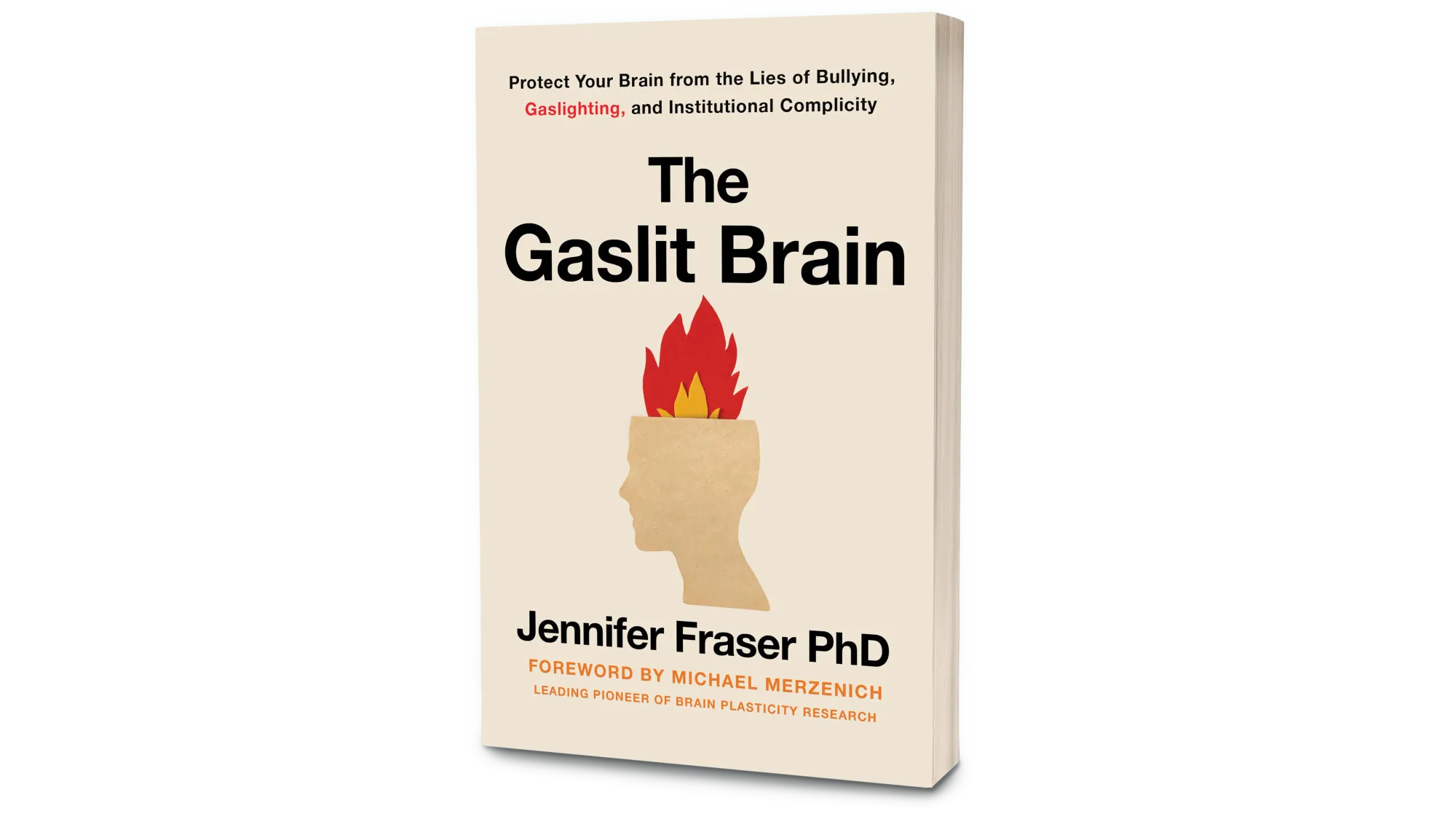
Those who tell the self-serving lies of bullying and gaslighting—with ease—are part of a formidable trio referred to in psychology as the Dark Triad: narcissists, Machiavellians, and psychopaths.8 How can we identify these manipulative people more quickly and refuse to believe them? What if there were a way to protect ourselves, and more specifically our sanity, from lies? These are the questions that drove the researching and writing of The Gaslit Brain. I needed to answer them because I was being gaslit at work.