How America Lost Its Sense of Humor

On the Biology of Why We Laugh … and a Brief History on Why We Stopped
In today’s America, humor—like nearly everything else—has become serious business, and in ways at once unusual and plain to see. Never before has every half-drunk joke, or every stumble of language, been so on the record. Welcome to the social media century. Never before have young people been more uptight, more afraid than old people, now labeled as the anxious generation. Never before has stand-up comedy in Republican Texas felt more cutting edge than in New York City.
The comedian Norm Macdonald has called this age a crisis of “clapter”—diagnosing a humorless age where jokes are rewarded with polite applause instead of genuine laughter. It is a mark of social retardation and nervous conformity. A strange fate for one of humanity’s oldest and most complex behaviors. As such, this essay is on the origin of humor, its evolutionary function, and its history in the United States.
The Origin of Humor
Babies do it. It exists in every known culture. We even see it in other species. Since Darwin, scientists have developed three ways to test for whether or not a trait evolved by natural selection for adaptive purposes. And by every test, laughter qualifies. That is to say, whatever else humor is, it is first and foremost, a fact of our evolved biology.
To this day, however, neither the scientists nor comedians (nor anyone else for that matter) has been able to produce what might be recognized as “a complete theory of humor.” What follows instead are the core components of a consilient model. These are ideas that do not compete so much as they combine, each explaining a different dimension that converge on a single theme.
1. Humor as play. The most fundamental and widely accepted finding in the study of humor is that it evolved as a function of mammalian play behavior—a way to test limits and roughhouse the rules. Dolphins laugh when they butt heads; elk laugh when they wrestle; and all the apes, including human children, laugh when we are being chased, like playing tag. All of these interactions are games that simulate aggressive predator-prey behavior; like fighting, stalking, hunting, or fleeing, it’s easier to learn the rules of conflict when the danger is make-believe. Laughter, on this account, evolved as a signal to the predator-in-pretend that he is not being perceived as a threat and that playtime can continue.
Laughing out loud is not just a reaction, it is a social tool that helps young mammals learn how to walk the line between aggression and cooperation, between pushing limits and maintaining bonds. It’s a training ground for managing social complexity. And so while we may be the only species that tells jokes, the logic is the same. Louis C.K. explaining that “you should never rape anyone unless you want to cum in them and they won’t let you” or Norm Macdonald reminiscing about “the old days when tweeting meant stabbing a hooker” is what scientists call “verbal play.” Here is how Jerry Seinfeld put it: “Comedy is a very aggressive art form. You put the brain into a vulnerable state [the setup] and then attack and destroy it [the punchline].”
Understanding the role of laughter in distinguishing between aggression and play explains why humor—like no other form of speech—is allowed to not make sense, to cross the line, and to have it not matter. As Louis C.K. often puts it after his punchlines: “I don’t know. I don’t care.”
2. Laughter is a hard to fake signal. Birds laugh, dogs laugh, rats laugh, cows laugh. There are—so far as we have counted—over sixty animal species that laugh. But there is only one species that can fake a laugh, and that’s us. It’s what biologists call nonduchenne laughter (tactical, deliberate, and carefully timed), as opposed to duchenne laughter (involuntary and honest). A duchenne smile—named after anatomist Guillaume Duchenne who first identified it, is characterized by the simultaneous contraction of the zygomatic major muscle (lifting mouth corners) and the orbicularis oculi muscle (crinkling eyes, forming “crow’s feet”), distinguishing it from a forced smile that only uses mouth muscles.
The duchenne smile evolved in humans because we are the only species that has language. In a world where deceiving others has obvious survival and reproductive advantages, language enhances our ability to manipulate beliefs and rig behaviors to our benefit, whether by lying about resources, alliances, or why the basement smells like bleach. In other words, it gives us the ability to influence each other, not just through force or direct observation, but through stories, symbols, and imagination. Try convincing a chimpanzee to give you a banana by promising eternal paradise or warning of a mythical curse and see what happens. Tell the right story to a human, however, and they might just give you all of their arable lands.
All this is to say that once we have language we also have bullshit, and so what we really need is a way to tell who’s full of it. Biologists call it an “honest signal,” and for a slick-tongued species of tricksters, the best we’ve got is duchenne laughter. Less corruptible than speech and harder to counterfeit, it works as a backchannel of communication by revealing genuine and honest feelings inside, unfiltered by words.
Studies suggest that few people can voluntarily produce crow’s feet in their eyes (the telltale sign of duchenne laughter) without feeling genuine joy—it is easy to identify and we respond more positively to it than the fake stuff.
But a laugh, real or not, means little until you know what provoked it.
3. Comedy is surprises. Arguably the most obvious feature of any joke is that the punchline arrives unexpected and upside down. Across cultures and contexts, the most consistent finding in humor research is that without surprise, there is no laugh.
The human brain, at its most basic, is a prediction making machine, honed by natural selection for survival in environments where knowing what’s going to happen before it does keeps you one step ahead of the predators. To know where the predator lurks, when the fruit will ripen, how an ally will behave—all in advance of the fact—is arguably a chief advantage of our big brained species over others. We are, put simply, pattern-seeking junkies—so wired that we are likely to see patterns that don’t exist (patternicity). As such, our awareness is often not of things as they are, but as we expect them to be.
Even our most basic experiences are not records of the present but guesses about what’s to come. Take, for example, drinking water. Our cells do not absorb the intake until about twenty minutes after the fact, but feeling quenched happens almost immediately. It is the brain, anticipating the chemistry that will follow, extending to us in the present the comfort of a future state. Most of life is lived in this way—on credit, in trust—our minds forever writing promissory notes for what the world has not yet delivered.
The advantage of the man with a sense of humor is that he is able to act more rationally by considering multiple angles and weighing their contradictions
But as much a benefit as there is in good predictions, there is a cost to bad ones. Evolution, therefore, had to do more than just adapt us to anticipate. It had to make us eager to correct our mistakes when reality proved us wrong. Laughter, in this view, evolved as a reward signal for fixing a bad prediction—an outburst of joy that marks the moment our model of the universe just got more accurate. One after another, it is a comedy of errors—predictions misfiring, intentions slipping—that keeps the system honest and the mind awake. As Norm Macdonald explains:
At times, the joy that life attacks me with is unbearable and leads to gasping hysterical laughter. I find myself completely out of control and wonder how life could surprise me again and again and again, so completely. How could a man be a cynic? It is a sin.
Yet if laughter were merely a private reward for cognitive course correction, it would be a silent, internal affair. But it isn’t. It is loud, contagious, and social. This is because the same mechanism that helps an individual update their model of the world becomes, in a social species, a powerful tool for establishing shared truths.
4. It’s funny because it’s true. Whether it’s making fun of someone else, making fun of ourselves, or making fun of the situation, we laugh because in some hidden, half-said sort of way, the joke forces us to connect the dots already in our head. It is an unspoken reality suddenly made obvious, but only to the people laughing. Anthropologists call it the encryption model of humor, and it explains humor’s widest social function.
As it suggests, the whole ludic apparatus works like the German Enigma machine of World War II, in which messages were sent via code to receivers who can crack it. In order to “get” a joke, you must share some background knowledge or belief that allows recognition to snap into place. This means that when people are laughing at the same thing, they are effectively signaling that they all possess the same information and preferences, thereby marking themselves as members of the same ingroup.
“You had to be there.” “If you know, you know.” In this way, all jokes are inside jokes, and research shows that the more encrypted comedy is, the funnier people find it. The writer E.B. White once compared explaining a joke to dissecting a frog—you understand it better but the frog dies in the process. Humor is like a bubble, he observed:
It won’t stand much blowing up, and it won’t stand much poking. It has a certain fragility, an evasiveness, which one had best respect. Essentially, it is a complete mystery.
And it is this very quality that allows humor to do its dirtiest work—exposing suppressed beliefs, humbling status, challenging groupthink, and revealing unseen truths.
5. We’ve all got a little Jeffrey Dahmer in us—and those of us who deny it rarely laugh at all. Research suggests that people who have a harder time acknowledging difficult truths find less humor in the world. In studies using the self-deception questionnaire, for example, subjects are asked to rate how much they agree (on a scale from “not at all true” to “very true”) with statements such as “More than once it felt good when I heard on the news that someone had been killed” or “I have never done anything that I am ashamed of.” Those who mark more claims as “not true” are scored as higher in self-deception and later observed to laugh less than individuals more able and willing to confess their sins. Other statements on the survey include: “Once in a while I think of things too bad to talk about.” Or: “I have never wanted to rape or be raped by someone.”
If self-deception hides the inconvenient angle, laughter drags it into view by forcing honesty not meant for show.
The results reflect two competing adaptations in the evolutionary arms race between liars and lie detectors. On the one hand, self-deception works in service of deceit, allowing lies to roll off the tongue with all the same confident fluency as truth. In other words, by believing our own lies we are less likely to show external cues of deception (e.g., sweaty palms, nervous voice changes, or averted eye contact), which makes them harder to detect. Its function is to protect us from admitting beliefs that might expose weakness, lower status, or trigger shame. Ninety-four percent of professors, for example, think they are in the top half of their field.
But if self-deception hides the inconvenient angle, laughter drags it into view by forcing honesty not meant for show. Chris Rock’s joke that “a man is as faithful as his options,” for example, plays on a familiar tension between our grandiose theories about marriage being a sacrament and our deep animalistic understanding that it’s easy to be faithful if nobody else wants to have sex with you.
Where self-deception narrows the field of vision, humor splits it open. The advantage of the man with a sense of humor is that he is able to act more rationally by considering multiple angles and weighing their contradictions. As Samuel Crothers wrote for The Atlantic in 1899:
The pleasure of humor is of a complex kind. There are some works of art that can be enjoyed by the man of one idea. To enjoy humor one must have at least two ideas. There must be two trains of thought going at full speed in opposite directions, so that there may be a collision. Such an accident does not happen in minds under economical management, that run only one train of thought a day.
It is what the poet John Keats called “negative capability”—the ability to keep in mind two incompatible truths that circle one another without resolution. Shakespeare, he argued, possessed this quality to an extraordinary degree, forcing his audience to hold both the positive and negative aspects of a character for as long as possible, denying them the sort of quick and facile judgment most of us make about most things all the time.
6. Funny is when the world won’t fit our ideas. Incongruity theory is the most supported scientific explanation for why humans laugh, and explains laughter as a shock moment of mismatch between the world we know and the world we thought we knew. In other words, comedians tell jokes that violate our expectations, identifying incongruities that can only be resolved by a shift in perspective. The setup creates an expectation, the punchline violates it, and laughter signals the change in perspective.
Take, for example, the old Onion headline: “School Bully Not So Tough Since Being Molested.” The setup primes us to cheer the bully’s downfall … until out of nowhere, like a trigger yanked too soon, the last word detonates that expectation. Had, for example, the line read “School Bully Not So Tough Since Being Cut From The Team”— it would have ended in simple justice, within the range of predicted ends. Instead, “molested” hurls a monkey-wrench perspective onto the tracks. In a flash, it turns the bully we wanted punished into the victim we want to protect—our original point of view bent, broken, flipped end over end like a compass needle snapped loose from north. Put another way, the joke forces contempt and pity to occupy, for a split second, the same moment of experience.
Its feeling is awkward, ambiguous, uncomfortable, bewildering; requiring the mind to twist in on itself, tight and ugly, in order to get the joke. As the character Marlo Stanfield says in season four of The Wire, “[We] want it to be one way. But it’s the other way.”
We want the world to be drawn in clean lines, with answers settled and nonsense gone. But experience proves otherwise.
Humor and Democracy in America
It was for the first time in 1789 that a new generation of men on a whole new continent chose to work with their flaws and make use of the mess. They were a generation of men who laughed at pretension, heckled certainty, and made a sport of nonconformity. This was, in part, because they had an American sense of funny. Only on this side of the Atlantic was humor fully let off the leash, divorced from the polite understanding that jokes ought leave the order intact. In Europe, mockery operated within a fixed aristocratic structure—a pressure valve in a system not designed to change its fundamental hierarchy. In America, however, ridicule was integrated into a self-correcting democratic project.
Historian Henry Steele Commager called American humor a “comedy of circumstance” that made fun of every man, who “at one time or another [had] aimed too high, adventured too boldly [or] boasted too loudly.” It mocked rich people like poor people, made fun of smart people in the same ways as dumb people; because in the United States, no man is allowed to stay king. Commager goes on to describe the American sense of humor like this:
It was fundamentally outrageous, and in this reflected the attitude towards authority and precedent. It celebrated the ludicrous and the grotesque with unruffled gravity … It bore the impress of the frontier long after the frontier had passed. It was leisurely and conversational; the tall story was usually a long story and was designed to be heard rather than read. American humor was shrewd, racy, robust, and masculine … It was generous and good-natured, and malicious only when directed against vanity and pretense. It cultivated understatement not, as with the British, as a sign of sophistication, but as an inverse exaggeration … It was democratic and leveling, took the side of the underdog, ridiculed the great and the proud, and the politician was its natural butt.
And as the democratic experiment hurtled forth, so too did its comedic counterpart, growing louder, meaner, and goofier. From the rambling tall tales of the frontier sprang, one after the other, a hard plain line of distinctly American inventions, including vaudeville, the comic strip, sketch shows, and stand-up comedy.
But now, as Americans slip back into the Old World habits we once escaped, both democracy and humor are dying of the same disease.
The Unfunny Revolution
In 2008, near the peak of his career, Louis C.K. taped what would become one of the most talked-about comedy specials in comedic history. Dedicating the set to his hero George Carlin, who had died earlier that year, Louis began his special with a joke modeled on one of Carlin’s most famous bits—the “seven dirty words”—that in 2008 became “nigger, cunt, faggot.” Operating under the same premise, both jokes asked what kind of society still has forbidden words. Some found it funny, some found it offensive, some found it stupid, and some didn’t care at all. But in 2009, one of the most obscene jokes in American comedy was nominated for an Emmy by the high and mighty Television Academy.
Fifteen years later, that world is unrecognizable. The culture has shifted so completely that now even Jerry Seinfeld—a comedian whose most offensive material pokes fun at airplane food—refuses to play college campuses, citing excessive political correctness. As Chris Rock, another comedian who no longer performs at universities, put it, “You can’t even be offensive on your way to being inoffensive.”
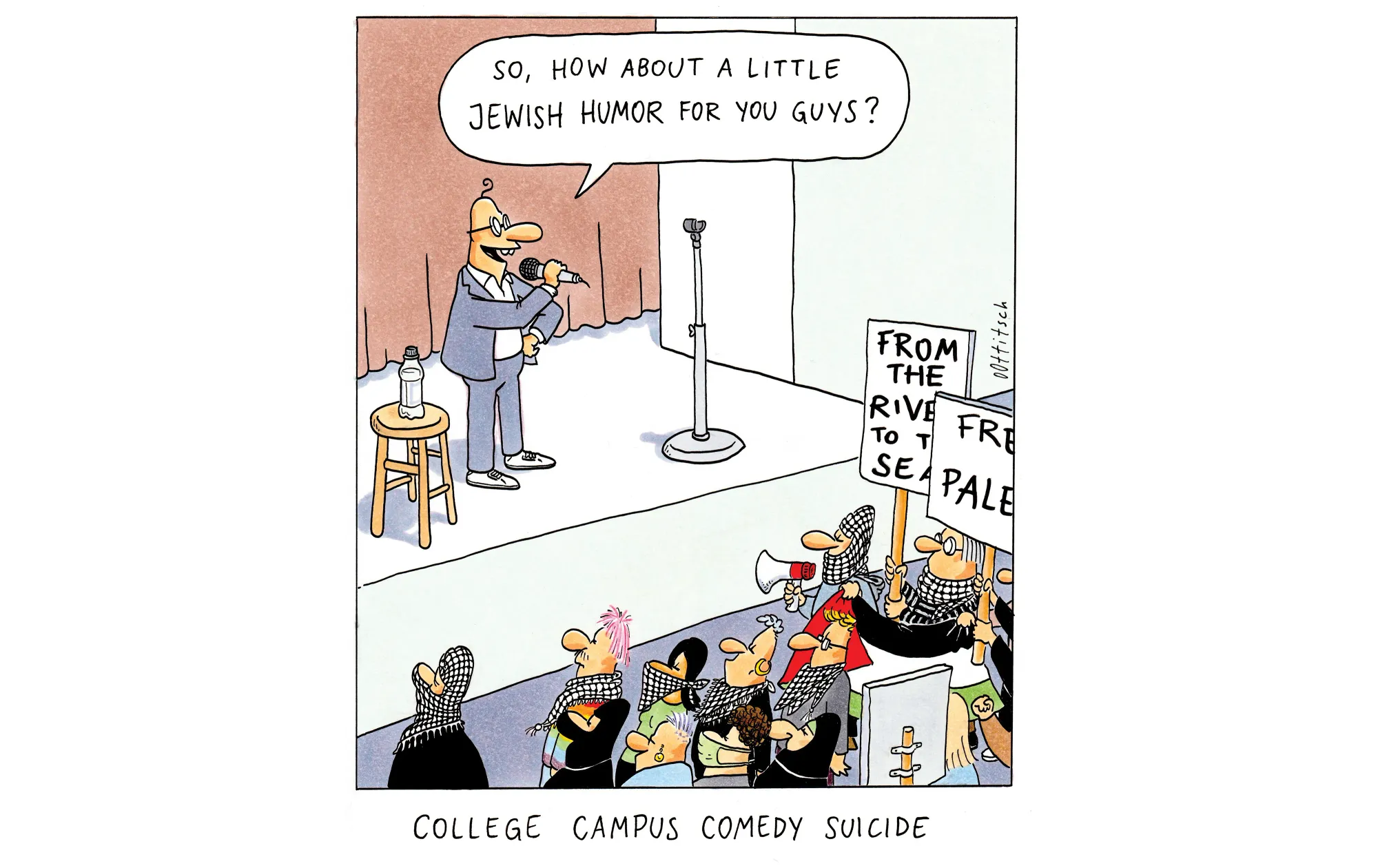
The shift is not just in what Americans find funny. It is a fundamental misunderstanding of the nature and function of humor. In a culture that now treats laughter as a moral act, it’s been bent out of shape by all sides; its purpose twisted into a dog and pony proof of allegiance. On the right, the rules are clear enough—mock the leader, mock the faith, and you’re done. The threat is old school dictatorship. On the left, nobody’s in charge, but everyone’s policing everyone else. The result is a social bureaucracy so sprawling and self-contradictory that no one, least of all the people enforcing it, can tell you where it starts, what it’s for, or whether anyone is still keeping score. Can a man tell a rape joke? Can a woman? Do gay, Black, or fat comedians (or any others belonging to oppressed or marginalized groups) have the exclusive right to make fun of their own group?
But beneath all the shouting lies something simpler: a handful of inconvenient facts that neither orthodoxy can accept.
1. Comedy has no responsibility. Jokes aren’t Hallmark cards. There’s no lesson. No moral mission. Funny has nothing to do with right or wrong, good or bad. If people laugh—the joke works. If they don’t, it doesn’t. It’s that simple. As Seinfeld put it, “The audience is the only judge. If they laugh, it’s funny.”
And whether they laugh for the right reasons, the wrong reasons, or no reason at all, it doesn’t matter. It’s all the same currency. Because again, no committee, no critic, no theoretical or ethical standard, not even comedians themselves, can determine what is funny. Only laughter can.
The impulse to sanitize humor in the name of safety is a well-intentioned but misguided coddling that infantilizes the very people it claims to protect.
It is for this reason that comedian Ricky Gervais argues you should never apologize for laughing—because it is an involuntary reflex, born of recognitions we can’t fully name; maddeningly hard to locate, explain, or repeat. Whatever insights, however real, are accidents, not assignments. A joke may be philosophical, but it must not philosophize. It may be moral, but it must not moralize, because life is serious and comedy is not.
2. There is no such thing as punching down. It is a conceit that rests on the fantasy that people exist within a clear hierarchy of oppression and that comedians should consult a moral spreadsheet before telling a joke. Humans, however, are messy, and power is multidimensional. If the joke lands, it’s good, and not because it “punched up,” but because it’s funny. As comedian Rowan Atkinson put it:
You’ve always got to kick up? Really? What if there’s someone extremely smug, arrogant, aggressive, self-satisfied, who happens to be below in society? … There are lots of extremely smug and self-satisfied people in what would be deemed lower down in society, who also deserve to be pulled up.
Humor, rather than reinforcing hierarchies, scrambles them, making a carnival of power, where prince and pauper swap faces and butts. People can be both victims and perpetrators at the same time. If a rich guy mocks a poor guy for being poor, he’s an asshole; if a poor guy does it, he’s an asshole too.
The impulse to sanitize humor in the name of safety is a well-intentioned but misguided coddling that infantilizes the very people it claims to protect. To be teased is to be an equal; to be seen as resilient enough to take a joke and confident enough to play along. Because good humor, by refusing to grant anyone a permanent victim’s pass, reminds us that our shared humanity, not our segregated identities, is the ultimate leveler.
3. The subject is not always the target. I heard a joke at an open mic the other day about a newspaper headline that read “World’s Worst Pedophile.” The story was about a man who had molested hundreds of children. After reading the headline, the comedian asked, “Shouldn’t he be the world’s best pedophile? I mean … the world’s worst pedophile—he’s been trying for years. He can’t afford the good candy, so he hands out stale trail mix. His van won’t start …” If you think the joke is making fun of molesting children or that it’s about finding pedophilia funny, you’re an idiot. It’s making fun of reporters and sloppy language.
But even if the joke actually was about pedophilia—as in Louis C.K.’s Saturday Night Live monologue, where he compares the joy of eating his favorite candy bar to what sex with children must be like for a child molester—treating a topic playfully doesn’t erase its gravity; it just recognizes that serious issues need not always be handled seriously.
Forcing comedy to seek 100 percent approval is like demanding a surgeon operate with a butter knife—you remove the danger, but you also remove the point.
4. Failure is the process. Even the best comics bomb; but in a decontextualized culture incentivized to screenshot rather than understand, we’ve made a habit of demanding perfection on the first try. The trouble is that, while great jokes look effortless, they’re the end result of a process that’s anything but. As David Chase said about the hundred hour weeks he spent making The Sopranos—“hard work looks like magic.” Seinfeld once said he spent 20 minutes fine-tuning a single syllable. Chris Rock worked on three of his jokes in a recent Netflix special for over a decade. Being funny is hard—and comics need the space to fail. If you’ve ever watched open mics and seen the same comedians go up week after week to tinker with their bits, you know that the difference between killing and bombing often hinges on a single well-timed pause. Perhaps comedian Ari Shaffir summed it up best:
Failing is part of my process … A new bit never works the first time. I figure I have to bomb seven times to make it good. So I tweak it. Then maybe the next time it will do great … but then it will fall flat again. So I’ll make more adjustments. Then it will be great, then it will be terrible again … and all of that is okay.
This is why people who understand the function of humor tend to be more forgiving when things go wrong; and comedians are the most likely to forgive a failed joke. Dave Chappelle, for instance, responded to Michael Richards (Kramer on Seinfeld) calling a heckler a “nigger” at the Laugh Factory—an incident widely perceived as genuinely racist—by saying that he learned that he was 20 percent Black and 80 percent comedian:
The Black part of me was offended and hurt, but the comedian part was like, “Whoo, dude is having a bad set. Hang in there, Kramer!”
The bottom line is this—good jokes can’t emerge without experimentation. If it kills—great. If it doesn’t, better—it means you’re part of a free society.
5. Risk is the form. Most humor involves taking risks. Larry David, for example, compared stand-up comedy to diving. You get extra points for degree of difficulty. Seinfeld said that jokes are like leaping from one tall building to another—the further the distance, the harder the joke. There is a big payoff if you can bring the audience with you, but if you try to jump too far or the dive is too difficult and you aren’t yet good enough, the joke bombs. This is why the worst thing you can do as a comedian is play it safe. As Patrice O’Neal put it: “The idea of comedy, really, is not [that] everybody should be laughing. It should be about 50 people laughing and 50 people horrified.”
Forcing comedy to seek 100 percent approval is like demanding a surgeon operate with a butter knife—you remove the danger, but you also remove the point.
The Last Laugh
Humor is not meant to be figured out, put to use, or taken seriously. It is meant to be experienced. But in a botox-bleached nation of caped crusaders wearing noise-cancelling headphones, deaf to anything but our own theme music and the imagined sound of unseen eggshells cracking beneath; Americans are being starved of the freedom to play without purpose.
Like an overzealous gardener who, in his war against the dandelion, has paved his entire yard with concrete, we are succeeding in eradicating the weed of offense but in the process killing the soil where flowers take root.
All of us, each so consumed in our own tiny corner of the universe, must be reminded every now and again that the world is what it is, and our ideas about it are not. It’s a ticklish business.