Interstellar Interlopers: Anomalous Natural Objects or Extraterrestrial Technologies?
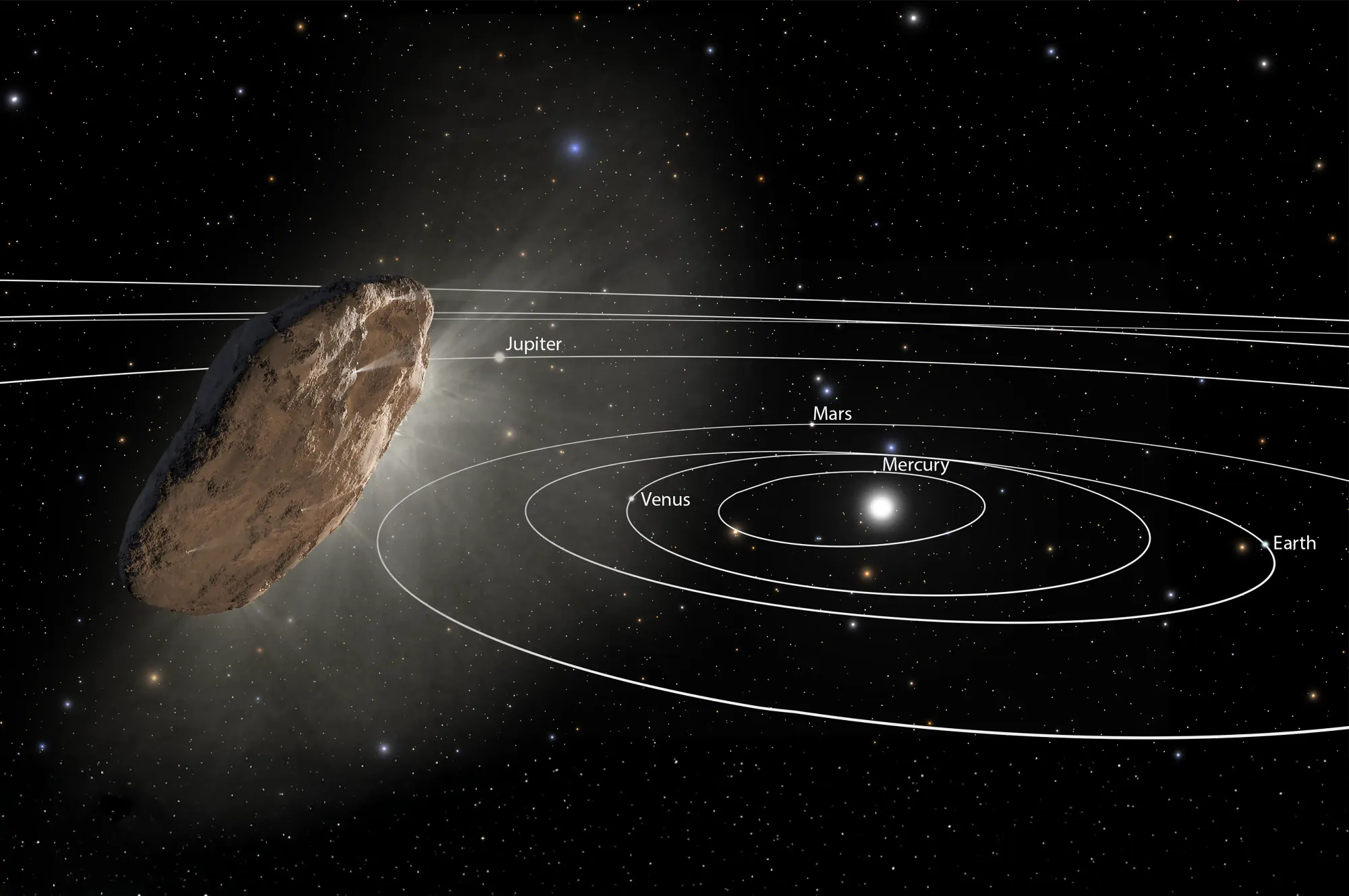
Area 51 may want to dust off the welcome mat. Not one, not two, but three interstellar objects have drifted through our solar system, now referred to as “interstellar interlopers.” Astronomers labeled them as 1I/‘Oumuamua in 2017, 2I/Borisov in 2019, and 3I/Atlas in 2025 (the prefixes refer to the order of discovery of the interlopers). While most astronomers see unusual but ultimately natural cosmic debris, Harvard astronomer and Galileo Project head Avi Loeb has stepped up to suggest these anomalous interstellar visitors could be alien technologies, possibly even a threat to humanity. Before we start waving white flags at space rubble, it’s worth noting that the rest of the scientific community is responding with something far less dramatic: data. Most scientists, armed with models and common sense, see nothing more exotic than fast-moving rocks and comets with unusual chemical compositions.
Avi Loeb: Prophet, Seer, or Publicity Seeker?
Avi Loeb is no UFOlogist conspiracy theorist with an active imagination. He holds Harvard’s Frank B. Baird Jr. Professorship of Science and has spent most of his academic life developing rigorous theories about black holes, galaxy formation, and the early universe. So, when he started speculating about alien artifacts drifting through our solar system and writing several popular books about extraterrestrials, it’s no surprise that a bevy of UFOlogists treated his words as something akin to the “next coming.”
In recent years, he has become known less for his contributions to cosmology and more for a far more audacious proposition: that humanity may have already encountered extraterrestrial technology created somewhere beyond our solar system. The shift has turned him into a public figure with an unusually large following for an astrophysicist, even as it strains his standing among colleagues. Admirers see him as refreshingly fearless and he has inspired my young students to go into the sciences (he regularly posts emails from them on his Medium blog); critics describe him as a man who has allowed publicity to eclipse prudence. The tension between those two views defines the controversy that now surrounds his work.
The ‘Oumuamua Puzzle and Loeb’s Radical Interpretation
When astronomers in Hawaii identified an unfamiliar object sweeping through the solar system in October 2017, they immediately realized it was something unprecedented. The object—later named ‘Oumuamua (Hawaiian for “messenger from afar”)—did not behave like the comets or asteroids astronomers routinely study. Its elongated appearance, lack of visible outgassing, and slight but measurable change in velocity puzzled researchers.
A large team of scientists, led by Karen Meech at the Institute for Astronomy in Hawaii, published a widely cited paper in Nature in 2017, concluding that ‘Oumuamua originated from outside our solar system. Building on the data from that paper, Avi Loeb and his graduate student Shmuel Bialy (now at the Israel Institute of Technology) proposed in a 2018 Astrophysical Journal Letters paper that ‘Oumuamua might be a “fully operational probe sent intentionally to Earth vicinity by an alien civilization.” That is, of course, a possibility—as is a cosmic teapot in orbit. But science does not require disproving every far-fetched alternative. The burden of proof lies squarely with Loeb and his collaborators.
In his boldly titled book Extraterrestrial: The First Sign of Intelligent Life Beyond Earth, Loeb offered a hypothesis that captured worldwide attention: perhaps ‘Oumuamua was not a natural relic at all but rather a fragment of engineered technology, possibly a thin, reflective structure propelled by starlight. He emphasized that he wasn’t announcing definitive proof (despite the book’s title), only pointing out that an artificial origin could not be ruled out. Nonetheless, his willingness to discuss this prospect publicly pushed the story far beyond the walls of academia.
Here are a few unique characteristics of ‘Oumuamua:
- ‘Oumuamua’s light curve. A light curve is a graph that shows how the brightness of an object changes over time. In 2019, Sergey Mashchenko analyzed the light curve from ‘Oumuamua, concluding that “the most likely model for ‘Oumuamua is a thin disc (slab) experiencing moderate torque from outgassing.” ‘Oumuamua’s brightness varied dramatically because it tumbled, suggesting an extreme aspect ratio (possibly 5:1 or more). That implies it was either very elongated like a cigar or very flat like a pancake. The shape is unlike anything in our solar system, and “non-comet-like.”
- ‘Oumuamua’s acceleration. Astronomers observed ‘Oumuamua making a nongravitational acceleration, that is, it sped up slightly as it left the Sun’s gravity well.
- ‘Oumuamua lacks a “comet” tail. Typically, comets coming in from the outer reaches of the Kuiper Belt or from within the Oort Cloud surrounding our solar system contain ice gases. Comets can develop two main types of tails. An ion (or plasma) tail forms when the solar wind—a stream of charged particles flowing outward from the Sun—interacts with gases from the comet. The solar wind ionizes these gases by stripping away electrons, and the resulting charged ions are then swept directly away from the Sun by the magnetic field carried in the solar wind. This produces a straight, narrow, bluish tail that always points directly away from the Sun, no matter which way the comet is moving. A dust tail, in contrast, is created when sunlight exerts radiation pressure on tiny dust particles released from the comet’s nucleus, pushing them away from the Sun. Because these dust particles follow slightly different orbits from the comet itself, the dust tail is broader, curved, and usually whitish or yellowish; it lags slightly behind and follows the curve of the comet’s trajectory around the Sun.
- ‘Oumuamua reflected more sunlight than typical asteroids or comets.
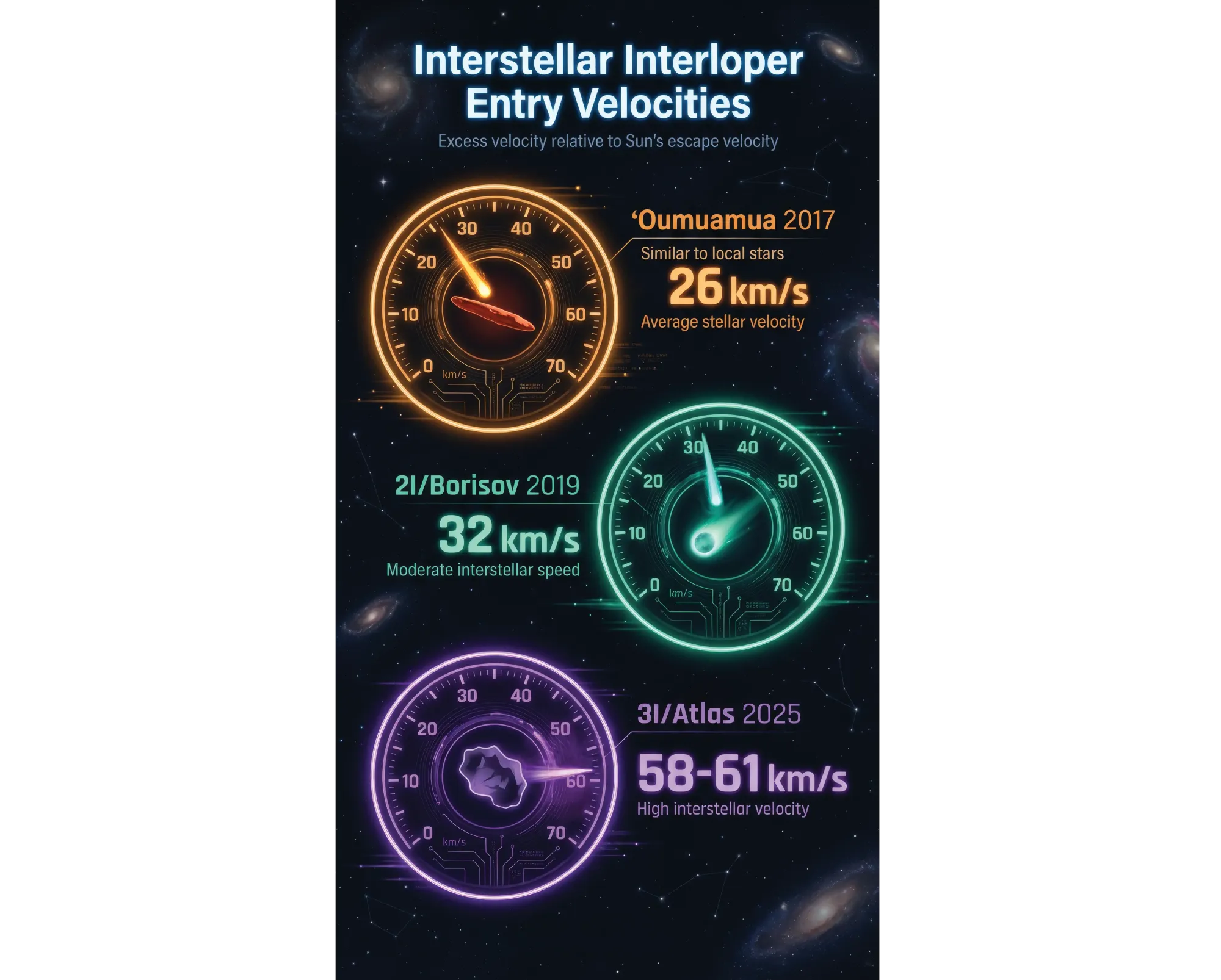
- ‘Oumuamua’s velocity entering the solar system was similar to the average speed of stars in the Sun’s neighborhood. Loeb pointed out that this was unusual and “unlikely by chance.”
Occam’s razor, named after William of Ockham (1287–1347) by Libert Froidmont (1587–1653), suggests that scientific hypotheses should consist of the smallest set of possible elements. For example, while staying in an old English hotel room, the lights flicker, the floor creaks, and the room gets chilly. You could conclude it’s the ghost of a Victorian child with unresolved issues—or, per Occam’s razor, you could check the wiring, the floorboards, and maybe close a window. When in doubt, blame the insulation before the afterlife. Occam’s razor doesn’t prove the simpler explanation is correct—just that it’s preferable until better evidence arises. It’s a tool for model selection, not an avenue to absolute truth.
Admirers see Avi Loeb as refreshingly fearless and he has inspired my young students to go into the sciences; critics describe him as a man who has allowed publicity to eclipse prudence.
Let’s examine the data for ‘Oumuamua in this light. The elongated or flat shape: In three research papers, Steven Desch and Alan Jackson proposed that ‘Oumuamua is a collisional fragment of nitrogen ice from an exoplanetary Pluto-like body. Not only does this explain the flat shape, but the lack of observable H2O, CO, CO2, lack of dust, and especially the magnitude of the nongravitational acceleration. I asked Desch what he thought of Loeb’s ideas about ‘Oumuamua and he responded: “Suffice it to say he [Loeb] long ago stopped being a serious scientist making innocent inquiries, and now unstoppingly manufactures doubt in the service of positioning himself as some sort of science maverick.” Sebastian Lorek’s and Anders Johansen’s theoretical work demonstrates that flattened, disc-shaped planetesimals can form naturally through the gentle gravitational collapse of a rotating “pebble cloud” in a protoplanetary disk. Lorek and Johansen emphasized to me that “the formation of flattened objects like ‘Oumuamua is a completely natural outcome of planetesimal formation.”
By contrast, Loeb postulates that ‘Oumuamua may be a light-sail—a thin, flat structure propelled by radiation pressure (i.e., the momentum of photons from starlight or sunlight). Photons carry no mass, but they do have momentum. When they hit a surface (especially a reflective one), they impart a tiny push. Over time, this small force accumulates, especially in the vacuum of space where there’s no friction. The challenge with using solar radiation for propulsion is that its force decreases with the square of the distance from the source (1/r²). While this pressure is weak but usable near Earth’s orbit (1 AU), it becomes vanishingly small at interstellar distances. In the vast space between stars, the photon flux is so low that even the nearest stars provide no meaningful thrust—effectively leaving a light sail adrift with nothing to push it along.
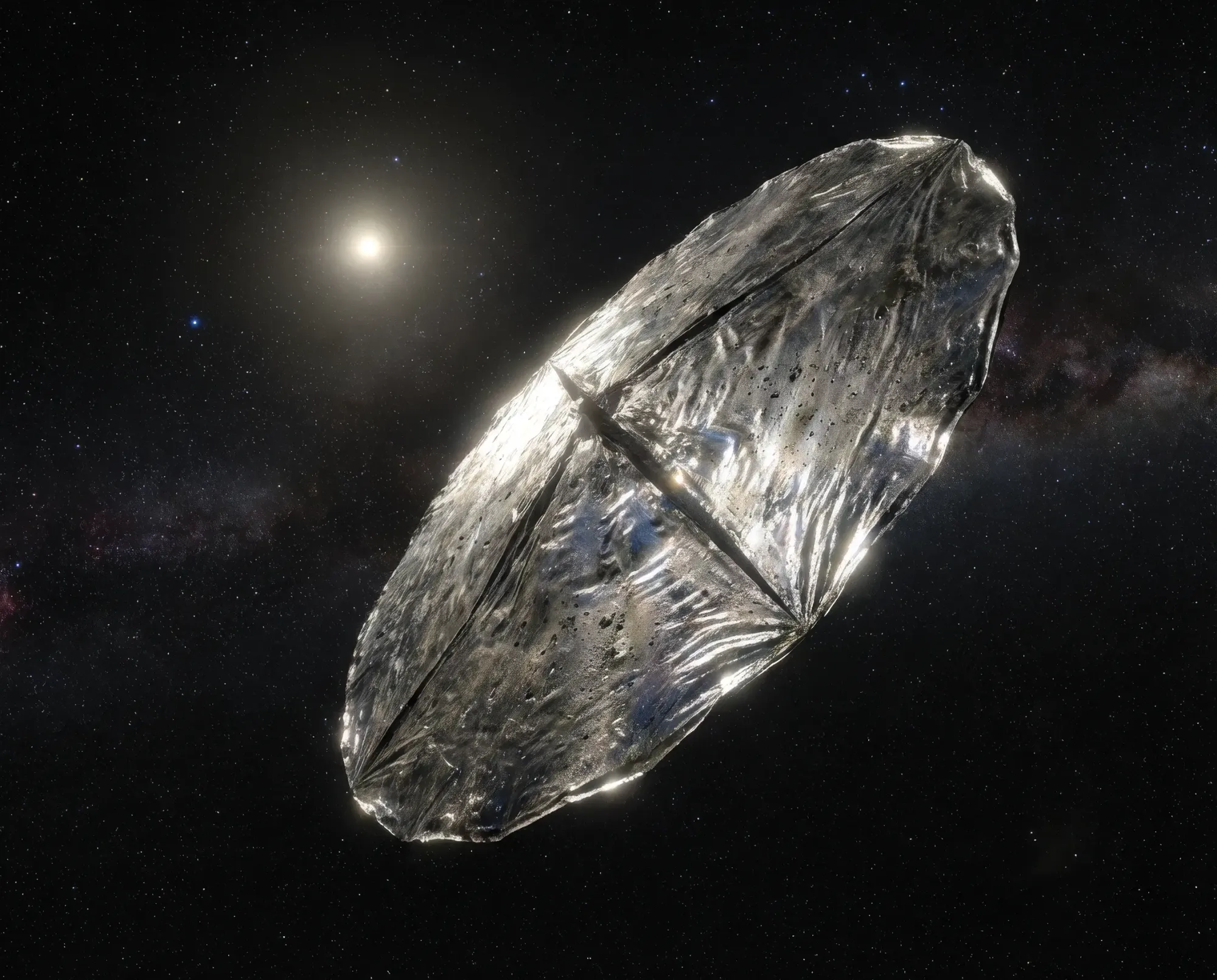
As for the nongravitational acceleration of ‘Oumuamua out of our solar system, Loeb believes that it can’t be explained by outgassing, because no gas or dust was detected. He proposed that the acceleration was caused by the solar radiation pressure hitting a light sail. If ‘Oumuamua were an ultra-thin object, just 0.3–0.9 mm thick and tens of meters wide, it could have experienced enough radiation pressure at its closest approach to the Sun, which was 0.25 AU, or one-quarter of an Astronomical Unit (the distance from the Earth to the Sun, 1 AU) to account for the motion—without requiring any expelled material. However, in 2023, Jennifer Bergner and Darryl Seligman showed that entrapped molecular hydrogen (H2) in water ice could have been released from ‘Oumuamua’s body as it warmed, producing the observed nongravitational acceleration without a visible coma (the cloud of gas and dust that typically forms around a comet when it gets close to the Sun). This supports the view that ‘Oumuamua was a comet-like planetesimal rather than anything technological. Although the study centered on chemistry, a consequence is that ‘Oumuamua must have had a very high surface-area-to-mass ratio for H2 outgassing to be effective. Such a requirement is naturally met by a thin, sheet-like geometry (a flattened body), again consistent with the disc-like shape inferred by the light-curve analyses. In short, even its puzzling acceleration can be explained by natural processes acting on an unusually flat, icy object.
The Galileo Project and Loeb’s Expanding Quest
Rather than retreat from public engagement after ‘Oumuamua’s exit from the scene, Loeb broadened his search. In 2021, he launched the Galileo Project—funded entirely through private donations—with the goal of systematically looking for physical evidence of extraterrestrial technology. The initiative includes specialized camera systems aimed at tracking unusual aerial phenomena and an expanded effort to locate interstellar debris.
One object in particular drew Loeb’s attention: a meteor that exploded over the Pacific Ocean in 2014. A U.S. Space Command memo suggested the meteor may have originated outside the solar system. Loeb seized upon the idea that remnants from this event might still rest on the ocean floor, potentially offering clues about materials forged beyond our stellar neighborhood. So in 2023 he orchestrated an expedition off the coast of Papua New Guinea to retrieve microscopic debris from the area where the meteor had disintegrated. Funded by a cryptocurrency entrepreneur, the mission blended scientific ambition with adventure-story drama—all captured by a documentary crew (to be aired in 2026).
The expedition recovered tiny metal beads—mere fractions of a millimeter in diameter. Laboratory analyses revealed unusual ratios of heavy elements that did not neatly align with common terrestrial or meteoritic compositions. Loeb interpreted the findings as suggestive of an exotic, possibly interstellar, origin. He stopped short of outright claiming discovery of alien technology (the tiny spherules were not exactly the dashboard of the Millennium Falcon), but he made clear that he considered the possibility worth exploring.
Many experts quickly objected. Planetary scientists noted that it is extremely unlikely for an object traveling at such high velocity to leave behind intact solid fragments. Others questioned whether the spherules could even be tied to the 2014 meteor, or whether the meteor itself was truly interstellar. Critics argued that uncertainties in the military data make firm conclusions impossible, and that Loeb was again presenting the most sensational interpretation well before the evidence justified it.
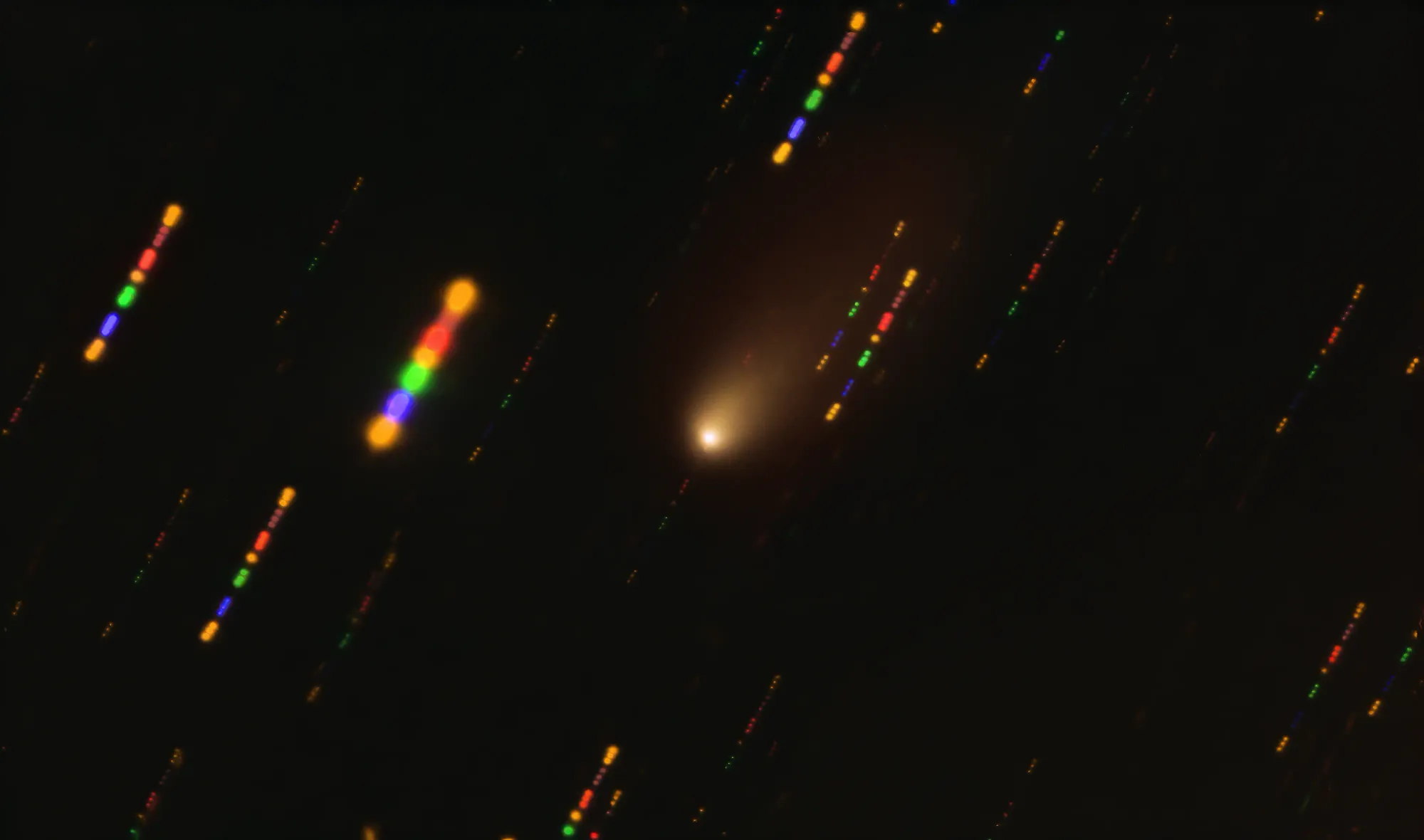
The interstellar comet 2I/Borisov behaves like a typical comet.
2I/Borisov is considered interstellar because it entered the solar system on a hyperbolic trajectory—with an orbital eccentricity greater than 3—meaning it is not gravitationally bound to the Sun and must have originated from outside our solar system. Its inbound velocity (approximately 32 km/s) and trajectory indicate it came from the direction of the galactic plane, rather than from within the Oort Cloud or Kuiper Belt. Unlike ‘Oumuamua, which baffled astronomers with its lack of cometary features, Borisov behaved exactly like a typical comet, complete with a bright coma, a dust tail, and outgassing of familiar volatiles like water, carbon monoxide, and cyanide.
Avi Loeb has suggested that Borisov may still deserve scrutiny as a potential technological relic—noting that it was more pristine than expected for a comet traveling interstellar distances, possibly implying unusual origins. However, most scientists interpret Borisov as strong evidence that other planetary systems form comets much like our own does. Its ordinary composition, active sublimation, and typical behavior all suggest it is natural, and in fact, it reinforces the view that cometary bodies are common ejecta from planetary systems throughout the galaxy. In Galileo Project Zoom meetings of late, Loeb has conceded that 2I/Borisov is a comet (Skeptic magazine’s Michael Shermer is on the Galileo Project team and attends the Zoom meetings).
3I/Atlas: The Third Interloper
3I/Atlas’s inbound excess velocity was about 58–61 km/s, far above the escape velocity of the Sun, indicating an origin outside the solar system (that is, it is not gravitationally bound to our solar system). Astronomers traced its incoming direction to the constellation Sagittarius and predict it will depart toward Gemini. Unlike the enigmatic ‘Oumuamua (which showed no outgassing) and more like 2I/Borisov, 3I/Atlas immediately revealed a coma and dust activity, behaving in most respects like a typical comet. Its trajectory and motion suggest it may have originated from the Milky Way’s thick disk, making it plausibly older than our solar system.
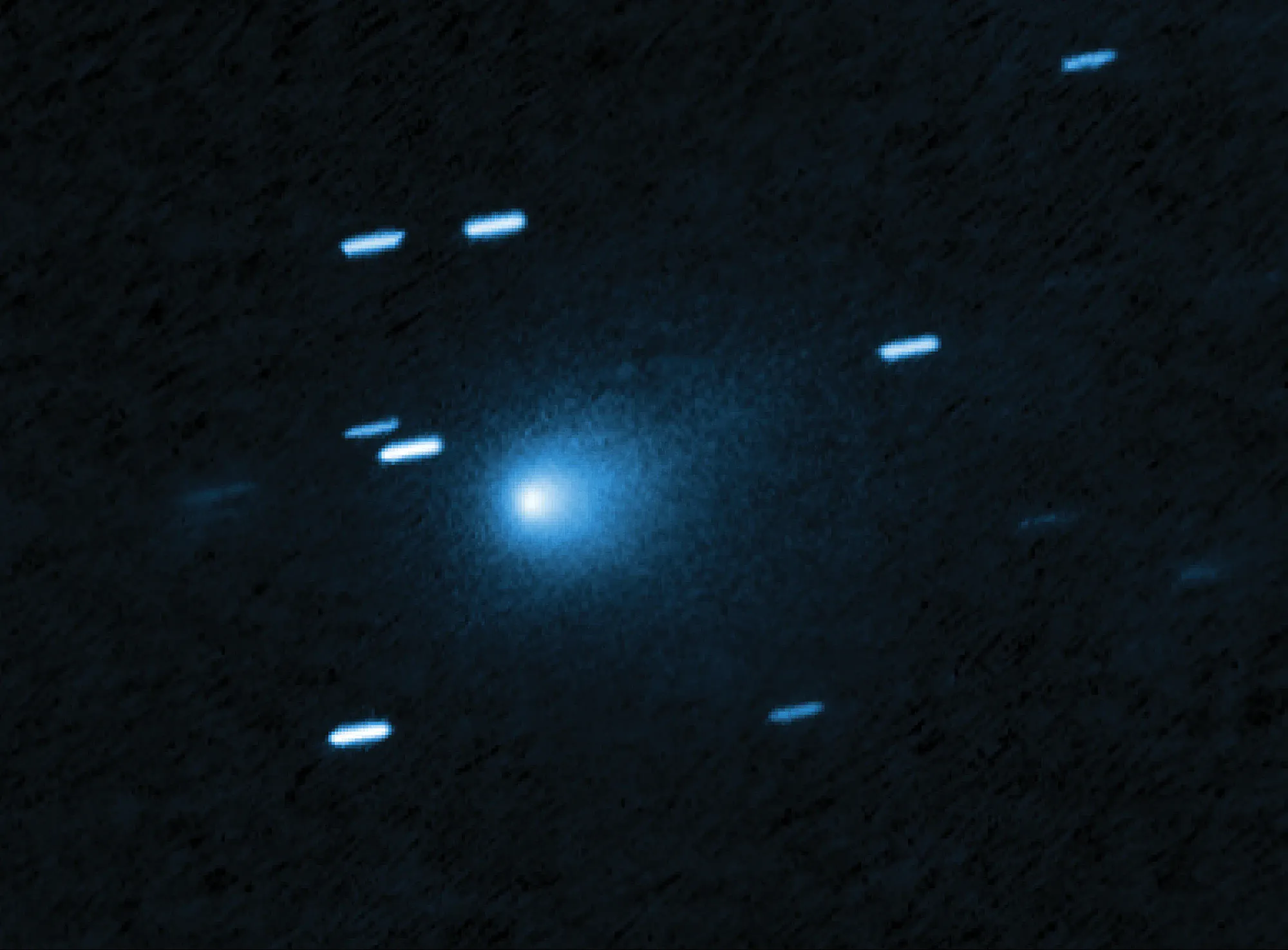
From the start, astronomers have viewed 3I/Atlas as a natural cometary body. Observatories around the world (including Hubble, the James Webb Telescope, and the Very Large Telescope in Chile) tracked its movement, noting that it started releasing gas and dust at large distances from the Sun—an unusual but not unprecedented behavior. Spectral studies revealed a coma rich in CO2, CO, and diatomic carbon (C2), while surprisingly low in water vapor, which typically dominates solar system comet outgassing. Polarimetry also showed an unusually strong negative polarization signal—meaning the light scattering off the coma’s dust was more directionally polarized than expected. (Polarimetry is the study of how light becomes polarized after it reflects off or scatters through materials like dust or gas. In astronomy, it’s used to analyze light from objects such as comets to infer the properties of their surfaces or comae. When astronomers applied polarimetry to 3I/Atlas, they found unusually strong negative polarization, suggesting its dust grains are very fine or have unusual textures—possibly hinting at a unique interstellar origin or formation environment.) These characteristics, while distinct, are seen as falling within the natural diversity of cometary compositions, especially for bodies formed in ultra-cold outer regions of a planetary system.
Researchers note that 3I/Atlas offers a unique opportunity to expand our understanding of planetary formation beyond the solar system. Its high CO2 content, early activity, and evolving tail structure suggest it likely formed in a cold, distant part of its home system—perhaps analogous to our Kuiper Belt around a distant solar system. Its compact nucleus (likely under 1 km in size) and slowly rotating, modestly active profile, contrast with the wildly tumbling, inert ‘Oumuamua. Scientists have emphasized that 3I/Atlas aligns with the expected behavior of a comet ejected from another stellar system, and they see no need to invoke exotic explanations.
Nevertheless, Avi Loeb has once again challenged the consensus. In public commentary and academic preprints, Loeb has listed a set of anomalies that, in his view, warrant consideration that 3I/Atlas might be artificial in origin. Among the features he highlights:
- The comet’s entry angle aligns closely with the solar system’s ecliptic plane, a statistically unlikely coincidence, he argues.
- Its antisolar jet initially pointed toward the Sun, rather than away, which Loeb suggests could imply directed propulsion rather than random outgassing.
- Its mass-to-acceleration ratio seems extreme given its apparent size.
- Spectral data show a high nickel-to-iron ratio in the coma, which Loeb suggests hints at industrial production instead of natural construction.
- 3I/Atlas’s inbound direction is near that of the so-called “Wow!” signal, a fact Loeb labels “curious” rather than conclusive. The Wow! signal was a strong, unexplained radio burst detected in 1977 near the hydrogen frequency—a band considered promising for interstellar communication. It lasted 72 seconds, came from the direction of Sagittarius, and has never been observed again, making it an intriguing mystery in the search for extraterrestrial intelligence.
Although intriguing, there is nothing alien about the 3I/Atlas’s jets. The presence of multiple jets pointing in both sunward and antisunward directions suggests that 3I/Atlas has several active regions on its rotating nucleus. As different surface areas are exposed to sunlight, localized jets of gas and dust are released, sometimes curving due to the object’s motion or erupting from regions not directly facing the Sun. This directional variety is a hallmark of cometary activity and reflects a complex interplay between surface composition, thermal dynamics, and rotational orientation, a more likely explanation than alien technology rocket thrusts and maneuvers that Loeb proposes.
Both features fall within known cometary behavior and don’t require invoking alien technology.
The same can be said for other characteristics Loeb deems of alien origin. The high acceleration relative to 3I/Atlas’s apparent size can be explained naturally by low-density, volatile-rich materials like CO2 or CO ices producing sustained outgassing. Similarly, the elevated nickel-to-iron ratio in its coma may result from observational bias—nickel is more easily detected in cometary gas, while iron often remains locked in dust. Both features fall within known cometary behavior and don’t require invoking alien technology.
Loeb’s position, as with ‘Oumuamua, is that extraordinary anomalies merit open-minded hypotheses. He does not claim that 3I/Atlas is definitively artificial, but argues that its distinctive properties should not be dismissed. He has proposed that it could represent alien debris, a probe, or some unknown technological object using controlled outgassing or exotic materials. Critics in the scientific community largely disagree, emphasizing that all of 3I/Atlas’s features—from its CO2-rich chemistry to its sunward jet and trajectory—can be explained by known physics. Observations of other comets with similar jets or compositional profiles provide natural precedents.
While most planetary scientists remain confident in a natural origin for 3I/Atlas, its detailed study is ongoing. Loeb’s speculations, while provocative, remain unsubstantiated.
In late 2025, NASA officials released detailed observations of 3I/Atlas, and their conclusion was unequivocal: “It looks and behaves like a comet, and all evidence points to it being a comet. But this one came from outside the solar system, which makes it fascinating,” said NASA Associate Administrator Amit Kshatriya. Indeed, high-resolution images from spacecraft showed 3I/Atlas with a normal cometary coma and tail—essentially indistinguishable from ordinary long-period comets aside from its hyperbolic orbit. In other words, 3I/Atlas is far more likely a natural interstellar comet than an extraterrestrial spacecraft.
In the end, 3I/Atlas has reinforced a key message: interstellar objects are not all alike, and some may appear quite strange by our standards. While most planetary scientists remain confident in a natural origin for 3I/Atlas, its detailed study is ongoing. Loeb’s speculations, while provocative, remain unsubstantiated. Whether the anomalies he flags prove to be outliers or just unfamiliar variations within a broad population of extrasolar comets, 3I/Atlas has already deepened our understanding of how planetary systems beyond our own may evolve—and what fragments they might fling into the void.
A Netflix documentary crew has followed Loeb’s work for several years, including his 2023 expedition to recover interstellar meteor fragments from the Pacific Ocean. The film, which Loeb has confirmed is in production, is expected to be released in 2026 and will chronicle his search for extraterrestrial technology. It reflects not only his scientific ambitions but also his increasingly prominent role in the public imagination.