Remembering Robert Trivers

Robert Trivers, who died on March 12, 2026, was arguably the most important evolutionary theorist since Darwin. He had a rare gift for seeing through the messy clutter of life and revealing the underlying logic beneath it. E. O. Wilson called him “one of the most influential and consistently correct theoretical evolutionary biologists of our time.” Steven Pinker described him as “one of the great thinkers in the history of Western thought.”
I was Robert’s graduate student at Rutgers from 2006 to 2014. Long before I knew him personally, however, he had already established himself as one of the most original and insightful scientists of the twentieth century. In an astonishing series of papers in the early 1970s, he changed forever our understanding of evolution and social behavior.
The first, published while he was still a graduate student at Harvard, confronted one of the deepest problems in evolutionary theory: how can natural selection favor cooperation between non-relatives? In The Evolution of Reciprocal Altruism Trivers proposed that cooperation could evolve when the same individuals interacted repeatedly, making it advantageous to help those who were likely to help in return while avoiding cheaters who took benefits without reciprocating — i.e.“you scratch my back, I’ll scratch yours.” The paper offered an elegant solution to the problem of how natural selection can “police the system” and has had enormous implications for human psychology, including our sense of justice, with parallels in other mammals such as capuchins and dogs.
From that insight flowed one of the most powerful and falsifiable ideas in modern science
The next year in 1972, Trivers published his most cited paper, Parental Investment and Sexual Selection. Here he offered a unified explanation for something that had puzzled biologists since Darwin. Writing perhaps the most famous sentence in all of evolutionary biology—“What governs the operation of sexual selection is the relative parental investment of the sexes in their offspring”—Trivers threw down the gauntlet and revealed a deceptively simple principle that reorganized the field. From that insight flowed one of the most powerful and falsifiable ideas in modern science: the sex that invests more in offspring will tend to be choosier about mates, while the sex that invests less will compete more intensely for access to them.
Two years later, in 1974, Robert once again gave birth to an entirely new field of study with Parent-Offspring Conflict. In it, he built on William Hamilton’s theory of inclusive fitness to show that parents and children have divergent genetic interests. Because a parent is equally related to all of its offspring, while each offspring is related to itself more than to its siblings, conflict is built into the family from the beginning. With that insight, Trivers revealed that some of the most intimate and emotionally charged features of life—begging, weaning, sibling rivalry, tantrums, parental favoritism, even the distribution of love and attention within families—all could be understood as the product of natural selection acting on family members with conflicting evolutionary interests.
In other papers, Trivers made wide-ranging predictions about the conditions under which parents should produce or invest more in sons than daughters, how female mate choice can favor male traits that benefit daughters, why insect colonies are structured by conflicts over sex ratios, reproduction, and control, and how self-deception may have evolved as a way of more effectively deceiving others.
It is hardly an exaggeration to say that his ideas gave birth to the field of evolutionary psychology and the whole line of popular Darwinian books
Each of these papers spawned entirely new research fields, and many have dedicated their careers to unpacking and testing the implications of his ideas. As Harvard biologist David Haig put it, “I don’t know of any comparable set of papers. Most of my career has been based on exploring the implications of one of them.” Indeed, it is hardly an exaggeration to say that his ideas gave birth to the field of evolutionary psychology and the whole line of popular Darwinian books from Richard Dawkins and Robert Wright to David Buss and Steven Pinker.
To know Robert personally, however, was to confront a more uneven and less orderly organism— to use one of his favorite words—than the one revealed in his papers. The man who explained the hidden order in life often struggled to impose order in his own. “Genius” is one of the most overused words in the language, with “asshole” not far behind, and I have known few people who truly deserved either label. Robert deserved both. He could be genuinely funny, extraordinarily generous, and breathtakingly perceptive, but also moody, childish, and needlessly cruel.


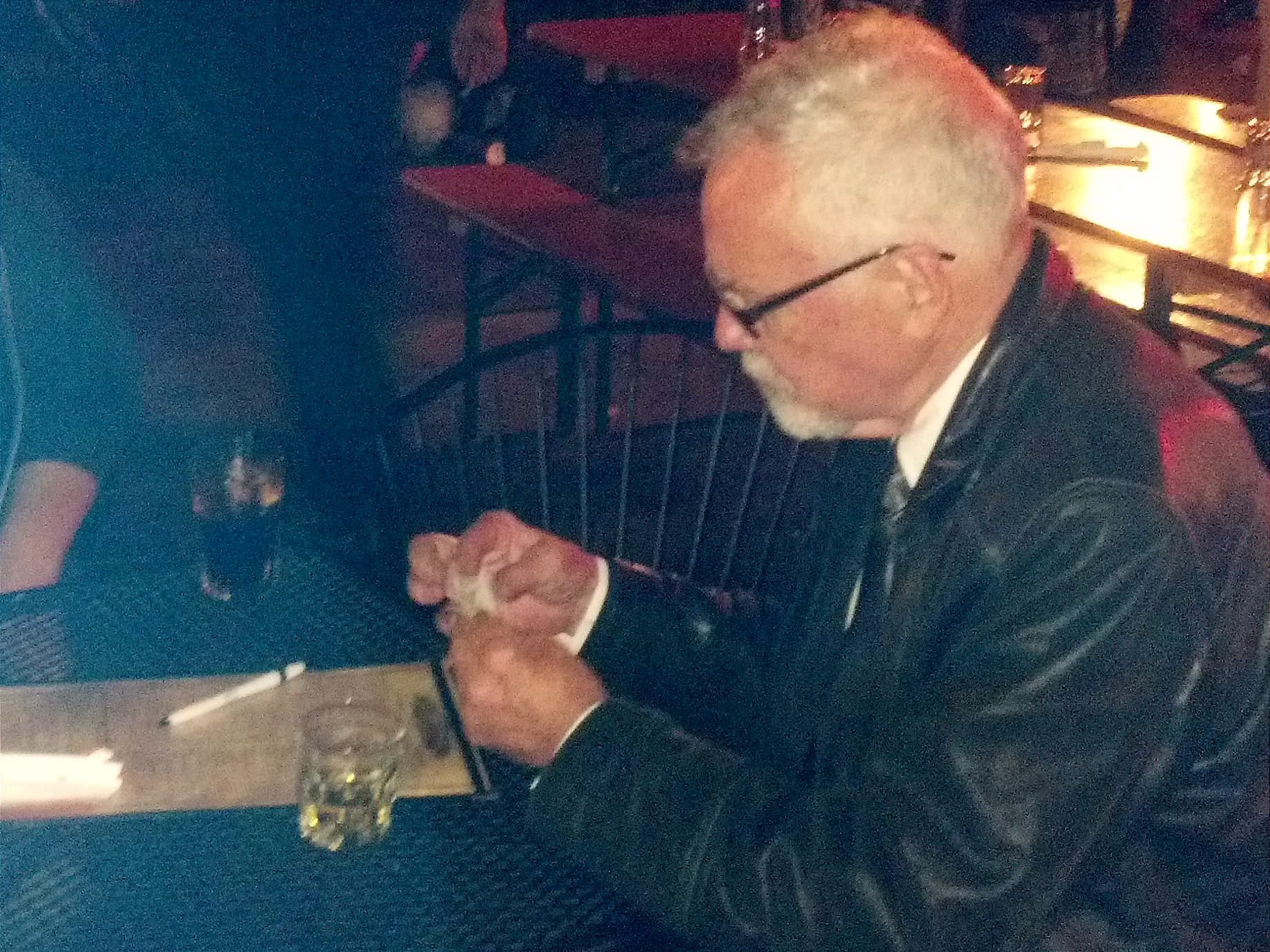
Bob and other committee members after my dissertation defense (2014) | Bob with undergraduate students (Jamaica, 2010)
Robert taught me that writing was endless revision and paying attention to the tiniest of details. He went through seven drafts of Parental Investment and Sexual Selection and frequently quoted Ernst Mayr telling him that papers are never finished, only abandoned. He used to call me “slovenly,” but more than once returned a draft of mine with a piece of his own dried lettuce stuck to it.
He was like an alien visiting our planet trying to make sense of our strange habits
He had an uncanny ability to see the obvious. I used to joke that one reason he was so good at explaining behaviors the rest of us took for granted was that he was like an alien visiting our planet trying to make sense of our strange habits—why we invest in our children, why we are nice to our friends, why we lie to ourselves. He told me that conflict with his own father was part of the inspiration for parent-offspring conflict and one of the observations that led to his insight into parental investment came from watching male pigeons jockeying for position on a railing outside his apartment window in Cambridge.
He cared more about truth than about his reputation
Robert also had a respect for evidence and for correcting mistakes that I’ve rarely seen among academics, a group not known for their humility. He cared more about truth than about his reputation and retracted papers at great cost to himself and his career when he thought there were errors. He also knew that he was standing on the shoulders of the giants who had come before him. He wrote that “the scales fell from his eyes,” crediting Bateman’s 1948 Heredity paper on fruit flies showing that males differ more than females in reproductive success for his insights into why males compete more for mates and females tend to be choosier, and he acknowledged that George Williams had already anticipated the importance of sex-role-reversed species in Parental Investment and Sexual Selection. Indeed he once described most of his insights into social behavior as those of W.D. Hamilton plus fractions.
He was a lifelong learner with a willingness to do hard things. After his astonishing early success, he could have done what many academics do: stay in his lane, guard his territory, and spend the rest of his career commenting on ideas he had already had. Instead, in the early 1990s he saw that genetics mattered and spent the next fifteen years trying to master it. The result was Genes in Conflict, the 2006 book he wrote with Austin Burt, which pushed his interest in conflict down to the level of selfish genetic elements. Few scientists, after making contributions as important as he had, would have had the curiosity, humility, and stamina to begin again in an entirely new area.
He liked to say, ‘I might be ignorant, but I ain’t gonna be for long.’
Trivers was a great teacher, though not always in the ways he intended. He often asked dumb questions—’What does cytosine bind to again?’ in the middle of a genetics seminar and made obvious observations—’Did you know that running the air-conditioner in the car uses gas?’ But as he liked to say, ‘I might be ignorant, but I ain’t gonna be for long.’
He could also be volatile and aggressive and there were many times when he threatened to kick my ass. I may have been the only graduate student who ever had to wonder whether he could take his advisor in a fight. Once, over lunch at Rutgers, I asked about a cut on his thumb after he had returned from one of his frequent trips to Jamaica. He matter-of-factly told me that he had just survived a home invasion in which two men armed with machetes held him hostage. He escaped by jumping from a second-story window, rolling downhill, and stabbing both men with the eight-inch knife he carried everywhere he went. He was 67 at the time.

The benefits of being Trivers’s only graduate student were obvious. He was a brilliant man and nobody else could speak with such clarity about the impact of operational sex ratios on parental investment and male mortality while rolling a joint. The costs were obvious too. He could be erratic and often seemed either indifferent to, or unaware of, the social consequences of what he said. This often left him professionally isolated and left me with few academic relationships I could count on when it came time to find a job.
The mark of a great person is someone who never reminds us of anyone else
One of the last times I spoke with Robert, a fall had left his right arm nearly useless. He described it as “two sausages connected by an elbow.” He was a chaotic and deeply imperfect man, but also one of the few people whose ideas permanently changed how we understand evolution, animal behavior, and ourselves. Steven Pinker wrote that “it would not be too much of an exaggeration to say that [Trivers] provided a scientific explanation for the human condition: the intricately complicated and endlessly fascinating relationships that bind us to one another.” That seems just about right to me.
His ideas are some of the deepest insights we have into human nature, animal behavior, and our place in the web of life. The mark of a great person is someone who never reminds us of anyone else. I have never known anyone like him.
I’ll miss you, Robert. You asshole.