The Rise of Decorative Neuroscience
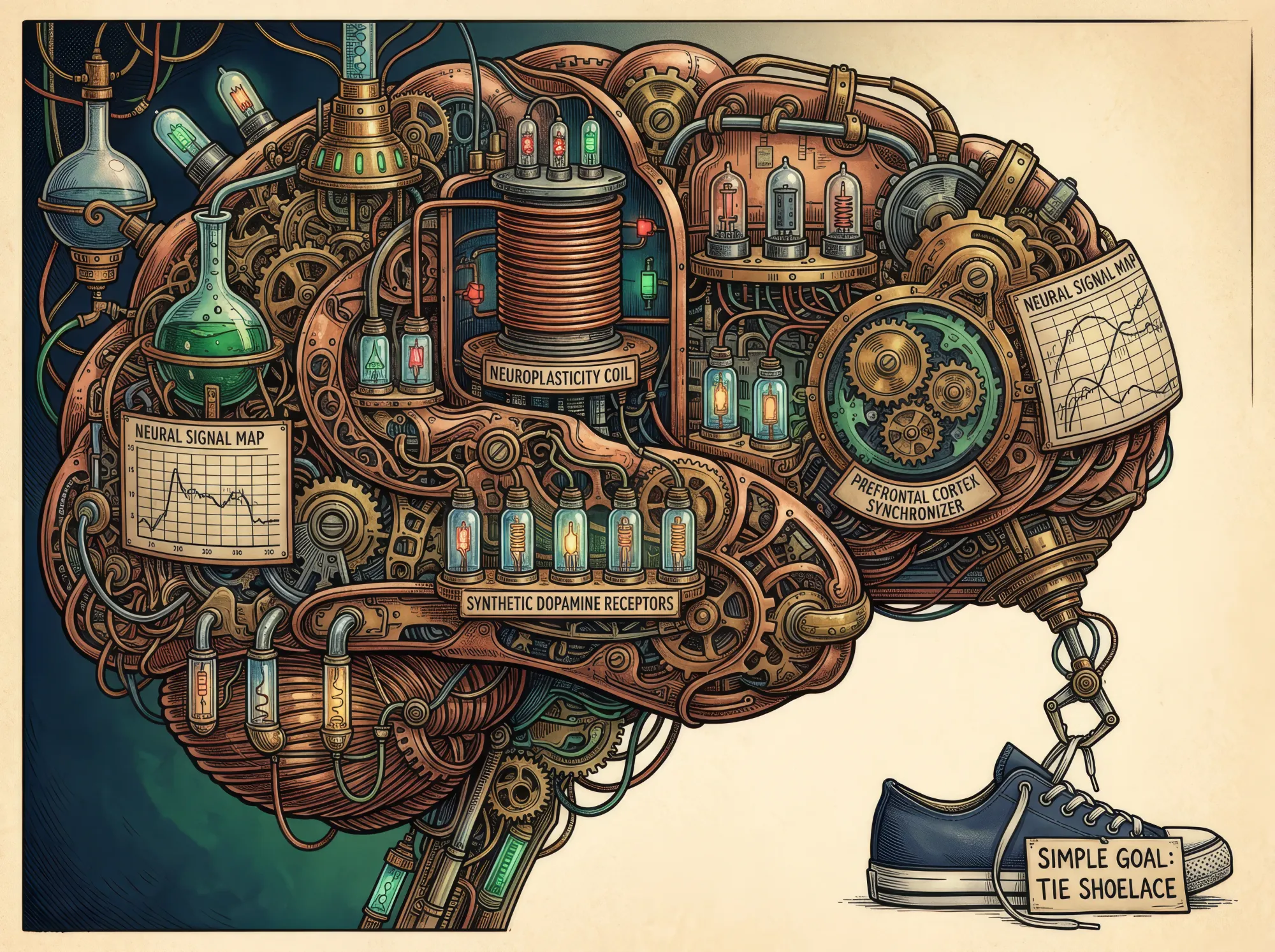
Neuroscience terms are everywhere. If you log into social media, you’re likely to be bombarded with advice on how to “increase neuroplasticity.” You might be told to “stop chasing the dopamine” or given instructions on how to “regulate your nervous system.” Meditation works because it “rewires your brain.”
Self-help gurus and productivity coaches love these terms. They signal depth. They suggest that beneath the surface of our messy behavior there are precise mechanisms that have been identified that can give us the answer to our problems, whatever those problems may be.
The trouble is, despite their suggestion of a mechanism, most of these terms are used in a way that offers no explanatory value. When a wellness blog tells you going for a walk will “regulate your nervous system” they’re just saying a walk may reduce stress. Whether it actually does reduce stress doesn’t hinge on whether we can describe it in neural terms. Similarly, when an influencer says meditation “changes the brain” this doesn’t tell you anything new. Anything from practicing a motor skill to remembering this sentence changes your brain. The question is whether it changes it in a way that’s helpful. For that, the neuroscience doesn’t provide an answer.
Neuroscience terms used in these ways are decorative—a way to jazz up tired old advice and make it seem fresh and new again. By decorative neuroscience, I mean the use of irrelevant or oversimplified brain-based concepts to rhetorically bolster some claim, explanation, or intervention.
Neuroscience terms used in these ways are decorative—a way to jazz up tired old advice and make it seem fresh and new again.
Why do we continue to see so much decorative neuroscience? A study published in 2008 found that laypeople rate explanations that contain irrelevant neuroscience as better than those that lack neuroscience. This has been termed “the seductive allure of neuroscience explanations.” People without neuroscience training interpret the presence of brain-based explanations as meaning we have a much firmer grasp on a concept than we do. When influencers throw in neuroscience terms, it ends up being interpreted as more authoritative.
Many of the uses of decorative neuroscience are innocuous enough. Influencers have discovered a new rhetorical trick to ply their trades, but much of what they’re saying is the same old thing. What's more worrying is the way decorative neuroscience has started to influence public discourse.
Dopamine talk has become ubiquitous. California psychiatrist Dr. Cameron Sepah recommends “dopamine fasting,” which involves taking a break from things like smartphones and social media. Individuals following his protocol talk about being “addicted to dopamine.” From a neuroscience perspective, these terms make little sense. You can’t take a “fast” from dopamine; it’s a naturally occurring molecule in your brain and critical for movement and motivation. While addictive substances alter dopamine signaling, you can’t be addicted to dopamine itself.
Instead, the term dopamine in “dopamine fasting” is decorative, something Dr. Sepah himself admits: “Dopamine is just a mechanism that explains how addictions can become reinforced, and makes for a catchy title. The title’s not to be taken literally.”
But when the catchy title is taken away, we see the dopamine fast for what it is: advice to take a break from technology to reconnect with ourselves and others. This may be good advice, but it certainly isn’t a new idea, and it has little to do with neuroscience.
More significantly, the term dopamine has become a catch-all for sinful pleasurable activities. The bestselling book Dopamine Nation by Anna Lembke claims anything pleasurable, even reading a book, is potentially addictive because it releases dopamine.
Positing a neural mechanism is no substitute for direct evidence that an intervention actually changes behavior, experience, or well-being.
While it’s true that pleasurable activities stimulate dopamine release, superficial similarities don’t mean two things are the same. The reward system of the brain responds to everything from love to video games to chocolate to methamphetamine. The involvement of the same brain regions doesn’t mean they have the same impact on us. Both addictive drugs and video games stimulate the release of dopamine, addictive drugs stimulate much more.
But again, the neuroscience is largely irrelevant—we should just look at the behaviors associated with these activities. The majority of methamphetamine users develop a use disorder, resulting in severe health and behavioral problems. Despite how widespread technology use is, technology use disorder is rare; it’s estimated around 3 percent of video game players develop any kind of behavioral problem associated with gaming (like neglecting schoolwork to the point of harming grades), and most of those problems are mild.
Part of the trouble here is pushing our understanding of neural mechanisms beyond their scope and assuming they provide a more solid basis for understanding than simple psychology. But often, the psychological level is much closer to the level of explanation we need than neuroscience. Take the classic misunderstanding of the brain hemispheres: the idea that the left hemisphere is analytical while the right hemisphere is creative. This isn’t just bad neuroscience, it’s bad psychology to boot.
First the neuroscience: it’s true there are hemispheric differences. Some functions occur more in the right or left hemisphere, something neuroscientists refer to as lateralization. Language production is a classic example—for most people, language production mostly happens in the left-hemisphere. While you can find some functional differences between the hemispheres, nearly every complex activity involves both sides. Even for analytical tasks like solving math problems, there’s substantial involvement from both hemispheres. For example, the left-brain right-brain personality theory claims that some people (the logical type) are “left-brained” and others (the creative type) are “right-brained.” This, too, doesn’t hold—people don't predominantly “use” one hemisphere over the other.
A bad psychological model can’t be bolstered by bad neuroscience. You don’t need a neuroscience mechanism to explain something that doesn’t exist.
But again, the neuroscience here is largely irrelevant. We should instead look at psychology. Is it true that people are either logical or creative? Without looking at the brain, we can determine that no, it isn’t. Far from there being two categories of people (left-brained and right-brained), people fall in different parts of the distribution for each. Classic measures of intuitive versus analytical thinking styles have found they’re largely independent. If anything, there may be a positive association between analytical thinking ability and creativity, as scoring higher on an IQ test makes one more likely to score high on a test of creativity. A bad psychological model can’t be bolstered by bad neuroscience. You don’t need a neuroscience mechanism to explain something that doesn’t exist.
If you have a theory of personality types, how to study better, be more productive, or strengthen self-control, that’s great. It should be put to the test to see if it works. What’s important is whether there’s actually an effect. Does reading books often lead to addiction? Are people either analytical or creative? Does going for walks lower stress? These are straightforward questions about behavior. Pointing to possible neural mechanisms doesn’t help—the brain is complex and has many mechanisms. You can come up with all sorts of post hoc possible neural mechanisms to explain theoretical relationships between an activity and an outcome.
Looking to neuroscience for wellness or productivity advice is like looking to cell biology for dietary advice.
It would be nice if we have some specific, clear mechanism like right brain versus left brain to explain the difference between people, but neuroscience rarely can offer something like this. Neuroscience is messy. Looking to neuroscience for wellness or productivity advice is like looking to cell biology for dietary advice. It might provide constraints and guidance for nutrition research, but what you really want is to have people eat stuff to see what happens.
Moving from behavior to neurons might feel like it’s digging down a level, getting rid of the messy complexities of psychology and leaving something more precise and scientific. But our understanding of the brain isn’t clearer or more complete than our understanding of behavior. Neuroscience is full of uncertainty, indirect measures, and interpretive gaps. More importantly, it operates one level down from the level of explanation we generally care about in our everyday lives: observable behavior and experience.
The human brain is a wonderfully complex organ. It’s arguably the most complex thing we’ve discovered in the universe. Neuroscience is a young science with a gargantuan task, made all the harder by the ethics of studying the living brain and the modesty of our tools for probing it. It has enriched our understanding of behavior, perception, and ourselves as biological beings. It’s helped clarify neurological and psychiatric pathologies, and offers hope for a future for treating them. Neuroscience can illuminate constraints and underlying processes, and work alongside psychological research to triangulate how cognition works in different domains. But positing a neural mechanism is no substitute for direct evidence that an intervention actually changes behavior, experience, or well-being.