Ufology: From Fringe to Mainstream to Fringe?
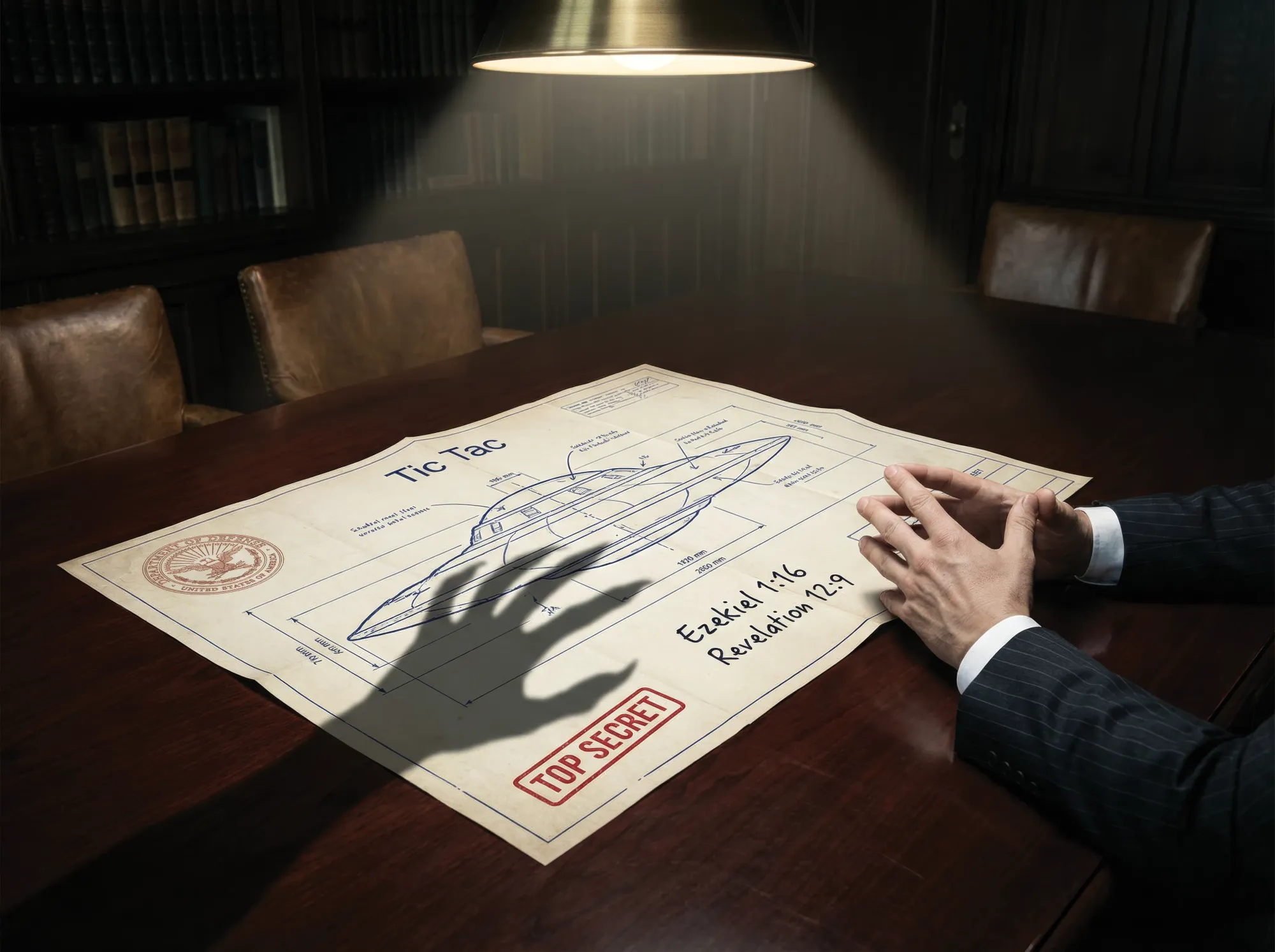
A little over eight years ago The New York Times published a story that had profound implications for the way in which the UFO topic was perceived.1 It also began, at least in the U.S., a process by which the subject became increasingly more mainstream. In this article I want to address three questions: (1) How did ufology get here? (2) Where does ufology stand now? (3) What does the future hold for ufology?
How did ufology get here?
On December 16, 2017, The New York Times broke two related stories. The first was the existence of forward-looking infrared videos of UAP (the U.S. government uses the term UAP—Unidentified Anomalous Phenomenon—as opposed to UFO) taken from U.S. Navy jets and confirmed by the Department of Defense as being authentic footage.2
The second part of the story was the existence of a shadowy intelligence program known as the Advanced Aerospace Threat Identification Program (AATIP), that supposedly researched and investigated UAP. This was newsworthy in and of itself, because for years the official position of the U.S. government was that there was no longer any interest in UAP, and that no programs had existed to study the phenomenon since the end of the 1960s, when a long running U.S. Air Force program known as Project Blue Book was terminated. Many people in the UFO community believed this was a lie and that covert programs existed, so it seemed like a clear-cut example of a conspiracy theory that turned out to be true.
The truth was rather more complex, and there’s still no universally accepted narrative here. Some skeptics say AATIP was more of an unofficial effort undertaken by a group of believers in the Intelligence Community. Whatever its true nature, AATIP was clearly a spin-off of an earlier Defense Intelligence Agency (DIA) program called the Advanced Aerospace Weapon System Applications Program (AAWSAP). AAWSAP was demonstrably a genuine program, and some official documents use the terms AAWSAP and AATIP interchangeably.3 In January 2020, Pentagon public affairs spokesperson Susan Gough issued a statement attempting to clear up the confusion. It stated:
The Advanced Aerospace Threat Identification Program (AATIP) was the name of the overall program. The Advanced Aerospace Weapons Systems Application Program (AAWSAP) was the name of the contract that DIA awarded for the production of all technical reports under AATIP.
I sought further clarification, and on January 13, 2020, Susan Gough followed this up with a statement that:
DIA managed the Advanced Aerospace Threat Identification Program. All of the work performed under AATIP was done via a single contract vehicle called AAWSAP. The total work effort for AATIP consisted of the 38 technical reports produced under the contract vehicle. DIA was the sole lead for management of AATIP via AAWSAP. Congress was briefed on the total work conducted for AATIP—the aforementioned 38 technical reports.
The authors of these 38 reports include Hal Puthoff, Eric Davis, and Kit Green—names well-known to those who follow government dabbling in fringe science and the paranormal.
My personal assessment is that all the euphemistic “advanced aerospace” references were a way of disguising a UFO or paranormal research program as being a program looking at next-generation foreign aerospace weapon threats, to try to protect it from skeptical Pentagon financiers and Congressional oversight folks who would have been horrified to learn that taxpayers’ money was being spent on such matters. This attempt was ultimately unsuccessful, because while $10M was appropriated in FY2008 and a further $12M in FY2010, funding ended in FY2012, after an earlier official review concluded that “the reports were of limited value to DIA.”
The roots of AAWSAP trace back to Intelligence Community personnel Jay Stratton and James Lacatski, as well as to Skinwalker Ranch in Utah, often portrayed as a hotbed of UFO sightings and paranormal phenomena. Following the DIA’s 2008 issue of a contractual solicitation (carefully worded to focus on breakthrough technologies that might underpin future aerospace weapon systems, while avoiding mention of UFOs or the paranormal), the contract was awarded to Bigelow Aerospace Advanced Space Studies (BAASS).4 Billionaire space entrepreneur Robert Bigelow was, at the time, the owner of Skinwalker Ranch.
Robert Bigelow had a longstanding interest in UFOs and the paranormal, and had previously funded the National Institute for Discovery Science (NIDS).5 The Chairman of the Board was the aforementioned Hal Puthoff, a parapsychologist who’d previously managed (with Russell Targ) a program at the Stanford Research Institute (not affiliated with Stanford University) to investigate paranormal phenomena. This work likely led to the U.S. government’s dabbling in such areas as remote viewing through Project Stargate, run by the DIA and CIA during the Cold War.
NIDS looked at a range of fringe science topics, and some have argued that AAWSAP was essentially a way to secure government funding for a continuation of the sort of work that had been done by NIDS. Senator Harry Reid (who knew Robert Bigelow) was instrumental in securing official status and funding for AAWSAP.
The New York Times story was quickly picked up by other mainstream media outlets around the world, and this caught the attention of numerous Congressional representatives and staffers. A key reason for this interest was the fact that aside from Harry Reid and two Senatorial colleagues, there seemed to have been no Congressional knowledge of AAWSAP or AATIP, and certainly no oversight.
In terms of UFOs, folks in Congress likely aren’t that different from society as a whole, in that there’s a wide range of opinions across the spectrum from skeptic to believer. Furthermore, irrespective of beliefs, it’s hardly surprising that an unknown but clearly significant number of people in Congress saw The New York Times article and thought to themselves something like, “Wait, the government has a UFO program, but didn’t tell us? It was run by Intelligence Community personnel and there’s no Congressional oversight? What are they doing and what have they found out?”
What followed was multifaceted Congressional interest in and engagement on the topic of UAP, to the extent that a critical mass built up. I believe a key factor here was that this engagement was bipartisan, covered both the Senate and the House, and involved several committees, mainly the Armed Services committees, the Intelligence committees, and the Oversight committees. This Congressional engagement led to classified briefings and public hearings. Witnesses at the public hearings included whistleblowers like Luis Elizondo (a retired counter-intelligence operative prominently featured in The New York Times article and described therein as being the individual who had run AATIP) and David Grusch, a former Intelligence Community member who had been attached to the UAP Task Force under the directorship of Jay Stratton.
Perhaps the most important part of Congressional UAP engagement was the insertion of multiple UAP-related provisions into several of the recent, annual National Defense Authorization Acts (NDAA). In part to meet these legislative remits, the DOD set up an office (the aforementioned UAP Task Force) to handle the response and to lead on the topic across government. This task force published a number of official reports and was eventually replaced by the All-domain Anomaly Resolution Office (AARO). AARO’s website hosts a wealth of reports, briefings, and other UAP-related materials, sourced both from the DOD and Congress, that perfectly illustrate both the breadth and depth of Congressional engagement and the government response to this Congressional interest.6
As an interesting side note, one of the directors of the UAP Task Force was the aforementioned Jay Stratton, who had previously been involved in AAWSAP and who had an anomalous experience at Skinwalker Ranch. Stratton’s upcoming memoir, apparently to be published in 2026 by HarperCollins, may shed some light on unresolved questions concerning the evolutionary process from NIDS to BAASS to AAWSAP to AATIP, as well as other not-yet-resolved questions.
Every intelligence analyst on the face of the planet knows the importance of differentiating between what they know and what they think, yet these very people often seem to be blurring the line.
It’s certainly interesting to note the connections between the various individuals involved and to see how the same names pop up repeatedly. This gives some potential insights into who the key players are and what the overall agenda is. The New York Times story, for example, had a long gestation period. The story was shopped around for some months prior to publication, not only to The New York Times, but also to The Washington Times and Politico, both of which were thus able to run fairly detailed stories very shortly after The New York Times got the scoop.
Further insights can be gained by looking at the three names that appeared on the byline for The New York Times story: Helene Cooper, Ralph Blumenthal, and Leslie Kean.
Helene Cooper was a Pentagon correspondent with The New York Times, with no previous UAP interest; The New York Times veteran reporter Ralph Blumenthal’s interest predated the December 2017 article and began with his research into Harvard Professor of Psychiatry John Mack, who had conducted research into the alien abduction mystery. This led to the 2021 publication of Blumenthal’s book on Mack, The Believer. Leslie Kean comes from a wealthy political family and had a prior interest in UAP and alien abductions, illustrated by her previous writings and by the fact that she lived for some years with abduction researcher Budd Hopkins, who first introduced John Mack to the topic.
It was Leslie Kean who was instrumental in bringing the story to The New York Times. Luis Elizondo had resigned from government service in the fall of 2017, but very shortly before leaving had passed the three best-known U.S. Navy UAP videos to Christopher Mellon, a former Deputy Assistant Secretary of Defense for Intelligence. Elizondo believed he had obtained official security clearance for their release, though it seems there was a misunderstanding and that the clearance was not intended to authorize public release. To illustrate this, an April 27, 2020, statement from the DOD referred to “unauthorized releases” of the videos in 2007 and 2017.7 In 2007, one of the videos leaked online on the Above Top Secret discussion forum, while 2017 referred to the process that led to The New York Times running the story.
Mellon and Elizondo then joined an organization called the To The Stars Academy of Arts and Science (TTSA), ostensibly headed by Blink-182 musician Tom DeLonge. TTSA was a sort of collaborative hub for a number of individuals, many with backgrounds in government UAP and fringe science research, including Hal Puthoff and retired CIA officer Jim Semivan.
It was Christopher Mellon who facilitated a meeting between Kean, Elizondo, and others, which then gave Kean enough to take the story to The New York Times, via Ralph Blumenthal, setting in motion a series of events that was to forever change the field of ufology.8
Where does ufology stand now?
This is how ufology in the U.S. went from fringe to mainstream, though it’s a simplified version, and not all the twists and turns of the story are universally agreed upon. If I had to summarize what I think happened and why, my best assessment would be as follows: A loose coalition of believers in UAP and the paranormal, often with backgrounds in government, military, and the Intelligence Community, sought and obtained official funding for their work. When that funding was terminated, they continued the work in a quasi-official capacity. Finally, when they felt they’d taken matters as far as they could without official funding, they decided to go public, successfully gambling that the resultant firestorm would generate other ways to take things forward. The goals may have included funding (TTSA certainly raised some money through a share issue) and Congressional engagement. The latter has clearly been a big success.
However, eight years into this process, there’s still no smoking gun and we appear to have hit some speed bumps, with several new and parallel events putting things in a rather different light.
Further ex-government whistleblowers have come forward. This sounds like a good thing, and in one sense, it is, but the unintended consequence has been that this has added to the information overload and created a landscape so complicated that even veteran commentators like myself, who follow the situation very closely, find it difficult to keep up. Furthermore, not all whistleblowers are equal. While one can be reasonably confident that those who have testified to Congress are who they say they are (staffers vet such people fairly thoroughly, not least by quizzing their former employers), others haven’t had their backgrounds investigated in such depth.
It should also be remembered that even when someone’s government background checks out, their specific role is often harder to pin down and their information can be all but impossible to verify. That’s partly because many of these folks have a background in the military and the Intelligence Community, where issues of classification often arise and where deception was literally in some of these people’s job descriptions. It’s also because much of the information is second hand, but where those concerned don’t make it clear that this is something that somebody else told them. Every intelligence analyst on the face of the planet knows the importance of differentiating between what they know and what they think, yet these very people often seem to be blurring the line. No wonder one occasionally hears some civilian UFO researchers complain that the whole thing is a PSYOP.
This already murky situation has been further complicated by factional infighting. There’s clearly a struggle for narrative control within the field. Even among the various whistleblowers and other key players, who are ostensibly polite with each other, there are clearly some tensions. By way of a personal anecdote, I’ve had more than one TV producer tell me how Individual A told them he’d appear on a show, provided Individual B wasn’t featured (the requests backfired because producers don’t usually play that game). I’m similarly aware that some of the key players who are ostensibly being polite to me are briefing against me, perhaps seeing my mainstream media platform as a potential threat, especially given that I’m independent in all this and don’t take anybody’s side. Because it so perfectly describes the situation, I can’t resist quoting a lyric from the O’Jays song Back Stabbers: “They smile in your face. All the time they want to take your place.”
There’s nothing new about infighting in the UFO community. What is new, however, is that folks with a background in military intelligence know a few dirty tricks that their civilian counterparts don’t. Plus, social media has acted as a force multiplier, with 𝕏 in particular having turned into a veritable battlefield between some of the key players, often using proxies and sock puppet accounts. Cliques, harassment, and doxxing seem to be the order of the day. Neither should we sweep under the carpet the uncomfortable truth that some of the people who’ve recently jumped aboard the ufology train clearly have psychological issues, while others sense a money-making opportunity.
To pick one example of all this infighting, the December 2025 appearance of Jay Anderson on Joe Rogan’s podcast seems to have set off a particularly nasty squabble.9 Jay criticized Luis Elizondo (among others), accusing him of orchestrating an aggressive campaign to control the narrative, as well as making reference to what he’s sometimes called a “UFO Hate Group.”10 In response, a group of Elizondo supporters, sometimes dubbed “the Lue Crew,” hit back against Jay Anderson.11
A related development is that a new generation of influential podcast hosts and YouTube channel owners saw the topic become increasingly mainstream and entered the fray. While many are honest brokers, their podcasts and channels are often the arena in which the struggle for narrative control plays out. Again, despite being a veteran commentator who follows all this closely, I struggle to work out who’s supporting which faction, how many factions there are, and the true nature of their respective agendas.
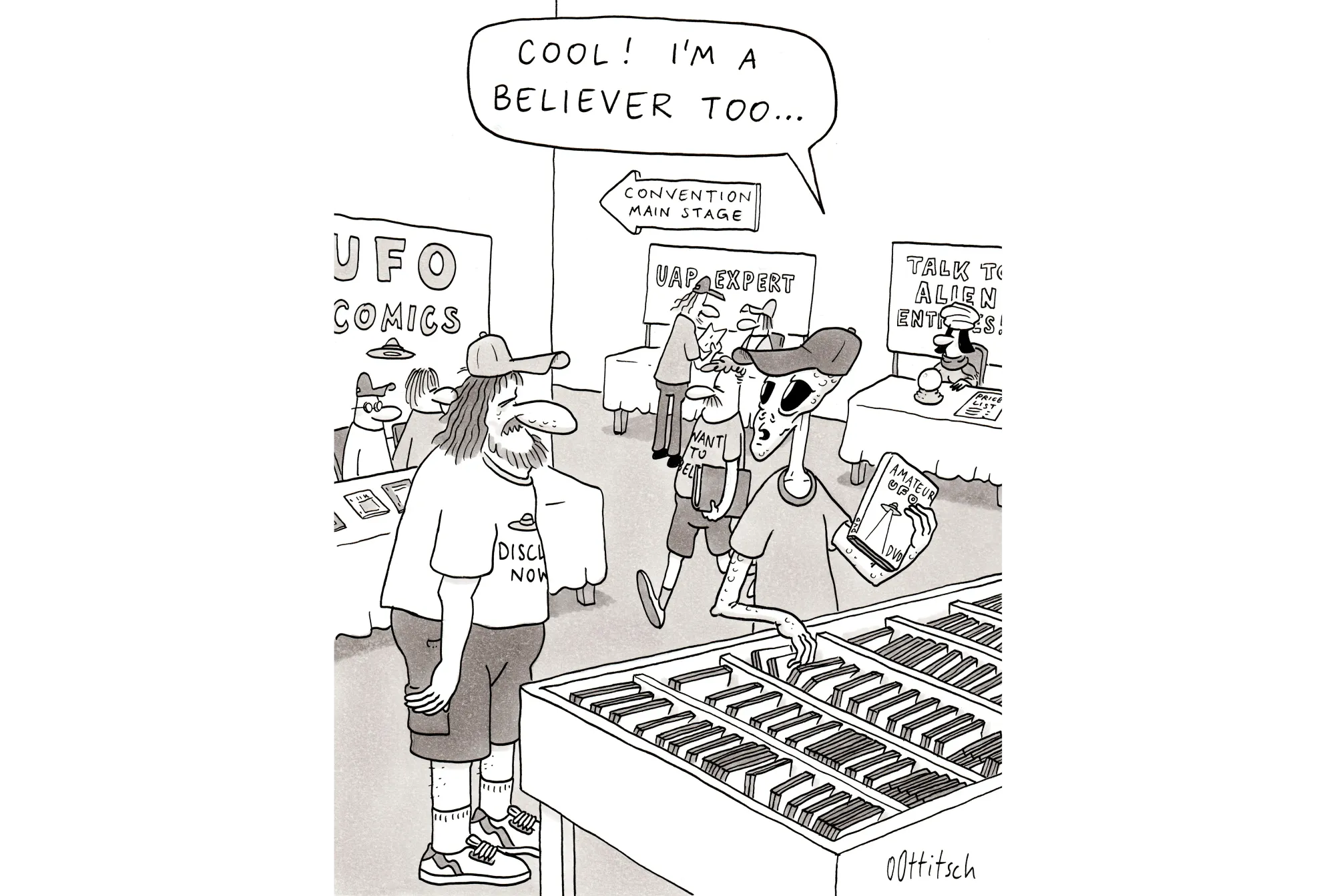
What is the result of all this information overload, confusion, and infighting? Speaking personally, I’m fatigued. Moreover, I see from social media that other people are fatigued too. I’m a free speech absolutist, so I’m certainly not advocating any controls on this. I completely reject the idea (which has been floated several times over the years) that ufology should set up some sort of governing body, or somehow police itself. After all, who gets to decide who’s on the governing body, and quis custodiet ipsos custodes?
There are other developments that give me cause for concern. One of them relates to a couple of narrative shifts that I’ve noticed creeping into the topic.
Ufology has always been a big tent. In whistleblower David Grusch’s testimony to Congress, and in some of his media interviews, he used the terms “nonhuman” and “non-human intelligence.”12 In the Schumer-Rounds Amendment (a legislative proposal intended for insertion into FY2024 NDAA, but which did not find its way into the final bill), the term “non-human intelligence” was used multiple times.13 Grusch has said that this leaves the door open for other possibilities aside from the extraterrestrial hypothesis. And this has opened the door to some highly speculative discussions about cryptoterrestrials, ultraterrestrials, extratempestrials, and interdimensionals. It’s also led to something a little more on the dark side, with a theological bent.
The idea that aliens are fallen angels, or demons, isn’t new. But this once-niche theory has gotten a little more traction lately. Luis Elizondo has previously told the story of how, when he lobbied a senior Pentagon official to take more action over UAP, the official told him he should read his Bible. This appeared to reflect a belief that some aspects of UAP are demonic and that to study it would be to give it energy and feed it.
Such opinions have gained more mainstream traction with Representative Marjorie Taylor Greene expressing the views that aliens could be fallen angels,14 while high-profile broadcaster Tucker Carlson has also talked about UAP in terms of spiritual forces and entities like angels and demons.15 All of this plays into a neoreligious interpretation of ufology. Chris Bledsoe—author of UFO of God—talks about how an entity he dubs “The Lady” told him how glowing orbs would intervene to stop the missiles if Israel and Iran go to war. There’s an “end times” theme to a lot of this.16
Again, as a free speech absolutist, I wouldn’t dream of telling people what they can and can’t say about UAP, let alone what they should believe. Again, I’m merely commenting on the current state of play and expressing a personal opinion that I think some of the current narrative isn’t necessarily healthy or helpful. And I certainly doubt that it holds any validity.
Another narrative shift is the use of the term “psionics”—the idea that one can use the power of one’s mind to summon UAP. It’s a scientific-sounding term, but is it really that different from Steven Greer’s CE5 (Close Encounter of the Fifth Kind) protocols, whereby one can supposedly use meditation and other techniques to initiate contact with extraterrestrials? The danger, of course, is that certain individuals can then insert themselves as intermediaries; you can access the phenomenon, but only through them, because of their special abilities. Again, there’s a sort of quasi-religious, cultish feel to all this, in which one can only access the divine through the intermediary of the priest.
What does the future hold for ufology?
Given my assessment that ufology has to some extent moved from fringe to mainstream, but has hit some speed bumps, where do we go from here? I don’t have a crystal ball, but based on statements from a range of people involved in the process, it seems that further Congressional hearings and more whistleblowers would be a fairly good bet. The problem, of course, is that, short of a “smoking gun” (actual evidence and not just more stories), this runs the risk of reinforcing the view that it’s all talk and no action. Where’s the beef?
The Task Force on the Declassification of Federal Secrets is looking at UAP. There’s considerable overlap between personnel involved with the Task Force and personnel serving on the House Oversight Committee, which has been particularly vociferous on UAP. This brings up a potential problem, because while the Task Force is bipartisan, it skews toward Republicans. Thus, it wouldn’t take much to jeopardize the bipartisan nature of Congressional engagement, which would be a setback.
If Donald Trump’s presidency ends without disclosure, I’ll be 99.9 percent convinced that there’s nothing to disclose.
The UFO community continues to hope for Disclosure—the official acknowledgement of an extraterrestrial presence. The Age of Disclosure, a documentary produced by Dan Farah and released late in 2025 plays into this.17 So does Steven Spielberg’s upcoming film Disclosure Day.18 But it goes further than this, and 2027 is a potential date that’s been frequently mentioned.
Disclosure in 2027 would mean that Donald Trump would be the Disclosure President. There’s a curious kind of logic in this, because if there truly is a decades-long official cover-up of an extraterrestrial presence, the secret has been scrupulously kept by successive administrations of both political parties. By inference, therefore, the reasons for secrecy must be exceptionally compelling. Perhaps only a populist, maverick, second-term President would disclose in such circumstances—more so, given that Trump will soon be in his 80s and is doubtless mindful of his legacy. I agree that if the U.S. government is aware of an extraterrestrial presence, Trump is more likely than any previous president to spill the beans. President Trump has occasionally hinted that he’s privy to some interesting information about UFOs, but has yet to elaborate on the topic.19
Some argue that the secret of an extraterrestrial presence is kept even from presidents (perhaps to maintain plausible deniability) and is in the hands of an unelected set of gatekeepers, perhaps in the government, but possibly in the private sector. I find this unconvincing. Most Western governments operate on the basis of what the UK civil service calls the culture of “no surprises,” by which political leaders need to be briefed on all big, impactful issues that might require quick decisions and action.
If Donald Trump’s presidency ends without Disclosure, I’ll be 99.9 percent convinced that there’s nothing to disclose. I’d have to accept that if extraterrestrials are visiting Earth, nobody in the government is aware of it. The acceptance of such a state of affairs might actually be rather good for ufology. After all, while some conspiracies are real, most conspiracy theories are false, and encourage a negative, accusatory approach. Removing—or at least reducing—this mindset from ufology might lead to a healthier, less aggressive approach. It would also remove a lot of redundant effort, which could be better used elsewhere, such as in encouraging more scientists and academics to engage on the topic.
As I see it, ufology stands at an interesting crossroads. While some of the details remain disputed, the topic has undoubtedly transitioned from fringe to mainstream in the last few years. However, a mixture of information overload, infighting, and quasi-religious narratives may conspire to undo this progress. Allied to this, mainstream media interest in most topics waxes and wanes. The UFO community can’t expect their current fascination with the subject to last indefinitely. This is particularly true if Congressional engagement falls away, as it may well do if the perception is that the subject is becoming more partisan and more fringe, with the attendant dangers of reputational damage attaching to those Representatives who continue to express an interest.
Ufology has come out of the fringe and into the mainstream, but I believe there’s a distinct possibility that it will move out of the mainstream and back into the fringe.