What Media Consolidation Means for Our Reality
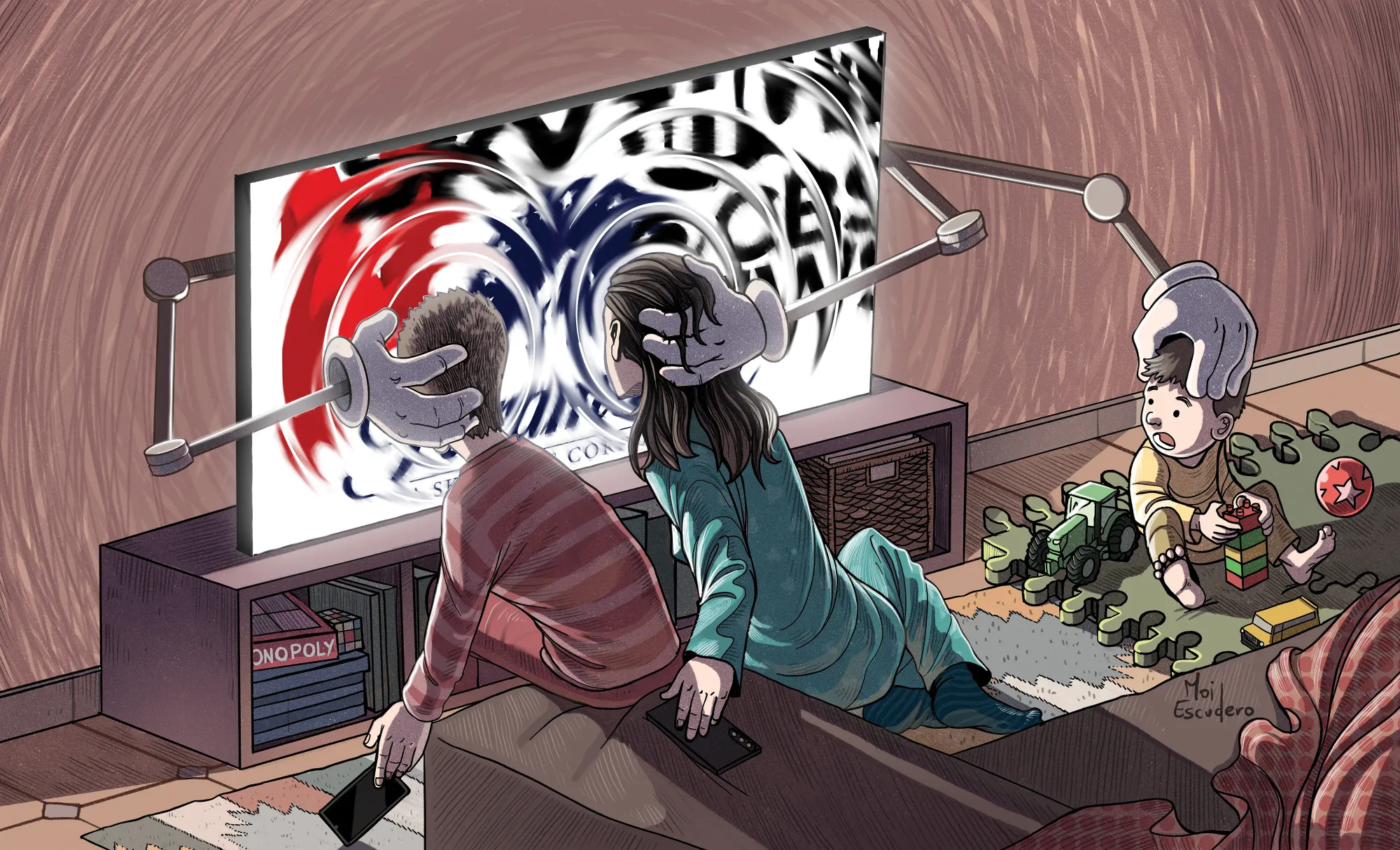
It’s been said that “He who controls the media controls the mind.” (Variously attributed to Jim Morrison of the rock band The Doors, along with Noam Chomsky.)
Whoever said it, billionaires seem to have taken it to heart. Elon Musk has made 𝕏 his “de facto public town square.” Jeff Bezos has The Washington Post. Rupert Murdoch continues to consolidate conservative media outfits via Fox and News Corp (which owns The Wall Street Journal, the New York Post, and HarperCollins). Mark Zuckerberg’s Meta has expanded from merely friending people on Facebook to Instagram, WhatsApp, and Threads. Brian Roberts’s Comcast is in charge of NBCUniversal, Sky News, Peacock, and Universal Pictures. And so on. Meanwhile, the Ellison family controls Paramount and CBS.
Recent headlines read like a game of high-stakes Pac-Man. Most notably, David Ellison’s Skydance Media merged with Paramount Global, bringing CBS, Paramount Pictures, MTV, Nickelodeon, and other assets under its new entity, Paramount Skydance Corporation. Then Paramount Skydance proceeded to buy The Free Press for some $150 million—putting its founder, Bari Weiss, at the helm of CBS News as its new Editor-in-Chief (she also retains her role at The Free Press).
Meanwhile, Netflix is in an $82.7 billion definitive agreement to acquire Warner Bros. Studios (subject to regulatory approvals), but not if Paramount Skydance can help it, with a lawsuit in place against the venerable studio alleging that the Netflix deal lacked transparency and that the Warner Bros. board has ignored higher offers from Skydance (the board has repeatedly rejected Skydance’s offers in support of the Netflix deal). The matter is currently in dispute, but if Paramount Skydance manages to win, it would have control over a giant piece of the media apparatus—including both CBS News and CNN.
And then there’s the recent forced sale of TikTok U.S. to an American entity. The deal creates a new U.S. joint venture where a consortium of investors led by Oracle Corporation, Silver Lake Technology Management, and MGX Fund Management Limited will hold a 50 percent stake, while ByteDance retains a 19.9 percent minority interest.
This marks a fundamental restructuring of the media landscape. Is it good for the public?
On the one hand, it’s possible that audiences will be pleased with having access to larger content libraries from a single provider, though Netflix is likely to raise its prices for the privilege of being able to share HBO’s “It’s not TV” content with them. Given its market share and massive content library, Netflix will sit firmly in the driver’s seat when negotiating acquisition costs and more.
It also means that Netflix could control 30–40 percent of all paid streaming in the U.S., according to analysts. This move risks creating a content monoculture where data-driven algorithms, rather than creative risk, dictate what gets made, especially given Netflix’s streaming-forward model, rather than a focus on theatrical releases. This new layout also makes it incredibly difficult for mid-sized companies with less capital to acquire attractive content and compete with existing massive IP libraries, and creates a near monopoly on content: a few giants at the helm, with only smaller, niche creators, podcasters, and independent outlets left on the margins. It also means that filmmakers have fewer options for their projects.
In fact, Netflix already offers a preview of what a fully consolidated media environment looks like in practice. Netflix has become infamous for canceling series after one or two seasons, often despite strong critical reception or dedicated audiences. Shows like Mindhunter, 1899, Glow, and Archive 81were all discontinued without narrative resolution. In several cases, creators later stated that the shows met or exceeded traditional benchmarks of success but failed to satisfy Netflix’s internal metrics for rapid audience growth and completion rates. The result is a cultural landscape littered with unfinished stories. Viewers learn, over time, that emotional investment is risky. Storytelling itself becomes provisional and disposable.
Genres proliferate, aesthetics vary, but narrative structures converge.
This incentive structure also shapes how stories are told. Former Netflix writers and executives have described internal guidelines that prioritize early engagement above all else. As a result, many Netflix originals front-load dramatic events—major chases, twists, or revelations often occur within the first five to ten minutes of an episode. Compare this to earlier television and feature films, where narrative tension was allowed to accumulate gradually, and climactic moments were often reserved for the end.
Dialogue has changed as well. In series such as The Witcher or You, key plot points are frequently repeated verbally, sometimes multiple times within the same scene. This is not accidental. Matt Damon, while promoting his new Netflix film The Rip, has mentioned that they’ve had discussions with the streamer about ensuring that the plot is restated “three or four times in the dialogue” to address the fact that many of the viewers are simultaneously on their phones while watching.
A number of writers have also openly noted that scripts are being increasingly optimized for distracted viewing. In other words, they are designed to be intelligible even when audiences are scrolling on their phones or half-paying attention. Subtle visual storytelling gives way to explicit exposition, because ambiguity does not perform well in engagement data. And Netflix is quite data driven indeed.
Over time, this produces a subtle form of cultural monoculture. Genres proliferate, aesthetics vary, but narrative structures converge. The result is a narrowing of how storytelling is constructed. Novelty is cosmetic and experimentation is constrained by metrics designed to optimize retention rather than meaning.
For most of television history, this logic would have been alien. In the broadcast era, shows were often allowed to fail slowly or to grow into themselves. Series such as The Wire, Breaking Bad, and Mad Men all struggled initially to attract large audiences, despite being critically acclaimed. The Wirein particular was never a ratings success during its original run, yet it survived because executives believed in its long-term cultural value and its ability to enhance the network’s reputation. Success was measured over years, not weeks, and shows were allowed to develop complexity that only made sense in retrospect. Creative risk was tolerated because it signaled seriousness, ambition in storytelling, and—significantly—trust in the audiences. Initially a modestly performing niche show, Mad Men saw a 63 percent increase in viewership by its second season alone and went on to become a cultural phenomenon.
HBO famously framed itself not as television, but as something adjacent to cinema—summed up in its slogan, “It’s not TV.” The network accepted that certain shows would never be mass hits, but would instead function as prestige anchors, shaping brand identity and attracting subscribers indirectly. A series like The Sopranos justified risks taken elsewhere; Six Feet Under or Deadwoodexisted because the ecosystem allowed for uneven returns. FX’s The Americans showrunners—Joel Fields and Joe Weisberg—had chosen to end the show on its sixth season—something they had announced during the fourth, which allowed them to plan their storytelling and provide a proper ending.
In that environment, creative autonomy was not merely tolerated but protected. Writers could trust that if an audience existed—even a modest one—it would be allowed to find the work. Today’s streaming platforms invert that logic. Instead of prestige underwriting experimentation, experimentation must justify itself instantly in data. What once functioned as cultural capital has been replaced by performance analytics, and patience has been redefined as inefficiency.
Of course, the issue drawing the most attention and concern is how this consolidation will affect who controls the narrative and how it is shared.
When only a handful of entities control the information available to us about the world around us, how can we make informed decisions about its future?
In particular, a lot of attention has surrounded the acquisition of CBS and the installment of Bari Weiss as its Editor-in-Chief. Proponents see this as a positive move that will help CBS become a more ideologically moderate—or centrist—outlet, creating a legacy broadcast network that appeals to and serves everyone on the political spectrum, not just those who lean left.
Critics, meanwhile, are concerned that the outlet will reflect the ideological leanings of its new owner, sympathetic to the current U.S. administration. As evidence, they point to the last-minute pulling and postponement of a 60 Minutes segment on the Trump administration’s deportations of Venezuelan migrants to El Salvador’s CECOT prison, with reports of internal tension around the ongoing delay. When the segment did eventually run, some critics noted that it didn’t contain additions that justified delaying it and argued it was intentionally aired during an NFL playoff.
To many of Weiss’s detractors, this seems to serve as a confirmation of what they believed all along—that Weiss is the mouthpiece of the Trump administration, intentionally put in place by Ellison to promote specific narratives. They point to her tenure at The Free Press, where sustained criticism of Trump has been less prominent.
Her proponents disagree, and claim that she was merely ensuring the coverage was balanced and provided an opportunity for the administration to respond to various claims—as per journalistic standards that they feel have been replaced by bias and activism elsewhere. They also note that none of the recent hires brought into CBS under Weiss could reasonably be described as MAGA.
It’s possible that Weiss is genuinely striving to bring a balanced perspective to CBS News, without ulterior motives or loyalties. Yet the network’s legacy audience is likely to remain skeptical, and many may drift away. Weiss’s goal appears to be attracting a more centrist, moderate audience—both left- and right-of-center—but in today’s polarized media landscape, many viewers seek content that aligns with their existing perspectives. In the first week under new editorial leadership, for example, CBS Evening News saw viewership drop 23 percent compared to last year, which signals, at the very least, a steep adjustment period.
Mainstream media has generally leaned left, with exceptions such as The Wall Street Journal and the New York Post. Hollywood, too, has remained largely left-leaning, which makes the recent acquisitions all the more significant when it comes to shaping culture. The right-wing media ecosystem has expanded beyond Fox with a strong presence in the online world.
In a recent article about Bari Weiss in The New Yorker, it was noted that her new role wasn’t necessarily a matter of a merely editorial choice. “Don’t think about it as David Ellison paying a hundred and fifty million dollars for The Free Press,” an unnamed industry exec said. “Think about it as a hundred and fifty million dollars on top of the price they paid for Paramount. It was basically the cost to get it to go through.” Whether that’s true will continue to be debated.
As more media outlets consolidate into the hands of a few, the number of voices shaping what we see and hear shrinks.
But as I mentioned earlier, whatever the ideology, what matters isn’t who owns which outlet, but that ownership itself is converging—across news, entertainment, and social platforms—into a single layer of influence.
When ownership is diverse, multiple perspectives can still compete for public attention. But as more media outlets consolidate into the hands of a few, the number of voices shaping what we see and hear shrinks, from news and opinion reporting to entertainment in the case of Netflix, Paramount, etc.
Our ability to understand the world from multiple perspectives diminishes, and our view of reality becomes narrower. When only a handful of entities control the information available to us about the world around us, how can we make informed decisions about its future?