Why Shermer Misfires on The Age of Disclosure
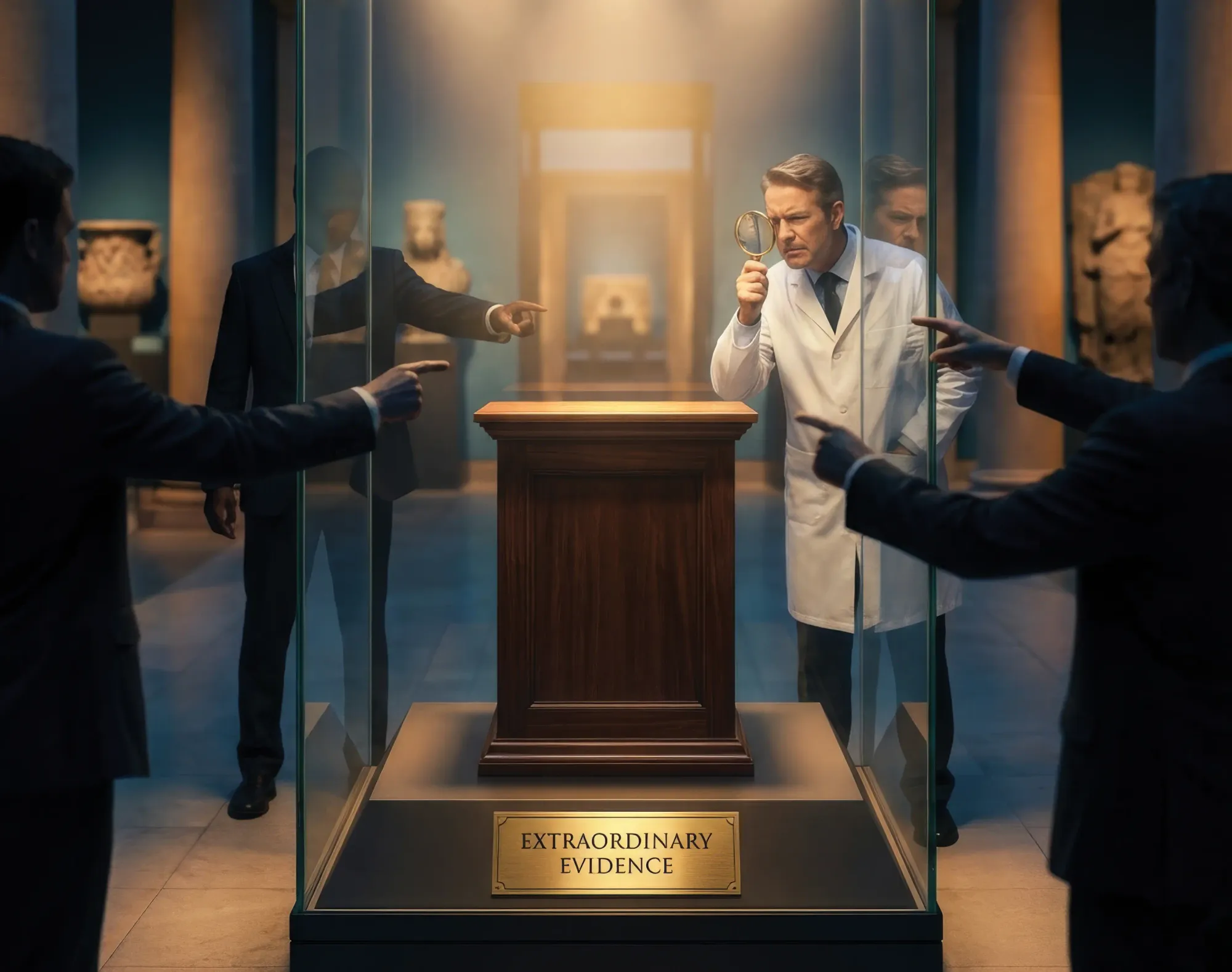
The Flawed Assumption Behind Skeptical Demands for Better Evidence
In his review of The Age of Disclosure for Skeptic, Michael Shermer reprises a familiar refrain: Until there’s a “type specimen,” a craft or body we can all examine, rational people should withhold belief.
On some level, that’s an understandable demand. Everyone serious about this topic wants publicly inspectable evidence. I do too. But beneath Shermer’s argument sits a quiet assumption that badly distorts his analysis: He treats any nonhuman intelligence, and any deeply compartmented program studying it, as if they must behave in ways tailored to our evidentiary expectations, our scientific culture, and our detection capabilities.
Once you notice that assumption, much of the review stops looking like hard-nosed empiricism and more like anthropocentrism.
Shermer complains that The Age of Disclosure contains “nothing new,” that “every fact, opinion, or anecdote … has been rehearsed elsewhere,” and that viewers are “always left wanting.” In a narrow sense, he’s right: The documentary does not unveil a crashed saucer on the Capitol lawn. But the claim that the documentary brings “nothing new” is also overstated. It offers fresh testimony, new on-record statements, and the clearest insider depiction yet of how the legacy crash-retrieval program is structured. But the deeper point is that novelty isn’t the right metric here. The real shift comes from the cumulative convergence: Inspector General (IG) complaints, congressional hearings, whistleblower protections, legislative text, and now a documentary that brings these strands into public view. Together they mark a substantive change in the evidentiary landscape, regardless of whether some of the names are familiar.
I’ve argued before that once you put the pieces together—David Grusch’s sworn testimony, corroborating statements from figures like Christopher Mellon and Luis Elizondo, the formal processes they triggered, and Congress’s bipartisan response—the “nothing to see here” hypothesis no longer looks like the simplest explanation. You do not have to conclude that every detail is true to recognize that “it’s all error, hoax, or delusion” now carries a heavy explanatory burden.
Shermer largely sidesteps that question and retreats to a more comfortable demand: Show us the specimen.
He reaches for a biological analogy: To name a new species, you must present a holotype everyone can see and examine. Otherwise, stories and grainy photos don’t cut it. From there he insists: “What scientists and skeptics are asking of the UFO and UAP community is to, at long last, show us the evidence … just show us what you claim is here and we will all believe. QED!”
The analogy sounds reasonable until you remember where the strongest UAP claims are actually located: not in the wild, but in the most tightly controlled corners of the U.S. national security state. We are not talking about zoologists stumbling on a primate in the Congo. These alleged crash-retrieval and reverse-engineering efforts were designed from the outset to be sequestered behind unacknowledged special access programs (SAPs), contractor firewalls, and classification regimes that exist precisely to prevent specimens from becoming public.
Shermer acknowledges that key witnesses in the film—Hal Puthoff, Eric Davis, Jay Stratton—explicitly say the best evidence remains classified. Stratton even states on camera: “I have seen with my own eyes nonhuman craft and nonhuman beings,” adding that “the clearest videos [and] best evidence … remains classified.” Shermer’s response is essentially: If I can’t see it too, I’m not obliged to update.
But that simply restates the problem. When the alleged artifacts and data are held by institutions whose very purpose is to control access, the absence of a holotype in the public domain is not a neutral fact. It’s exactly what you’d expect if (a) some version of these programs exists and (b) classification is doing its job.
In my published exchange with skeptic Mick West, I tried to make this point as clearly as possible: In domains dominated by secrecy and compartmentalization, the evidential regime is different. You will not get a lab-bench specimen first; you will get whistleblowers, classified briefings, oversight activity, legal frameworks, and institutional behavior that starts to look very strange if you insist there is “nothing there at all.”
Shermer, by contrast, behaves as though the only evidence that counts is the one form that, by design, is least likely to appear.
The anthropocentrism becomes even clearer when he leans into rhetorical questions. He quotes pilot Ryan Graves’s statement that UAP were “ubiquitous” and seen “almost daily,” then argues that if this were true, “there should be thousands of clear and unmistakable photographs and videos” from passengers with smartphones—yet “to date there is not one. Nada. Zilch. Here the absence of evidence is evidence of absence.”
Shermer’s favorite refrain—“just show us the evidence or we’ll remain unconvinced”—is not the neutral, scientifically modest stance it appears to be.
That inference only works if you assume several things he never justifies:
- that the phenomenon presents itself regularly in commercial airspace rather than primarily in restricted or sensitive military zones
- that it emits signatures easily captured by consumer cameras at distance and speed
- that it does not meaningfully control when, where, or how it is visible.
If we’re dealing with advanced, maneuverable craft—human or otherwise—that can outfly F-18s and play tag with carrier groups, it is hardly obvious that iPhone videos from 30,000 feet should be abundant. Shermer treats our existing sensorium and consumer devices as the default epistemic filter of the universe. Anything that doesn’t easily show up there is treated with suspicion.
But that’s exactly the point: If the phenomenon is technologically and informationally asymmetric, absence of public footage is a very weak indicator of absence in reality. That’s true even if you imagine purely human black platforms; it is doubly true if you grant the possibility of nonhuman systems capable of managing their own observability.
The same pattern appears in his treatment of nuclear questions. The film notes that UAPs have allegedly interacted with nuclear weapons systems in both the U.S. and Russia. Shermer’s response is to ask: Where were the aliens in 1945? Why didn’t they prevent Hiroshima and Nagasaki, or halt nuclear testing in Nevada and the South Pacific?
According to him, if they’re here and care about nukes, they should have intervened in the specific, morally satisfying ways we imagine we would in their place. Because they did not, their involvement is doubtful.
That’s hardly an argument from evidence. It’s a projection of human ethics and narrative expectations onto unknown others. A nonhuman intelligence might operate under noninterference principles, long-term observational strategies, constraints we don’t understand, or values that don’t map cleanly onto our own. “They didn’t stop Hiroshima, therefore they’re probably not here” tells us far more about our moral imagination than about the structure of reality.
Even the old skeptical jab—“Why do they keep crashing?”—rests on a similar symmetry assumption. Shermer jokes that if these craft are capable of “antigravity propulsion systems” that can cross the galaxy, we should not see them “slamming into the ground” in New Mexico.
But this presumes we know the accident rate of whatever is behind the phenomenon, the purpose of those incursions, the nature of the vehicles (probes? decoys? testbeds?), and the relevant physical constraints. We don’t. As long as the core claims remain at least partly testimonial, there will be room for speculative explanations: misidentification, deliberate seeding, hostile action, technological failure, or any combination of the above. Simply appealing to how “they ought to behave” is not a serious refutation.
Shermer is on firmer ground when he reminds readers that 90 to 95 percent of UFO reports are explainable as ordinary phenomena: weather balloons, Venus, drones, planes, atmospheric optics, the usual catalogue. That has been common ground between serious ufologists and skeptics for years. The dispute is about the residue—the genuinely anomalous cases, and now, more importantly, the institutional claims about programs built around them.
Here again, his evidential expectations are tuned to the wrong domain. The All-domain Anomaly Resolution Office (AARO) report he cites, which found “no evidence” of legacy crash-retrieval programs and attributed the claims to misidentified events and circular reporting, looked only within compartments it could see and relied on the cooperation of entities that, if a covert program exists, would have strong incentives to minimize or obfuscate.
Unacknowledged SAPs can be hidden through contractor structures, budget games, and narrow read-ins even from senior officials. Christopher Mellon has publicly described these mechanisms. Grusch’s IG complaint was, in essence, a claim that such a program had evaded normal oversight via exactly those methods. Treating a single formal inquiry, bound by the very structures under suspicion, is institutional deference more than it is good-faith skepticism.
Shermer’s favorite refrain—“just show us the evidence or we’ll remain unconvinced”—is not the neutral, scientifically modest stance it appears to be. It smuggles in a picture of the world where:
- advanced programs cannot remain compartmentalized for decades
- nonhuman intelligences, if they exist, would choose to satisfy our public-facing evidentiary norms
- human institutions responsible for the most sensitive technologies would voluntarily hand over specimens once asked nicely.
That picture is, at best, an article of faith about how the universe and the national security state ought to behave.
I share Shermer’s desire for decisive, public proof. If a crash-retrieval and reverse-engineering ecosystem really does exist, nothing would be more important than prying its artifacts, data, and history into the open, under democratic control. The scientific and societal implications would be staggering.
But we don’t get to dictate how reality presents its secrets. In domains shaped by secrecy, asymmetric technology, and potentially nonhuman agency, absence of iPhone videos and lab-bench specimens is not the trump card Shermer takes it to be.
The right question is no longer “Why haven’t I seen the holotype?” It’s “Given what we now know about whistleblowers, oversight activity, and the internal signals coming from within the system itself, is ‘nothing at all is going on here’ really the most plausible story left on the table?”
I don’t think it is. And you don’t need aliens to cooperate with our evidentiary preferences to see why.