Why UAPs? Why Now?

How a Fringe Movement Became a National Conversation at the Highest Levels of Society and Government
The new documentary film by Dan Farah, The Age of Disclosure, has been widely reviewed in mainstream media (CNN, Fox News, News Nation, The New York Times, The Guardian, etc.) and intensely discussed not only on popular podcasts with UFO enthusiasts but at the highest levels of government with comments by President Trump and an exclusive interview on Fox News by Sean Hannity with Secretary of State Marco Rubio, who clarified that the film had been selectively edited to make it seem like he knows more than he does about the phenomena, now known as UAPs, or Unidentified Anomalous Phenomena, so designated to mark the transition of this once fringe movement into mainstream conversation. How did this happen … and why?
In this excerpt from my book, Truth, I will give a general overview of the UFO/UAP phenomena, explain why most scientists and journalists reject the evidence (that consists almost entirely of grainy videos, blurry photographs, and anecdotes about strange lights in the sky) and remain skeptical, discuss the accusations of a government cover-up of the evidence and a secret Pentagon crash-retrieval program, and offer a sociocultural explanation for how and why all this unfolded as it did and what the deeper quasi-religious motivations might be for belief in a higher power come to Earth to rescue humanity from itself.
The Residue Problem
In Leslie Kean’s 2010 book UFOs: Generals, Pilots and Government Officials Go on the Record, the ufologist admitted that “roughly 90 to 95 percent of UFO sightings can be explained” as:
weather balloons, flares, sky lanterns, planes flying in formation, secret military aircraft, birds reflecting the sun, planes reflecting the sun, blimps, helicopters, the planets Venus or Mars, meteors or meteorites, space junk, satellites, swamp gas, spinning eddies, sundogs, ball lightning, ice crystals, reflected light off clouds, lights on the ground or lights reflected on a cockpit window, temperature inversions, hole-punch clouds, and the list goes on!1
So the entire extraterrestrial hypothesis for explaining UFOs and UAPs is based on a residue of data left over after the above list has been exhausted. What’s left? Not much.
Kean opens her exploration “on very solid ground, with a Major General’s firsthand chronicle of one of the most vivid and well-documented UFO cases ever”—the UFO wave over Belgium in 1989–1990. That Major General is Wilfried De Brouwer, and here is his recounting of the first night of sightings:
Hundreds of people saw a majestic triangular craft with a span of approximately a hundred and twenty feet and powerful beaming spotlights, moving very slowly without making any significant noise but, in several cases, accelerating to very high speeds.
First, how does he know it had a span of 120 feet? What measurement instrument was used? Questions that if answered could lead us to truth about this UFO sighting. Regardless, even seemingly unexplainable sightings such as De Brouwer’s can have quotidian explanations. Perhaps it was an early experimental model of a delta-wing bomber (U.S., Soviet, or otherwise) that secret-keeping military agencies were understandably loath to reveal. Or maybe it was three sources of aerial lights (flares? small planes?) that from the perspective of a ground observer appeared triangular shaped, with the mind filling in the space in between the lights.
The one and only photograph associated with the Belgian event seems to show a triangular shaped craft, but UFO investigator Robert Sheaffer reports that it was, in fact, a faked photograph of a small styrofoam model with three spots affixed to it.2 According to the Belgian news organization RTL, it was hoaxed by a 20-something man named Patrick:
A DIY, done in a few hours and photographed in the evening, a joke, inspired by the UFO wave born a few months earlier, which targeted the friends of the small company where Patrick worked. But now, the joke will leave the walls of the factory. “We didn’t think it would come out of the factory where we worked. It went much further and then we let it go,” admits Patrick.3
Since the fake photograph was inspired by “real” sightings, we still need to deal with those in order to get to the truth, so let’s compare De Brouwer’s narrative above to Kean’s summary of the same incident:
Common sense tells us that if a government had developed huge craft that can hover motionless only a few hundred feet up, and then speed off in the blink of an eye—all without making a sound—such technology would have revolutionized both air travel and modern warfare, and probably physics as well.
Note how de Brouwer’s 120-foot craft becomes “huge” in Kean’s retelling, how “moving very slowly” was changed to “can hover motionless,” how “without making any significant noise” shifted to “without making a sound,” and how “accelerating to very high speeds” was transformed into “speed off in the blink of an eye.” This language transmutation is common in UFO narratives, making it harder for scientists and skeptics to provide natural explanations.
Pilots, Astronauts, and Eyewitness Accuracy
One reason for Kean’s confidence in her assertion that at least some UFOs and UAPs represent alien spacecraft is that she thinks pilots and astronauts “represent the world’s best-trained observers of everything that flies. What better source for data on UFOs is there? ... [They] are among the least likely of any group of witnesses to fabricate or exaggerate reports of strange sightings.”
Is that true? Consider this assessment by the renowned astronaut and pilot Scott Kelly, at a NASA press conference dealing with the latest flap of UAP sightings, who threw cold water on the myth of extraordinary perceptual powers of pilots and astronauts (condensed and edited for style and clarity):4
In my experience of flying over 15,000 hours in 30 something years in airplanes and in space, the environment that we fly in is very conducive to optical illusions, so I get why these pilots would look at that Go Fast video and think it was going really, really fast. I remember one time I was flying off Virginia Beach Military operating area, and my RIO [Radar Intercept Officer], who sits in the back of the Tomcat, was convinced we flew by a UFO. I didn’t see it, so we turned around to go look at it. It turns out it was a Bart Simpson balloon.
My brother Mark Kelly, a former NASA astronaut and also now a U.S. Senator, shared a story with me about an experience he had years ago when he was the commander of STS 124. They were getting ready to close the payload bay doors of the Space Shuttle and they saw something in the payload bay that they thought was a tool, or maybe a bolt—they couldn’t quite figure it out—and they were potentially going to have to do a spacewalk to retrieve it. But before they did that my brother grabbed the camera and they took a picture of it, and when they blew up the picture they realized that it was not a bolt or a tool in the payload bay; it was actually the International Space Station that was 80 miles away.
There are cases where pilots have rendezvoused on a buoy because they thought that was their wingman. It’s just an extremely challenging environment to work, especially at night.
What does “real” mean?
When UFO enthusiasts breathlessly state that this latest wave of UAP sightings was confirmed as “real” by no less an authority than The New York Times, the assumption is that the “paper of record” launched an investigation of its own, independent of ufologists.
That is not what happened. If you check the byline for that and related articles in that paper, one of the coauthors is none other than Leslie Kean, who as we have seen is anything but a neutral and objective narrator of the UFO phenomena and the government’s response to it. (Kean has since written a book and produced a Netflix documentary series called Surviving Death, on Near-Death Experiences and the afterlife.5) Although coauthor Helene Cooper does work for the paper as a correspondent for Pentagon matters, the other coauthor, Ralph Blumenthal, left the paper in 2009 and wrote a book titled The Believer: Alien Encounters, Hard Science, and the Passion of John Mack, the late Harvard psychiatrist who uncritically accepted alien abduction stories as accounts of real close encounters of the fourth kind.6 And while The New York Times article was an accurate work of reportage as far as it goes, it didn’t go very far, quoting only one skeptic, James Oberg. This was at least better than 60 Minutes in their coverage of the UAP flap that astonishingly—given their reputation as one of the most respected sources in all media—failed to interview a single scientist or skeptic familiar with the sightings under investigation.
When UFO believers and the general public hear the word “real,” their brains tend to autocorrect to “alien” or “Russian or Chinese assets,” instead of an ordinary effect of cameras and visual illusions or, simply, unexplained anomalies.
60 Minutes’ correspondent Bill Whitaker asked Lue Elizondo, who directed the Pentagon’s Advanced Aerospace Threat Identification Program (AATIP), “So what you are telling me is that UFOs, Unidentified Flying Objects, are real?” Elizondo replied: “The government has already stated for the record that they’re real. I’m not telling you that. The United States government is telling you that.”7
The word “real” is doing a lot of work here. No one—not the media, not the military, and certainly not the United States government—is saying that these sightings represent real alien visitors. What they are confirming as “real” is the videos themselves, as representing something out there in the world (and not a fake video or hoaxed CGI production). But when UFO believers and the general public hear the word “real,” their brains tend to autocorrect to “alien” or “Russian or Chinese assets,” instead of an ordinary effect of cameras and visual illusions or, simply, unexplained anomalies.
In my own classification system to explain UFO and UAP sightings, I distill them into three hypotheses: (1) Ordinary Terrestrial (balloons, camera or lens effects, visual illusions, etc.), (2) Extraordinary Terrestrial (Russian or Chinese spy planes or drones capable of feats of physics and aerodynamics unheard of in the U.S.), and (3) Extraordinary Extraterrestrial (alien intelligence). Let’s consider each of these hypotheses and see which one has the highest credence.
Ordinary Terrestrial
The first video in this latest UFO/UAP flap was that of Lt. Commander Alex Dietrich, who reported seeing an unidentified aircraft about 70 miles west of San Diego in 2004. Her explanation of what she thinks she saw is emblematic of the entire phenomena and reinforces my point about the residue problem: “Just because I’m saying that we saw this unusual thing in 2004, I am in no way implying that it was extraterrestrial or alien technology or anything like that,” adding that “I think that the [U.S. government] report’s going to be a huge letdown. I don’t think that it’s going to reveal any fantastic new insight.”8 Indeed, the report was predictably unrevealing of anything alien.
The three most widely viewed and discussed videos were filmed by infrared cameras mounted on Navy F/A-18 jets over the Atlantic seaboard and off the coast of San Diego. They were taken by the Navy Advanced Targeting Forward Looking Infrared (ATFLIR) camera pods attached to the fuselage of the jets, and the videos are now known as FLIR/Nimitz/Tic Tac (San Diego, 2004), Gimbal, and Go Fast (Florida coast, 2015).
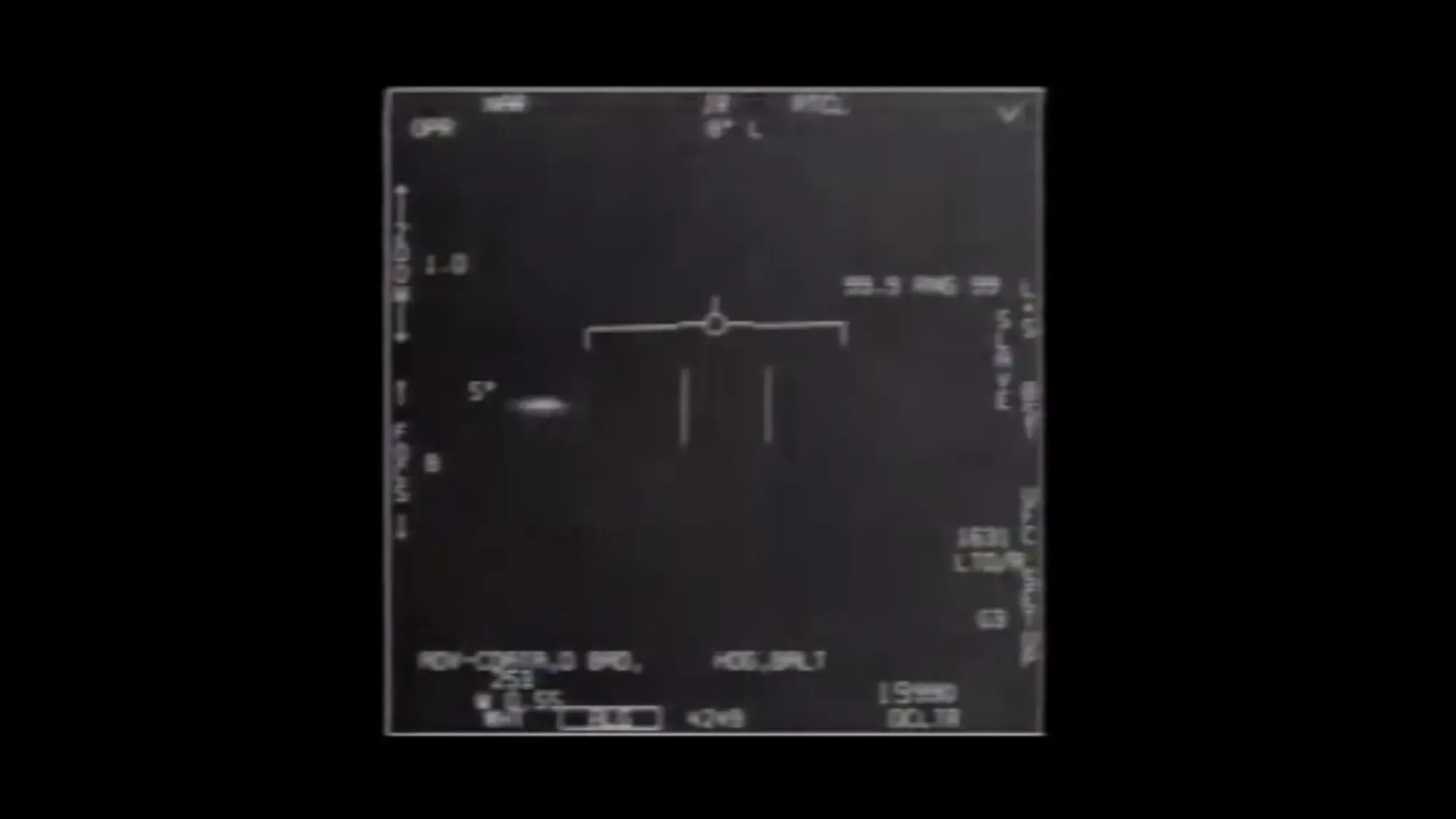
FLIR/Nimitz/Tic Tac (Figure 1) is the 2004 Nimitz video taken by Lt. Chad Underwood. According to Popular Mechanics, it first came to light in 2007 on a UFO website.9 It was elevated into public consciousness when it was reposted by The New York Times in Leslie Kean’s original article, then re-reposted in 2019 by the former Blink-182 front man guitarist Tom DeLonge’s UFO organization “To the Stars Academy of Arts and Science.”10 In response, the Navy acknowledged that the videos were “real,” meaning that they are real videos and not hoaxes.11 Finally, in 2020 the Pentagon re-re-reposted the three videos “in order to clear up any misconceptions by the public on whether or not the footage that has been circulating was real, or whether or not there is more to the videos.”12 So, when people talk about these “new” videos, they are anything but new.
The heavy lifting on analyzing these videos from the skeptical community was done by Mick West, a former video game designer, host of the Metabunk.org website and Tales From the Rabbit Holepodcast, and a former columnist for Skeptic magazine.13 It is a remarkable body of work that one can only hope the Pentagon has conducted at such a high level on its own, or at the very least considered West’s analyses as part of their investigations.
In the FLIR video, for example, the object appears to zoom almost instantly off the screen, interpreted by some to indicate extraordinary speed and turning ability far beyond anything our jets are capable of. Note that in the upper left of the screen the camera “zoom” indicator doubles from 1 to 2 at the moment the object “zooms” to the left. When West slowed down the video replay from zoom 2 to 1, the extraordinary maneuver becomes quite ordinary.
FLIR and Gimbal, says West, are what one would see if a jet were flying away from the camera, thus accounting for the eyewitness accounts that the object showed no directional control surfaces or exhaust. And their apparent shapes as saucer-like and “Tic Tac,” West continues, are due to glare on the lens of the camera. As he told the San Diego Union-Tribune reporter Andrew Dyer, “What we’re seeing in the distance is essentially just the glare of a hot object,” most likely that “of an engine—maybe a pair of engines with an F/A-18—something like that.”
(To be sure, not everyone accepts West’s conclusions. See, for example, ufologist Robert Powell’s analysis in his 2024 book UFOs,14 who told me “You are correct in your quoting of Mick. Whether his assertions are correct is very debatable.”15)
As well, West notes, sudden acceleration of the aircraft could cause the FLIR camera to lose lock on the object, thereby making it look like it is the object making extraordinary maneuvers. As he writes, “The supposed impossible accelerations in the Tic Tac video were revealed to coincide with (and hence caused by) sudden movements of the camera, leading to the conclusion that the object in the video was not actually doing anything special.”16
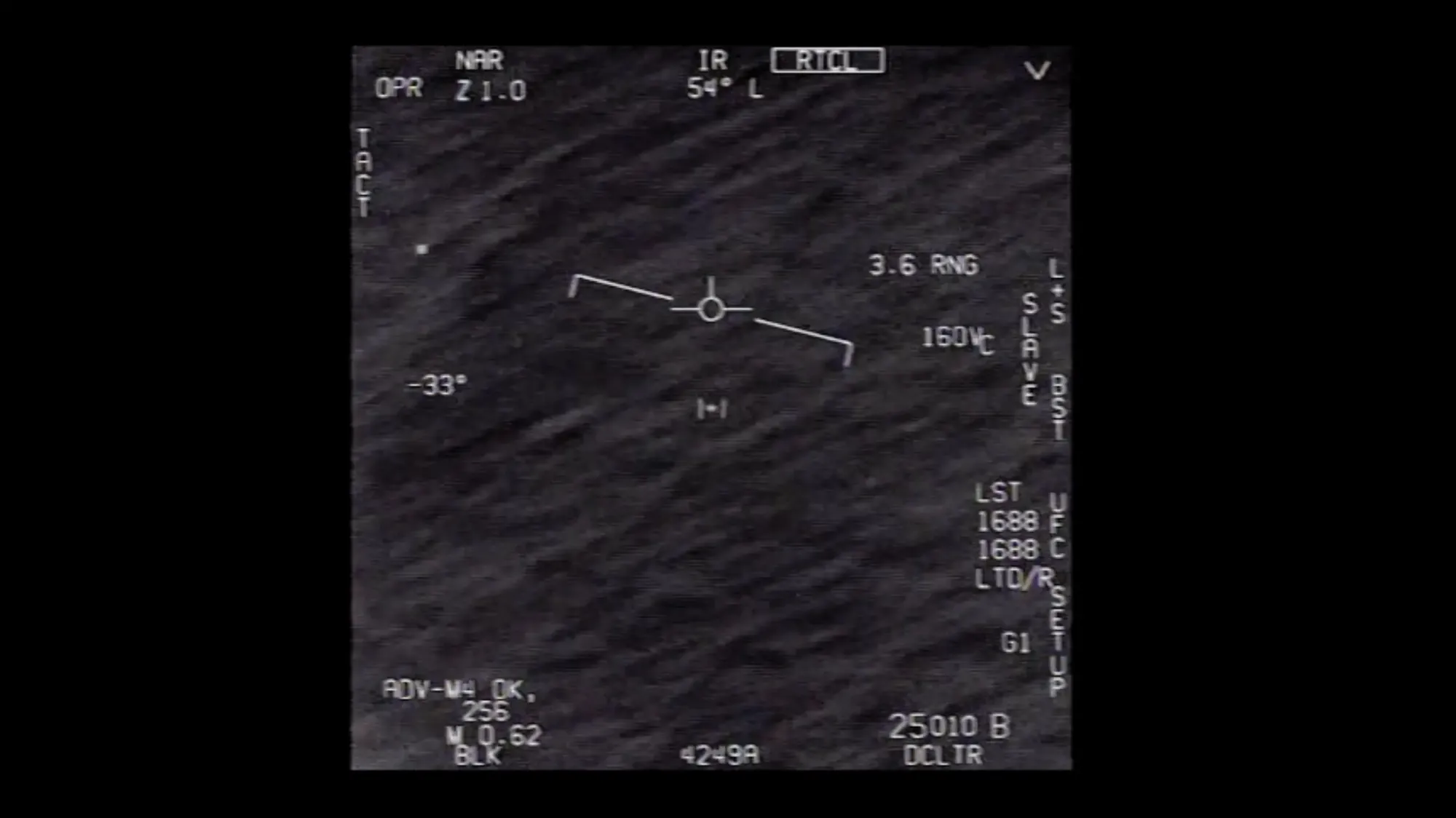
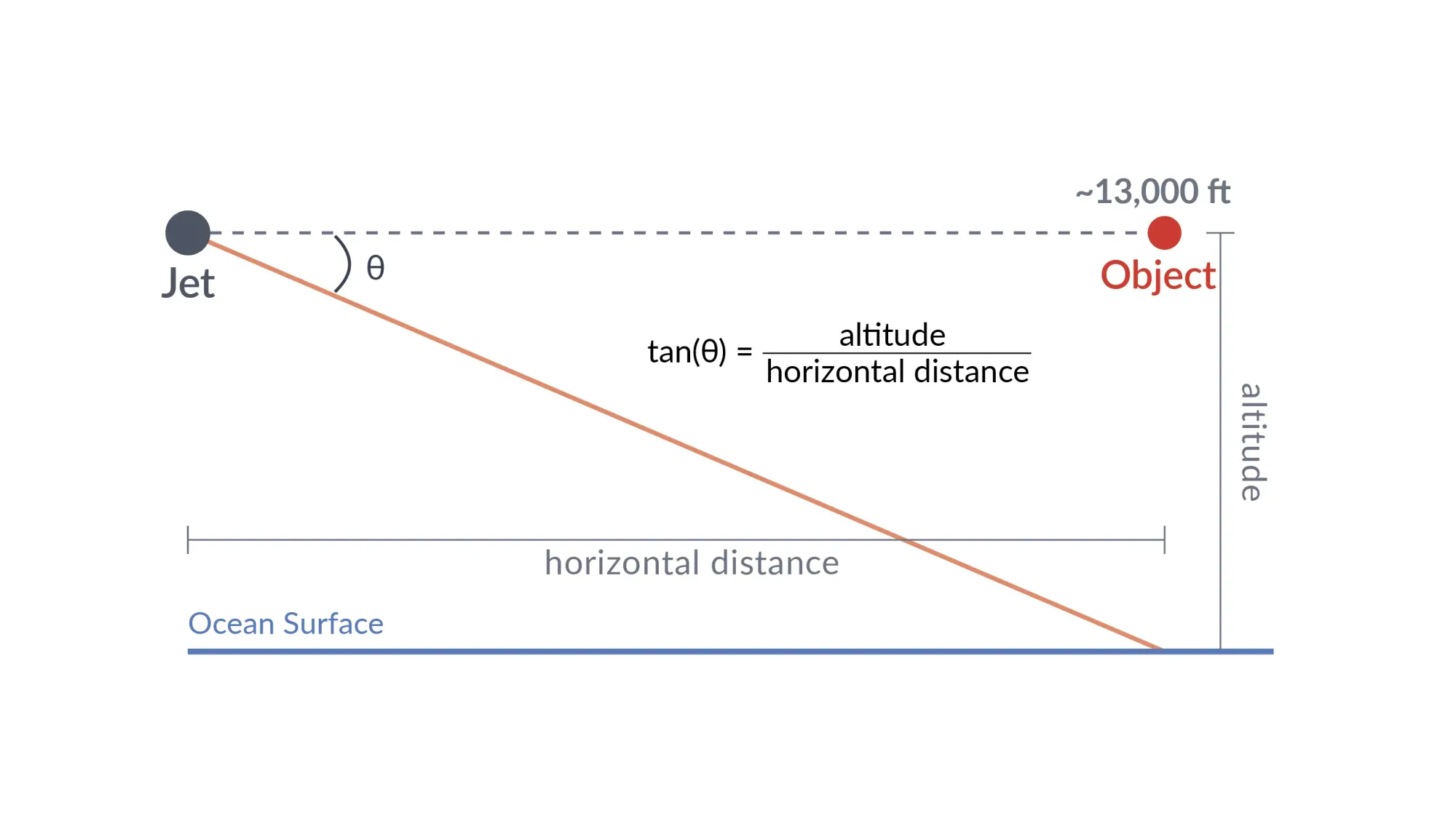
The Go Fast video (Figure 2a) purportedly shows an object with no heat source (and therefore propelled by some unconventional engine) that appears to move impossibly fast just above the surface of the ocean. West then conducted what he describes as “10th-grade trigonometry” to show that, in fact, the object was actually well above the ocean surface at around 13,000 feet (Figure 2b) and was probably just a weather balloon traveling at about 30–40 knots.17 “Because of the extreme zoom and because the camera is locked onto this object … the motion of the ocean in this video is actually exactly the same as the motion of the jet plane itself. You’re seeing something that’s actually hardly moving at all, and all of the apparent motion is the parallax effect from the jet flying by.”
Figure 3a. Mick West’s Gimbal analysis (YouTube video)
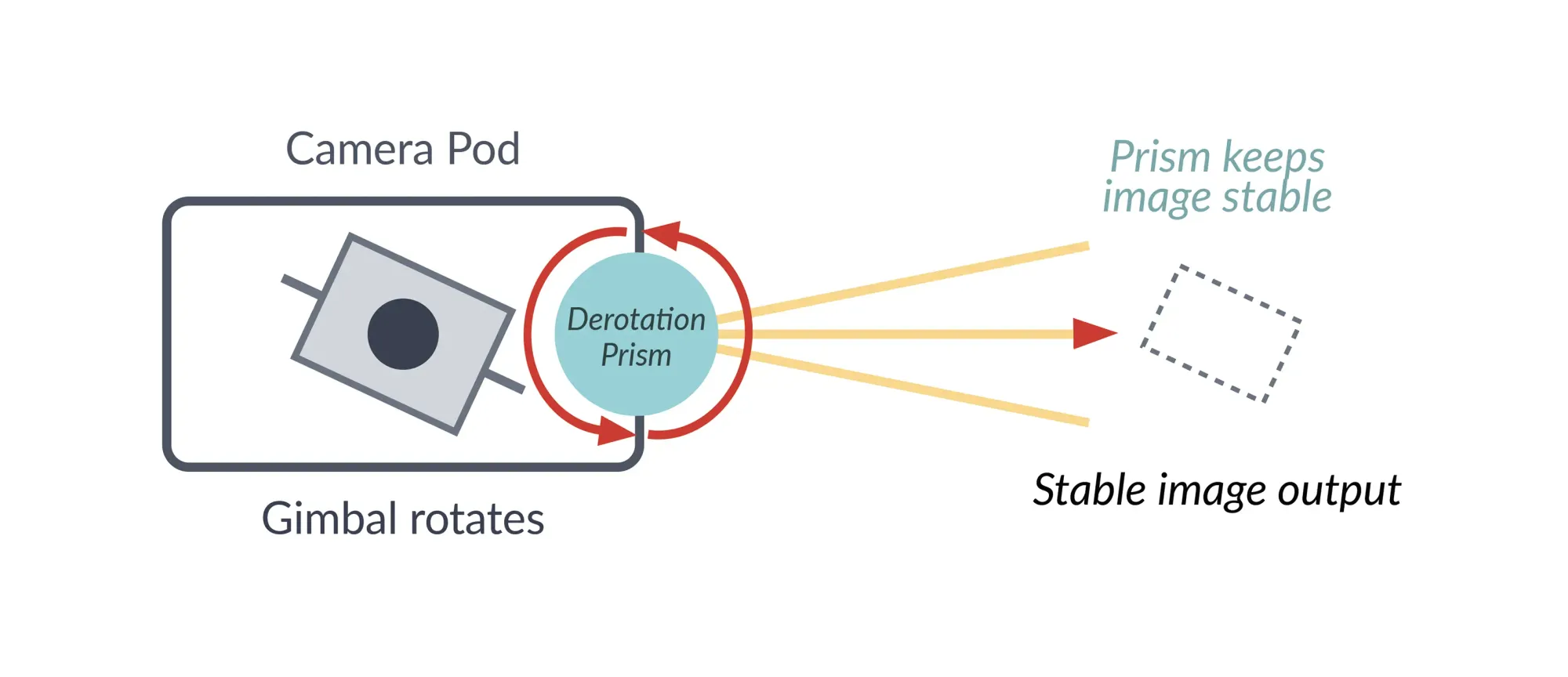
The most talked-about video is “Gimbal” (Figure 3a), an object that appears to skim effortlessly over background clouds then come to an abrupt stop and rotate in midair with no apparent propulsion systems to pull off such a maneuver. Again, astoundingly, West appears to be the only person to notice that when the Gimbal object rotates, background patches of light in the scene also rotate in perfect unison with the object. “I think what’s clear about Gimbal is it’s very hot—it’s consistent with two jet engines next to each other and the glare of these engines gets a lot bigger than the actual aircraft itself, so it gets obscured by it,” West explains, adding that “at the start of the video, it looks like the object is moving rapidly to the left because of the parallax effect, and the rotation was a camera artifact (Figure 3b), and that the ‘flying saucer’ was simply the infrared glare from the engines of a distant aircraft that was flying away.”18 When he looked up the patents for that camera, West found that the gimbal mechanism was responsible for the apparent rotation.19
Figure 4. Flying Triangle (YouTube video). Mick West demonstrating that the triangular shape is likely the bokeh effect—where out-of-focus light takes the shape of the camera’s triangular lens aperture rather than a physical craft.
Since then, two more videos by the UAP Task Force were released, one showing a flying triangle (Figure 4) and the second an apparently zig-zagging submersible sphere (Figure 5). As the media and public gawked at yet another triangle-shaped UFO, West noted that it was filmed at night beneath the flight path into LAX, and that the object blinked in perfect unison with that of commercial airliners flying into Los Angeles from Hawaii. The triangular shape, he surmised, was most likely the result of a triangular shaped lens aperture, and the “bokeh” effect, or the soft out-of-focus background generated by shooting a subject with a fast lens and wide aperture.20 In fact, there were other triangle shaped objects in the image that correspond perfectly to celestial objects that West identified as the planet Jupiter and some known stars.
Figure 5. Submersible Sphere (YouTube video). Analysis by Mick West.
As for the “zig-zagging” object, also filmed off the coast of California from the combat ship Omaha, as you can see in West’s video analysis it is the camera that is zig-zagging, not the object, and it doesn’t “submerse” into the water, it simply disappears beyond the horizon (and is, in any case, so grainy a video that it isn’t clear at all what is going on with whatever it was being filmed).21
Extraordinary Terrestrial
An alternative to ordinary explanations for UAP sightings is that they represent Russian or Chinese assets, drones, spy planes, or some related but as yet unknown (to us) technology capable of speeds and turns that seemingly defy all known physics and aerodynamics.
This hypothesis is highly unlikely, given what we know about the evolution of technological innovation, which is cumulative from the past. In his 2020 book, How Innovation Works,22 Matt Ridley demonstrates through numerous examples that innovation is an incremental, bottom-up, fortuitous process that is a result of the human habit of exchange, rather than an orderly, top-down process developing according to a plan. Innovation, he continues, “is always a collective, collaborative phenomenon, not a matter of lonely genius. It is gradual, serendipitous, recombinant, inexorable, contagious, experimental, and unpredictable. It happens mainly in just a few parts of the world at any one time.” Examples include steam engines, jet engines, search engines, airships, vaping, vaccines, cuisine, antibiotics, mosquito nets, turbines, propellers, fertilizer, computers, dogs, farming, fire, genetic engineering, gene editing, container shipping, railways, cars, safety rules, wheeled suitcases, mobile phones, corrugated iron, powered flight, chlorinated water, toilets, vacuum cleaners, shale gas, the telegraph, radio, social media, block chain, the sharing economy, artificial intelligence, faddish diets, and hyperloop tubes.
ETIs are probably out there in the cosmos, but there probably are not that many of them, and because of the vast interstellar distances and their extreme rarity they have not been here.
It is simply not possible that some nation, corporation, or lone individual—no matter how smart and creative—could have invented and innovated new physics and aerodynamics to create an aircraft of any sort that could be, essentially, centuries ahead of all known present technologies. That is not how innovation works. It would be as if the United States were using rotary phones while the Russians or Chinese had smart phones, or we were flying biplanes while they were flying Stealth fighter jets, or we were sending letters and memos via Fax machine while they were emailing files via the internet, or we were still experimenting with captured German V-2 rockets while they were testing SpaceX-level rocketry. Impossible. We would know about all the steps leading to such technological wizardry.
Extraordinary Extraterrestrial
Could these UAPs and UFOs represent visitations by ETIs? Let’s first separate two questions that most people confuse: (1) Are aliens out there somewhere in the cosmos? (2) Have aliens come here? When I state my skepticism about the latter, people assume I’m also skeptical about the former. “Do you seriously think we’re alone in this vast cosmos?” is a common rejoinder I hear when I say something like “UFOs are not ETIs.” So let me state for the record that although we have no definitive evidence to answer either question in the affirmative, I think it highly likely that aliens are out there somewhere but have not yet come here.
To the first question, the law of large numbers suggests that aliens are very likely out there somewhere in the cosmos. A 2016 analysis of the Hubble Ultra Deep Field by NASA and the European Space Agency estimated that there are ten times the number of galaxies previously known (about one hundred billion), meaning that there are at least one trillion galaxies in the universe,23 each of which has at least one hundred billion stars, for a total of a hundred million trillion stars—100,000,000,000,000,000,000,000—an almost inconceivably large number made even larger by the Kepler Space Telescope’s discovery that nearly all stars have planets, adding yet another zero to that already Brobdingnagian number for the number of possible places where life could evolve into an intelligent communicating species. We also now know that it takes only a few million years for stars and planets to coalesce out of clouds of dust and gas to form solar systems. In our galaxy alone this happens about once a month. In the universe with the above number of stars, this would mean a thousand new solar systems are born every second.
To the second question, Fermi’s Paradox—first articulated by the renowned physicist Enrico Fermi—implies that with so many stars and planets in the known universe there should be lots of ETIs out there, and assuming that at least some of those (half?) would be millions of years ahead of us on an evolutionary time scale, their technologies would be advanced enough to have found us by now, but they haven’t, so … where is everybody?
Answers to the paradox are now legion, with at least 75 explanations for why we haven’t found ETIs yet,24 including: uniqueness (we’re alone), out of range (they’re too far away to have been discovered yet), failures of perception (they’re aquatic instead of land-based), failures of imagination (they haven’t thought of searching), inadequate search strategies (they or we are using the wrong technology to search), dark forest (they’re hiding), zoo hypothesis (they’re observing us secretly), transcendence (they’re from a different dimension or are pure spirit beings), ancient aliens (they visited thousands or millions of years ago), home bound (they don’t travel), and beyond our imaginations (they are so wholly Other that we can’t begin to know how to make contact).25 Here is my Twitter-length answer to Fermi’s Paradox:
ETIs are probably out there in the cosmos, but there probably are not that many of them, and because of the vast interstellar distances and their extreme rarity they have not been here. But keep searching, as such a discovery would be one of the greatest in human history!
Sky Gods for Skeptics
In his 1982 book The Plurality of Worlds, the historian of science Steven Dick suggested that when Newton’s mechanical universe replaced the medieval spiritual world it left a lifeless void that was filled with the modern search for ETI.26 In his 1995 book Are We Alone? the physicist Paul Davies wondered: “What I am more concerned with is the extent to which the modern search for aliens is, at rock bottom, part of an ancient religious quest.”27 The historian George Basalla made a similar observation in his 2006 work Civilized Life in the Universe: “The idea of the superiority of celestial beings is neither new nor scientific. It is a widespread and old belief in religious thought.”28 In his 2007 book, Contact with Alien Civilizations, Michael A.G. Michaud proposes that “one of the drivers behind our search for other intelligent beings is our desire to find or attribute purpose to our existence. We have an innate yearning to be identified as part of some ill-defined grander scheme of things.”29Here is how Carl Sagan expressed the sentiment in an interview with CBS anchor Walter Cronkite:
I think a key to what’s behind the real belief in flying saucers is most easily obtained if you look at the contact myths. There are several hundred people in the United States who claim to have had personal contact with the inhabitants of flying saucers that have landed. And if you examine these myths, you find that there are some peculiar regularities. The inhabitants of saucers are benevolent. I mean, they’re really concerned for our well-being. They’re omnipotent, extremely powerful, omniscient, extremely knowledgeable, and they often wear long, white robes. Now this combination is something I’ve heard in another context. This isn’t science, this is religion.30
To test this hypothesis the psychologist Clay Routledge and his colleagues published a paper titled “We Are Not Alone,” in which they reported an inverse relationship between religiosity and ETI beliefs—that is, those who report low levels of religious belief but high desire for meaning show greater belief in ETIs.31 In Study 1, subjects who read an essay “arguing that human life is ultimately meaningless and cosmically insignificant” were statistically significantly more likely to believe in ETIs than those who read an essay on the “limitations of computers.” In Study 2, subjects who self-identified as either atheist or agnostic were statistically significantly more likely to report believing in ETIs than those who reported being religious (primarily Christian). In Studies 3 and 4, subjects completed a religiosity scale, a meaning in life scale, a well-being scale, an ETI belief scale, and a religious supernatural belief scale. “Lower presence of meaning and higher search for meaning were associated with greater belief in ETI,” the researchers reported, but ETI beliefs showed no correlation with supernatural beliefs or well-being beliefs.
From these studies the authors conclude: “ETI beliefs serve an existential function: the promotion of perceived meaning in life. In this way, we view belief in ETI as serving a function similar to religion without relying on the traditional religious doctrines that some people have deliberately rejected.” By this they mean the supernatural. “That is, accepting ETI beliefs does not require one to believe in supernatural forces or agents that are incompatible with a scientific understanding of the world.” If you don’t believe in God, but seek deeper meaning outside of our world, the thought that we are not alone in the universe “could make humans feel like they are part of a larger and more meaningful cosmic drama.” I concur, and so give the last word to Lt. Commander Alex Dietrich, who witnessed the 2004 UAP incident from a USS Nimitz fighter jet, as I think it well sums up 75 years of ufologists’ search for aliens: “I think they enjoy the anticipation more than actually finding answers.”