How Would You Design a Code of Conduct?
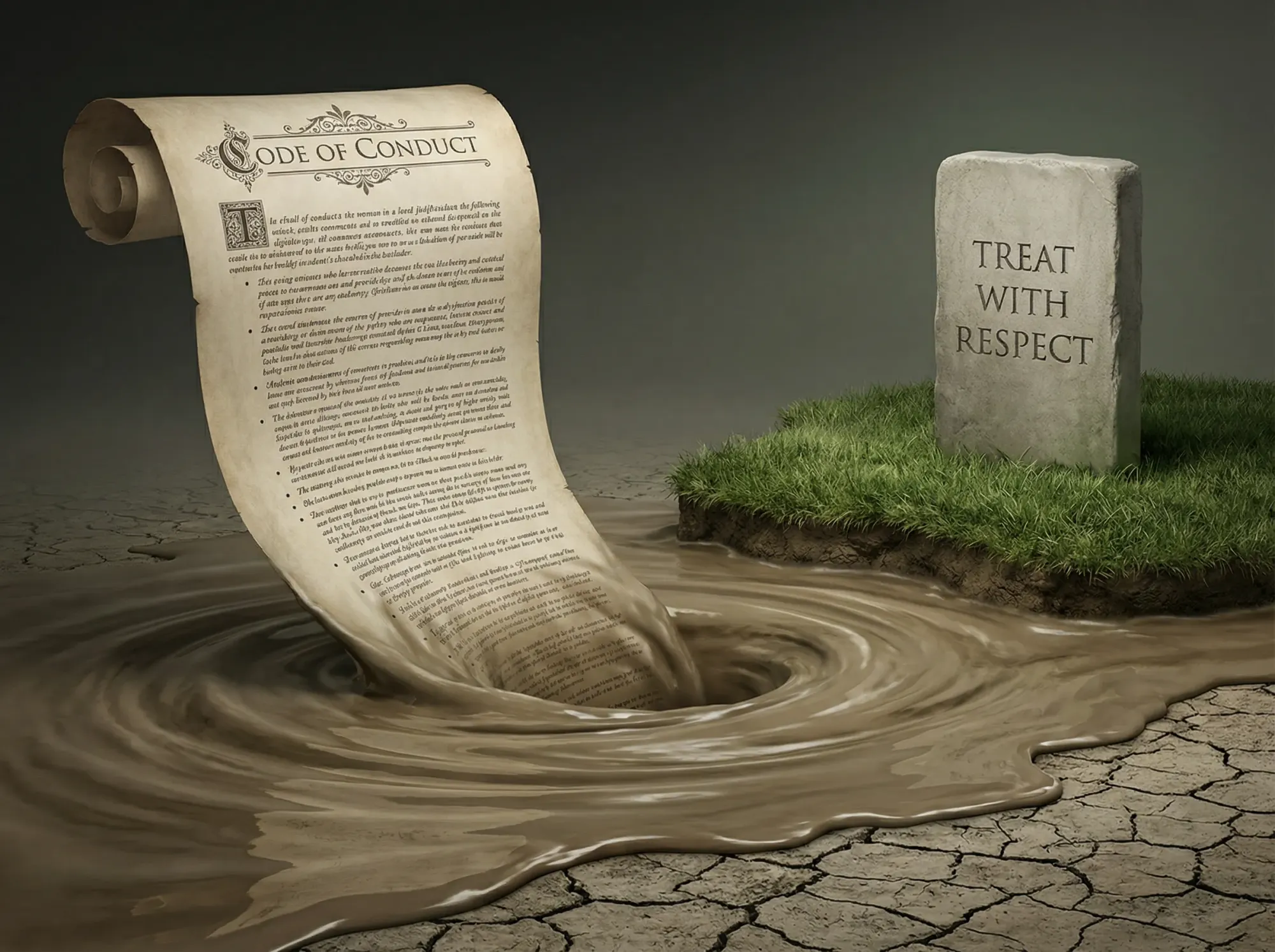
If you have attended a conference in the past decade, you undoubtedly will have been alerted to the sponsoring organization’s Code of Conduct, detailing how you must behave, or what you must not do, or what other people must not do. Organizations are spending considerable time and effort to create Codes of Conduct meant to govern the behavior of their members at meetings. The codes try to specify precisely what behavior will evoke censure, if not ejection from the meeting (or even the organization).
Words matter. An organization’s statement of its mission and values tells members which truths it holds to be self-evident. Yet once an organization tries to specify each and every one of the possible behaviors it wishes to prohibit (or encourage), it will find itself in linguistic and psychological quicksand. It’s like telling a child not to eat the gumballs, muffins, or chocolates on the table, but failing to forbid the ice cream and pie. The overall concept—no sweets—is lost.
I had assumed that organizations produce codes of conduct to reduce the risk of being sued for harassment. “Look how we meticulously specified inappropriate behavior that will not be tolerated,” they can say. But when Sarah Brookhart, Executive Director of the Association for Psychological Science, consulted their attorney, she was strongly advised against having any kind of such code or policy “because of the liability it creates.” Brookhart told me that the code of conduct issue varies among science organizations. “For some it comes out of rampant harassment at their conferences,” she wrote in an email. “For others it seems more symbolic than a response to an actual problem at conventions. I also think it reflects conditions for women in many academic departments.” For example, she said, harassment is an especially serious problem for disciplines where women are very much the minority.
Consider two very different Codes of Conduct, which anchor the ends of the spectrum of approaches. One comes from the Society for the Scientific Study of Sexuality (SSSS) and its Sexual Harassment Task Force, which recently created a Statement of Values and Expectations, a Code of Conduct, and a set of procedures for handling violations of the code. When a draft of the document was sent to all members for their comments, president Eric R. Walsh-Buhi reported that “approximately half of those that responded wanted a less restrictive policy and the other half wanted a more restrictive policy.” That alone might have made the board question the very plausibility of its efforts to specify every kind of behavior that all would agree is a “violation,” but no. The final document, approved by the organization’s Board of Directors and its attorney, is five single-spaced pages. The president acknowledged the length problem in his message to members, justifying it by asserting that “these documents have important legal implications,” and therefore “must be as precise as possible to ensure that cases of reported misconduct are handled consistently, predictably, and fairly.”
It’s like telling a child not to eat the gumballs, muffins, or chocolates on the table, but failing to forbid the ice cream and pie. The overall concept—no sweets—is lost.
The SSSS statement starts with a list of “Aspirational behaviors,” unenforceable but desired standards, which include (I am not paraphrasing):
- Be respectful and constructive when providing scholarly feedback or criticism.
- Be considerate of audience members’ hearing and visual needs.
- Support respectfully-communicated dissent and alternative viewpoints.
- Keep an open, skeptical, and curious mind.
- Be welcoming and respectful to individuals of all ages, races/ethnicities, gender identities, sexual identities, religions, abilities, physical appearances, etc.
- Make efforts to talk to and include new attendees and those attending the conference alone.
- Be cautious about inviting individuals with less professional or institutional power … to private locations or to become inebriated with you, as they may not feel free to decline without repercussions.
- Use welcoming, respectful, and inclusive language. Examples of this include using the language that reflects what people call themselves, and using language that reflects all genders and sexualities.
- Intervene if you see harassment occurring … [e.g., create a distraction, butt into the conversation, report it to conference authorities.]
Next are “Expected behaviors,” violations of which may simply involve (at least initially) asking the violator to quit it. Here I will paraphrase the central ones, which include, but are not limited to:
- Don’t interrupt a speaker unless the speaker says that would be ok.
- Don’t comment on people’s bodies, appearance, or sex appeal.
- Ask for consent before you hug or rub the back of anyone you don’t know well or over whom you have power.
- Do not call people by gendered titles or pronouns unless they have directly disclosed their gender, and “do not call individuals by non-disclosed gender titles or pronouns.” They have to tell you; you are not permitted to ask attendees about their sexual identity.
- Do not make generalizations about any “identity group” or make disparaging comments.
- Do not make “uninvited judgments regarding a person’s lifestyle choices and practices, including those related to food, health, parenting, sex, and employment.”
- People at SSSS will obviously talk about sexuality, but whereas it is fine to talk about the content of your sex research, do not ask attendees about their own sexual behavior.
- Don’t get drunk, stoned, or high on anything “that might lead to interference with the scientific and social agendas.”
How are you doing? Can you keep the “aspirational” standards separate from the “expected” ones? But now that you’ve gotten the point—that SSSS expects you to behave like a grown-up and not a rude, drunken boor—you get to the list of “prohibited behaviors, most of which are illegal”:
- Repeatedly violating the “expected behaviors” despite being asked to stop.
- Sustained and repeated disruption during talks.
- Engaging in sexual behavior (e.g., kissing; touching the buttocks, breasts, or genitals; oral, anal, or vaginal sex) without the other person’s consent.
- Physically threatening or stalking any attendee.
- Using violent language or threats of violence.
- Encouraging another individual to commit violence or engage in self-harm.
- Repeatedly photographing or recording someone without their permission.
- Repeated sexual flirtations, advances, or propositions that continue after the other person has communicated a lack of interest.
- Epithets, slurs, or negative stereotyping; threatening, intimidating, or hostile acts; jokes and display or circulation of written material or visual images that denigrates or shows hostility or aversion toward an individual or group.
- Retaliating against someone who reports a violation of this code of conduct.
One long-time member of SSSS wrote to the board wondering why a professional Code of Conduct did not include other behaviors that annoy attendees. How about “no cellphones and texting during talks,” “no unreadable power points,” “no exceeding your allotted time and failing to leave time for the others in your symposium”? She added that while she appreciated “the efforts and good intentions behind this document,” she was concerned about the proliferation of lengthy documents like this one. “It feels to me like a heavy cloak of moralistic finger-wagging rather than inviting more good work in a collegial atmosphere,” she said.
Most sexists and racists deny that they are prejudiced; even Donald Trump, with his long-documented history of discrimination against African Americans, claimed that he is “the least racist person you’ve ever met.”
Precisely. As a social psychologist, I wondered what this document specifies that the organization’s members don’t already know, and, more important, what effect it would have on anyone’s actual behavior. As I read the SSSS Code of Conduct, I thought of how children react to all the finger-wagging don’ts that adults are forever telling them: Don’t hit your sister. Don’t be a bully. Don’t be greedy. Don’t leave messes. How many say, “Ok, mom, I won’t”? More likely, they continue the prohibited (but otherwise satisfying) misbehaviors and justify them: “I’m not a bully—he started it.” “It’s her fault.” “He spilled the jam, not me.”
Adults, as far as I can tell, are no different. Most sexists and racists deny that they are prejudiced; even Donald Trump, with his long-documented history of discrimination against African Americans, claimed that he is “the least racist person you’ve ever met.” Will anyone recognize their own disapproved-of behavior? It would be like having a prohibition against being excruciatingly boring in your lectures and assuming that the worst bores would recognize themselves immediately and sign up for lecture improvement classes.
Moreover, notice how many of the prohibited behaviors are simultaneously specific and vague—quite an achievement in and of itself. They sound clear, but any psychologist would realize that human beings have an annoying tendency to disagree on their interpretation of any given act—and give the “rightness” of their own interpretation the benefit of the doubt. I’d like to be “welcoming and respectful” to you, a person from a different generation or country or ethnic group from mine, but what if my good intentions clash with your hypersensitive response? What if my cultural tradition is to greet a colleague with a kiss on each cheek or stand closer than most Northern Europeans like, and another person’s isn’t? Why am I the one who is automatically in violation?
At the other end of the spectrum from SSSS’s code, here is what the board of the Society for Applied Research in Memory and Cognition unanimously approved:
SARMAC is committed to being a friendly, supportive, and inclusive professional society, one in which everyone is treated with respect. We work hard so that our conferences deliver on that commitment. If your experiences during the conference fall short of our expectations, please speak with a member of the Governing Board, and we’ll do what we can to help.
Couldn’t have said it better, or more succinctly, myself.