Photographer’s Amnesia, or the Side Effects of Selfies
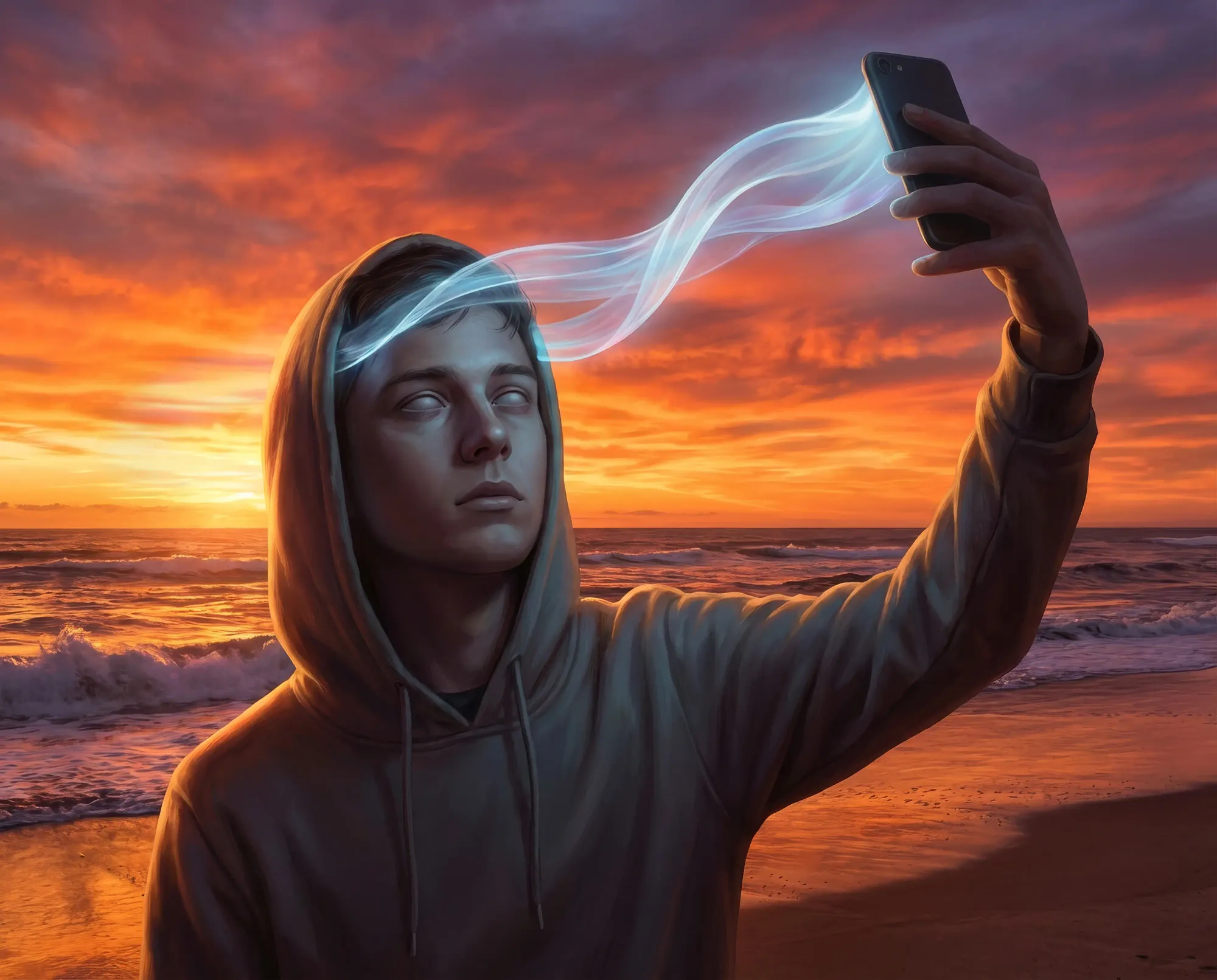
I have a terrible memory. However, I know many people who think that they have terrible memories and that mine is admirably fine. So I’ve decided that this common perception stems from panicked generalizing from the latest thing we have forgotten—the star of that movie we saw four months ago, or, hell, the name of the movie itself. We forget, as it were, everything we remember.
Because I have a terrible memory, though, I often wish I had more pictures of my past—especially of childhood, the time before I started taking snapshots myself. I don’t want more images of the big events, birthday parties, and vacations, but of mundane events: my grandmother baking oatmeal cookies for relatives far and near; my mother’s daft secretary, Clara; my father working in his darkroom, allowing me to watch images miraculously emerging in their bath of chemicals.
We’ve all had the experience of a photo’s awakening a long-dormant memory, producing feelings of nostalgia, regret, or bittersweet times past. Yet seeing a photo of Clara (whose face I cannot conjure) wouldn’t affect my memory of how her inability to spell—she was always “taking things for granite”—exasperated my mother. I can completely visualize my grandmother baking cookies, because she often used a washtub to make them in ten-pound batches. (Plus I have the recipe.) And I could describe my father’s darkroom to you, its rough-hewn construction in the corner of our garage. Besides, we’ve all had the experience of looking back at photos of scenes or parties or places we can’t quite remember, and the ensuing shock of surprise: “He was there? I thought she’d thrown him out of the house by then!” or “Say, I didn’t look nearly as homely as I felt I was” or “Look at me, smiling like an idiot, when all the time I was seething with fury” or even “Huh? where the hell is this?”
In short, the relationship between photos and memory is complicated. Most people say they take pictures to help them remember an experience, and if that’s so, their memories are getting awfully crowded. According to one estimate, people took more than three billion photos in 2012; another estimate claims 900 billion in this year alone. It is said that 300 million photos are uploaded to Facebook every day, to say nothing of the gurzillions on Instagram, Snapchat, Pinterest, dating sites, and other social media. Apart from the “look at me” factor and the “here I am, having more fun than you are” factor, what effect do all these pictures have on our memories?
People remember much less about scenes and objects they have observed and photographed than about scenes they have merely observed.
Just as the public is becoming aware of the overall unreliability and malleability of human memory—how subject it is to post-event suggestions, confabulation, and historical revisionism—now the cognitive psychologists who study memory are taking away our confidence in photographs to help. Indeed, their research challenges the popular notion that taking photos helps us remember our lives more accurately. One team of memory scientists—Rachel Zajac, Linda Henkel, and Maryanne Garry—put it this way: “we think that photographing your life actually shapes how you remember it. And the shaping begins as soon as you pick up the camera and press click.” You don’t actually have to press click; seeing a neutral photo attached to a news story1 will affect what people remember about what they had read in that story. But even when you are the photographer, the mere act of taking a photo often impairs memory. People remember much less about scenes and objects they have observed and photographed than about scenes they have merely observed.
To demonstrate this phenomenon of “photographer’s amnesia,” Linda Henkel, a psychologist at Fairfield University2 in Connecticut conducted two simple, elegant experiments. In the first, she took participants on a tour of a museum, where they saw 30 diverse objects (paintings, sculptures, jewels, and so on). After looking at each object for 20 seconds, they were asked to photograph 15 of them and simply continue observing the other 15. The next day she assessed their memories of what they seen. In one measure, they responded to a name-recognition test that consisted of the 30 objects mixed with 10 names of art objects they hadn’t seen; for each item, they had to indicate whether they had seen it, taken a photo of it, or hadn’t seen it on the tour at all. In addition, everyone took a multiple-choice test about visual details of the objects: for example, the question for a Tang Dynasty warrior figure was “What did the warrior have in his hands?” with answers a shield, a spear, his helmet, or nothing. Finally, everyone took a photo-recognition test in which they looked at photos of the same 40 objects in a different, random order, with its name underneath. Participants had to say whether they had photographed the object, simply seen it, or thought it was new.
On all of these measures, people who had taken photos of the objects were less accurate in overall memory and in details than were people who had simply looked at them in a focused way. Even recognition accuracy was impaired in the photo-takers: They recalled fewer than half of the items they had photographed. “People remembered fewer objects overall and remembered fewer details about the objects they had photographed compared with objects they had observed,” Henkel summarized.
Photographer’s amnesia is not caused by divided attention—the idea that taking a photograph siphons your attention away from the event you’re trying to capture and shifts it onto the process of taking the pictures—and it doesn’t happen because the people taking photos spent less time looking at the objects. When Henkel gave everybody 25 uninterrupted seconds to observe each work of art, and extra time if they were then assigned to the group taking photos of them, once again the participants’ memory for details about the objects was significantly lower among those who took photos.
Zajac and her colleagues hypothesize that photographer’s amnesia is another aspect of the brain’s normal “cognitive economy”: “As soon as you point and click,” they explain, “you ‘outsource’ the job of remembering, counting on the camera to remember for you. Your brain outsources for the same reason that the corporate world outsources”—it’s cheaper and more efficient. Indeed, other research has found that people are less likely to remember new information if they expect easy access to it later (e.g., on the internet or their smartphone). If that is the case, they say, taking a photo might be a cue to “dismiss and forget.”
An antidote for photographer’s amnesia—on occasions that might be more important to you than discovering good trout amandine at a new bistro—is: Don’t just point and click; think, point, and zoom. In a second experiment, Henkel asked some of the participants on the museum tour to photograph objects by zooming in on one specified part, such as the Tang Dynasty warrior’s hands. When people took pictures with a zoom, their memory for details was unimpaired—in fact, it was no different from that of the people who were simply observing the art. Zooming protected, even enhanced, memory: People were better able to remember whether they had photographed the objects or simply observed them. Zooming must serve as a way of taking pictures actively rather than mindlessly, encoding the scene for future recall.
Memory researchers have plenty of questions, but one answer is already clear: We can’t outsource our memories—or any other task—without consequences.
Cognitive psychologists are also investigating how photographer’s amnesia might inadvertently shape the way we tell the stories of our lives. Every photo, after all, has a point of view. You can recall a memory in the first person (as though you’re seeing the experience through your own eyes) or in the third person (as though you’re watching yourself on a video). But when people recall memories in the third person, those memories feel less vivid and more discrepant with their current feelings about themselves than when they recall memories in the first person. (They feel as if it is a former self, a different one, who did all that drunken dancing on tables years ago.) Third-person accounts are also more likely3 to depress people’s moods and make them feel less optimistic. For Zajac, Henkel and Garry, this raises a fascinating concern. The typical selfie, after all, registers a third-person memory: You see yourself in the scene you’re observing rather than being the active recorder of the memory. (And you’re certainly not zooming in on some special aspect of the scene.) Might selfies, therefore, have some unanticipated negative effects, perhaps undercutting our later recall of the happy occasion that we took the selfie for in the first place?
Memory researchers have plenty of questions, but one answer is already clear: We can’t outsource our memories—or any other task—without consequences. There’s no technology that will record our memories in some pristinely perfect fashion, because we humans will reinterpret, revise, and misremember our photos just as we do with our own fallible brains. Memory scientists hope we will use this information constructively: if you know that your camera’s memory card is nearly full, or your smartphone’s battery is perilously low again, you will be more likely to “take back the responsibility for remembering.” We can do that even when the camera is working fine—and perhaps not take quite so many photos mindlessly. Still, I wish I could remember what Clara looked like.