A Skeptic’s Guide to Ozempic and Other GLP-1 Agonists

I have been practicing medicine for more than 40 years. During that time the management of obesity and Type 2 diabetes (T2DM)—the kind that usually is caused by being overweight—often felt like Sisyphus pushing a boulder up a hill, only to have it roll back down, often heavier than before. We faced a “diabesity” epidemic where the available tools were blunt instruments at best.
Lifestyle interventions—meaning trying to get someone to change their behavior—was the most and least effective method we had. Most, because in the less than two percent of patients who were successful, it works very well. Least, because, well … 98 percent failed. And they failed because all of our evolutionary history (“See food? Eat it!”) was working against them. This is the mismatch theory: a mismatch between the environment of our evolutionary ancestry that designed our brains to seek foods that were at once rare and nutritious (sweets and fats) and the modern environment in which such foods are in such overabundance that we eat far beyond the saturation point.
The pharmacological options were often disappointing: Sulfonylureas and insulin lower blood sugar but caused weight gain, exacerbating the underlying problem. Bariatric surgery works, but it is invasive and carries surgical as well as lifelong nutritional risks.
When we look at the data for GLP receptor agonists, along with the innumerable before and after photos of successful weight loss transformations, we are forced to admit that we have moved from a realm of wishful thinking into one of potent pharmacology.
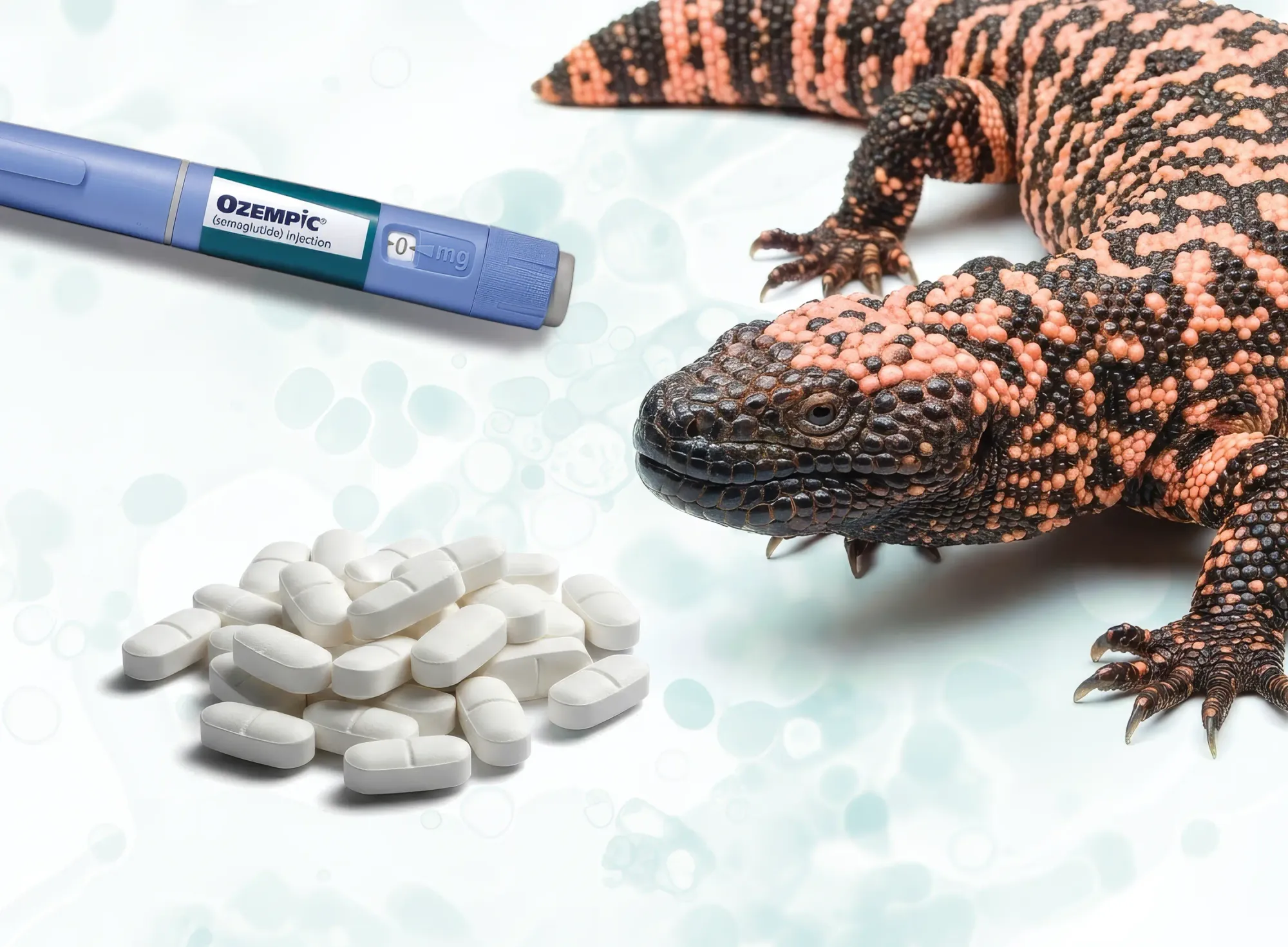
Into this therapeutic desert crawled the Gila Monster (above), a venomous lizard native to the American Southwest from which researchers derived GLP receptor agonists (Glucagon-like peptide-1 receptor agonists)—medications that mimic the natural GLP-1 hormone that lead to lower blood sugar, help control appetite, and promote weight loss by telling the pancreas to release more insulin when glucose is high, slowing the rate of stomach emptying, and signaling to the brain a sense of fullness.
As a skeptic, I am allergic to the word “miracle,” but when we look at the data for GLP receptor agonists, along with the innumerable before and after photos of successful weight loss transformations, we are forced to admit that we have moved from a realm of wishful thinking into one of potent pharmacology. But, as always in medicine, there is no free lunch.
The Incretin Concept: From Gut to Glory
The story begins with the “incretin effect”—the observation that glucose taken by mouth triggers a much stronger insulin response by increasing the production of hormones in the pancreas, compared to when it is injected directly into a vein. The gut knows you are eating and tells the pancreas to get ready to pack away the extra calories as fat. In patients with Type 2 diabetes, this effect is blunted and the sugar floats around in the bloodstream much longer.
Scientists identified two main hormones responsible: Glucose-dependent Insulinotropic Polypeptide (GIP) and Glucagon-like Peptide (GLP-1). The problem is that GIP doesn’t work well in diabetics. GLP-1 works beautifully—stimulating insulin, suppressing glucagon, and slowing gastric emptying—but it has a fatal flaw: It is destroyed by the enzyme DPP-4 within minutes of entering the bloodstream.
This led to two distinct pharmaceutical strategies. The earlier version was DPP-4 Inhibitors. Drugs like the “Gliptins” block DPP-4, making GLP-1 last longer. They are well-tolerated but their ability to lower blood sugar is modest and they generally do not cause weight loss.
The newer strategy was to engineer versions of GLP to resist degradation. This is where the Gila monster strolled in. In the 1990s, while researching hormone-like drugs, Dr. John Eng noted a similarity between exendin-4 found in Gila venom to Glucagon-like peptide (GLP), and it was able to resist breakdown by DPP!
The Evidence: Efficacy Beyond the Hype
The first GLP-1 agonist, exenatide (Byetta, approved in 2005), required twice-daily injections and produced modest weight loss. But the pharmacology evolved rapidly. We moved to once-daily liraglutide, and then to the once-weekly heavyweights: dulaglutide, semaglutide (Ozempic and Wegovy), and the dual GIP and GLP-1 agonist tirzepatide (Mounjaro and Zepbound).
The clinical trials, called LEAD, SUSTAIN, PIONEER, STEP, and SURPASS (you’ve got to just love the creative acronyms!) have generated data that are hard to dismiss:
Glycemic Control: These drugs consistently outperform most oral antidiabetics in lowering blood sugar by 10 to 20 percent.
Weight Loss: This is the game changer. While early drugs produced 2–4 kg of weight loss over six months, the newer agents are producing results previously only seen with surgery. In the STEP-1 trial, semaglutide 2.4 mg resulted in an approximately 15 percent body weight reduction. Tirzepatide pushed this further, achieving up to 22 percent weight loss in the SURMOUNT-1 trial. That is the effect of a 250-pound person losing 55 pounds! Who wouldn’t want some of that?!
Cardiovascular Outcomes: Perhaps most importantly, these drugs are not like some that just make numbers look better; they are saving lives. Liraglutide and semaglutide have demonstrated significant reductions in major adverse cardiovascular events (MACE), including heart attack and stroke, in high-risk populations. The SELECT trial recently showed semaglutide reduces MACE by 20 percent even in nondiabetic patients with cardiovascular disease. But don’t be fooled, it is not likely that these drugs have specific effects on the heart. It is probable that the fat loss alone is causing these benefits.
Some Skeptical Scrutiny: The Risks
If a drug sounds too good to be true, we must look for the catch. GLP-1 agonists have plenty.
The “Puke” Diet? The most common side effects of GLP-1 agonists are gastrointestinal: nausea, vomiting, diarrhea, and bloating. In some trials, up to 45 percent of patients experienced nausea. While this usually subsides, it raises a valid question: Are people losing weight because their metabolism is optimized, or because they feel too sick to eat? The mechanism involves central appetite suppression in the hypothalamus, but the “gastric braking” effect is real and unpleasant for many.
The Pancreas and Thyroid Scare. Early observational data suggested a link between GLP-1 agonists and pancreatitis and pancreatic cancer. However, extensive reviews have not confirmed a causal link to pancreatic cancer, though a slight increase in pancreatitis persists in some data. This makes sense, as one of the major sites of GLP’s effects is on the pancreas. In the thyroid, these drugs cause C-cell tumors in rodents. Humans have far fewer GLP-1 receptors on their thyroid C-cells than rats, and so far no evidence of increased thyroid cancer has been confirmed in humans. Still, the Black Box warning remains: If you have a family history of endocrine tumors or medullary thyroid cancer, these drugs are not for you.
If we are simply shrinking patients without preserving their strength, we may be trading one set of problems for another.
Vanishing Muscle. Weight loss via GLP-1 agonists is not just fat loss, so overall body composition must be monitored. In the STEP-1 trial, DEXA scans showed that lean body mass (muscle and bone) accounted for nearly 40 percent of the weight lost. In older adults, this raises the specter of “sarcopenic obesity”—being frail and weak despite having excess fat. Losing muscle mass compromises physical function and metabolic health. If we are simply shrinking patients without preserving their strength, we may be trading one set of problems for another. Now, regular and increased exercise is part of the prescription for all patients taking GLP drugs, but studies on how well this works are still in progress.
The Perioperative Peril. Because GLP-1 agonists delay gastric emptying, there have been reports of patients aspirating (inhaling) gastric contents during anesthesia, even after standard fasting protocols. This is a new, practical safety concern that surgical societies are rushing to address.
Mental Health. Reports of suicidal ideation appeared in postmarketing monitoring of GLP-1 agonist users, prompting investigations by European regulators. However, recent large cohort studies have not supported an increased risk of suicidality compared to other diabetes medications. As with all centrally acting drugs, vigilance is required, but the current data are reassuring.
A Lifetime Prescription? The most significant caveat for GLP-1 agonists is durability. Obesity can be a chronic, relapsing disease. Trials show that when patients stop taking semaglutide, they regain two-thirds of the lost weight within a year, and cardiometabolic improvements revert toward baseline. This implies that these are not “cures” but lifelong therapies, much like blood pressure medication.
Financial Toxicity. As I write this, these drugs are prohibitively expensive, creating a massive public health gap. We also saw shortages that left diabetic patients unable to fill prescriptions because the supply was diverted to off-label weight loss use. GLP-1 agonists are not expensive to produce, however, and the patent on Ozempic expired in January of 2026 in Canada and China (and lasts until 2030 in the U.S.), but I expect the market to bring the costs down dramatically over the next few years. As of this year, close to 12 percent of Americans have tried it at least once.
Needles Versus Pills
If there is one thing that holds patients back from the current crop of injectable incretins it is the needle. Despite the efficacy of weekly injections, people prefer pills. The pharmaceutical industry, never one to leave money on the table, has been racing to develop an oral alternative that doesn’t require the strict fasting rituals of earlier attempts like oral semaglutide. Enter orforglipron, the latest contender in the “nonpeptide small molecule” class, which promises the benefits of GLPs without the injection or the fuss.
Unlike existing peptide predecessors that are digested by stomach acid unless armored with absorption enhancers, orforglipron is a chemical—a small molecule designed to survive the GI tract and activate the GLP-1 receptor directly. The data from the ATTAIN-1 trial, published in September 2025, look good. Patients on the 36 mg dose achieved an average weight loss of 11.2 percent over 72 weeks, compared to just 2.1 percent for placebo. No needles. And this pill does not require the “empty stomach, no water, wait 30 minutes” song-and-dance required by oral semaglutide; it can be taken with or without food.
These are serious medications with serious side effects, and they may require lifelong commitment.
However, let’s look a little past the convenience. While an 11.2 percent average weight loss is clinically significant, it trails behind the 13.7 percent average reduction seen with semaglutide and 20.2 percent with tirzepatide. Furthermore, the biology of GLP-1 agonism remains the same regardless of delivery method: You cannot cheat physiology. In the ATTAIN-1 trial, adverse events led to treatment discontinuation in up to 10.3 percent of patients on the drug, compared to only 2.7 percent on placebo. The side effects are the usual suspects—gastrointestinal distress, nausea, and constipation—confirming that oral delivery does not bypass the “gastric braking” misery.
We must also remain vigilant regarding safety. The development of a similar small molecule, lotiglipron, was unceremoniously halted due to liver toxicity concerns. While orforglipron has passed its Phase 3 hurdles without these specific signals so far, the history of pharmacology teaches us that rare, serious adverse events often lurk in the postmarketing shadows.
Additionally, while proponents argue that small molecules are cheaper to manufacture than biologics, whether those savings will be passed on to the patient or simply absorbed into the profit margins remains to be seen, with projected self-pay costs in some cases exceeding $1,000 per month. Orforglipron represents a technological leap, but it is not a magic wand; it is simply a more convenient way to induce the same physiological trade-offs we have seen over the last several years with the shots.
Conclusion
Prior to the incretin era, our ability to manage the twin epidemics of diabetes and obesity was dishearteningly limited. GLP-1 receptor agonists represent a hard-earned pharmacological breakthrough, offering potent glucose control and unprecedented weight loss.
However, skepticism is still warranted regarding their indiscriminate use. They are already being used in numerous off-label ways, like shedding a few pounds before a wedding, allegedly decreasing cravings for addictive drugs like alcohol and narcotics, and purportedly even for the treatment of Alzheimer’s and Parkinson’s disease. There are ongoing studies for these uses, but early data are weak and the risks are unknown. These are serious medications with serious side effects, and they may require lifelong commitment.
Caveat emptor.