What Would Falsify “There’s Nothing There”?
Michael Shermer’s reply is a welcome development, and I appreciate both the tone and the fact that Skeptic is willing to stage a real dialogue.
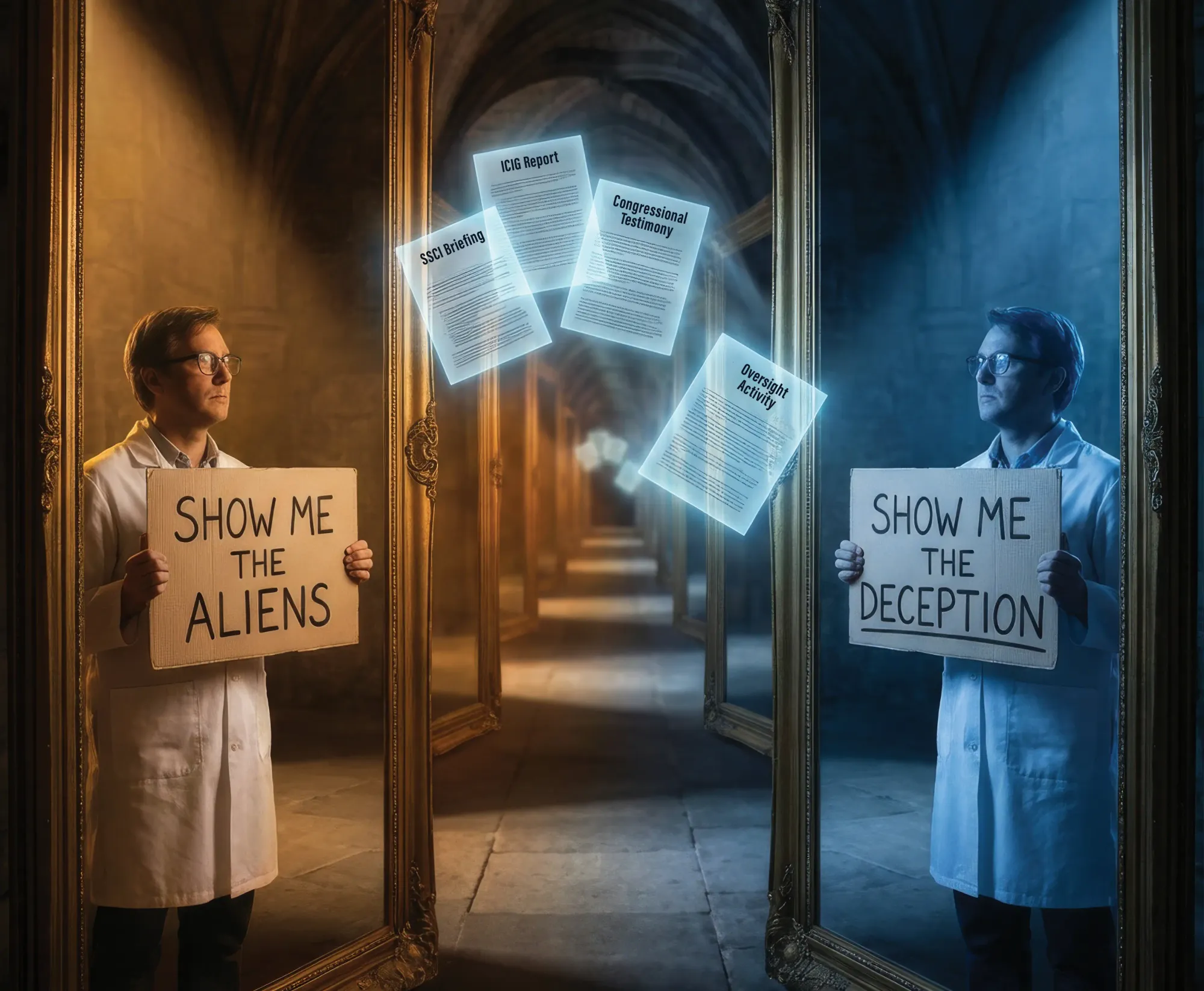
Shermer asks the obvious question. If these programs are as secret as alleged, how do we know about them at all? The answer is not mysterious. Secrets leak through people. And yes, people can be deceived, and eyewitnesses can be wrong. In this case, though, the relevant claims did not begin as a public mythology looking for applause. They moved through closed channels first, toward institutions built to filter exactly this kind of thing. David Grusch did not surface as a lone eccentric asking the public to take his word for it. He filed a protected disclosure through the Intelligence Community Inspector General (ICIG) process, which deemed the complaint “credible and urgent” and referred it onward, with briefings flowing to Congressional intelligence oversight staff. That signals the complaint cleared a high bar in a national security setting, where obvious falsehoods, internal incoherence, and casual rumor are supposed to die quickly. The Senate Select Committee on Intelligence (SSCI) sits even further from fringe-friendly dynamics. It has access to classified briefings and incentives to keep garbage out of its lanes. When bodies like the ICIG and SSCI support protections for a whistleblower and back mechanisms to dig deeper, they are treating the underlying allegations as plausible enough to warrant formal scrutiny.
To preserve “this is all just deception or self-deception,” you have to assume a more specific failure mode. Multiple cleared individuals would need to risk perjury in sensitive settings, while the very oversight institutions designed to detect disinformation would have to miss the telltale seams at the same time. That is possible in the abstract. It is a strange bet in practice. Why would institutions that have every incentive to avoid chasing fantasies treat these claims as plausible enough to warrant formal review and protections?
“Extraordinary claims require extraordinary evidence” applies on both sides of the ledger.
If the answer is “they were all deceived,” then the skeptic has to specify what kind of deception could do that. A simple story of gullibility does not fit the observed pathway. The deception would have to be systematic enough to generate a convergence of accounts across compartments, durable enough to survive contact with oversight mechanisms, and disciplined enough to keep producing the same core allegation while staying just beyond public inspection. That may be possible, but it is not epistemically cheap. It becomes a competing extraordinary claim about how the state manufactures and sustains false belief within its own accountability machinery. At that point, “extraordinary claims require extraordinary evidence” applies on both sides of the ledger.
That is why I must resist Shermer’s framing that my position cashes out as simple agnosticism. My claim is a comparative one. The available record does not justify declaring “aliens are here” as settled fact, but it does justify moving past a flat suspension of judgment toward a provisional view about what is likeliest going on inside the system.
The loudest lines in The Age of Disclosure are ontological declarations. I am not asking readers to treat those as proven. I am arguing that a narrower proposition now clears a meaningful plausibility threshold. The U.S. national security apparatus appears to be grappling with an anomalous technology claim that it cannot easily close out as error, hoax, or folklore.
ECREE still matters here, but it does not force an all-or-nothing stance where the only rational positions are certainty or agnosticism. In real inquiry, we often act on graded confidence long before we get museum-ready specimens. We open investigations, run audits, issue subpoenas, expand oversight, and treat certain hypotheses as increasingly strained. That is the posture I am defending. Treat the crash-retrieval allegation as plausible enough to warrant aggressive scrutiny, and treat “there is nothing here at all” as a claim that now carries its own burden.
If Shermer wants a clean dividing line, I can offer one. I would revise downward quickly if the core allegations were aired in a setting with genuine cross-compartment access and adversarial testing, and the result was a coherent, well-documented account that explains the witnesses, the oversight pathway, and the persistent institutional friction without leaving large remainders. Until then, “withhold judgment” is too blunt a tool. The more honest stance is provisional inference under constraint, coupled to a demand for the kind of access that could finally turn plausibility into proof or collapse it. A rational skeptic does not need to embrace the most extraordinary interpretation. Yet rationality does require updating on the structure of the problem space when the old intuitions about visibility, access, and disclosure begin to look like articles of faith.