Yes, We Have No Free Will
I have long argued that free will, as understood by most people, is simply an illusion, and I recently criticized Shermer’s view that it is not. In response, Shermer says I’m mistaken, but concludes that the issue of free will versus determinism is “an insoluble problem because we may be ultimately talking past one another at different levels of causality.”
In fact, the problem is not one of levels of causality, but of semantics: Shermer has made up a new definition of free will that’s very different from the one most people hold, and different as well from definitions offered by other “compatibilists”—people who argue that yes, human decisions and behavior are determined by the laws of physics, but we still have free will anyway. Here, I argue that Shermer’s compatibilist definition of free will is incoherent and incapable of refutation. In contrast, my form of determinism, adhering to purely physical causation of thoughts and behaviors free from any human “will,” is scientifically testable—and, so far, supported by lots of evidence.
But first let’s look at our respective definitions. I adhere to biochemist Anthony Cashmore’s definition of free will:
… I believe that free will is better defined as a belief that there is a component to biological behavior that is something more than the unavoidable consequences of the genetic and environmental history of the individual and the possible stochastic laws of nature.
In this definition there’s a “will” that doesn’t involve physical processes but can alter decisions. Another way of saying this is the way most people understand free will: “If you could replay the tape of life and return to a moment of decision at which everything—every molecule—was in exactly the same position, you have free will if you could have decided differently—and that decision was up to you.” This in turn can be condensed to the view that “you could have done other than what you did.” This concept is called “libertarian free will” or “contra-causal free will.”
Surveys in different countries show that most people indeed think we live in a world in which behavior is not deterministic, and our actions are controlled by an intangible, nonphysical “will.” The prevailing view is that we could have done other than what we did.
The science suggests that our feeling that we could have acted differently is, pure and simple, an illusion.
This concept is rejected by physical determinists like Shermer and me. Determinism does, however, allow different outcomes in a moment of decision, but only insofar as the laws of physics are non-deterministic and inherently unpredictable. The only physical laws with such unpredictability are those of quantum mechanics (some physicists suggest that quantum events are deterministic in a way we don’t yet understand). For example, it is possible that you ordered a steak rather than salmon because, somewhere in the neurons of your brain, a quantum event took place when you gave your order. But most physicists and biologists think that quantum effects don’t apply on the macro scale of human behavior, where classical mechanics probably rules. And, at any rate, quantum effects cannot buttress free will, for we cannot will the movement of electrons. Libertarianism says the decision must be up to you, not up to probabilistic movements of particles.
Like most compatibilists, Shermer is a determinist, asserting that, “I agree with Jerry and Dan [Dennett] that we live in a determined universe governed by laws of nature.” But he argues that this determinism still leaves us room for free will.
How can that be? It’s because Shermer defines free will in such a way that even in a physics-determined universe we still have a “freedom to choose.” Although I find his definition somewhat confusing, here’s what he says:
So, while the world is determined, we are active agents in determining our decisions going forward in a self-determined way, in the context of what already happened and what might happen.
… Here, for example, is [Robert] Sapolsky defending his belief that free will does not exist because single neurons don’t have it: “Individual neurons don’t become causeless causes that defy gravity and help generate free will just because they’re interacting with lots of other neurons.” In fact, billions of interacting neurons is exactly where self-determinism (or volition or free will) arises.
Shermer adds that our behavior satisfies the three requirements for volition given by philosopher Christian List. We have:
- “the capacity to form an intention to pursue different possibilities,”
- “the capacity to consider several possibilities for this action (this is the ‘could have done otherwise’ element),” and
- causal control, “the capacity to take action to move toward one of these possibilities.”
Our brains, of course, are the meat computers that form intentions, weigh possibilities, and emit decisions.
All this is puzzling because if we live in a universe governed by the laws of nature, then of course our bodies and brains are part of that physical nexus. Our brains, of course, are the meat computers that form intentions, weigh possibilities, and emit decisions. But this doesn’t answer the critical question: At any moment, could we have done other than what we did? If so, then there is something spooky going on whereby our brains are somehow exempt from the laws of physics. This seems to reside in Shermer’s claim that we are “active agents in determining our decisions going forward in a self-determined way.” What else can that mean but a form of dualism, or even magic?
This smuggled-in dualism becomes clear when Shermer claims that although the action of individual neurons may be determined, “billions of interacting neurons is exactly where self-determinism (or volition or free will) arises.” But how can one neuron be governed by the laws of physics but a group of interacting neurons not be governed by the laws of physics. If they are, then there is no freedom, no volition, no “willed” control of our behavior, and no ability to have done otherwise. Yet Shermer argues that when a group of neurons cooperates, some kind of “will” arises. This dilemma won’t be resolved until Shermer explains the relevant difference between the behavior of one neuron and of a group of neurons.
This is not a semantic distinction, for the definition of free will I gave is testable while Shermer’s is not. There are many experiments and phenomena showing that our sense of agency can be altered by physically manipulating the brain (a big group of neurons), observing human behavior, or performing psychological tricks. For example, neurological experiments show that predictable binary “choices” occur in the brain well before they are consciously made by an individual—up to ten seconds in advance. Such decisions cannot come from conscious “will.” Various lesions in the brain can remove the illusion that we can make real choices (e.g., alien hand syndrome), and doctors, by electrically stimulating parts of the brain can create intentions to do specific acts, like licking your lips or moving your arms. Given more electricity, patients report that they had indeed done those acts even when they didn’t.
What we think of as choice is really a neuronal newsreel screened after the events have already happened.
Alternatively, computer games or Ouija boards show that humans can perform actions they attribute to external forces like spirits even though they’re actually, but unconsciously, moving their muscles. All of this suggests that our conscious intentions are not “free,” but are formed by the brain before we’re aware of them, and can be manipulated to either add or remove feelings of “intention.” “Will,” “volition,” or “agency” may well be post facto phenomena in which deterministic activity in the brain is brought into consciousness a bit later, so that what we think of as choice is really a neuronal newsreel screened after the events have already happened. To repeat, it’s useless to see freedom in groups of neurons if it doesn’t occur in single neurons. As Cashmore noted:
Some will argue that free will could be explained by emergent properties that may be associated with neural networks. This is almost certainly correct in reference to the phenomenon of consciousness. However, as admirably appreciated by Epicurus and Lucretius, in the absence of any hint of a mechanism that affects the activities of atoms in a manner that is not a direct and unavoidable consequence of the forces of GES [genes, environment, and stochastic processes], this line of thinking is not informative in reference to the question of free will.
The science suggests that our feeling that we could have acted differently is, pure and simple, an illusion.
In contrast, Shermer’s definition of free will is untestable, precisely because he’s defined free will tautologically: because people feel and act like they have free will, they do have some form of it. We feel like we control our actions, weigh alternatives, and make “choices” among those alternatives. But if we couldn’t have done other than what we did—if, at bottom, all we think and do reflects physical law—then what exactly is “free” about our decisions and behaviors?
As Shermer notes, 59 percent of surveyed philosophers are compatibilists while the rest are almost equally divided between libertarians, determinists, and those with no opinion. He deems philosophers the “most qualified people” to pronounce on the problem, but are philosophers more qualified than neuroscientists or physicists? As Sam Harris (a neuroscientist and a determinist) said:
[Compatibilism] ignores the very source of our belief in free will: the feeling of conscious agency. People feel that they are the authors of their thoughts and actions, and this is the only reason why there seems to be a problem of free will worth talking about.
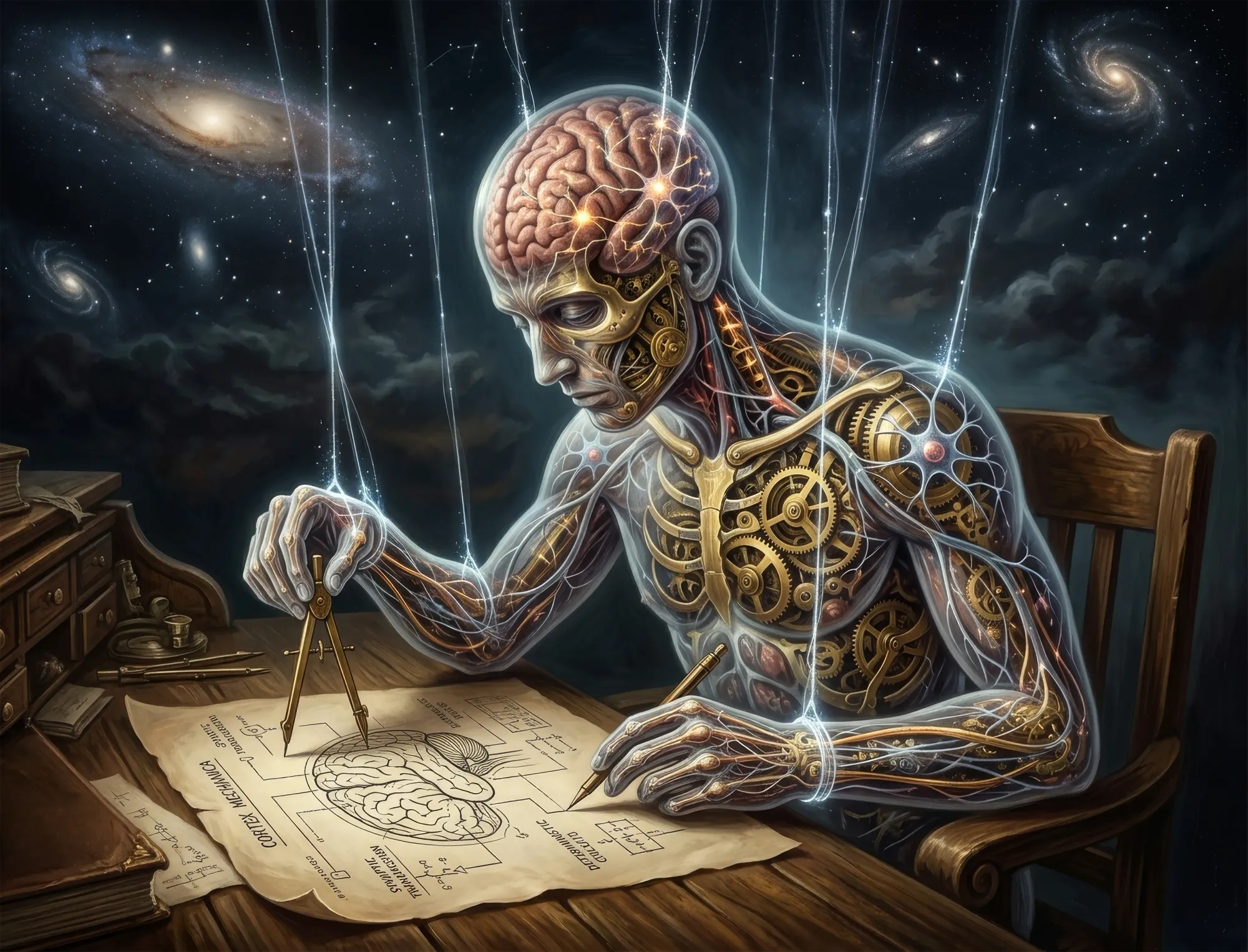
… Compatibilism amounts to nothing more than an assertion of the following creed: A puppet is free as long as he loves his strings.
Importantly, the “folk” conception of free will—the libertarian version—is what most people think they have. It is that version that permeates society, the legal system, and, of course, religion, and is therefore the most important version to discuss.
Frankly, I’m puzzled by the eagerness of intellectuals to embrace various forms of compatibilism, and I’ve concluded—Dennett said this explicitly—that this comes largely from the view that without some idea that we have free will, society would fall apart, with nobody being “morally responsible” for their actions. I don’t have space to rebut that claim, except to say that it’s an untested assertion. Further, it’s clear that most determinists are not running amok by flouting morality and the law, nor are we nihilists who see no point in getting out of bed. I’ll add that while we are “responsible” for our actions in the sense that we performed them, under determinism the concept of moral responsibility is incoherent, for it assumes we could have made either a moral or an immoral choice.
Finally, Shermer poses what he sees as an unassailable challenge to my determinism:
In fact, billions of interacting neurons is exactly where self-determinism (or volition or free will) arises. This is why I like to ask determinists: Where is inflation [of the monetary sort] in the laws and principles of physics, biology, or neuroscience? It’s not, because inflation is an emergent property arising from millions of individuals in economic exchange, a subject properly described by economists, not physicists, biologists, or neuroscientists.
That is a red herring. Like all phenomena in human society, you won’t find monetary inflation in the laws of physics. Nor will you find academics, music, sports, or any other human endeavor. The question is not whether these phenomena are in the laws of physics, but whether they result from the laws of physics as emergent phenomena wholly compatible with underlying naturalism. And Shermer himself said yes, they do: “we live in a determined universe governed by laws of nature.”
The problem of free will is “insoluble” only insofar as Shermer, trying to retain an idea of self-control, and ignoring the massive body of data on affecting volition, has confected a new definition that simply redescribes human behavior. The important question is this: “Is there physical determinism of human behavior or not?” Both Shermer and I agree that there is. In the end, however, Shermer seems to argue that we have free will because we feel like it. One might as well say that there’s a God because we feel like there is one.