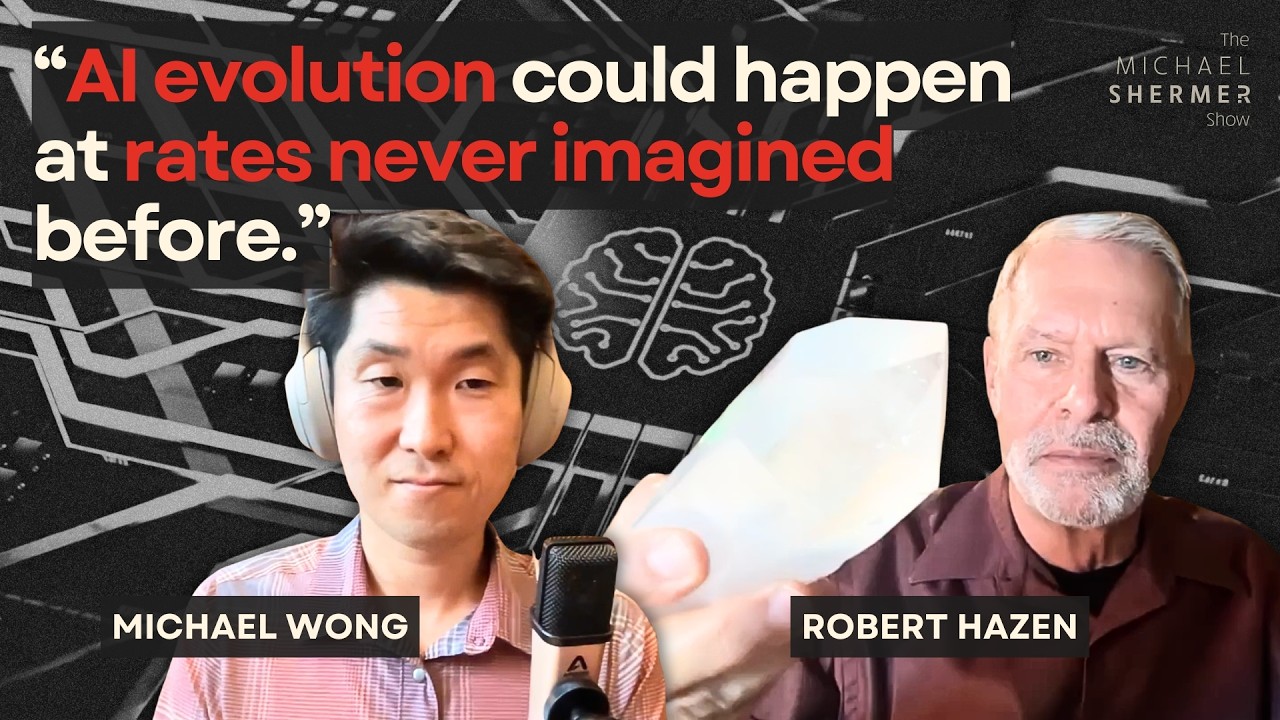

Is There a Second Arrow of Time? A New Law of Evolution, Information, and Complexity

About this episode:
Why does the universe produce ever more elaborate forms, from atoms and minerals to cells, organisms, brains, technology, and civilization? The familiar laws of physics can explain much of what happens in nature, but Robert Hazen and Michael Wong argue that something important has been missing: a law describing how evolving systems generate and select new forms over time.
Michael Shermer speaks with Hazen and Wong about their proposed law of increasing functional information, the central idea behind their new book Time’s Second Arrow. They discuss entropy and the second law of thermodynamics, the origin of life, the Cambrian explosion, emergence and complexity, Stephen Jay Gould and evolutionary contingency, whether evolution has a direction, and why the same basic process of variation and selection may apply far beyond biology.
Shermer also presses them on what evidence could falsify their theory, whether AI could evolve far faster than biological organisms, and the biggest question of all: does any of this imply that the universe has a purpose?
Robert M. Hazen, a geoscientist at the Carnegie Institution for Science, is the author of Symphony in C, among other titles.
Michael L. Wong is a planetary scientist and astrobiologist at the Carnegie Institution for Science.

Support the show
Did you enjoy this episode? Show your support with a tax-deductible donation and share the show with your friends and family. Together, we can make a meaningful difference.
Transcript
Coming soon...