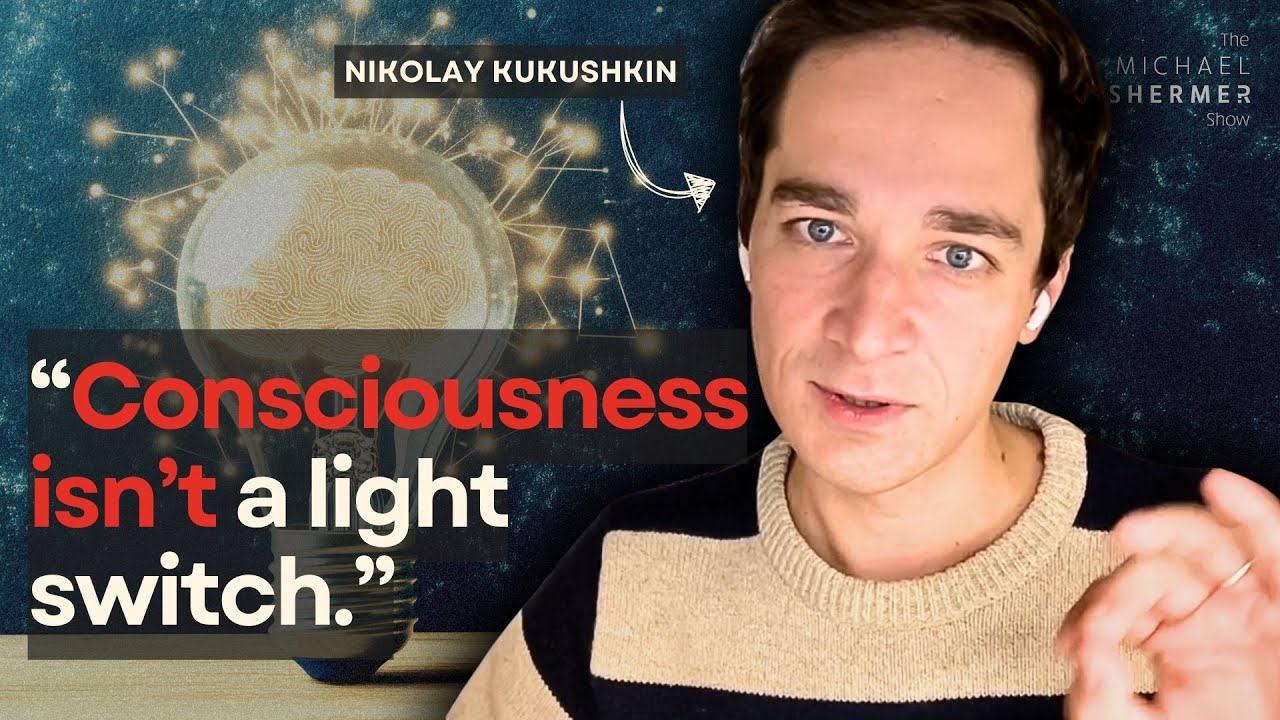

What Makes You “You” When Everything Is Just Atoms?

About this episode:
What is consciousness, really? Why does it not simply switch on at a single moment? Neuroscientist Niko Kukushkin explains how even single cells can show primitive forms of memory and agency, why the human mind is not a mysterious force floating above biology, and why reducing it to “just neurons” misses what actually matters.
He also discusses the evolutionary gamble of complexity, why bacteria still dominate the planet, and how abstraction and memory together give rise to thought.
At the center of the conversation is an unsettling question: Why does it feel so special to be you when science says that you are nothing but a chemical reaction—a collection of atoms and molecules, like rocks, paperclips, and everything else in the physical universe?
Nikolay Kukushkin is a clinical associate professor at New York University and a research fellow at NYU’s Center for Neural Science, where he studies how temporal patterns shape memory formation. He holds degrees from St. Petersburg State University and Oxford University, and completed postdoctoral training at Harvard Medical School. He is the author of a recent paper in Nature Communications demonstrating canonical memory in non-neural cells. His book is One Hand Clapping.

Support the show
Did you enjoy this episode? Show your support with a tax-deductible donation and share the show with your friends and family. Together, we can make a meaningful difference.
Transcript
Coming soon...