20 Questions Revisited, or, How the Slick Police Psychics Fool the Bumbling Cops
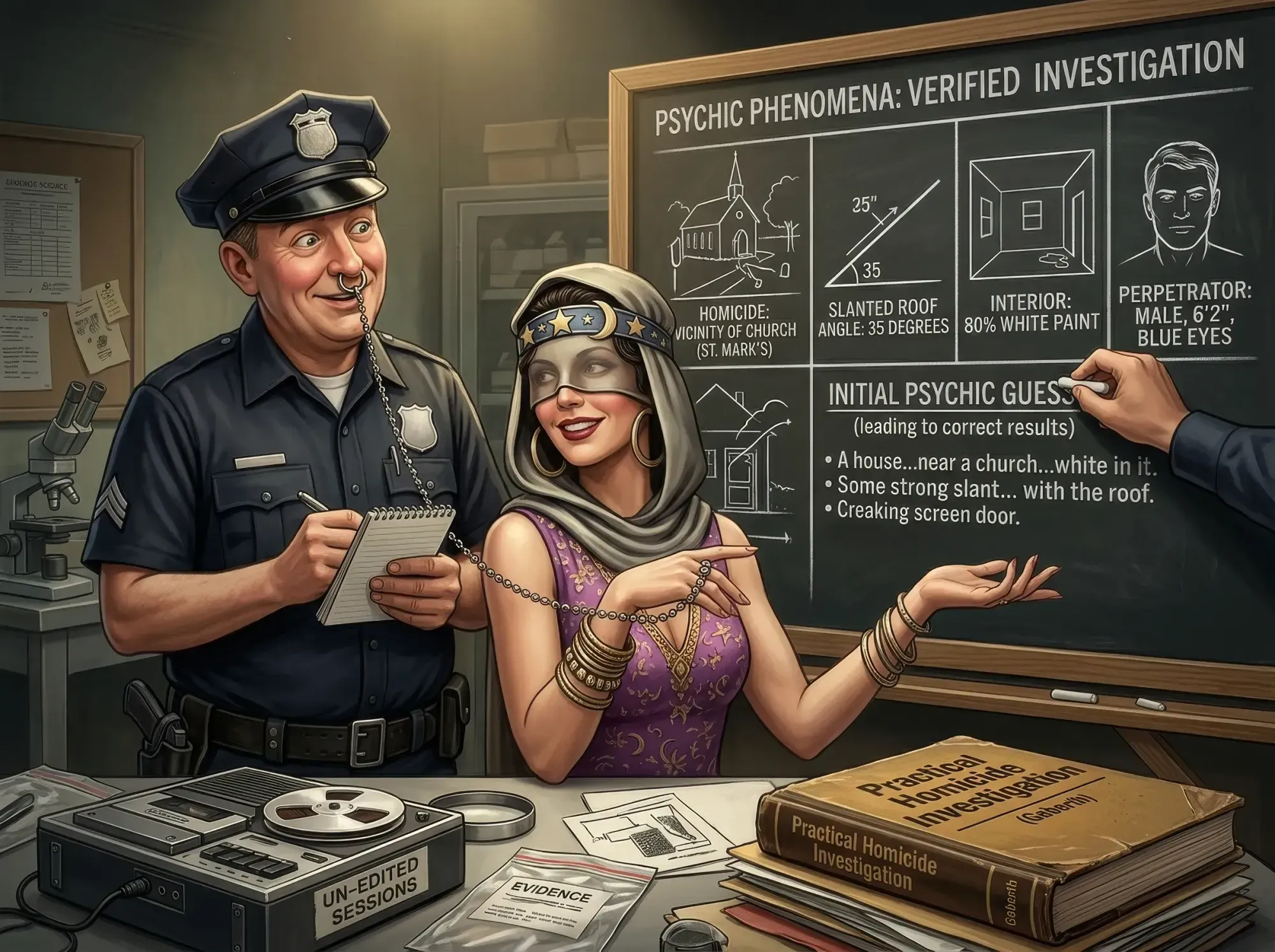
My friend Alec Jason, a forensics expert who was instrumental in my exposure of the tricks used by Reverend Peter Popoff in his faith-healing swindle, has shared with me his dismay at the naiveté shown by one of the major authorities in forensics, Vernon J. Geberth. A book by Geberth, Practical Homicide Investigation—Tactics, Procedures, and Forensic Techniques, begins a section on “Identification of Suspects” with this definition:
A psychic is a person who is especially sensitive to nonphysical forces of life energy.
Examine that inane statement for errors of logic, language, and factual content. Okay. Just kidding. I don’t want to give you more than you can handle. That task could consume the rest of your life.
Geberth depends upon the fatuous claims of Noreen Renier, an Orlando, Florida “police psychic.” Renier was featured on the April 29th episode of “Put to the Test,” featuring naive “investigators” who would be unlikely to find a bowling ball in a bathtub in full sunlight. The show did, however, provide an excellent example of just how bad the “readings” of the operators actually are, and how much wishful thinking, enhancement of vague statements, and sheer invention play in making the data appear to work.
The mind boggles at the perception and sensitivity of this inspired psychic.
As Dr. Gary Posner of the Tampa Bay Skeptics points out in his review of this program, Renier provided a description of a murderer that was so far off the mark (except for the gender) that it would require an incredible amount of imagination to make it fit the perpetrator. As for providing a psychic impression of the crime scene, which was in a small California community, Renier trotted out the usual can’t-miss statements. In a stroke of divine inspiration, Renier said about the house:
It seems that there is a lot of white in it.
Wow. What more can I say? A Southern California home with some white in it! But there’s more:
And there’s some strong slant … with the roof …
Double wow. How does the woman do it?
A house, or church, or a house near a church …
The mind boggles at the perception and sensitivity of this inspired psychic. These are facts obviously unknown to her, except by divine insight. The three hosts of “Put to the Test,” along with the attending investigator—who knew all the details of the crime and dutifully prompted Renier—were appropriately bowled over. Only on one detail did they express some reservation. Renier ventured:
Screen door creaks.
Oops. The screen door scraped the porch, but did not creak. Well, maybe it used to creak. Or it will creak someday. We’ll wait and see.
Renier’s reading is full of the usual “I feel,” “It seems like,” “I see,” “There would have been,” “maybe,” “could have been,” “I think,” and other such expressions of confidence. And, of course, she asks numerous questions. “Is that right?” and “I don’t know” share the same breath. All the way through, the questioners lead her rambling guesses, as well as nodding when she’s right, and looking puzzled when she’s not.
But there’s a good reason for all that feedback, according to Geberth’s book. He specifies that
… the police have a responsibility to assure that the psychic is properly handled.
As it turns out this “proper handling” consists of rules that allow the psychic to operate in an ideal “cold reading” atmosphere. The psychic must be questioned “in a casual gentle manner” and “… there should be no series of ‘Yes’ and ‘No’ questions.” Further, “If an answer doesn’t sound right, instead of a negative, ‘No, no, you’re all wrong,’ [the psychic prefers] ‘Let’s go back to that later.’” And “Psychics respond better and are more accurate when the individuals working with them have a positive attitude.”
Geberth suggests that to sort out the authenticity of a psychic, a good method is to depend upon word-of-mouth. “This report [about how good the psychic is] may appear in a local newspaper …” he tells us. Sounds good enough to me!
On the rational side of the description on how to handle psychics, the author goes on to actually suggest several rather good methods of avoiding giving data to the psychic, and yet misses the importance of taping the session. To his mind, taping should be done only in order that none of the details offered will be lost; in my opinion, the astute investigator might wish to tape a session in order to record the entire gamut of details, the real precision of the statements, and the wild range of guesses, right and wrong. From taped records such facts are invariably evident.
Geberth warns his reader that an unusually accurate performance by a psychic should be regarded with suspicion:
The phonies like conditions they can control. They do a lot of key bending and blindfold tricks that are impressive. Their clarity and accuracy are usually overwhelming…Real psychics are human, and therefore are subject to error.
And this is an expert in “practical homicide investigation”?
In closing his naive reference to police psychics, Geberth writes
… there is a definite need for the evaluation of the successes and failures of psychic phenomena as they relate to law enforcement before they can be recognized as a “legitimate” investigative tool.
Grammar aside, I believe he meant to write “psychics” rather than “psychic phenomena,” and he seems unaware of Martin Reiser’s rather definitive and damning evaluations, in 1979 and 1982, of whether law enforcement agencies could benefit from employing psychics, and the in-depth examination by Piet Hein Hoebens in 1981 of Dutch psychic Gerald Croiset and Peter Hurkos, unarguably two of the best-known practitioners of this flummery. The evaluation Geberth calls for has already been done. He also notes:
The police have much to learn about the relative value of psychic phenomena in criminal investigations.
He might have better stated:
The police have much to learn about how their own evaluation of psychics can be colored by wishful thinking and their willingness to believe that these abilities have been established as genuine.
In the 1960s, while I was involved in my all-night radio show out of New York City, I was invited by an ardent believer to witness a performance of “psychometry” by Florence Sternfels of Edgewater, New Jersey. Psychometry is the claimed ability to handle an object and to then describe by psychic means the history of the object and its owners. I was allowed to bring along a test object with some sort of history.
Florence had made a bit of news when she tricked the phone company into giving her a listing that they were unwilling to allow. She had a private phone, but wanted to be listed as “Florence the Psychic” and the company insisted that she take a (more expensive) business listing. She promptly took a private line and listed her name as “Psychic Florence,” which got her listed in the white pages as, “Florence Psychic.” That satisfied her needs.
I showed up at a huge home in Croton-on-Hudson with an envelope containing an object about which I actually knew nothing, in fact I’d not even opened the well-padded envelope. It was an object that had been loaned to me by Walter B. Gibeon, creator of the fictional Shadow character that was at one time so popular, and a man who had known most of the major figures in the magic profession. I knew nothing about the object, so that the test would be appropriately “blinded.” Walter was standing by at his telephone awaiting a call from me so that he could reveal the actual history of the test item he’d loaned me.
After Florence had given several “readings” on offered objects, pumping the owners for information as expected and thus scoring strongly to the delight of the faithful fans present, it came my turn. When I was asked to give her my test object I told her that I knew nothing about it. However, as soon as she shook from the envelope a man’s well-worn and very old-fashioned silver belt buckle engraved with the initials “H.H.,” I rather guessed who the owner was, and had to work hard to avoid her reading my reactions to anything she said.
It did not appear that the psychic looked at the object at all, but I noticed that she always gave each item a quick look and turned it over while making a few disconnected comments then held it tightly in her hand, out of sight. “This belonged to a man,” Florence began. I said nothing. “Did it?” she asked me. “I don’t know,” I answered. “Oh. I get the initials H.H.” she said, staring off into space, then she held the buckle close to her face and squinted at it, as if she had a hard time focusing in on it. “Ah!” she exclaimed, “Look at this! Those are the initials right here on it!” She showed it around to a few seated near her, and received appropriate verification of her insight. She turned to me. “I get that this man is in spirit.” I did not react. “Is he in spirit?” she asked. “I don’t know,” I replied. Florence looked unhappy.
There it was, from her own lips, a succinct statement of just how she operated.
Much fingering and turning of the belt buckle ensued. “Politics?” she ventured. “Or maybe the military, in some way?” I did not react. “Was he in politics, or in the military, at any time?” she asked. “Florence,” I replied, “I know nothing about this object. It’s a test object.” “You don’t know anythingabout this buckle?” she said as she angrily rose from her chair. “That’s right,” I told her. “Well how the hell am I supposed to know, then?” she screeched, and threw the buckle down on the thick rug at my feet.
There it was, from her own lips, a succinct statement of just how she operated. I left the room, called Walter and verified my suspicion that the silver buckle had belonged to Harry Houdini, and discovered that it had been worn by him in October of 1926 when he entered Grace Hospital in Chicago to be treated for the ailment that did him in 10 days later. When I returned to the waiting audience and informed them of this fact, Florence immediately came up with, “You see, I knew there was serious sickness involved with this object, and that always dulls my sensitivity, because I feel the pain.” I quickly asked her where the pain was, and while transfixing me with a hard look, she pointed to her chest. “Really?” I remarked, “It was appendicitis that killed Houdini.” “He also had a heart condition” she growled, and my reading was over.
Perhaps Houdini—or Florence Sternfels—had a misplaced variform appendix …?