A Celebration of the Life of Martin Gardner
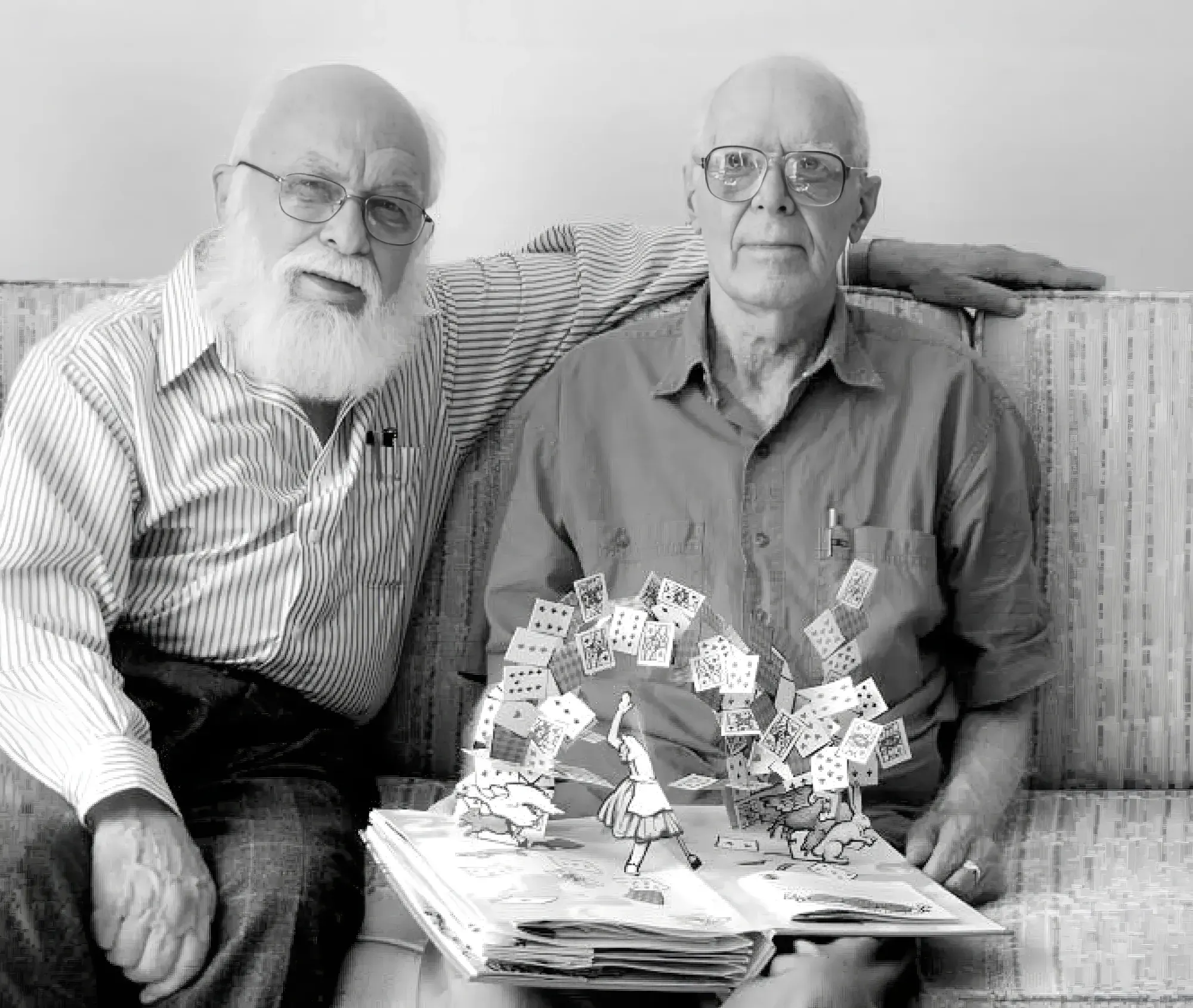
Well, here goes … my most excellent friend Martin Gardner has passed on, following a magnificent career as a mathematician, philosopher, serious skeptic, author/columnist, ardent amateur magician, and game expert. No small part of the miracle that was Martin Gardner is the fact that he accomplished all of this in a mere .95 of a century. What follows is not a memorial, not an expression of grief, but an exuberant celebration of the man, who—I’m very proud to say—I knew for more than 60 years. That was a privilege and an honor.
Martin was one of the most modest persons I ever knew, and since my basic professional background has been in show business, I’ve known very few modest persons, I assure you. This man just could not understand the fuss that was made over him by celebrated personalities in science, in the conjuring profession, and in an impressive spectrum of human endeavor. He could get a little grumpy when confronted with the accolades that came his way, fidgeting about as if to dismiss the praise expressed. He was fond of reminding me of the fact that he never even took a class in mathematics after leaving high school, but rather failed to accept the wonderful fact that he had contributed hugely to that discipline in a way that few others have done, since those he communicated with through his monthly column in Scientific American magazine were largely laypersons who might never have come upon his wisdom, had the editors of SciAm failed to retain his services for 24 years.
Try as I might, I cannot exactly recall when I first met him, though I believe it was in the late 1970s when I was in New York and dropped by to say hello to the Scientific American editor Gerry Piel, and found myself in the presence of the physicist Phil Morrison and Martin Gardner, rather heavy company, I’d say. Gerry chose to spring a surprise on these three renegades by producing from a cupboard a rather heavy wheeled contraption that he invited us to see in action, without explaining to us just what it was. It was to be quite a revelation. He took his entourage down to the street, over to Fifth Avenue, and began wheeling this mystery machine northward until he came to 52nd St., at which point he stopped, opened the box, and revealed an electronic device that had a basic old-style CRT display—a green line on a black background—and other mysterious dials and settings.
He was unique, he was admired, he was honored time and again, and we may never see another with quite that combination of talent, dedication, and perseverance.
Gerry proudly announced to us and to the small crowd gathered around that this machine would tell us, within 200 feet, where we were located anywhere in America. What we were looking at was a very early version of what we now know as the GPS, entrusted to him as a prototype. We expressed our delight and amazement at this technological wonder, and though it operated—so far as I know—on only a few satellites “up there” somewhere, it did indeed accurately tell us the latitude and longitude of this particular NYC location. Morrison, ever the wag, told Gerry and his audience that he had a better method that required much less technology; he leaned back, looked up at the street sign, and announced, “We’re at the intersection of 52nd St. and Fifth Avenue!” I will leave to your imagination the response of Gerry Piel and the suppressed laughter of the small audience we had. And Martin never tired of telling the story.
Once introduced to Martin, I seized every opportunity to be in his presence. His observations on conjuring techniques, his deep insight into the psychological facets of the conjuring art, and his ability to suggest variations of approach to the tricks and illusions I was already familiar with and using in my act, were most welcome to me. Martin had serious problems with his eyesight, and had undergone cataract removal, which in those days was a most difficult ordeal; all the rest of his life he wore very thick lenses. This severely limited his ability to perform as a magician, but in no way did it hinder his imagination. His many books on conjuring—directed towards children, in most cases—are classics of simplicity and clarity.
A remarkable coincidence (or was it?) is that Martin and his wife Charlotte made their home in Hastings-on-Hudson at—are you ready?—10 Euclid Avenue. Was this planned? Was the address just too attractive to resist? I never asked. In any case, the reason that the name Martin Gardner became so internationally famous is found to be the result of what he published on mathematics. His very first column for Scientific American dealt with the remarkable “hexaflexagon,” a geometrical wonder that can be created from a strip of adding-machine paper, and which I suggest you pursue if you have any interest whatsoever in a consuming, compelling, mysterious new activity that might well remove you from continued involvement in everyday life. But beware of getting as far as tetrahexaflexagons; you have been warned.
A word here about “delight,” one of Martin’s most important attributes. He could be easily seduced by a new idea, by a new way of perceiving the world, or by some surprise that simply made him chuckle and decide to share his discovery with his public. Along the way, he was dismayed by the fact that he saw so much deception—in and out of science—and particularly in the field of journalism, when it came to rationality and common sense. One of his first books, in 1957, was Fads and Fallacies in the Name of Science, in which he covered such myths and personalities as Atlantis, dowsing, reincarnation, Scientology, Albert Abrams, Ambrose Bierce, Helena Blavatsky, and a selection of other absurdities; Uri Geller was still 17 years from joining this constellation of dark stars. My copy of this book is inscribed by Martin to: “Randi—The Amazing non-gulliblist.” How good can life get … ?
Martin’s impact on the field of skepticism cannot be measured; it can only be appreciated and admired.
For the next 50 years Martin continued to pursue this subject, to the benefit of us all and to his own great satisfaction. It resulted in the creation of the Committee for the Scientific Investigation of Claims of the Paranormal—CSICOP, now CSI. The idea was hatched during one of our monthly meetings at a Manhattan French restaurant and in the company of Isaac Asimov, L. Vosburgh Lyons, a couple of lawyers, and other interested parties who felt the need for such an organization. Almost from the beginning, there was a suggestion that I could serve as the spokesman—the head—but I pointed out that we needed a serious academic to fill that position, and that a magician could be looked upon as a frivolous choice for that task. At the time, I was being seen on major television shows, but someone with appropriate academic credentials, I correctly thought, was needed. Dr. Paul Kurtz was suggested, we looked into his qualifications, and immediately asked him to serve in that position. To our delight, he agreed.
In addition to mathematics and skepticism, Martin was totally captivated by the Alice in Wonderland creations of Lewis Carroll. He found in those stories a myriad of hidden literary devices, codes, anagrams, mathematical puzzles, and subtle hints offered by the author, who might well have thought that those secrets would never be discovered; he could not have been aware that Martin Gardner would probe into that delightful morass and extract those gems. All this can be found in Martin’s wonderful book The Annotated Alice: The Definitive Edition. If you survive hexaflexagons, I suggest that you may wish to take on the Annotated Alice. But, again, this is accompanied by the usual warning …
In this brief Exultation, I believe I have given you sufficient reason to celebrate with me the existence of this most remarkable man, and I hope I’ve inspired you to follow up on what I suggested you do to further appreciate his impact on our knowledge of how the world works, and—more importantly—how we can know how it does not work. Martin’s impact on the field of skepticism cannot be measured; it can only be appreciated and admired. He was unique, he was admired, he was honored time and again, and we may never see another with quite that combination of talent, dedication, and perseverance, though I suspect and hope that another Martin Gardner can eventually emerge to light up our lives.
I could go on, but tears keep clouding my vision.