A Gardner Centennial
Every now and then, we’ll all admit, we have to ask for help, right? To whom did I turn when I needed advice, data, an opinion or an idea, as I made my way through the construction of an essay such as this one? Dick Feynman, Carl Sagan, John Maddox, Isaac Asimov, Martin Gardner—among a growing number—are no longer available to me except from their writings. One of those advisors persisted to the age of 96, vigorously and with every bit of his wit and wisdom still evident and available. Let me tell you about him on this, the centennial of his birth in 1914.
In my professional life I’ve met a great number of interesting folks, some famous, others not. By far the most thoroughly enjoyable, stimulating, original person I’ve ever met and gotten to know very well, was Martin Gardner. I’ve not the slightest recollection of when I first met him; it often seems that I’ve always known him. Martin thought that we might have had first contact at a magicians’ convention somewhere. That might well be.
Its many rooms were jammed with columns of full filing cabinets bearing exotic labels.
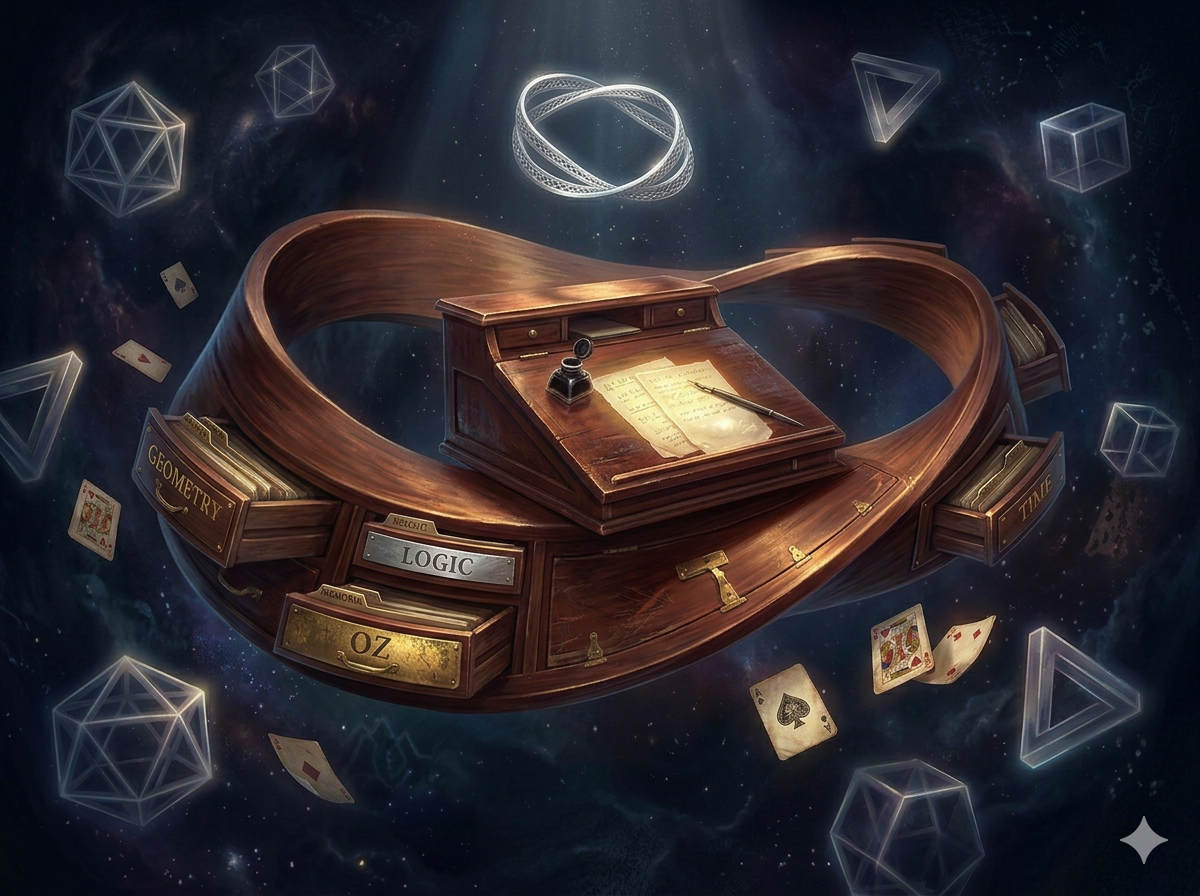
When I first began visiting with Martin I lived in New York City and he lived in Hastings-on-Hudson, in his private Kingdom of Oz at an appropriate address for a math whiz: 10 Euclid Avenue. I never summoned up enough nerve to ask Martin if he chose the house for its address or for its topology, which I suspect on closer examination would prove similar to a Klein bottle (a bottle in the form of a three-dimensional Möbius strip). Its many rooms were jammed with columns of full filing cabinets bearing exotic labels reading, typically, “Geometry, plane, solid, 4D and up” and “Combinational Color Cubes, Magic Squares, Logic & Misc. problems.” It makes one’s mind boggle.
Martin’s bookshelves boasted originals of many classics in the field of mathematics and in the art of conjuring, as well as first editions of all the L. Frank Baum Oz books. One section several feet long was devoted entirely to “Hollow Earth” theories, and there must have been several shelves consisting only of his own books, in several languages and various combinations. A copy machine, using that dreadful old “thermo” paper which smelled like soap and turned brown after only a few months, stood humming at “ready” so that every clipping gleaned might be multiply-copied for filing under as many headings as possible. An article on the subject of telepathy could show up under that filing, but also in the “ESP” file, the “Rhine” file, and the “pseudoscience” file.
Martin also filed numbers. If a number was shown to be a prime, it was filed under “primes,” then given its own file if some other of its specifics might be noted. Any peculiarity or distinction of any sort was described and preserved in those files. I recalled the advantages of this system when I was asked by IBM to work up a stage presentation involving logic, multiple solutions and new ways of approaching problems. The company was concerned with promoting their Series-370 business machines, and I asked Martin about that specific number.
“Aha!” he said (thus also creating a subsequent book-title), “the number 370 is one of only four—aside from 1 itself—that are the sums of the cubes of their own digits. What’s the next highest one?” I had no answer, and felt like a fool when he told me. It is so very obvious. “And if you’re interested in a Spanish connection,” he continued, “turn it upside-down.” I did, and IBM was happy with the results. I’m sure Martin could have gone on and on with fascinating facts about 370 or any other number I’d have cared to choose.
Martin was the most organized person I ever knew. His tastes were simple, but in keeping with his interests. Numerous Escher prints—originals, of course—bought from the artist by Martin many years earlier when no one else cared, graced the walls of #10 Euclid, and a few were later on display at his retirement home in Oklahoma. Some ingenious mechanical devices occupied various shelves, and typically a table would display some puzzle that needed a solution. One such was a group of eight letter-cards spelling out “PICTURES.” Told that these could be rearranged to form another English word of eight letters, all I could come up with was “SCRIPTURE”—leaving me short one “R.” I’ve quite forgotten that solution …
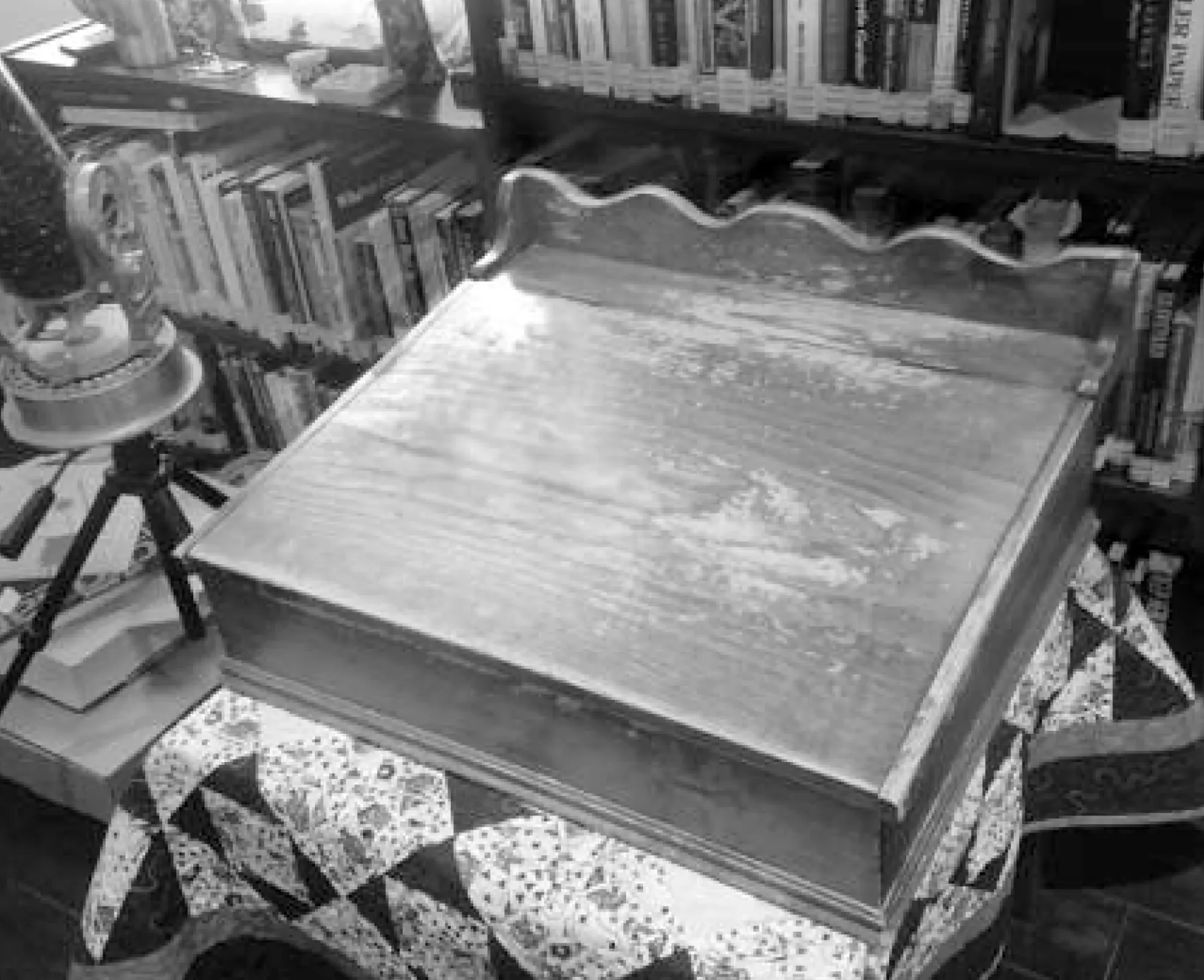
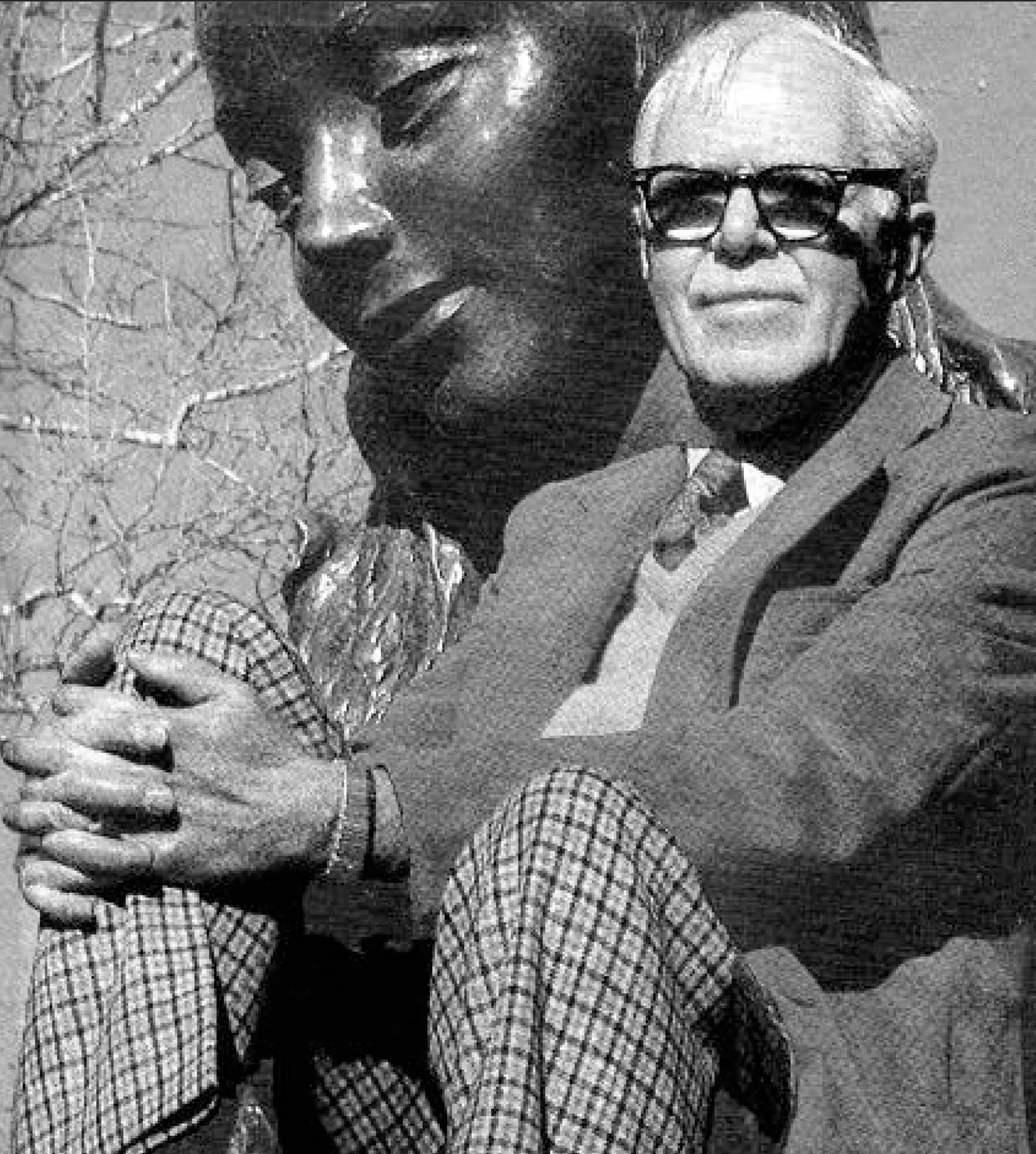
Early in 2012, I received at my door a carefully-packed 19" × 23" × 11" wooden lectern, worn and scratched, very well-used and perhaps proud of that fact. On that sturdy desk Martin Gardner had actually written most of his books, columns, articles, and letters, either by hand or on an ancient mechanical typewriter—remember them?—about which I could tell you another story, at another time. Every visitor to my home has been shown that lectern, which under its lid still contains two decks of cards that Martin used when inventing his card tricks. They will never be opened by me. You see, I’d often admired this very personal object at Martin’s home, and I’d expressed the fact that it would receive loving care if it were ever to come into my possession. Upon Martin’s passing, his son Jim packed it up and shipped it to me. Every morning as I make my way from my breakfast to my office, I pat that artifact and follow it up with a “Good morning!” to a photograph of this great man, seated astride the “Alice” statue in New York’s Central Park—a portrait that looks down on me from above my desk.
A silver ring is the only personal adornment I’d ever seen on Martin, shaped as a tiny Möbius strip. I suppose that there are numerous other artifacts of this kind about, but that particular shape seemed to express the man fully: it’s fascinating in a direct and amusing way, has many unsuspected facets and possibilities, it is simple and basic, suited him quite well, and attested to his good taste.
I don’t think Martin could ever drink a Martini. The pun would have been more than he could stand.
At four in the afternoon at Emerald City—pardon me, at 10 Euclid—after a long day of cerebration, a holler would come up the winding stairway (counterclockwise, two complete turns, going up) from wife Charlotte, the only other inhabitant of Oz besides the very proper cat, which one presumed was certainly Cheshire in another life. Four p.m. was “Manhattan time,” and deadline or no, Martin would break away from his labors to relax. It was a ceremony carefully observed and respected by all visitors upon pain of banishment. I don’t think Martin could ever drink a Martini. The pun would have been more than he could stand.
Martin impressed me in so many varied ways. Looking over just some of my very considerable correspondence with him, I note that he was never reluctant to say he’d been wrong or ignorant about something. He always checked with me before quoting me on anything, as a professional journalist should, and his inborn sense of humor and delight with his universe was always obvious. He never stopped despairing over parapsychologists who came to silly conclusions. In a letter sent to him by Dr. Joseph Banks Rhine (of ESP fame), one that particularly amused him, he found himself referred to as, “a professional denigrator.”
Yes, there was a Martin Gardner, and he was a delight and a frustration, a wonder and a good friend to every rational mind.
Closing these few less-than-brief observations, let me return to that IBM 370 symposium in San Francisco. After my presentation, I credited Martin from the stage with having supplied the raw data for the production, and was pleased to see that the Systems Engineers present gave him a prolonged round of applause in absentia. But I was astonished when, immediately afterwards, I was surrounded by a large group of them who asked me a strange question: Was Martin Gardner a real person, or a composite? They found it difficult to believe that he was only one person and that he turned out such an astounding amount of such excellent material on a regular basis. They suggested that perhaps he was Isaac Asimov and John Dickinson Carr working as a team, and other combinations were also put forth.
To those folks I said, as I say to you: Yes, there was a Martin Gardner, and he was a delight and a frustration, a wonder and a good friend to every rational mind. He was rare, generous, thoughtful, shy, valuable and valued all in one. And he would rather I had not written any of this. But I had to. In the last century, we had Einstein, the lunar landing, instant coffee, biorhythms, black holes, and Doctor Matrix. And, to me, Martin made it all worthwhile being here.
That photo of Martin faces me from the wall as I peck out these comments at my desk, a photo to which I bid “Good morning, Martin!” as I ease into my office chair each morning, and as I turn in at night, I touch that lectern on the way to my slumber.
Oh yes: that number from nine paragraphs back? It’s 371. You were looking too far. Sometimes the sought answer is much closer than we anticipated. And look up “Möbius strip” …
Aha!