The Amazing Speaking Machine of Sir David Brewster
Scotsman Sir David Brewster (1781–1868) was a remarkable intellect. Though he is, unfairly, best known for his invention of the kaleidoscope, he also developed the mathematics of the polarization of light, and made substantial improvements in the design of the stereoscope, besides many other accomplishments. I have come into possession of one of his better-known books, Letters on Natural Magic (1842), in which he discussed many oddities of the kind that fascinated learned persons of his day.
Brewster was, in many ways, rather naïve about the real world. For example, he was totally deceived by the old “lifting-with-the-fingers” stunt in which four persons standing around a fifth would lift that person from a seated position, in an apparently miraculous manner. (See http://archive.randi.org/site/jr/05-15-2000.html.)
Remarkably, this highly-intelligent man seems to have believed in a quite incorrect solution to this stunt. He described a variation of the classic version, which used only the forefingers of the “lifters,” with the “liftee” seated in a chair. In his version any grip on the body of the subject seems to have been permitted. Brewster described the procedure thus:
One of the most remarkable and inexplicable experiments relative to the strength of the human frame which you [Sir Walter Scott] have yourself seen and admired, is that in which a heavy man is raised with the greatest facility, when he is lifted up the instant that his own lungs and those of the persons who raise him are inflated with air. This experiment was, I believe, first shown in England a few years ago by Major H., who saw it performed in a large party at Venice under the direction of an officer of the American navy. As Major H. performed it more than once in my presence, I shall describe as nearly as possible the method which he prescribed.
The heaviest person in the party lies down upon two chairs, his legs being supported by the one and his back by the other. Four persons, one at each leg, and one at each shoulder, then try to raise him, and they find his dead weight to be very great, from the difficulty they experience in supporting him. When he is replaced in the chair, each of the four persons takes hold of the body as before, and the person to be lifted gives two signals by clapping his hands. At the first signal he himself and the four lifters begin to draw a long and full breath, and when the inhalation is completed, or the lungs filled, the second signal is given, for raising the person from the chair. To his own surprise and that of his bearers, he rises with the greatest facility, as if he were no heavier than a feather. On several occasions I have observed that when one of the bearers performs his part ill, by making the inhalation out of time, the part of the body which he tries to raise is left, as it were, behind.
As you have repeatedly seen this experiment, and have performed the part both of the load and of the bearer, you can testify how remarkable the effects appear to all parties, and how complete is the conviction, either that the load has been lightened, or the bearer strengthened by the prescribed process.
Yes, the effects do appear remarkable, but not at all beyond explanation. First, it’s obvious that the weight has been distributed fairly equally among the four lifters. Thus, each person lifts one-quarter of the total, though “no heavier than a feather” hardly describes the reality. But how do we explain the apparent dramatic decrease in weight? Lifting a relatively “relaxed” or floppy weight is much more difficult and awkward than lifting a more rigid load. When all five participants take in a deep breath, and particularly when that action is performed in unison, the lifting procedure is much easier. The person being lifted is naturally much more rigid than previously, thus more easily handled, and the lifting action is synchronized.
Continuing his description, Brewster relates another similar “experiment” which meets more closely the classic description of this trick:
At Venice the experiment was performed in a much more imposing manner. The heaviest man in the party was raised and sustained upon the points of the forefingers of six persons. Major H. declared that the experiment would not succeed if the person lifted were placed upon a board, and the strength of the individuals applied to the board. He conceived it necessary that the bearers should communicate directly with the body to be raised.
Whoever “Major H.” was, he failed to realize that trying to lift a hard object like a board on the tip of the finger is rather painful, entirely unlike the experience of poking one’s finger into a relatively soft human body! But here we see the semi-mystical aspect of this description, which implies that actually touching the body, albeit through clothing, is somehow a closer-to-nature way of going about things.
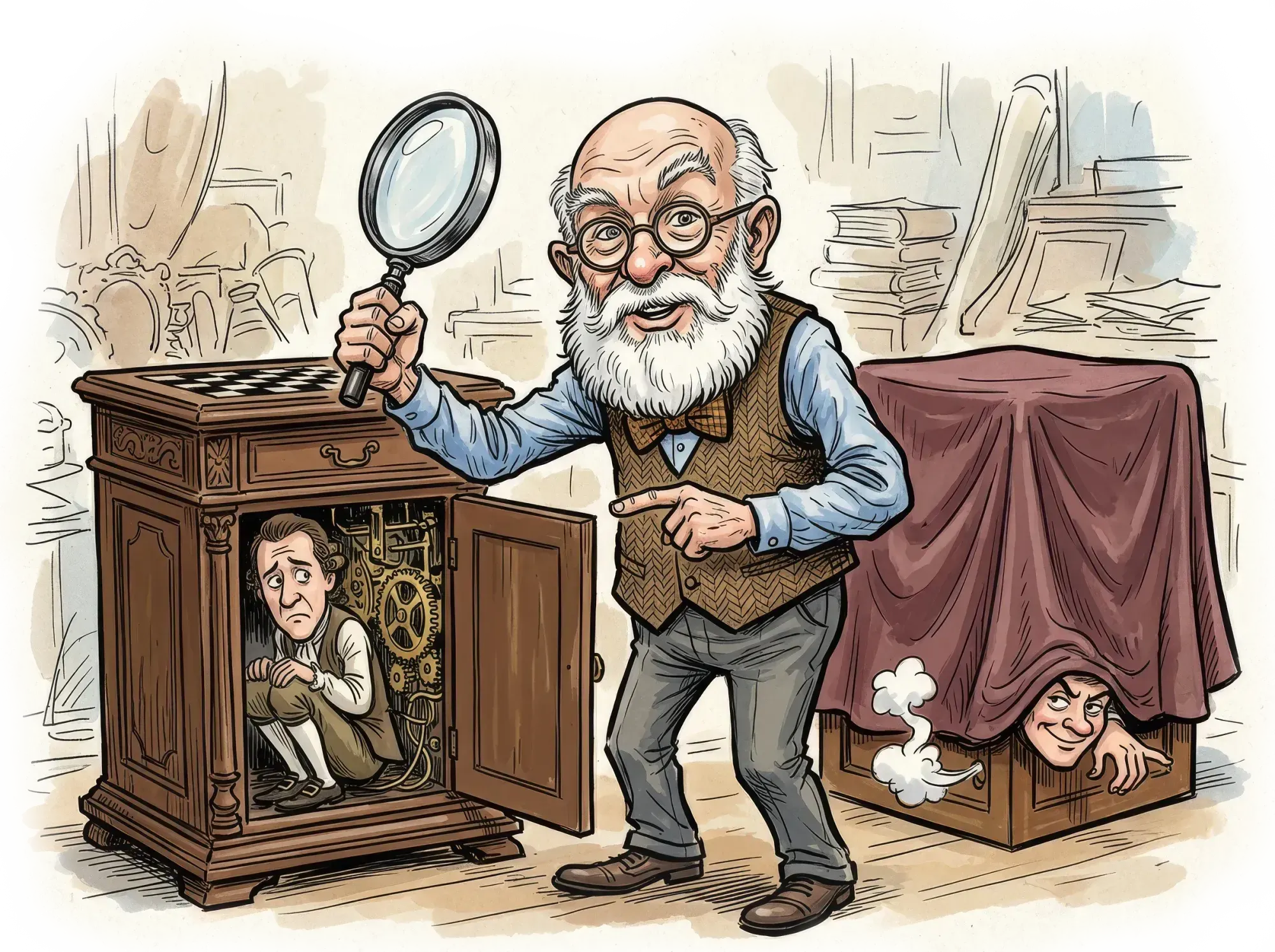
You may agree with me that performing over a mysterious box large enough to hold a human being, with your hands underneath a concealing cloth, smacks of some sort of deception.
Brewster somewhat rescues himself at the conclusion of his description with this disclaimer: “I have not had an opportunity of making any experiments relative to these curious facts; but whether the general effect is an illusion, or the result of known or of new principles, the subject merits a careful investigation.”
I’ve noted another event that Sir David Brewster described in the same chapter of his book, this one involving a character I discussed in another venue (http://archive.randi.org/site/jr/01-19-2000.htmland http://archive.randi.org/site/jr/02-03-2000.html) where Baron Wolfgang von Kempelen (1734-1804) is mentioned in connection with a demonstration of a “talking engine”—something that “mechanicians” (we’d call them mechanics or engineers) had been trying to make for many years. This was a mechanical way of reproducing the human voice, using systems of air pumps, valves, reeds, and funnels, that could be manipulated by an experienced operator to produce at least the basic sounds—consonants and vowels—and, ideally, actual words of speech.
Brewster described the work of well-known technicians, such as a gentleman named Kratzenstein, who demonstrated in 1779 how he could obtain the fundamental vowel-sounds. It seems very much as if this was a genuine demonstration of this man’s ingenuity, but then Brewster described a quite different matter: referring to Baron von Kempelen as, “a celebrated mechanician of Vienna,” he cited the “long study, and diligent examination” entered into by von Kempelen to produce actual words and sentences, and he says that these efforts were successful:
There seems to be no doubt that [von Kempelen] at last was able to produce entire words and sentences, such as, opera, astronomy, Constantinopolis, vous êtes mon ami, je vous aime de tout mon coeur, venez avec moi à Paris, Leopoldus secundus, Romanorum imperator semper Augustus, etc,; but he never fitted up a speaking figure, and probably, from being dissatisfied with the general result of his labors, he exhibited only to his private friends the effects …
Brewster refers here to the expected possibility of von Kempelen preparing a “speaking figure,” probably recalling the famous chess-playing “automaton” for which he was already so very famous, and which he had first put on public display a decade earlier. Knowing, as we do now, that the automaton was a fake, having a human being concealed within it, we read the continuation of Brewster’s description in a new light:
… of the apparatus, which was fitted up in the form of a box. This box was rectangular, and about three feet long, and was placed upon a table and covered with a cloth. When any particular word was mentioned by the company, M. Kempelen caused the machine to pronounce it, by introducing his hands beneath the cloth, and apparently giving motion to some parts of the apparatus.
Was that an “Aha!” moment for you? It certainly was for me. It sounds very much as if this clever rascal simply substituted a French-speaking concealed-in-the-box confederate for the chess-player he’d previously used for the former stunt! Why the “French” connection (pun intended)? Read on about what Brewster says:
Mr. Thomas Collinson, who had seen this machine in London, mentions in a letter to Dr. Hutton, that he afterward saw it at M. Kempelen’s own house in Vienna, and that he then gave it the same word to be pronounced which he gave it in London, viz. the word Exploitation, which, he assures us, it again distinctly pronounced, with the French accent.
With a French accent? I wonder why? Von Kempelen, on one occasion at least, specified that there were language preferences for this machine to operate with. It was easier, he said, “if one chooses the Latin, French, or Italian language, since German is much more difficult because of its many closed syllables and consonant clusters.” Being of a suspicious nature, I see here the possibility that his concealed man-in-the-box was French, and might have had difficulty with the German language.
Science writer John P. Cater is the author of a 1983 article, “Electronically Speaking: Computer Speech Generation,” in which he apparently accepts that von Kempelen actually had a “talking” machine that could perform as advertised. Perhaps he did. However, you may agree with me that performing over a mysterious box large enough to hold a human being, with your hands underneath a concealing cloth, smacks of some sort of deception. There is a strong possibility here that von Kempelen was only doing trickery during this particular demonstration, and might well have had an actual device that he had developed to mimic some parts of speech. His previous history gives us good reason to believe that he could have—and probably would have—resorted to tricks, if and when he had to.
What fascinates me most of all here is the fact that Sir David Brewster didn’t express this same possibility, especially since later on in the same book he describes in detail the very strong suspicion that the von Kempelen chess-playing device was a fake, and probably did contain a human being as the operator! He devotes 13 pages and 10 illustrations to an exposé of this trick, but never connects the “talking engine” demo by von Kempelen with the far more renowned and celebrated chess-player fraud perpetrated by the same man!
I’ll just add one more note here: Sir David, despite his substantial contributions to the science of his day, balked at accepting the discoveries of Charles Darwin, since he was a confirmed creationist. As we’ve said before, even the most intelligent and dedicated thinkers can refuse to face reality when it conflicts with their preferred philosophies.