An Adventure in Asia or, How a Cultural Gap Can Lead to Total Misunderstanding
Early in June this year I began getting esoteric faxes from the “Guinness World Records Korea” office in Seoul, South Korea. They informed me that they wanted to import my talents to do a TV show for the Seoul Broadcasting System (SBS). I put them in touch with my agent in New York, and a flurry of faxes passed between us. (Consider the problem—Seoul is 13 hours ahead of my time zone, thus any fax I sent would arrive the “next day” in Seoul. If they sent me a response it would get to me at night, usually after I’d fallen into the arms of Morpheus. One fax a day became the rule; not a very swift way of communicating but still better than snail mail!)
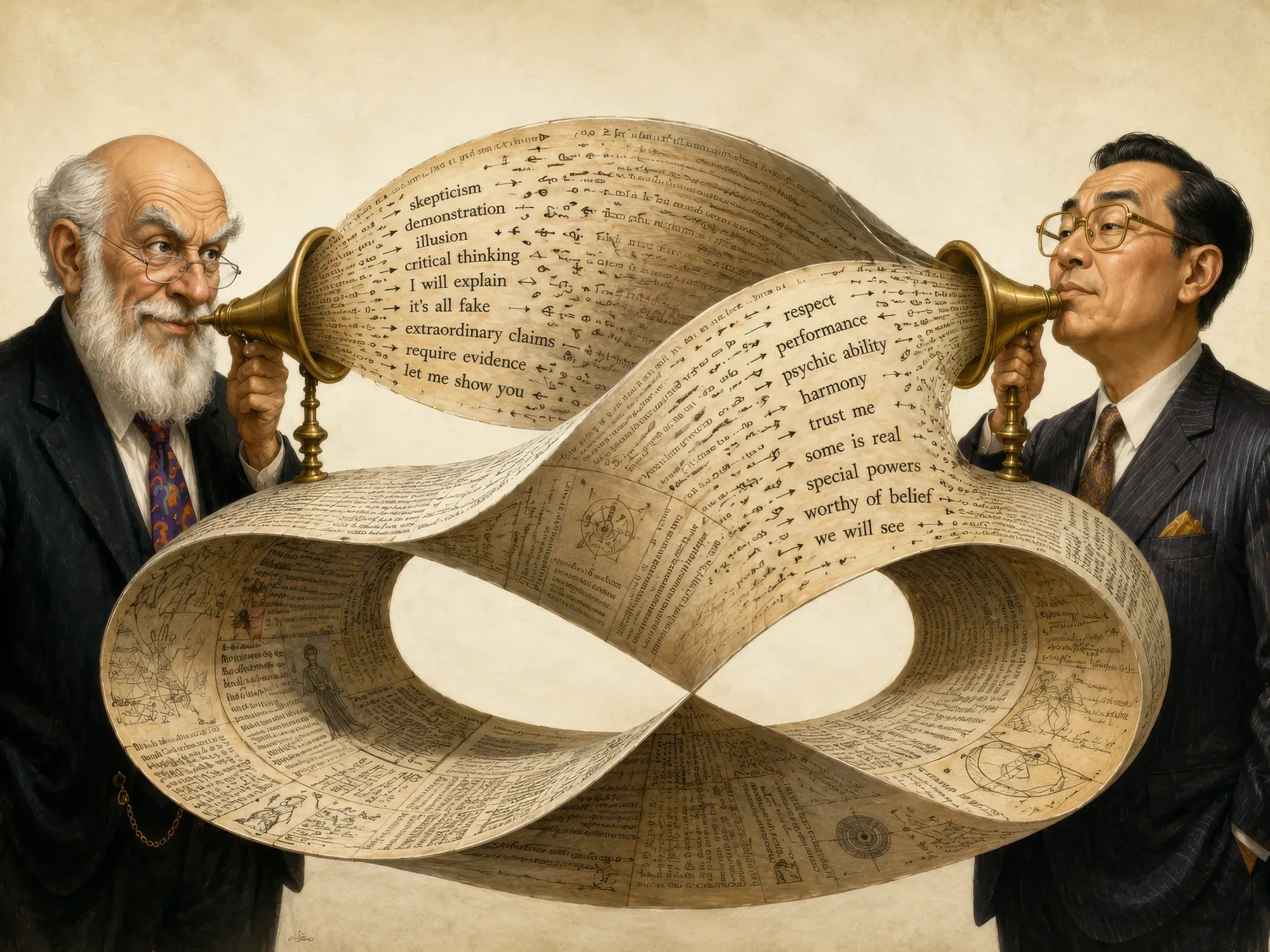
The show they were interested in doing involved occult and supernatural claims, and it was to be taped. It turned out that the Executive Producer (a very august individual, seldom seen, who, I discovered, evoked effusive bows and was almost legendary in the office) had seen a videotape of me at work, and decided that South Korea needed me. From the very beginning, when I described to the producer and his staff (via fax) the demos I would do, I also took great pains to specify that I would explain to the studio audience how it had been done by me, and was probably being done in a similar fashion, as well, by the “psychics.” That all seemed to go down well.
All contracts being arranged—after considerable trouble with getting the air tickets paid for and delivered—I arrived in Seoul and was whisked away directly from the airport to the production office, where a huge staff awaited me. We immediately set about planning the performance, which was to be taped three days from that date.
The problem with the air tickets should have alerted me. There was another agenda planned for me that I’d not been made aware of, and telling me about it proved to be a major difficulty. But let me digress for a moment.
The executive producer, outranking everyone in sight, had decided that I would declare all my tricks to be the real thing!
Many years ago, when I first went to Japan, I found that ways of doing very simple things could become very, very complicated. Protocols were, to the Western view, bizarre. Appointments were not kept if the intention and the invitation to meet was not repeated many times: the initial statement was often a polite gesture, not a serious decision. I often found myself in a hotel lobby awaiting persons who never showed up, and who I never saw again. In the years since, the Japanese have adjusted to some of our more direct ways of personal interaction, and the problem has effectively vanished. But in Korea the situation still exists and it is, to the Westerner, infuriating. A rehearsal appointment made for 9:30 a.m. was not met until after 4 p.m., and by then I’d passed more than six hours in my hotel room, not daring to step out. Another facet of Asiatic protocol, it happens, is that one never gives bad news to a high-ranking person, nor offers any contradiction to something that person has declared to be a fact. You will see what I mean in a moment.
At the meeting immediately before the taping, I was told “The Awful Truth.” The executive producer, outranking everyone in sight, had decided that I would declare all my tricks to be the real thing! Needless to say I very firmly declined to do so. A compromise was offered. Perhaps I could say that some of what I did was fake but most of it was real? No. Well, perhaps I could say that most of what I did was fake, but some of it was real? No, I explained to them, it’s all fake.
Impasse.
The reason for the impasse soon became clear. As it turns out, this executive producer’s little daughter is “psychic.” She can read the contents of sealed envelopes, and can see through walls. “Oh. Now I understand,” I explained, “but the answer is still no. I do tricks. They’re not demonstrations of real psychic powers And that’s it.”
Another facet of Asiatic protocol, it happens, is that one never gives bad news to a high-ranking person, nor offers any contradiction to something that person has declared to be a fact.
“Well,” the Executive Producer said, “that is unacceptable.” He looked very uncomfortable and there was a heavy silence. I stood my ground, and we parted in bad humor.
The next day I presented myself at the studio (the pick-up was very late, not to my surprise) and prepared to do my bit. The studio was very elegant, with my name in a huge neon sign over the stage. In the awful sophomoric manner that all Asiatic shows are done, a bevy of “TV stars” had been assembled onstage to ooh and aah over my miracles, as well as to do juvenile moves designed to bring attention to themselves. I suffered through all of it, did my pieces, and ended up asking the audience how many persons there believed it was all real. Most responded, yes.
During my stay in Seoul I’d met Dr. Sangjoon Kim, a prominent planetary astronomer who is also a leading skeptic. He agreed to watch the program as it was finally edited and aired (September 3) and to report to me whether my work had been misrepresented.
I am pleased to say that SBS presented the program exactly as I had wished. The reaction from the studio audience was interesting when I told them that everything I had done was by trickery, but of course I have no way of knowing how many of them accepted my statement as true. Though the Executive Producer had wished my performance to be very much different, and it was doubtless a disappointment to him that I had not presented it as being genuine, he had enough respect for me and for his audience to represent the material directly and correctly. We are, in the U.S., accustomed to the way that “token” skeptics are frequently worked in on otherwise irresponsible TV shows, given a few seconds of air time, and then shuffled off to some corner, never to be allowed to express anything further. This did not happen to me in South Korea, and I thank the Executive Producer for his honesty. It could have been very different.
But my adventure was hardly over. I’d been promised that my fee for this performance would be paid immediately following the taping. Darn, but they hadn’t made it to the bank in time. I was told I’d be paid at the airport the next day. Well (need I tell you?) the person who had the money got stuck in traffic, and couldn’t make it to the airport. Drat! Having been subjected to this sort of con game previously in both Brazil and Venezuela, I was quite prepared to handle it. (I didn’t fall off an apple tree yesterday.) The upshot was that the money was suddenly discovered, and I left with it in my pocket. It wasn’t exactly sleight of hand, but it took considerable effort to collect. Such is the life of an itinerant skeptic.
South Korea, it seems evident, needs a good dollop of skepticism. While I was there, immediately following the spectacular collapse of the Sampoong department store in which hundreds died, I saw Catholic nuns walking about with dowsing sticks claiming to find buried persons, both alive and dead. Every “find” by a nun was immediately investigated, and when occasionally a “hit” occurred, there was great excitement and a report was published in the newspapers. Naturally misses, which wasted the time and facilities of the rescue teams (as well as the lives of those who might have been rescued), went unreported.
There were “ki” (“spirits” or “elan”) experts everywhere, using the “water vein tracing method.” And the local newspapers expressed no doubts at all about the claim that the dowsing stick was far more sensitive than the “STOLS” detection equipment being used by the godless, ignorant technicians. One nun found a water vein, she said, and traced it all the way to the U.S.A. on a map. Wow!