Animal Friendships Abound
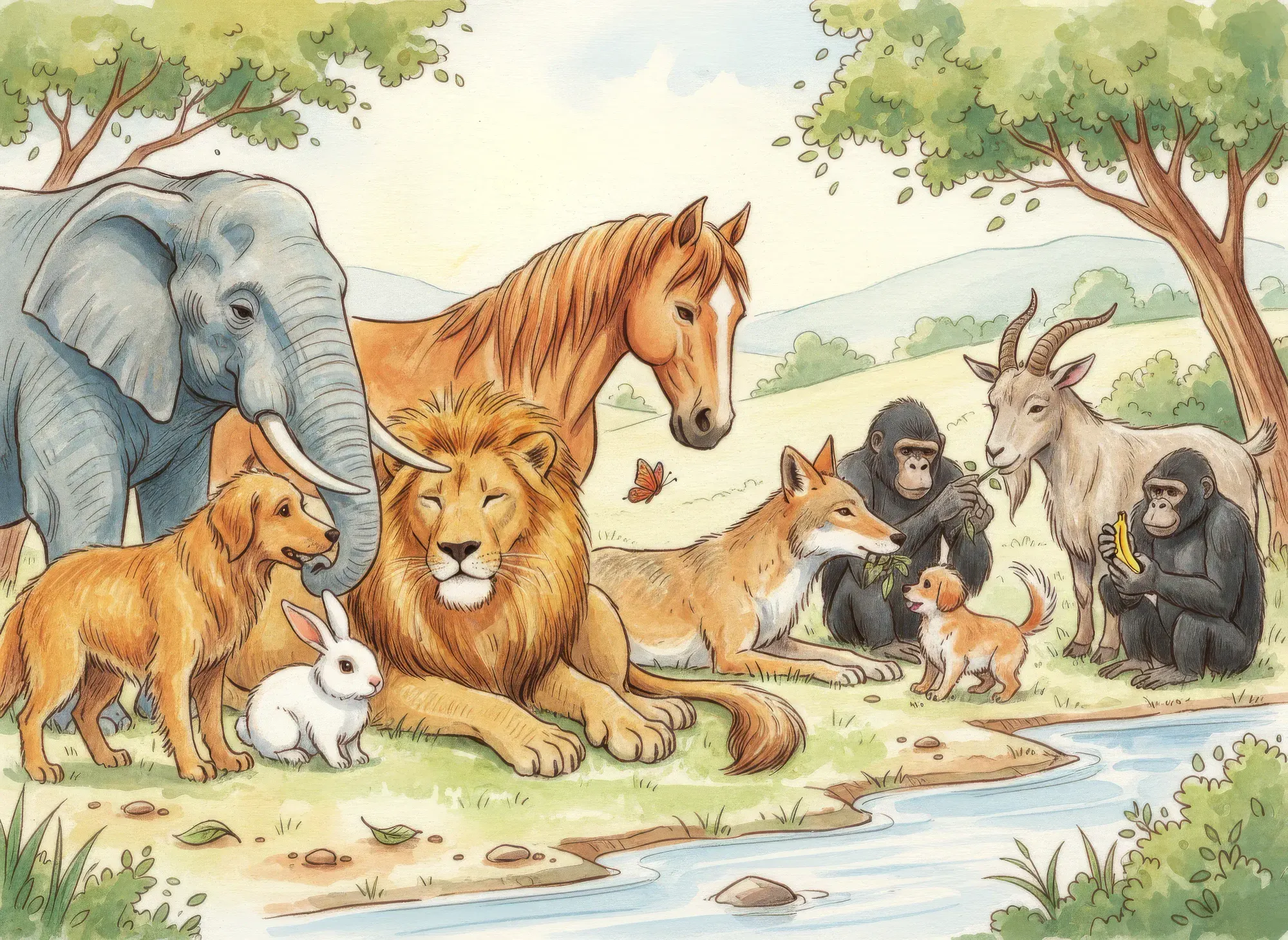
Let’s get over thinking we’re the only animals who make friends—we’re not.
While a small number of people, including some academic researchers, argue that nonhuman animals don’t really make friends, we posit that most people, including both researchers and non-researchers, know from simple observation and experience that a wide variety of animals do, indeed, make friends and form long-term friendships. No matter how one defines the words “friend” and “friendship,” ample evidence clearly shows that humans aren’t the only species capable and even desirous of making and keeping friends.
As far back as we (Marc and Marlon) can remember, we knew that animals lead deep and rich emotional lives. We observed our nonhuman family members (pets), and wondered how anyone could possibly doubt it. What else would you call the bonds we form with our animal companions if not friendships? Marlon was lucky enough to grow up with five cats—all the same species—but each unique in everything from their personalities, to how they preferred to while away the hours, to what they liked to eat, and whom they chose to keep close. Is it really so hard to imagine that if people and cats can form friendships, so too can cats with other cats and, indeed, animals of totally different species with one another? No other conclusion is tenable if one pays attention to science and common sense. Concerning this special topic for Skeptic—if animals can be fiends, can they likewise be friends? The answer seems clear to us, so let’s review the evidence and arguments, starting with a key definition.
Who counts as a friend?
Who’s a friend? Marc asked 50 people to define “friend” and some common elements included: someone you like to spend time with, trust, feel safe with, care about, miss, seek out, are more than happy to help, and feel will help you when needed.
When he asked if animals make friends, all but one of these people thought the question was “asinine,” and a few even commented, “You academics beat the hell out of everything and some try to make the word ‘friend’ only refer to humans to place us above or make us better and separate from other animals, which is absurd.”
Indeed, many researchers have long found this uncertainty about who does and does not form friends to be ridiculous, even when applying the most rigorous criteria to the conceptual basis for “friendship.” In an essay in The New York Times, anthropologist Barbara J. King notes that a friendly relationship “must be sustained for some period of time; there must be mutuality, with both of the animals engaged in the interaction; and some sort of accommodation must take place in the service of the relationship, whether a modification in behavior or in communication.” These are excellent guidelines for assessing the nature of a relationship between two or more individuals. Applying these empirically defined and testable criteria to animals leaves no doubt that they form friendships with members of their own species, and the same is true for members of different species, often called odd couples.1
To answer questions about nonhuman friendships, we need to focus on who animals are and what they can do rather than who they aren’t and assumptions about their inabilities. Indeed, when one examines the scientific data centering on the cognitive skills and emotional capacities of other animals, what emerges is not their limitations, but the extraordinary ways in which they take in life and live it on their own terms.2
While they may not write love letters or make phone calls, many animals use sounds, body language, and even pee-mail—different odors or combinations thereof—and other subtle signals that are beyond our own capacity to see, hear, or smell, and these communiques serve to make friends and sustain relationships over long periods of time. When you consider their lifestyles and how they communicate with one another, they simply express friendship and love in ways different but no less valid than how we do.
Why Animals Make Friends
Renowned researchers Robert Seyfarth and Dorothy Cheney published an essay in the Annual Review of Psychology titled “The Evolutionary Origins of Friendship.” The abstract for this landmark essay reads:
Convergent evidence from many species reveals the evolutionary origins of human friendship. In horses, elephants, hyenas, dolphins, monkeys, and chimpanzees, some individuals form friendships that last for years. Bonds occur among females, among males, or between males and females. Genetic relatedness affects friendships. In species where males disperse, friendships are more likely among females. If females disperse, friendships are more likely among males. Not all friendships, however, depend on kinship; many are formed between unrelated individuals. Friendships often involve cooperative interactions that are separated in time. They depend, at least in part, on the memory and emotions associated with past interactions.3
Why do animals form friendships? According to Seyfarth and Cheney: “Applying the term ‘friendship’ to animals is not anthropomorphic: Many studies have shown that the animals themselves recognize others’ relationships. Friendships are adaptive. Male allies have superior competitive ability and improved reproductive success; females with the strongest, most enduring friendships experience less stress, higher infant survival, and live longer.”
Such observations lend themselves to questions of sentience—the ability to feel—that arise in the ever-growing field called cognitive ethology—the study of animal minds and how they work. Cognitive ethologists basically study what are called “subjective experiences,” that is, what animals are thinking about and feeling. In other words, their cognitive and emotional lives and sentience. Concerning friendships, then, we can ask, why did they evolve? What are they good for? How do they help individuals adapt to the wide variety of social situations in which they find themselves? And what causes them to form and develop? We can also ask why do individual differences emerge even among members of the same species (conspecifics); what do they think about these differences, and how do they make them feel?
Not unlike humans, animals are selective about the individuals they let into their lives.
Nonhuman friendships evolved because they play a role in survival by helping individuals adapt to varying social situations and novel encounters with other individual organisms. They’re caused by external situations involving different individuals and internal factors such as hormones—perhaps oxytocin, sometimes called the “love hormone.” And they develop when it feels good to do so.
A Menagerie of Animal Friendships
Some people say that dogs shouldn’t be cited as a good example of animals who form friendships because they’ve been domesticated and selectively bred and so are essentially different from other animals. We think there is no reason to exclude dogs or other companion animals from conversations about the nature of nonhuman friendships. A visit to a dog park or other places where dogs can run free and decide for themselves who to play with (or not) and how, shows they can form layered social interactions just like other animals. Dogs certainly have the cognitive and emotional capacities required to form deep and enduring friendships.
Some years ago, Marc received a letter from a reader asking, “Does my dog Shara really make friends with other animals?” The reader made it clear she was referring to nonhuman animals, especially dogs, as she also wrote, “I’m sure Shara is my friend.” Whenever Marc receives this sort of question, his first response is to write something along the lines of, “Of course she does. You can see it—and often feel it—when they effusively greet one another, when they play with one another, when they actively seek one another out even if other dogs are around, when they clearly miss the presence of another dog or grieve their absence, and when they occasionally groom one another.” Oxytocin plays an important role in the expression of sociality among mammals. Among dogs, oxytocin enhances the social motivation to approach and interact with both other dogs and with their human partners. Oxytocin levels increase after dogs engage in play with their dog partners, which indicates that friendships stimulate the oxytocin system.4 On the flip side, other research found that levels of the stress hormone cortisol drop, not in the mere presence of friends, but when they actively cooperate.5
Friendships among individuals of the same species often develop during play. When animals play, there’s usually some kind of elaborate play invitation ceremony that’s evolved, often uniquely, across different species. In dogs, a highly recognizable signal called the “bow” is used as an invitation to ask other dogs and other animals, including humans, to play. It’s a simple act—a dog crouches on their forelimbs, sticks their butt into the air, and sometimes wags their tail and barks. They’re essentially saying something like, “I want to play with you.” Bows also are used to maintain a play mood when things get rough, as if a dog is saying, “I’m sorry, I didn’t mean to bite you so hard, let’s keep playing.” Decades of research in this area by Marc has established that there are “Golden Rules” of play that develop as dogs become regular playmates.
Dogs who are friends invite one another to play differently from dogs who don’t know one another or are in the midst of getting to know one another to say, “Let’s play.” With friends they use more individualized gestures and vocalizations that reflect their history of friendly interactions. With an unfamiliar dog, they “play safe” and stick to the ingrained, species-specific behaviors such as play bows and “floppy” rather than stiff movements to signal their playful intentions and prevent misunderstandings. (Interestingly, police officers recognize that when a suspect gets “stiff” it means they are probably about to resist or flee.6)
Odd couples: friendships cross species lines.
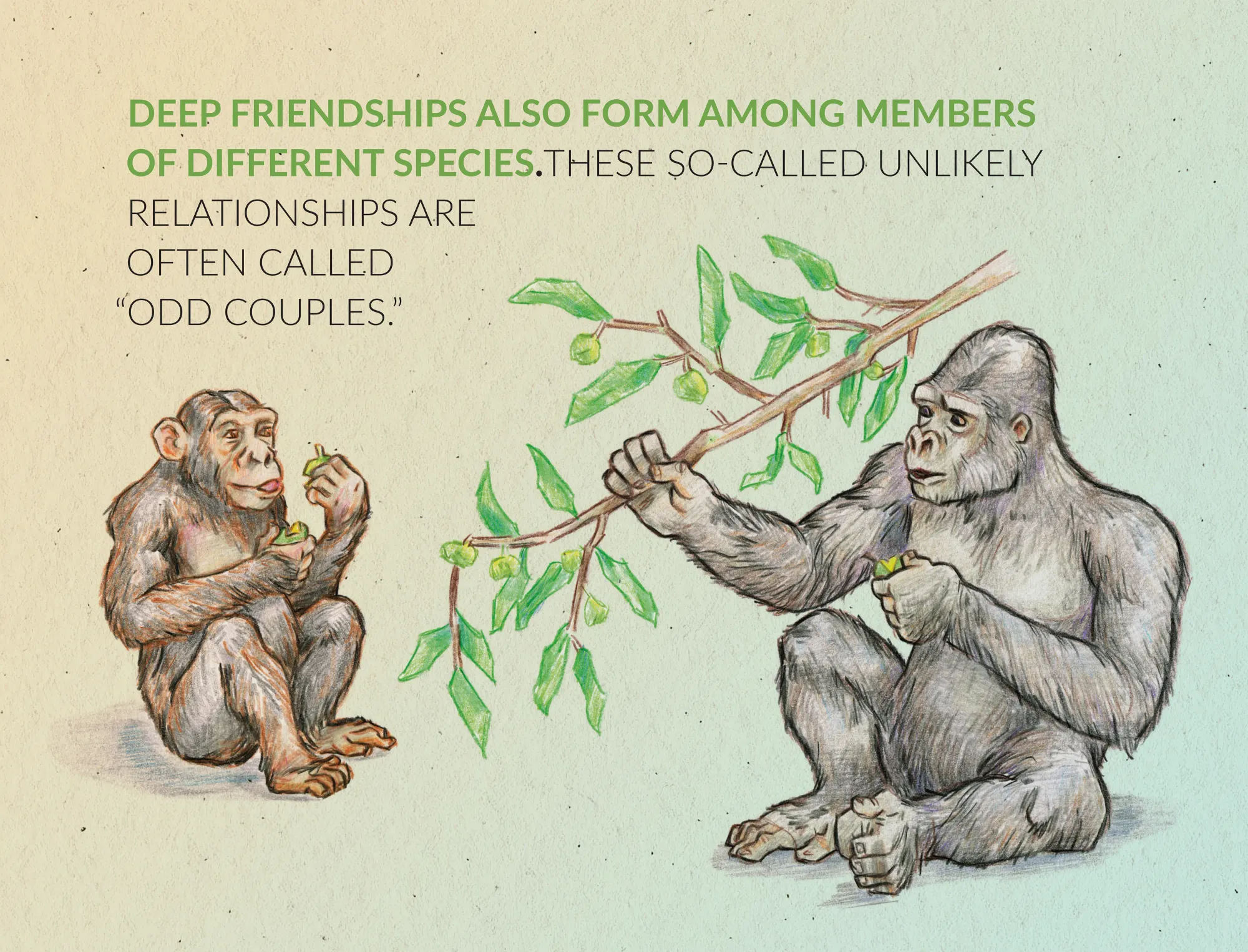
Deep friendships also form among members of different species. These so-called unlikely relationships are often called “odd couples.” Researchers find evidence for such bonds, with one such example being the friendships that form between dogs and dolphins.7 The choices animals make in cross-species relationships are the same as those they make in same-species relationships. Not unlike humans, animals are selective about the individuals they let into their lives.
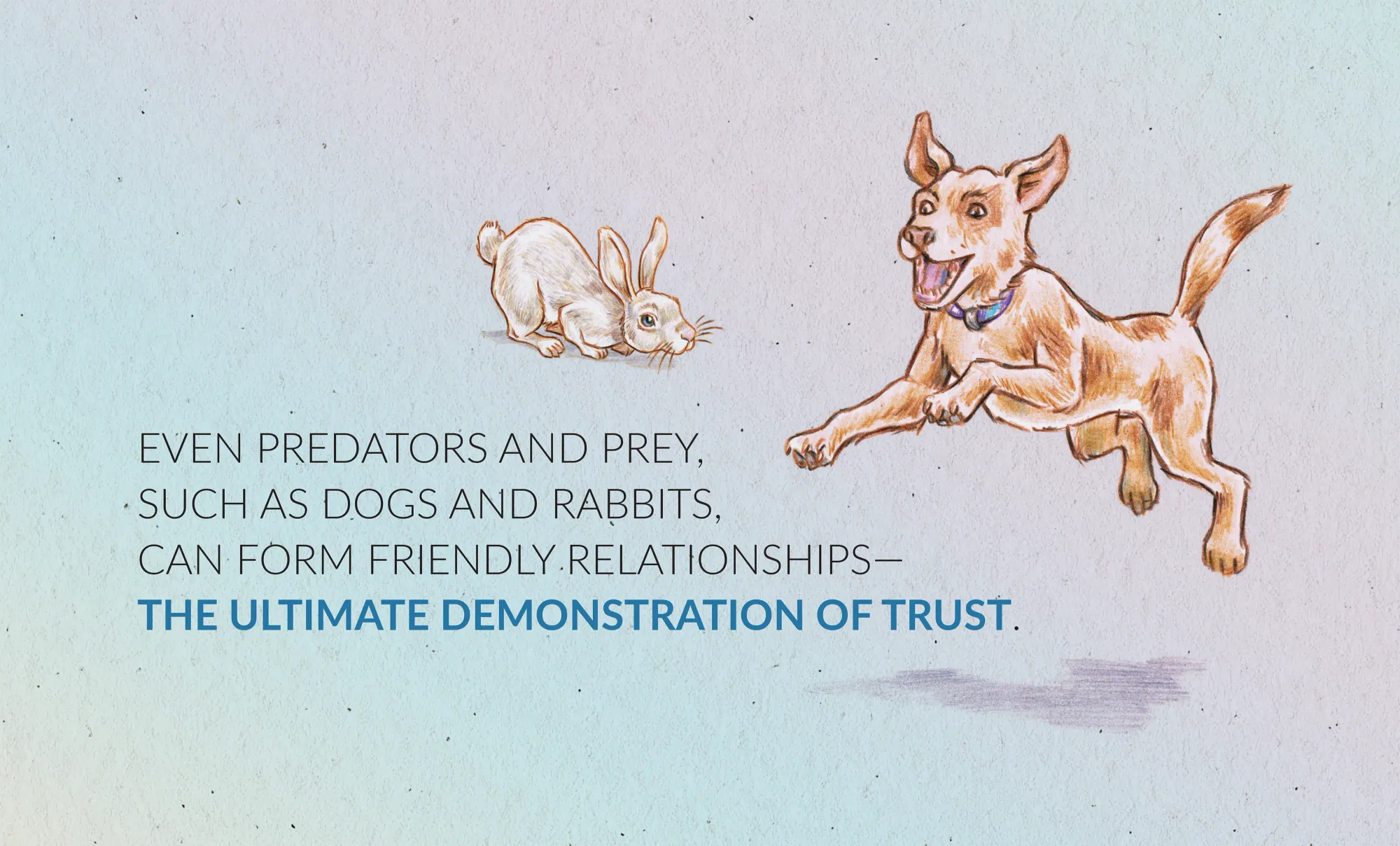
Even predators and prey, such as dogs and rabbits, can form friendly relationships—the ultimate demonstration of trust. Consider, for example, the PBS documentary Animal Odd Couples. A lion befriends a coyote. A goat guides a blind horse. A goose romances a tortoise, and so on. The growing number of documented cases of unlikely and enduring animal pairings have generated a good deal of scientific interest in the fields of interspecies and intraspecies bonding and animal altruism.8
In a research project about the grief of losing friends of different species, scientists documented mourning across a large variety of animals, including dogs, hippos, and apes, who had developed bonds with individuals of other species.9 Unsurprisingly, they found that when one dies, the survivor grieves. An excellent example involved an elephant named Tarra and the close relationship she formed with a dog named Bella. When Bella died after being attacked by coyotes, Tarra grieved her loss in ways humans would recognize. Another odd couple involved a hippo named Owen and a 100-year-old tortoise named Mzee. These distantly related animals could communicate with one another and formed a strong emotional bond.
At Florida’s Busch Gardens, Kasi, an orphaned cheetah cub, was paired with Mtani, a Labrador retriever puppy, to see if they would support each other. In an account of their behavior, we read, “Their initial comfort with one another was shaped by shared means of communicating, their use of similar signals and sounds.” They created their own language—not dog or cheetah, but a combination—Kasi-Mtani language. They seemed more than happy to become companions.
There are some more compelling examples. Consider Anthony, a lion, and Riley, a coyote, living at Arizona’s Keepers of the Wild sanctuary. They were brought together when they were both a little more than a month old. Despite the difference in their relative sizes and that they would never be friends in the wild, these unlikely companions formed a close and gentle bond and have learned to enjoy one another’s company.
There’s also a heartwarming story from Oklahoma’s Wild Heart Ranch of an elderly horse named Charlie that went blind and learned to rely on his friend, Jack, a goat, for guidance and protection.
One of the most remarkable accounts of a friendship between two very distantly related species is that between an octopus and a human.
Making Friends With an Octopus Named Octavia
Octavia had two eyes, three hearts, nine brains, one beak, and no skeleton or shell. Slimy to the touch and covered in muscle, she could squirt both black ink and a toxic skin-dissolving venom. She could change color and texture on a whim to mimic her surroundings or in imitation of other deadly creatures. And her arms were covered in hundreds of suckers that served as her taste buds, and were so strong, they could pull up to a hundred times her own weight.
Octavia wanted nothing to do with the humans gawking at her. A giant Pacific octopus, Octavia was like some sci-fi alien, an intelligent visitor from another planet. Like the fictional ET, she probably wished to return home to the rocky Pacific Ocean floor off British Columbia rather than be stuck in a temporary container at the New England Aquarium.
One of the people crowded around was naturalist and award-winning author Sy Montgomery. Sy hoped to reach across a vast evolutionary divide—the modern octopus had barely changed in 200 million years, while modern humans had been around a measly 300,000 years. Sy very much wanted to befriend Octavia, but again and again, she refused her overtures, choosing instead to remain at the bottom of her container, as far from people as she could get. But Sy was undeterred.
Octopuses are wickedly smart and emotionally complex, but we can barely conceive of their inner lives. An octopus’s eight arms contain about two-thirds of their neurons, and each arm can think and act independently. This is called “distributed intelligence,” and it gives octopuses nine brains. Octopuses are notorious for escaping tanks, using brawn, brains, and the ability to squeeze through holes no larger than an apple. Sometimes, they sneak out at night to steal fish and crabs in neighboring tanks, returning to their own by morning. Sadly, octopuses are at risk of dying if they get stuck between tanks and are out of water for too long.
Battling an octopus’s boredom is a genuine problem for aquarium staff. In 2000, about a decade before Octavia arrived, the New England Aquarium instituted regular touch sessions with people. No one knew if octopuses would enjoy this, “but we said to hell with it,” one staff member explained. “The octopus is bored! Then we started playing with it.”
The third time Sy visited Octavia, the octopus changed her mind. After the container opened, Octavia rose to the top, and Sy recounts, “Her red skin signaled her excitement. I was excited too. She had my left arm up to the elbow encased in three of hers, and my right arm held firmly in another.” Despite Octavia’s tremendous strength, her beak, and her venom, Sy says, “I felt no threat from Octavia. I felt only that she was curious.” Sy describes her bulbous head as “silky and softer than custard.” Since “octopuses can taste with their entire bodies,” Sy felt Octavia “knows me in a way no being has known me before.” By tasting Sy’s hormones, Octavia could deduce a lot: what she was feeling, that she was female, what she’d had to eat or drink, even medications she’d taken. Octopuses have been observed reacting negatively to smokers, perhaps indicating dislike for the taste of nicotine.
After this encounter, Sy visited Octavia regularly for months, and each time, “Octavia rose to the top of the tank and flowed over to meet me, eager to taste me with her suckers and look me in the face.” All they did was touch. “Octavia enjoyed me, I think, because we liked to play with each other. Our games … were more like versions of patty cake, but with suckers.” One time, right before Sy left to travel, they had their longest hug yet. Sy wrote: “She held on to me, gently but firmly, for an hour and fifteen minutes. I stroked her head, her arms, her webbing, absorbed in her presence. She seemed equally attentive to me. Clearly, each of us wanted the other’s company, just as human friends are excited to reunite with each other. With each touch and each taste, we seemed to reiterate, almost like a mantra: “It’s you! It’s you! It’s you!” While stroking an octopus, it is easy to fall into reverie. To share such a moment of deep tranquility with another being, especially one as different from us as the octopus, is a humbling privilege. It’s a shared sweetness, a gentle miracle, an uplink to universal consciousness.”
Seeing our feelings reflected in other animals is not anthropomorphic. It is affirmation that we are not alone in the world.
When Sy returned from her trip, Octavia had been moved to the aquarium’s main tank, where she’d laid an enormous clutch of eggs. Sadly, the eggs were sterile. They would never hatch, but Octavia devoted every ounce of energy she had to them. She stopped interacting with people and focused solely on being a mother. As Octavia tended to her eggs, she began to die. For female octopuses, hatching offspring is their final act in life. Mothers forgo food for as long as it takes to watch their eggs hatch, and then pass away.
Almost a year later, the aquarium removed Octavia from the main tank. She was by then an “old lady” and near death. After so long apart, Sy and Octavia met one last time. Sy says, “Her wet grip on my skin felt gentle and familiar, the pull of her suckers tender as a kiss.” She and the other aquarium staff interacted with her for about ten minutes, and “we knew in that moment that Octavia had not only remembered us and recognized us; she had wanted to touch us again.”
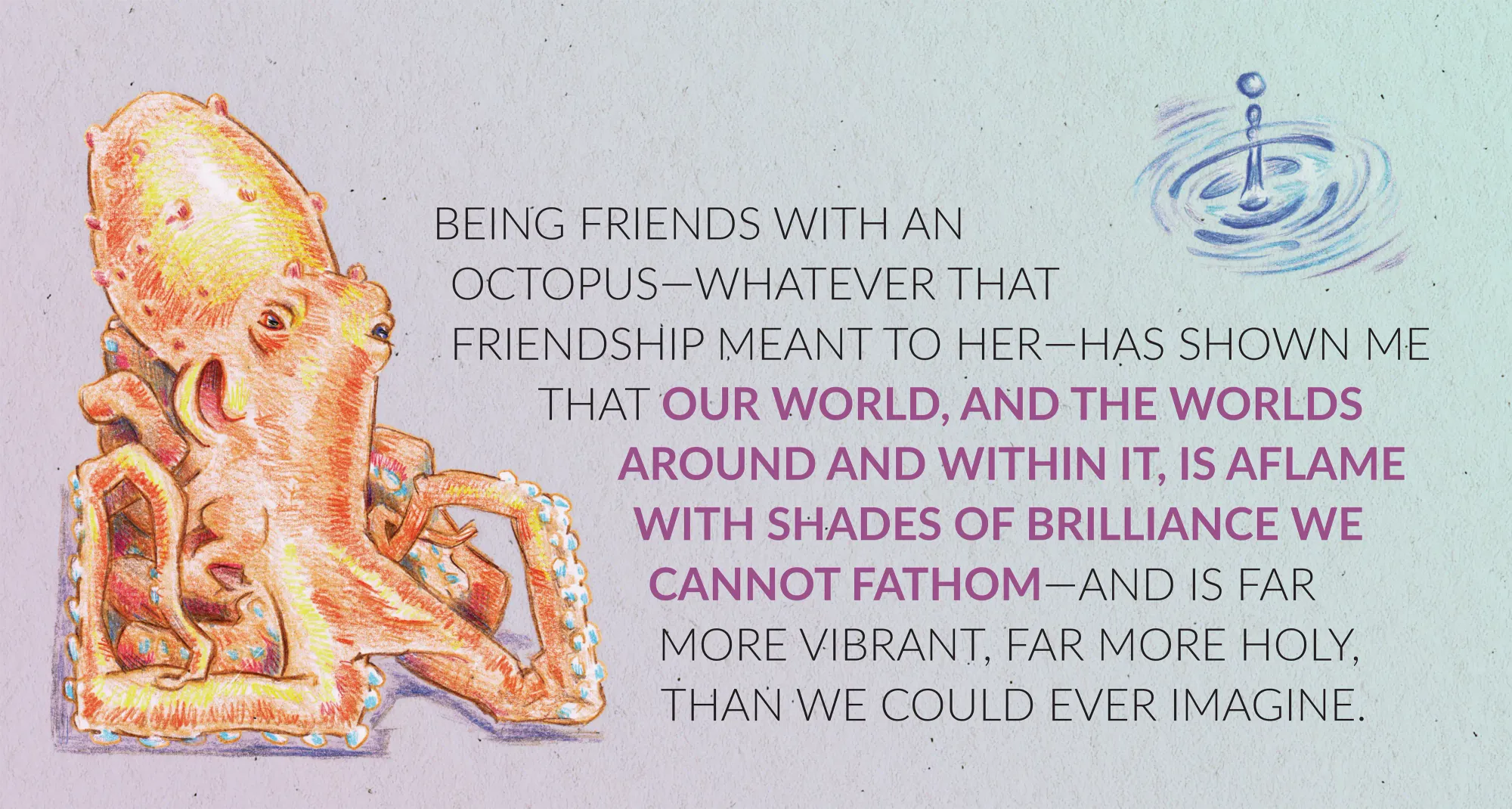
After Octavia returned to the bottom, Sy remembers, “I leaned over the barrel and stared at her in awe and gratitude. My eyes brimmed, and a tear dripped into the water.” Sy wonders if Octavia might have tasted that tear. She wrote: “Being friends with an octopus—whatever that friendship meant to her—has shown me that our world, and the worlds around and within it, is aflame with shades of brilliance we cannot fathom—and is far more vibrant, far more holy, than we could ever imagine.”
Friendship Affirmation
There’s no doubt that other animals form deep and enduring friendships with individuals of their own and other species. Science confirms they have these cognitive and emotional capacities.
By watching animals closely and allowing ourselves to feel the joy of greeting an old friend or the thrill of making a new one—by acknowledging that, like us, they suffer the grief of losing loved ones—by letting ourselves feel what other animals are likely feeling, only then might we realize the true folly of questioning whether animals make friends. Their feelings are contagious and often very much like our own. Seeing our feelings reflected in other animals is not anthropomorphic. It is affirmation that we are not alone in the world, and that the selfsame feelings that underly human friendships crisscross species, connecting us all in ways that enrich life and make it worth living. After all is said and done, the great divide between them and us is nothing more than a thought distracting us from what truly matters in life.