Astrology, Astronomy and Where Science and Pseudoscience Overlap
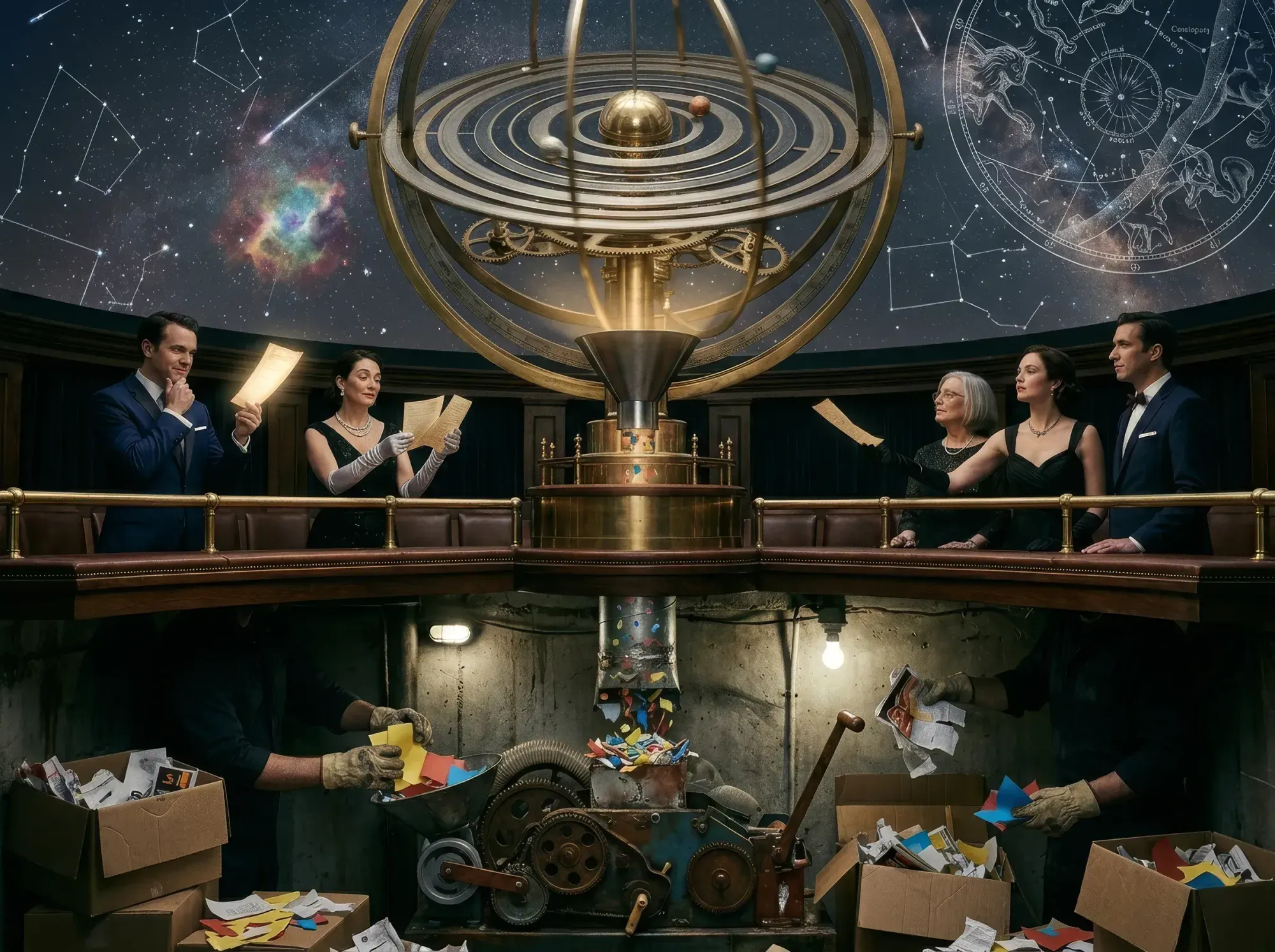
My friend and fellow magician Jamy Ian Swiss has commented that “astrology” and “astronomy” have only seven things in common: the letters a, s, t, r, 2 o’s, and a y … Please bear that in mind.
I very much doubt that anyone remembers the astrologer Zoran. Perhaps it’s time his tale were told. Back in 1954—I was 26, living and working the night club circuits as a magician in Montreal—my friend Joe Azaria (1929-2001) approached me with a proposition. He was the editor of Midnight, a weekly tabloid he’d just founded with $14 and a $1,000 line of credit from a local printer. (Midnighteventually became The Globe, still the third largest-selling newspaper of its type after National Enquirer.) Joe suggested that I write an astrology column for his newspaper, a gossip tabloid that doted on UFOs, psychics, and scandals. He pointed out that I could just make up the column, modeling it on standard astrology magazine formats, and I could then later show the world that the believers would accept anything as long as it sounded good. I of course agreed, since it could provide me with excellent material about why the public accepted such nonsense.
I bought a couple of the newsstand astrology magazines, set to work with scissors and cut out several hundred daily predictions. Then I (literally) stirred them up in a bowl, selected out 84 at random, and simply pasted them into place for the printer, thus giving predictions day by day to the twelve zodiac signs for each day of that week—and occasionally adding a few ridiculous and rather obvious hyperbolic twists. It all went well for a couple of months. Then very late one night as Joe, his partner John Vader (yes, that was his name, and there is no known family member named Darth), and Zoran—that was the name I took as the astrologer, “zodiac” and “Randi” together, you see—were sitting having coffee at a diner with hot-off-the-press copies of Midnight in our hands, I got a huge surprise. A young lady sitting nearby spotted the new issue, and asked if she could see Zoran’s predictions for her that week, little knowing that the ink-stained man who handed it over was the illustrious astrologer himself.
Joe, John, and I looked covertly at one another, amused by the situation, when this woman turned to us and proclaimed that Zoran was surely the best astrologer who ever lived, and that she was following his every word and suggestion for her future.
The world that the believers would accept anything as long as it sounded good.
That was it. I resigned from Midnight. The astrology column—still bearing the Zoran name—continued on for some time, though I didn’t see its demise because within weeks of my leaving my pseudo-astrological career, I received a call from New York City to appear on the CBS Saturday TV show It’s Magic, which was recorded at the Ed Sullivan Theater on Broadway. I was suddenly on American TV—and on my way. Astrology and I parted company permanently.
When I later published the Zoran adventure and related material on the Internet, I discovered that others had been similarly involved. One reader wrote:
Your item about the astrology page of the Israeli People magazine sent my thoughts back to the early 1960s when I was a young journalist with an Afrikaans-language Sunday newspaper in Johannesburg, South Africa. As a cost-cutting measure, I offered to write the weekly astrology column under a pseudonym rather than buying the expensive syndicated (US) product.
So, for more than a year I forecast our readers’ fates and fortunes although I knew absolutely nothing about the subject. No one seemed to notice the treachery; in fact, I was amazed one day when my wife (not knowing that I was the perpetrator) actually quoted one of my own predictions as having turned out exactly true in her case! Of course I was always very careful not to make any definite predictions which could have led people to make rash decisions—sufficiently vague, open-ended statements worked very well. And isn’t that what all astrologers do?
On that same subject, another reader offered:
I played the same trick … on some of my family members recently. I was reading the morning paper, and I polled a few asking who reads and “believes” their horoscope. A few spoke up and said they did, and asked me to read each of theirs. I then read them from the paper, but mixed them up. I read Leo to Aries, Libra to Gemini, etc. Lo and behold, what do you think happened? Over 75% of them felt it was relevant and accurate for them. We had a laugh, but I’m hoping that I opened up their eyes just a bit on this stuff. And yes, they’re still talking to me.
While we’re on the subject of fakes, consider Puerto Rico’s somewhat over-dressed—to put it mildly—80-year-old Walter Mercado, who appears on Telemundo’s AM show Levántate and evening news show Al Rojo Vivo. If you’ve never seen his show, I’d spoil the experience for you by describing it. It may be enough for you to know that he has a “Doctorate of Divinity” degree from the International Philo-Byzantine Academy and University, and in 1969 he was inducted as a Universal Teacher in Poona, Bombay; in Tibet and Nepal he holds the title of Chela and Buddhist Bikku; he has been a minister of the California Christian Brotherhood since 1970; and he also has a doctorate in Divine Healing from Tokyo, Japan. On top of all that, Walter is also an astrologer. Wow!
Pseudoscience appears to speak to the meaning of life in ways that science does not, as in astrology.
Now, Mercado is taken very seriously by a large percentage of the population of Puerto Rico, have no doubt about that. Though surveys show that people in the U.S. now know more about basic science than they did two decades ago, this fact is tempered by an alarming growth in the belief in pseudoscience such as astrology, or so we’re told by Dr. Jon D. Miller, a Michigan State University professor who presented his findings at the 2006 meeting of the American Association for the Advancement of Science (AAAS). This improvement, he said, largely reflects the requirement that all college students now have at least some science courses. This way, they should be better able to keep up with new developments through the media, but a panel of researchers expressed concern that people are still giving increasing credence to pseudoscience, such as the visits of space aliens, lucky numbers and horoscopes.
But what is a horoscope? It claims to be an interpretation of the secret meaning of the way the stars and planets were relatively configured at the moment of one’s birth, as seen from the geographical location of that happy event, and how they move relative to that basic configuration. The horoscope is said to be subject to analysis by a skilled astrologer, to the degree that the probability and wisdom of making investments, choosing plans of action, coming to critical decisions, marrying, travelling, or resolving any matter at all, can be advised upon by the soothsayer. This is all said to be done by examining mathematical relationships among the planets as seen against the stars. Since that provides a very involved set of possible configurations, any interpretation can be re-analyzed from a different point of view, and thus the future predicted for the person under examination can change—radically—depending upon which astrologer does the interpretation, and whether that individual was well rested the night before. Then too, that configuration of heavenly bodies was already scheduled by celestial physics many centuries ago, so it would appear that we should choose our birth date, geographical location, and exact time, with great care …
Belief in astrology just might be a misunderstanding of a question, with people confusing astrology with astronomy.
To me, a much more alarming fact by far was that the AAAS panel referred to above also reported an increase in the percentage of college students who reported they were “unsure” about creationism as compared with evolution. There has been a drop in the number of people who believe that evolution correctly explains the development of life on Earth, and an increase in those who believe humanity was “created” about 6,000 years ago by a sky god.
Indeed, when it comes to pseudoscience in general, the news today is not good. One part of this problem is that pseudoscience appears to speak to the meaning of life in ways that science does not, as in astrology. For many women—particularly in third-world areas—having a good life unfortunately still depends on whom they marry, and astrologers there address love relationships more than any other aspect of life. This is reflected in the fact that belief in horoscopes is much higher among women than men. Even in the USA, women also tend to take fewer college science courses, and are often not encouraged to pursue such activities.
But beware. Belief in astrology just might be a misunderstanding of a question, with people confusing astrology with astronomy. In one European study, about 25 percent of people said, when asked, that they thought astrology was very scientific, but when the question was rephrased to refer to horoscopes, that figure fell to about seven percent. Such basic misunderstanding of terminology would not, I hope, be encountered in too many major countries.