Can We Know What the Past Really Felt Like?
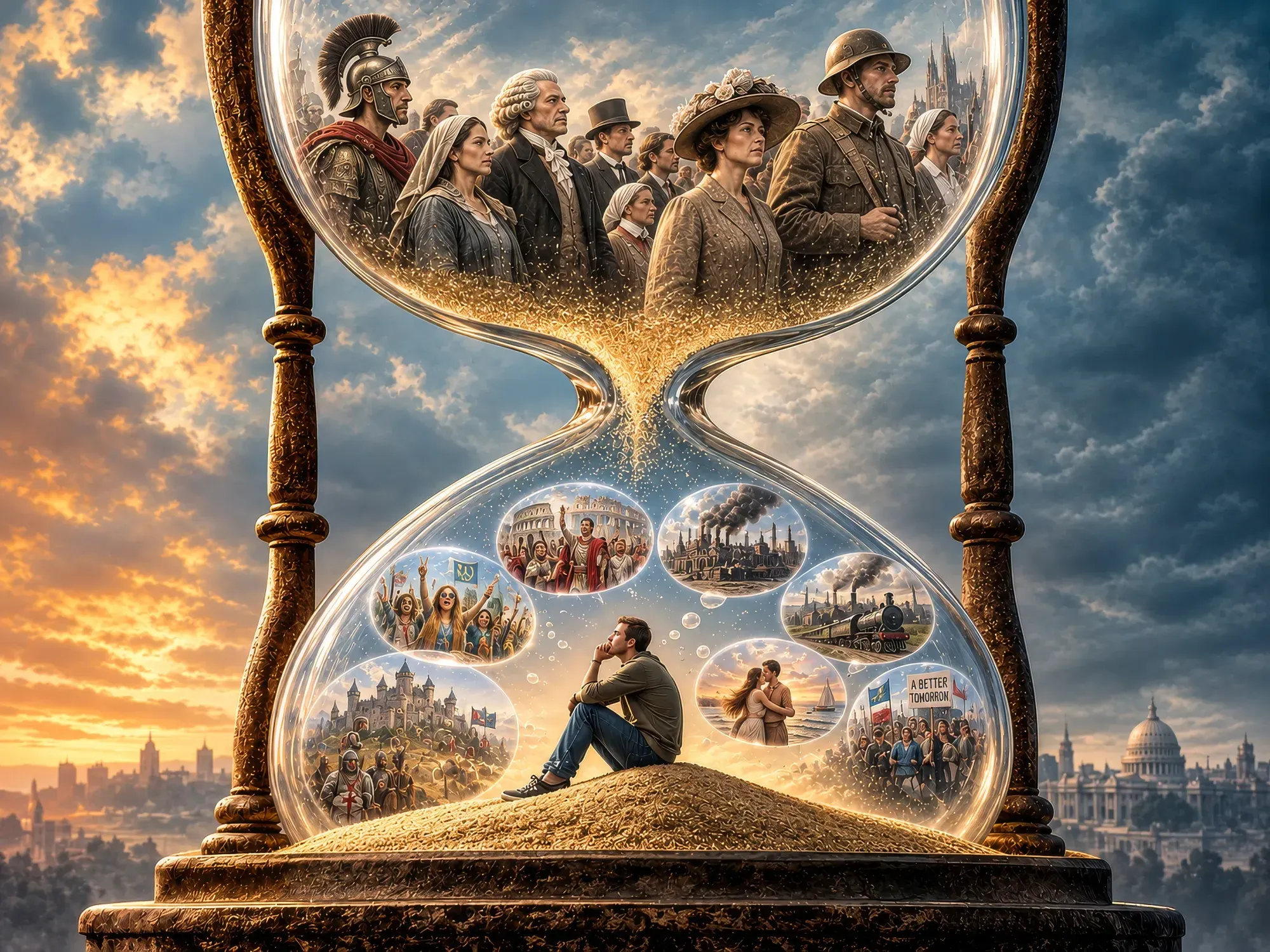
William Golding’s Lord of the Flies begins with British schoolboys stranded on an island without adults. They establish rules and choose a leader, but order gradually collapses and fear gives way to violence. The novel offers a disturbing account of human nature: remove the restraints of civilization and something ugly may emerge.
In Humankind: A Hopeful History, Rutger Bregman asks what happens when something similar occurs outside fiction. In 1965, six Tongan schoolboys became stranded on the uninhabited island of ‘Ata. They survived for more than a year by cooperating. They collected rainwater, cultivated food, kept a fire burning, and divided the work among themselves. For Bregman, their survival offered a welcome answer to Golding’s pessimism.
Bregman—whose argument is deliberately hopeful—found the contrast irresistible. Golding gave us a fictional descent into savagery; the Tongan boys appear to offer a historical counterexample. But the episode raises a deeper question: what if both stories tell us less about fixed human nature than about the historical and social conditions under which different human capacities become visible?
People living through history have a disadvantage that historians do not: they cannot read ahead.
We call periods hopeful, revolutionary, or nostalgic. The 1920s were exuberant, the 1930s fearful, the 1960s rebellious, and so forth. Such descriptions seem to tell us what living through those years was like. We speak of Zeitgeist, collective mood, and generations that supposedly experienced history in a particular way. But are we describing what happened, how people experienced it, the atmosphere of the age, or are we considering what later generations came to believe it meant? If we confuse these, we may mistake our interpretation of history for history itself.
Facts are not experience.
People living through history have a disadvantage that historians do not: they cannot read ahead. Søren Kierkegaard captured this asymmetry in his famous observation:
Life can only be understood backwards; but it must be lived forwards.
What is true for individual life is also true of history. People living through a historical moment do not know which developments will prove decisive. Consider Europe before the First World War. Looking backward, the years before 1914 are easily read as a prelude to catastrophe. Yet people living in 1913 did not experience themselves as characters in the prelude chapter of a world war. Some perceived instability and danger; others saw technological progress, expanding trade, artistic experimentation, and the promise of modernity.
The same principle applies more generally. While the past becomes unmistakable once its consequences are visible, contemporaries inhabit uncertainty. This leaves us with two very different questions: 1) What happened? and 2) How was it experienced at the time? The first concerns historical reconstruction; the second, lived historical reality.
Historical experience emerges from the interaction between present conditions, remembered pasts, and anticipated futures.
People encounter and participate in events, and interpret them through their expectations, memories, and fears. A crisis, for example, may evoke an earlier crisis, just as prosperity may be measured against a lost golden age. Even political conflict may be framed through inherited stories, for example notions of victory or injustice and betrayal. Historical experience emerges from the interaction between present conditions, remembered pasts, and anticipated futures.
Put simply, facts alone cannot tell us what an era felt like from within. For that, we need to ask what broader atmosphere made certain expectations and possibilities seem plausible.
Zeitgeist and the Experience of Historical Time
The German idea of Zeitgeist—the “spirit of the age”—emerged from eighteenth- and nineteenth-century attempts, especially in the work of Johann Gottfried Herder and later G. W. F. Hegel, to understand historical periods as possessing a distinctive cultural and intellectual character. Today, Zeitgeist refers more broadly to the atmosphere of an era: the ideas people take seriously, the futures they imagine, the styles they adopt, and the assumptions that seem self-evident at the time.
But is Zeitgeist really something people experience while living through an era, or something historians construct retrospectively? Reinhart Koselleck helps clarify the problem through his distinction between a “space of experience” and a “horizon of expectation.” The former is the past available in the present through memory and inherited experience; the latter concerns the futures people consider possible. Historical action takes place in the tension between the two.
The same circumstances can therefore acquire different meanings in different periods. Technological advance may appear liberating in one era and threatening in another; political instability may be seen as renewal or collapse. Koselleck also argued that, in modernity, the distance between experience and expectation widened: the future increasingly came to be imagined as genuinely different from the past.
Yet temporal expectations alone do not capture what an era feels like. Raymond Williams’s concept of a “structure of feeling” does so somewhat better. Williams was interested in meanings and values as they are actively lived and felt, including characteristic tones and affects that exist before they become formal doctrines. An era may show recurring patterns of confidence, unease, rebellion, conformity or exhaustion across culture and everyday behavior without every individual sharing them.
At this point, however, the limits of all these concepts become apparent. Zeitgeist can describe the characteristic expressions of an age. Koselleck helps us understand its temporal horizon; Williams, its lived cultural feeling. But neither necessarily explains what generates the broader collective disposition from which those expressions emerge. If Zeitgeist is primarily descriptive—an observable pattern in the culture of an era—we still need to ask whether something beneath those expressions influences which expectations feel plausible, which behaviors spread, and which cultural forms resonate.
The Missing Dimension: Social Mood
If Zeitgeist describes the characteristic atmosphere of an age, a deeper question remains: where does that atmosphere come from? Historical conditions obviously shape people. Wars, economic crises, technological change, and political conflict alter the environment in which individuals live. Collective attitudes are often responses to such events. But that may not be the whole story.
The hypothesis of “social mood” originated from a different possibility: societies may possess collective dispositions that are not merely reactions to events, but those which can emerge endogenously and influence how events are perceived and acted upon. This is more than saying that people influence one another or that crowds sometimes behave irrationally. Nor is social mood simply another word for public opinion, emotion, or Zeitgeist. It is an ontological hypothesis, one in which collective mood is treated as a real feature of social life, visible indirectly through patterns of confidence and fear, openness and defensiveness, risk-taking and risk-aversion, cooperation and antagonism. Individuals need not consciously recognize it or agree with one another. A politically divided society may still display broader shifts in trust, risk appetite, or expectations about the future.
A useful theory, therefore, must do more than rename hindsight.
Indeed, if social mood were merely another name for Zeitgeist, it would add little. But it is an idea aimed at capturing a shifting collective disposition that may help generate the cultural expressions we later recognize as the “character of an age.” In simplified form:
Social mood → Cultural Expression → Observable Zeitgeist
Yet, if social mood cannot be observed directly, how can we know that it exists independently of the expressions used to infer it?
One possibility is to treat social mood as a latent variable. Rather than observing it directly, we infer it from converging patterns across partly independent domains: financial risk-taking, cultural preferences, political rhetoric, social trust, consumer behavior, artistic expression, and attitudes toward the future. That makes sense, except if we know the mood was negative because bad things happened and then explain those events by saying the mood was negative, we have learned nothing. The entire analysis becomes circular.
A useful theory, therefore, must do more than rename hindsight. Social mood must be investigated through evidence available within the relevant historical period itself. In other words, what collective tendencies were visible before the historical outcome later became known?
Consider Egypt in the years before the 2011 uprising. The economy was growing, but Gallup surveys recorded a marked deterioration in how Egyptians evaluated their lives. Between 2005 and 2010, the proportion classified as “thriving,” based on their assessments of their present lives and future prospects, fell from 29 percent to 12 percent. The interviews took place before the demonstrations that brought down Hosni Mubarak. We therefore have evidence of dissatisfaction recorded before the upheaval, when neither the respondents nor the interviewers knew what would follow. Economic growth alone would have given us an incomplete picture of what those years felt like.
These findings do not establish that an independently emerging social mood caused the uprising. Dissatisfaction could reflect corruption, insecure employment, or frustrations concealed by national growth figures. Nor does unhappiness necessarily produce rebellion. But the surveys allow us to investigate whether a documented change in collective outlook helped shape how people interpreted events and judged the possibility of political change. An explanation based on social mood would still have to account for how dissatisfaction became a willingness to act, and why that happened when it did. It would, however, begin with evidence of what people felt before the outcome, avoiding the circular assumption that a revolutionary mood must have existed because a revolution followed.
Mnemohistory: When the Present Rewrites the Past
If Zeitgeist concerns the atmosphere of an age and social mood the collective disposition operating within it, another question presents itself once that age has passed: how is it remembered? In an attempt to answer this question, in his book Moses the Egyptian the German Egyptologist and cultural theorist Jan Assmann coined the term mnemohistory, distinguishing between conventional history and the history of remembrance: mnemohistory concerns the past as it is remembered rather than simply the past as such.
Indeed, facts may remain unchanged while their meaning changes. A war can later become a story of sacrifice, failure, or betrayal, just as an economic crisis may become evidence of political incompetence or resilience and renewal. Assmann also distinguishes communicative memory, carried by living generations, from cultural memory preserved through texts, monuments, rituals, museums, and institutions. The latter can survive long after direct witnesses are gone, yet preservation is selective.
The past reaches the present through selection, and each present can select differently.
All societies choose what to commemorate, teach, and forget. Some memories become central to collective identity while others recede. Later generations inherit representations of the actual experience of events. The past reaches the present through selection, and each present can select differently. Evidence still constrains interpretation, but the significance attached to it is historically unstable.
Here social mood and mnemohistory intersect. If societies reconstruct the past from within their own present, the collective disposition of that present may influence which memories become salient. A confident society may emphasize achievement and possibility; a defensive one may focus on lost greatness or unresolved grievance.
This remains a hypothesis. But if it is correct, social mood may shape not only how people experience the present but also how they select and reinterpret the past. This would mean, then, that history may contain a feedback loop: the present is interpreted through remembered history, while remembered history is continually reconstructed from within the present. This may help explain why historical analogies recur so persistently: another 1930s, another Cold War, another Vietnam, another Roaring Twenties. We use remembered versions of the past to make the present intelligible.
With this background, we can now place the four dimensions—historical facts, Zeitgeist, social mood, and mnemohistory—side by side:
| Descriptive / Observable | Generative / Interpretive | |
|---|---|---|
| Lived / Contemporary | Historical Facts— what happened | Social Mood—the collective disposition operating within the period |
| Retrospective / Reconstructed | Zeitgeist—the recognizable character of an age | Mnemohistory—how later societies remember and reconstruct that age |
The boundaries are not absolute. Zeitgeist, for example, can be experienced contemporaneously as well as identified retrospectively. The matrix is analytical: it prevents us from treating facts, atmosphere, collective disposition, and memory as if they were the same thing.
The observer never stands entirely outside the system being observed.
Historical facts constrain interpretation. Zeitgeist describes the visible cultural character of a period. Social mood proposes an underlying collective disposition that may help generate those expressions. Mnemohistory describes the later reconstruction of the past. Taken together, these four dimensions suggest a recursive rather than linear model of historical experience:
Social Mood → Zeitgeist → Historical Behavior and Events → Historical Facts → Mnemohistory → Expectations and Interpretive Frames → Social Mood
Influence may operate in more than one direction, so it is not a “rigid” causal chain. This may help explain why history seems to rhyme. Similar collective conditions can reactivate inherited ways of interpreting uncertainty, opportunity, and threat. History is therefore neither a simple sequence of external events nor merely a set of narratives imposed afterward. It is a process in which historically situated human beings participate.
People living through history perceive events from within the collective conditions of their time, and historians reconstruct that experience from within another historical present. The observer never stands entirely outside the system being observed. This need not lead to relativism. Facts still matter. Evidence can contradict memory, archives can expose myths, and interpretations can be tested.
References
- Assmann, J. (1997). Moses the Egyptian: The Memory of Egypt in Western Monotheism. Harvard University Press.
- Assmann, J. (2011). Cultural Memory and Early Civilization: Writing, Remembrance, and Political Imagination. Cambridge University Press.
- Bregman, R. (2020). Humankind: A Hopeful History (E. Manton & E. Moore, Trans.). Little, Brown and Company.
- Ketovuori, M. (2024). Socionomics: How Social Mood Shapes Society. Routledge.
- Koselleck, R. (1985). Futures Past: On the Semantics of Historical Time (K. Tribe, Trans.). MIT Press.
- Williams, R. (1961). The Long Revolution. Chatto & Windus.