The Case Against the Resurrection of Jesus

When I was an undergraduate philosophy student, my plan was to do graduate study in Christian apologetics under Dr. William Lane Craig at Trinity Evangelical Divinity School. However, my study of philosophy of religion and critical thinking at Sonoma State University led me to question my Christian beliefs, so I left the faith. Ever since, I have applied the concepts, skills, and tools of critical thinking, logic and rationality to basic Christian beliefs, including and especially the resurrection of Jesus, which the apostle Paul insists is central to Christianity as he explains in 1 Corinthians 15:17–19 (NRSV Updated Edition, used throughout this article):
If Christ has not been raised, your faith is futile, and you are still in your sins. Then those also who have died in Christ have perished. If for this life only we have hoped in Christ, we are of all people most to be pitied.
Thus, from a Christian point of view, the purported death of Jesus on a cross and his alleged resurrection are arguably the most important events in human history. If either Jesus did not die on the cross, or Jesus died on the cross but stayed dead, then the Christian faith is false.
In this article I examine three different cases for the resurrection of Jesus, and I will point out serious problems with each. They are from these books: Reasonable Faith (3rd edition, hereafter: RF3) by William Lane Craig, Handbook of Christian Apologetics by Peter Kreeft and Ronald Tacelli, and The Case for the Resurrection of Jesus by Gary Habermas and Michael Licona.
William Lane Craig’s Case for the Resurrection
Dr. Craig is a smart and highly respected Christian philosopher who has conducted serious study of the New Testament. If anyone can make a strong and solid case for the resurrection of Jesus, Craig would clearly be able to do so, and he has worked for decades developing his case. In my analysis, Craig’s case has at least five serious problems.
Although Craig concludes that God raised Jesus from the dead, unlike most Christian apologists, Craig does not try to prove this conclusion or to show that this conclusion is a historical fact, and instead makes the more modest claim that “the evidence for the resurrection of Jesus is such that a well-informed investigator ought to agree that it is more likely than not to have occurred.” Craig argues that, “the hypothesis ‘God raised Jesus from the dead’ furnishes the best explanation of the historical data relevant to Jesus’s final fate” (RF3, 360). This argument is grounded in three key historical claims:
- Jesus’s tomb was found empty by a group of his women followers on the first day of the week following his crucifixion.
- Beginning on the first day of the week following Jesus’s crucifixion, various individuals and groups experienced on different occasions and under varying circumstances appearances of Jesus alive.
- The first disciples of Jesus came to sincerely believe in Jesus’s resurrection.
Craig’s argument for the main assumption of his case is stated this way (RF3, 361):
If these three facts can be established and no plausible natural explanation can account for them as well as the resurrection hypothesis, then one is justified in inferring Jesus’s resurrection as the most plausible explanation of the data.
Craig’s case can be summarized briefly: Craig’s three historical claims are considered to be historical facts. The most plausible explanation for these three facts is that God raised Jesus from the dead. Thus, the best explanation of the historical facts relevant to the final fate of Jesus is that God raised Jesus from the dead. That means it is more likely than not that this explanation is true.
If either Jesus did not die on the cross, or Jesus died on the cross but stayed dead, then the Christian faith is false.
This conclusion, however, does not follow. First, suppose these probabilities of the competing hypotheses about Jesus’s final fate compared to Craig’s conclusion:
- .30 God raised Jesus from the dead.
- .25 Some disciples of Jesus lied about him rising from the dead.
- .25 Somebody moved Jesus’s body but didn’t tell his disciples.
- .20 Jesus appeared to die on the cross, but he was still alive when removed.
On this scenario, the resurrection hypothesis would be more probable and more plausible than any of the alternative hypotheses, based on the relevant historical data, but the probability of the resurrection hypothesis being true at only .30 means that it would have a probability far less than Craig’s .50 (“more likely than not” translates to the “preponderance of evidence” argument in court, which amounts to .50 + a feather).
Now suppose these probabilities for 9 alternative hypotheses compared to Craig’s conclusion:
- .15 God raised Jesus from the dead.
- .10 One disciple of Jesus lied about seeing him risen.
- .10 Two or three disciples of Jesus lied about seeing him risen.
- .10 Four or more disciples of Jesus lied about seeing him risen.
- .10 Somebody moved Jesus’s body but didn’t tell the disciples.
- .10 Jesus only appeared to die on the cross because he fainted.
- .10 Jesus only appeared to die on the cross because he was in a coma.
- .10 Jesus was clinically dead but did not actually die on the cross.
- .10 Jesus was drugged on the cross and appeared to die but didn’t.
- .05 Jesus pretended to be dead on the cross.
In this scenario, even though the resurrection hypothesis would be more probable than any of the alternatives, its likelihood would only be .15, and thus although it would be the best explanation of the relevant historical facts, it would not be “more likely than not” that the resurrection happened. Adding up the probabilities that these other possibilities are true is .85 in this scenario, compared to only .15 for the truth of the resurrection.
A second serious problem with Craig’s case is his equation of the resurrection as “the most plausible explanation” for his three historical facts with it as “the best explanation” of all the relevant facts. There are dozens (perhaps hundreds) of historical facts that are “relevant to Jesus’s final fate,” but it is illogical and unreasonable to infer that a hypothesis that provides the most plausible explanation of three hand-selected historical facts must also be the best explanation of all the relevant facts about Jesus’s final fate.
An analogy: suppose we are evaluating different models of SUV to purchase and are given only three facts about the vehicle—price, horsepower, and fuel efficiency—while ignoring dozens of additional facts, such as, performance, handling, safety, reliability, comfort, maintenance cost, warranty, resale value, etc. Craig’s focus on just three specific historical facts in order to make a comparative evaluation of various hypotheses about the final fate of Jesus is just as unreasonable as evaluating SUVs on the basis of just three relevant facts as opposed to using dozens of relevant facts for the comparative evaluation.
Furthermore, since Craig is a professional Christian apologist, it is not unreasonable to suspect that he might be selective in choosing certain historical facts that support his belief, while ignoring other facts that do not fit the resurrection hypothesis, a classic case of confirmation bias. Having studied the resurrection for years, I can think of at least seven historical facts that cast doubt on, or run contrary to, the resurrection hypothesis:
- People who were crucified by the Romans would usually hang on the cross for at least two or three days before dying.
- The authors of the Gospels claim that Jesus was removed from the cross after hanging on the cross for less than half of a day (i.e., for somewhere between 2 hours and 10 hours).
- The Jewish historian Josephus reports that a person he knew was crucified by the Romans, was later removed from the cross, and survived the ordeal.
- There are several different medical theories about how Roman crucifixion caused people to die; medical experts do not agree on which theory is correct.
- Victims of Roman crucifixion were usually buried in shallow graves or left to rot on their crosses and were not permitted to have an honorable burial.
- The authors of the gospels Mark and Matthew believed that the first appearances of the allegedly risen Jesus to his male disciples took place in Galilee about a week or more after Jesus was crucified.
- The authors of the gospels Luke and John claimed that the first appearances of the allegedly risen Jesus to his male disciples took place in Jerusalem about 48 hours after Jesus had been crucified and buried.
Tellingly, not one of these historical facts is included in Craig’s analysis of the resurrection.
A third serious problem with Craig’s case is his contrasting natural with supernatural explanations. In his reasoning, if you can eliminate the natural explanations (e.g., he fainted, was drugged, or otherwise didn’t actually die on the cross), then the supernatural explanation that God raised Jesus from the dead must be true. There are dozens of different possible supernatural explanations concerning Jesus’s final fate, but Craig considers and evaluates only the one (preferred) supernatural hypothesis of God resurrecting Jesus. Thus, Craig’s either/or assumption is false, and Craig has failed to give us a good reason to believe that the most plausible explanation of his three key historical facts is the hypothesis that God raised Jesus from the dead.
A fourth serious problem with Craig’s case involves his key historical claims being asserted to be historical facts, the most important being his second key historical claim:
Beginning on the first day of the week following Jesus’s crucifixion, various individuals and groups experienced on different occasions and under varying circumstances appearances of Jesus alive.
Craig supports this claim primarily on the basis of six alleged appearances of the risen Jesus beginning on the first day of the week following the crucifixion to: Peter, the twelve, five hundred brethren, James (Jesus’s brother), “all the apostles,” and Saul of Tarsus (Paul).
Let’s begin with what Craig says is “the best-attested resurrection appearance of Jesus,” namely that in Jerusalem to “the Twelve” disciples (minus Judas Iscariot who betrayed Jesus), as noted in the gospels of Luke (24:36–42) and John (20:19–20). The problem is that these appearance stories are probably fictional.
The gospels of Mark and Matthew clearly imply that the first appearance of the risen Jesus to his disciples took place in Galilee, not in Jerusalem. Because Galilee was several days journey on foot from Jerusalem, the first appearance of Jesus to his disciples would have taken place a week or more after his crucifixion, not on Sunday about 48 hours after he was crucified. Because the gospel of John is historically unreliable, what the other gospels say on this matter is more significant. Mark is the earliest written gospel, so its account is to be preferred over the appearance story in Luke. Therefore, it is probable that the stories of a Jerusalem appearance of Jesus on Easter Sunday to his disciples are fictional.
The alleged appearance of the risen Jesus to Peter also fails to support Craig’s most important historical claim. Craig himself admits that “We have no story in the Gospels telling of Jesus’s appearance to Peter” and that “we have no detailed story of this appearance …” (RF3, 378). That means that we don’t know when or where this alleged appearance to Peter occurred, and we don’t know anything about the circumstances surrounding it. Therefore, the alleged appearance to Peter cannot be used to show that experiences of appearances of a risen Jesus occurred “on different occasions and under varying circumstances” as Craig’s historical claim asserts.
Paul never set eyes on the flesh-and-blood Jesus, so he had no idea what the man looked like.
The alleged appearance of the risen Jesus to “five hundred brethren” is mentioned by Paul in Chapter 15 of 1 Corinthians, but Craig admits that “we have no mention whatsoever of this appearance elsewhere in the New Testament” (RF3, 378). This example is thus based on shaky historical evidence. Furthermore, the only thing Paul says about this alleged appearance is in 1 Corinthians 15:6: “Then he appeared to more than five hundred brothers and sisters at one time, most of whom are still alive, though some have died.” We don’t know when or where this allegedly happened, and we have no idea what circumstances surrounded it. Thus, this example is just as irrelevant as the example of the alleged appearance to Peter. The same problem exists with the purported appearances to Jesus’s brother James and to “all the apostles.”
That leaves two alleged appearances: to the Twelve and to Saul of Tarsus (Paul). But we have seen that “the Twelve” appearance story is based on those recounted in Luke and John that, again, are probably fictional, which leaves just the account about the appearance to Saul, supported by both the book of Acts and by Paul’s own statements. So, it seems reasonable to grant that Saul/Paul did have some sort of experience that he took to be an experience of the risen Jesus.
However, there are at least two serious problems with this example. First, there are clear indications that this experience was subjective in nature, and thus could have been either a hallucination or a dream or a vision. Second, Paul never set eyes on the flesh-and-blood Jesus, so he had no idea what the man looked like. Thus, even if a living and embodied Jesus stood right in front of him, Paul would not have been able to identify that person as being Jesus of Nazareth. Thus, Paul’s claim to have seen Jesus after the crucifixion is highly dubious.
Thus, the most important historical claim in Craig’s case has not been shown to be a historical fact. None of the six main examples of alleged appearances of the risen Jesus put forward by Craig provides significant evidence that Craig’s historical claim about appearances of the risen Jesus is a historical fact.
A fifth serious problem with Craig’s case is that he left out a crucial historical claim. Even if we granted, for the sake of argument, that his three key historical claims were facts, there is a crucial historical claim that is missing: Jesus died on the cross.
Unlike other Christian philosophers and apologists, Craig fails to understand that this historical claim is crucial to any case for the resurrection. For example, the Christian philosophers and apologists Norman Geisler and Ronald Brooks understand how crucial this historical claim is to making a case for the resurrection:
Before we can show that Jesus rose from the dead, we need to show that He really did die. The Koran claims that Jesus only pretended to be dead (Surah IV:157), and many skeptics have said that He appeared to be dead, possibly being drugged, but revived while in the tomb. It is no miracle for a live man to walk out of a tomb. For the Resurrection to have any significance, Jesus had to be dead first.
The Christian apologists Gary Habermas and Michael Licona, who are leading proponents of the resurrection of Jesus, agree with Geisler and Brooks on this point, and their case is based on five historical claims, starting with the claim that Jesus died by crucifixion. Josh McDowell and Sean McDowell are two well-known Christian apologists, and although they do not limit their case for the resurrection to just a small handful of historical claims (the way that Habermas, Licona, and Craig do), it is clear that they view the death of Jesus on the cross as crucial to their case for the resurrection:
So in this chapter, we will look at the events surrounding the death of Christ and special precautions taken by those who crucified him to ensure that his death was accomplished. As we will see, ascertaining the historical fact of his death is a prerequisite to our conviction about his resurrection.
Nevertheless, William Lane Craig does not seem to understand this central point, and in conjunction with the other four serious problems in his case, we can conclude that his case for the resurrection fails.
The Case by Peter Kreeft and Ronald Tacelli
In Chapter 8 of their Handbook of Christian Apologetics (hereafter: HCA), the Christian philosophers Peter Kreeft and Ronald Tacelli attempt to prove that God raised Jesus from the dead, not through positive evidence in favor of the resurrection as Craig did (the empty tomb, post-crucifixion appearances, beliefs of the disciples), but through negative evidence against alternative explanations for the purported miracle. The four alternative skeptical explanations they claim to refute are: the Swoon Theory, the Hallucination Theory, the Conspiracy Theory, and the Myth Theory. They claim to have proven that these four alternative theories are wrong, therefore the resurrection of Jesus is true.
The first problem with this line of reasoning is that their assumption that there are only those four alternative theories is false. There are many alternative theories, including: Wrong Tomb, Someone Else Moved the Body from the Tomb, Unknown Tomb, Legend, Delusions, Objective Visions, Spiritual Resurrection, Mistaken Identity, and Substitution. I have found there are dozens of different alternative explanations of how belief in the resurrection of Jesus could have developed among the earliest followers of Jesus.
Furthermore, their four alternative theories are actually just specific examples of more general categories of skeptical theories.
Swoon Theory. According to this theory, Jesus was still alive when he was removed from the cross but had swooned (i.e., fainted) and the Roman soldiers mistakenly judged him to be dead. Sometime after being removed from the cross, Jesus became conscious again and thus he survived the crucifixion. Of course, there are other ways besides fainting that Jesus could have appeared to be dead: he went into a coma, he was given a drug that made him appear to be dead, he pretended to be dead, or even that he experienced clinical death but was revived shortly after being removed from the cross. The Swoon Theory is just one of at least five Apparent Death Theories.
Scientific medicine did not exist two thousand years ago, and even highly trained modern medical doctors sometimes mistakenly diagnose a patient to be dead when the patient is actually still alive.
Survival Theories. The point of Jesus appearing to die while on the cross is to explain why the Roman soldiers might have removed him while he was still alive. But there are various possible explanations of why that might have happened, in a general group of skeptical theories that we could call Survival Theories. These include: The soldiers were bribed, threatened, deceived, or drugged; the soldiers’ superior officer ordered them to do this; the soldiers were followers of Jesus so they removed him from the cross while he was alive; the soldiers fell asleep, so some followers of Jesus were able to remove Jesus from the cross while he was alive.
The second serious problem with the case by Kreeft and Tacelli concerns their claim to have proven the four alternative theories to be wrong. Not so. Let’s examine their nine objections against the Swoon Theory:
- Deadliness of Roman Crucifixion
- Break their Legs
- Blood and Water
- Winding Sheets and Entombment
- The Sickly Jesus Objection
- Who Overpowered the Guards?
- Who Moved the Stone?
- Where did Jesus Go?
- Swoon Theory implies False Theories

.jpg)
Deadliness of Roman Crucifixion. Kreeft and Tacelli claim that Jesus could not have survived the crucifixion; in fact, crucifixion is not as deadly as some other forms of execution, such as beheading. People can be hung on a cross and stay alive for days. Since Jesus was hanging on his cross for only a matter of hours, it is not unreasonable to suggest that he wasn’t actually dead when he was taken down. There is historical precedence for such survival:
- The Jewish historian Josephus writes about a person who survived Roman crucifixion in the first century.
- In 1815, a missionary named Felix Carey, reported an incident in Burma where four people had been crucified, and he stated, “Those which I saw, were liberated at the end of three or four days,” implying at least two of those four people survived crucifixion.
- In 1943, an Australian soldier in WWII named Herbert James “Ringer” Edwards was crucified by the Japanese military for 63 hours, but he survived.
- In 2014, ISIS nailed a man to a cross in Syria for eight hours and the man survived.
Kreeft and Tacelli claim that no Roman soldier ever bungled a crucifixion, but historically there were tens of thousands of crucifixions conducted by Roman soldiers over a period of about 850 years, from the start of the Roman Republic (in 509 BCE) to the outlawing of crucifixion in the Roman Empire (in 337 CE). Because many crucified people have remained alive on a cross for days, and because a few people have survived crucifixion, it is reasonable to conclude that several of these tens of thousands of crucified people survived, and because Jesus was hanging on the cross for only a few hours, there is good reason to think that Jesus could have survived his crucifixion.
Broken Legs. Kreeft and Tacelli assert that the Roman soldiers were sure Jesus was dead while he was still on the cross. But Roman soldiers were not medical experts. Scientific medicine did not exist two thousand years ago, and even highly trained modern medical doctors sometimes mistakenly diagnose a patient to be dead when the patient is actually still alive. Therefore, there is good reason to doubt the “diagnosis” of the death of Jesus by Roman soldiers.
The authors claim that the Roman soldiers broke the legs of the other two crucified criminals next to Jesus while they were still on their crosses, but they did not break Jesus’s legs. The assertion is that the soldiers did not bother to break Jesus’s legs because they believed Jesus was already dead. However, the soldiers might have despised Jesus and decided not to break his legs so that Jesus would suffer longer on the cross. In that case, their failure to break his legs did not mean they believed Jesus was already dead.
The historical claims in this objection depend on an unstated assumption that the Gospel of John provides a historically reliable account of the life of Jesus, including his crucifixion (John 19:31–34). No other Gospel makes these historical claims about the breaking of the legs of the other crucified men. In fact, there are good reasons to believe that John provides a historically unreliable account of the life of Jesus, including his crucifixion.
Jesus scholars in general, in fact, do not view any of the four Gospels as providing historically reliable accounts of the life of Jesus, but John is viewed as much less reliable than the other three Gospels. In short, this objection is based on questionable historical claims and dubious inferences from those historical claims, so this second objection against the Swoon Theory fails.
Since Jesus was hanging on his cross for only a matter of hours, it is not unreasonable to suggest that he wasn’t actually dead when he was taken down.
Blood and Water. Blood and water allegedly leaked out of Jesus’s body immediately after one of the Roman soldiers pierced his side with a spear. According to Kreeft and Tacelli, this shows that Jesus died of asphyxiation while he was still on the cross, and that means the Swoon Theory is false.
This spear-wound event is probably fictional because it appears in the gospel of John, which is a historically unreliable account of the life, teachings, and crucifixion of Jesus, none of the other Gospels corroborate any aspect of the spear-wound story, and this story fulfilled an Old Testament prophecy according to the author of John (John 19:36–37), which indicates the story might well have been created based on that Old Testament passage.
The view that Jesus died from asphyxiation is probably false because medical experts disagree about what caused Jesus’s death, and because the Asphyxiation Theory about how crucifixion causes death is probably false: “Ancient literature, including the Gospels, also reveal that victims could talk, spit, or yell out from the cross, even at the moment of death. A suffocation victim cannot do that.”
Because this objection is based on dubious historical claims and on a dubious medical theory about the cause of Jesus’s death, the third objection by Kreeft and Tacelli against the Swoon Theory fails.
Winding Sheets and Entombment. Kreeft and Tacelli object that Jesus’s body was wrapped in a burial cloth and placed into a stone tomb after his crucifixion, ensuring that Jesus would quickly die in the tomb, if he had somehow survived the crucifixion. I believe they were persuaded of this by another Christian apologist named Josh McDowell, who argues that if Jesus was still alive after his crucifixion he would have either quickly suffocated as a result of being wrapped in a burial cloth that included 100-plus pounds of spices and a gummy substance, or he would have quickly died as a result of the cold damp air in the tomb.
However, McDowell’s claim that 100-plus pounds of spices and gummy substance was included in Jesus’s burial cloth is false or very unlikely, and his assumption that the tomb was cold enough and damp enough to cause Jesus to die in a matter of a few hours very dubious. Thus, this objection against the Swoon Theory fails.
Sickly Jesus Objection. Christian apologists love what I call the Sickly Jesus Objection. The idea is that if Jesus had survived crucifixion, the physical abuse and wounds he received from the Roman soldiers, from being scourged, from the crown of thorns, from his crucifixion, and from the spear wound to his side, would have left him weak, bruised, bloody, limping, and nearly dead. So, if he then contacted his disciples, he would have been so weak and sickly in appearance and demeanor that nobody would have believed that God had miraculously raised him from the dead. There are at least two serious problems with this objection.
First, Christian apologists assume a worst-case-scenario in terms of the abuse and wounds of Jesus, but none of these are a historical fact. Each of the wounds and injuries that Christians traditionally believe were inflicted upon Jesus are subject to significant historical doubt. They are possible, but most are dubious, none rise to the level of historical fact, and each is subject to reasonable doubt, including multiple lacerations to Jesus’s scalp from the Crown of Thorns, the nailing of Jesus’s hands, wrists, feet, or ankles to the cross, and the spear wound to Jesus’s side.
Christian apologists don’t feel a need to justify these beliefs because paintings, sculptures, sermons, books, and movies have been filled with images and descriptions of Jesus experiencing a worst-case scenario of violent abuse, wounds, and injuries. Yet, the Gospel accounts of the crucifixion do not provide details that would indicate the severity of these wounds. So, not only is there is uncertainty about which, if any, of the alleged wounds and injuries of Jesus actually occurred, there is also uncertainty about the severity of each of the alleged wounds or injuries of Jesus. For these reasons, we cannot be confident that Jesus would have been in terrible physical condition in the days immediately after his crucifixion, if he had survived the crucifixion.
A second serious problem with this objection is that it assumes that Jesus first appeared to his disciples in Jerusalem about 48 hours after his crucifixion in Jerusalem on the first Easter Sunday (i.e., Luke 24:36–42 and John 20:19–20). Those stories, however, are probably fictional, as noted earlier in the consideration of William Lane Craig’s case. It is more likely that the first appearance of Jesus to his disciples after his crucifixion took place in Galilee a week or more after he had been crucified. If so, then the wounds and injuries of Jesus would have had significantly more time to heal than just the 48 hours that Christian apologists assume.
Because the Sickly Jesus Objection is based on dubious historical assumptions about the extent of Jesus’s physical abuse, wounds, and injuries, and because this objection is based on the dubious historical assumption that the first appearance of Jesus to his disciples took place in Jerusalem about 48 hours after his crucifixion, this fifth objection by Kreeft and Tacelli against the Swoon Theory fails.
Overpowering of the Guards. This sixth objection to the Swoon Theory makes at least two problematic assumptions. First, it assumes that a Roman guard was placed at Jesus’s tomb the day after he was buried, to make sure that nobody would take Jesus’s body from the tomb, but this story is found only in the gospel of Matthew, and many New Testament scholars view this as a fictional story, created for apologetic purposes (i.e. to respond to the skeptical view that Jesus’s disciples stole the body of Jesus from his tomb).
We have no good reason to believe that most scholars use a standard of evidence that is any stronger than “more likely than not” in making decisions about historicity of alleged events in the life of Jesus.
Second, this objection makes the false assumption that somebody or some group overpowering the guards would be the only way that Jesus would have been able to leave the tomb where he had been buried. Other ways are clearly possible; for example, the distraction, deception, bribery or drugging of the guards.
Because this sixth objection is based on a dubious historical claim, and because it is based on a false assumption about there being only one way to have managed the alleged Roman guards, this sixth objection by Kreeft and Tacelli against the Swoon Theory fails.

.jpg)
Moving the Stone. This objection is actually an argument for the claim that an angel must have moved the stone blocking the entrance to Jesus’s tomb. The argument is that neither Jesus, nor his disciples, nor the Roman guards, nor the Jewish authorities would have moved the stone, so it must have been moved by an angel!
Yet, how the stone got moved is irrelevant to the question of whether Jesus died on the cross or survived his crucifixion. Suppose that an angel did move the stone. It could still be the case either that Jesus died or survived his crucifixion. Thus, this seventh objection by Kreeft and Tacelli against the Swoon Theory fails as irrelevant to the truth or falsehood of the Swoon Theory.
Where did Jesus Go? This objection argues that Jesus could not have survived his crucifixion, because there is an absence of historical information about Jesus continuing on in his life after his crucifixion and alleged initial appearances to his disciples. However, the Swoon Theory does not imply there would be credible historical data about Jesus’s life after the few weeks of alleged appearances to his disciples.
The Swoon Theory is compatible with scenarios where Jesus dies or disappears shortly after those alleged appearances: Jesus could have died as a result of infection of a wound from his crucifixion, or as a result of being killed by a Roman soldier who recognized Jesus, or as a result of being physically attacked by a robber. In those cases, there would be a good chance no credible historical data would exist about Jesus’s life after his initial appearances. Thus, the eighth objection by Kreeft and Tacelli against the Swoon Theory fails.
Swoon Theory Implies False Theories. According to Kreeft and Tacelli, the Swoon Theory implies that either (a) the Conspiracy Theory is true or (b) the Hallucination Theory is true. But they claim to have refuted those two other theories.
According to the Swoon Theory, the disciples did actually see a living and physically embodied Jesus after his crucifixion. If actually seeing Jesus alive after his crucifixion was the main reason why the disciples believed Jesus had been raised from the dead, then it cannot also be the case that they lied about seeing Jesus alive again (i.e., the Conspiracy Theory), nor that the main reason why the disciples believed in the resurrection was because they had hallucinations about Jesus when Jesus was not actually present.
Because the Swoon Theory rules out both the Conspiracy Theory and the Hallucination Theory, the ninth and final objection by Kreeft and Tacelli against the Swoon Theory fails, and that means their claim to have refuted all four alternative theories is false, just like the claim that there are only four alternative theories is false. Therefore, it is clear that the case for the resurrection of Jesus by Kreeft and Tacelli fails.
The Case by Habermas and Licona
Gary Habermas is a Christian philosopher who has been developing and perfecting a case for the resurrection of Jesus for decades. He is a leading defender of this Christian belief, and many view Habermas as the leading apologist on this issue. Michael Licona is a New Testament scholar who is also a leading defender of the resurrection of Jesus, and together they wrote The Case for the Resurrection of Jesus (CRJ).
One way in which the case by Habermas and Licona differs from the case by Craig, is in the strength of their conclusions. For Craig, the resurrection of Jesus is more likely than not. For Habermas and Licona, the resurrection of Jesus is a “reasonable historical certainty.”
My understanding of this phrase is that they mean that the resurrection of Jesus has a probability of at least .70. That appears to be a significantly stronger claim than Craig’s “more likely than not” (50% plus a feather). Since Craig failed to show that the probability of the resurrection was greater than .50, can Habermas and Licona do any better?
First, this is not an apples-to-apples comparison, because Habermas and Licona are talking about the claim that Jesus died and then came back to life (i.e. Jesus rose from the dead), while Craig is clearly talking about the stronger claim that God raised Jesus from the dead. Habermas and Licona argue that historical and scientific evidence can only establish the first claim, but that the claim that God was the cause of Jesus coming back to life requires philosophical arguments. So, although Habermas and Licona make a higher probability claim, they make it about the weaker and less significant claim that Jesus rose from the dead, not about the stronger and more significant claim that God raised Jesus from the dead.
Whereas Craig’s case was based on three historical claims, Habermas and Licona focus on five historical claims they call “minimal facts”:
- Jesus died by crucifixion.
- Jesus’s disciples believed that he rose from the dead and appeared to them.
- The conversion of Paul after what he believed was an experience of the risen Jesus.
- The conversion of James (brother of Jesus) because he believed the risen Jesus appeared to him.
- The tomb of Jesus was discovered to be empty.
In order to qualify as a “minimal fact,” a historical claim must (a) be accepted by nearly every scholar who studies the subject and, (b) be well evidenced (CRJ, 44). They summarize their case this way (CRJ, 207):
- The disciples sincerely believed that Jesus rose from the dead and had appeared to them.
- A number of outside evidences support the truth of their belief in his resurrection.
- Since no opposing theories can adequately account for all of the historical evidence, Jesus’s resurrection is the only plausible explanation.
The first problem for Habermas and Licona is that their case is based on the “minimal facts approach,” which is illogical and unreasonable, as in Craig’s case based on just a handful of facts while ignoring dozens of others.
A second problem is that Habermas and Licona were also influenced by confirmation bias: There is no good reason to believe that their five alleged facts are a fair and accurate representation of the dozens of historical facts that could be used to make an evaluative comparison of alternative theories, but we do have good reasons to believe that their selection of historical claims/facts is biased in favor of their deeply held belief that Jesus rose from the dead.
A third problem is that the “minimal facts approach” leans heavily on consensus of scholars in terms of determining which historical claims constitute “facts” by means of the requirement “nearly every scholar accepts them” (CRJ, 44). By a scholar “accepting” a historical claim, they mean the claim is “considered historical” by the scholar (CRJ, 46).
But different scholars use different standards of evidence to decide whether to accept a historical claim or to decide whether an alleged event should be considered historical. If most scholars use the standard of “more likely than not,” then if we want to rely on the consensus of scholars, we cannot then judge the historical claims they “accept” to have a probability that is significantly greater than .50.
But Habermas and Licona are trying to show that the resurrection of Jesus has “reasonable historical certainty” which, again, suggests a probability of at least .70. Habermas and Licona are suggesting that scholars require a historical claim to have “reasonable historical certainty” in order to accept a historical claim or to consider an alleged event to be historical. But they have not shown that this higher standard is used by most scholars. So, we have no good reason to believe that most scholars use a standard of evidence that is any stronger than “more likely than not” in making decisions about historicity of alleged events in the life of Jesus. Thus, the “minimal facts approach” used by Habermas and Licona is dubious.
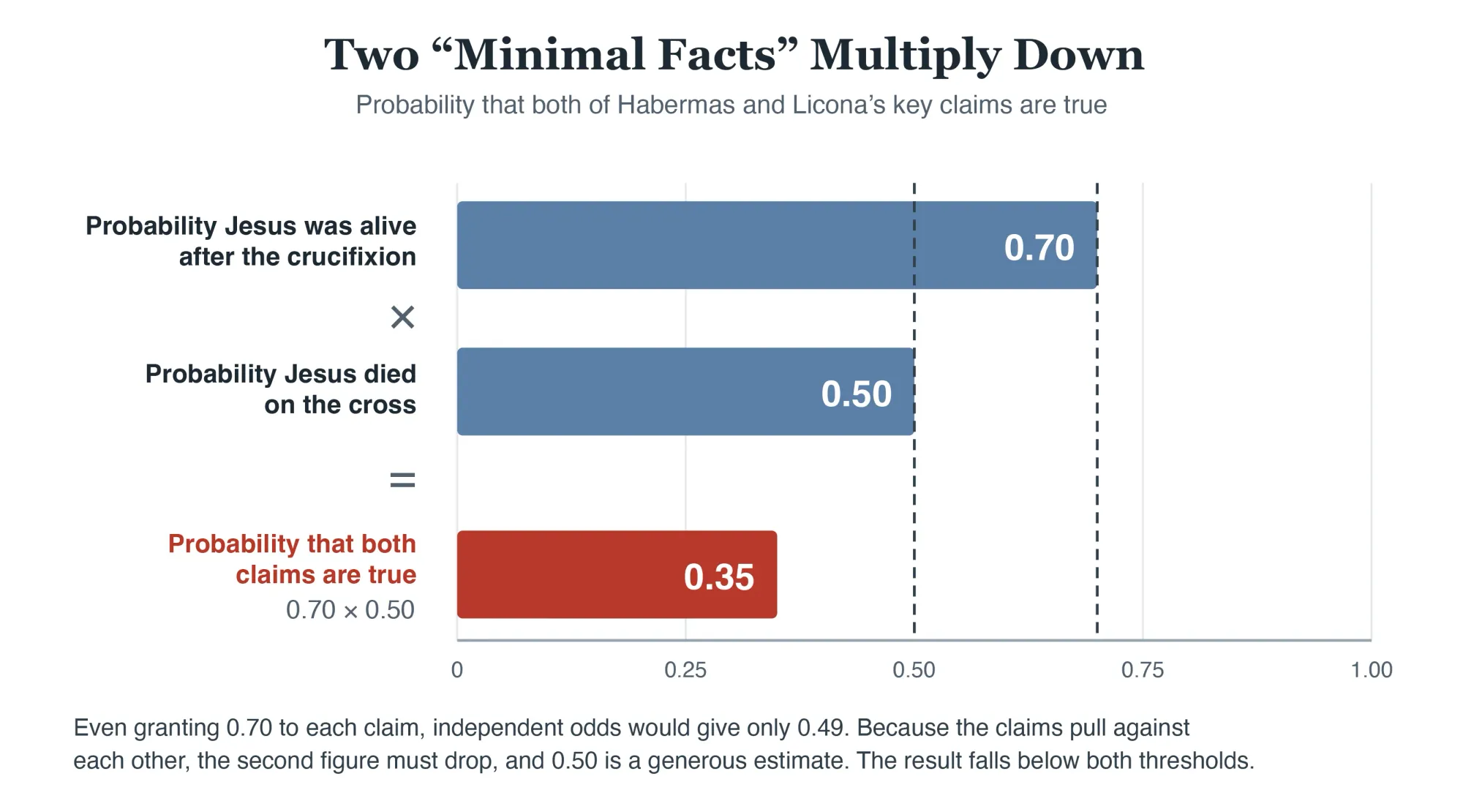
A fourth problem with their case is that they fail to take into account the need to multiply probabilities, namely these two:
- Jesus died on the cross.
- Jesus was alive and walking around in the days and weeks after his crucifixion.
It would be a significant accomplishment if Habermas and Licona could show that each of these claims has a probability of .70, but they would still fall short because the probabilities of the above two historical claims must be multiplied together to determine the probability of their both being true:
.70 x .70 = .49
However, these are not independent events. If we assume that Jesus died on the cross, then that provides very powerful evidence against the claim that Jesus was alive and walking around in the days and weeks after his crucifixion. That means the probability of both events occurring will be significantly less than .49, because the probability calculation above did not take into account the fact that the truth of the first claim impacts (significantly lowers) the probability of the second claim.
We have to determine the degree to which Jesus being alive after his crucifixion reduces the probability of Jesus having died on the cross.
To make the point, let’s reverse the order in which the two events are considered. If people saw that Jesus was alive and walking around in the days and weeks following his crucifixion, they would reasonably assume that he didn’t actually die on the cross. So, we cannot merely multiply the probabilities of the above two events. We have to determine the degree to which Jesus being alive after his crucifixion reduces the probability of Jesus having died on the cross.
Thus, there is no possible way that the probability of Jesus’s death on the cross could be anywhere near .70, given the assumption that Jesus was alive and walking around in the days and weeks following his crucifixion. But even if one was to estimate the probability of Jesus having died on the cross to be .50, on the assumption that he was alive after his crucifixion, the probability of both key claims being true would be significantly less than the goal of .70:
.70 x .50 = .35
Not only is a probability of .35 lower than what Habermas and Licona imply they have shown the resurrection of Jesus to have, it also falls below the fairly low standard of evidence for any scholars who reject historical claims when the probability of the claim falls below being more likely than not (.50).
A fifth problem with the case by Habermas and Licona is their reliance on the conversions of Paul and James (Jesus’s brother) that were the result of experiences they believed to be appearances of the risen Jesus. I have already shown that these alleged appearances are dubious and problematic, in my discussion of Craig’s case for the resurrection.
A sixth problem is that, like the case made by Kreeft and Tacelli, Habermas and Licona fail to refute the Swoon Theory, which they object to as follows (CRJ, 99-103):
- Jesus was severely scourged and his hands and feet were nailed to the cross.
- The Asphyxiation Theory (of how crucifixion causes death).
- The Spear-Wound Story in the gospel of John.
- The Sickly Jesus Objection.
- The alleged appearance of the risen Jesus to Paul.
The alleged severe scourging and the alleged nailing of Jesus to the cross are not historical facts. The Asphyxiation Theory is probably false. The spear-wound story is probably fictional, as I argued in my discussion of the “Blood and Water” objection to the Swoon Theory by Kreeft and Tacelli. The Sickly Jesus Objection also fails, as I showed in my discussion of that objection put forward in the case by Kreeft and Tacelli. The alleged appearance of the risen Jesus to Paul is dubious and problematic, as I argued in my critique of Craig’s key claim about alleged appearances of a risen Jesus. All of these objections to the Swoon Theory fail.
A seventh and final problem with the case by Habermas and Licona is that they don’t consistently follow their “minimal facts approach.” For example, the first four objections they raise against the Swoon Theory are unrelated to their “minimal facts.” Only the fifth dubious point about the alleged appearance of the risen Jesus to Paul is based on their list of “minimal facts.”
In other words, Habermas and Licona are happy to bring in lots of dubious historical claims that are not part of their “minimal facts” whenever doing so is needed to help their case. But that just means that their case is not actually based on “minimal facts.” It is based on dozens of historical claims, many of which don’t pass the requirements for being “minimal facts.”
Based on the seven serious problems with the case by Habermas and Licona, their case for the resurrection of Jesus fails.
Conclusion
The failure of leading Christian apologists to make a strong and solid case for the resurrection of Jesus is evidence that no such strong case can be made, and that the available historical evidence is not sufficient to allow for a strong and solid case to be made for the resurrection. Thus, it is rational to conclude that Jesus did not rise from the dead.
Contact the author for citations/sources.