The Clicker Culture: How That Handy Little Gadget Has Changed the Evening News
Television news, once as sober as an anatomy lecture, is now a veritable frat party. There is Holy News (“The 700 Club”), Prurient News (“A Current Affair,” “Hard Copy”), Birthday News (“Entertainment Tonight”), Twilight Zone News (“Unsolved Mysteries”), Happy News (and now our lovable weatherman), Snake Oil News (“Amazing Discoveries”), and Incessant News (CNN). Rush Limbaugh reports for the ruthless capitalists, National Public Radio for the bleeding-heart pinkos.
I recall when the news was not in color, and when the headlines did not include the results of polls taken among the ignorant. But things have changed. Time does cover stories on God. The “Psychic Friends Network” delivers reports from astrologers and the bunco squad doesn’t come knocking at their door! (Is there a bunco squad any more?) No story is too dimwitted, trivial or implausible. All scoops are created equal.
That’s the bad news. The good news is that the public has come to hold reporters in the same wary disdain that they formerly reserved for politicians. This is good, you say? Absolutely. Although it means, on the one hand, that we must suffer liars corroborating with scoundrels; on the other hand, it also means we have grown sophisticated enough to doubt even pretty ladies in pastel suits and men in their 60s with spectacles and silver hair. As a magician, anticipating the day that I will be performing with spectacles on my silver temples, I applaud that skepticism. I don’t mind working harder to fool people, if it makes the bad guys work harder too.
No story is too dimwitted, trivial or implausible. All scoops are created equal.
But what led us down the primrose path to Infotainment in which info makes only the rarest guest appearance? My hypothesis—The Clicker.
As far as the sponsors who support broadcasting are concerned, if people stay tuned to a given program, it has done its job. If people tune elsewhere, no matter how important the show’s content, it has failed. And it is very easy to tune out nowadays—you don’t even have to walk across the room—you just touch a button on the remote control. “The Clicker is the enemy,” a showbiz mogul once explained to me. Is MacNeil/Lehrer a wee dry tonight? Click, and voila—breast implants!
I understand this problem firsthand. When my partner, Penn Jillette, and I appear on television, we keep in mind that what we are doing—before it can begin to entertain—has to stop the finger from hitting the clicker again. So on TV we do a sleight of hand with cockroaches and leeches; we run ourselves over with tractor-trailers; we nail innocent bystanders into crates, set them on fire, and dump them into the East River.
Now don’t misunderstand—we don’t dislike violent imagery; artistic violence is at the heart of much great drama (think of Sophocles). But we also know that disturbing pictures are the right choice for a medium that gives us one second to catch the eye and six minutes to stamp the memory of the viewer. Now and then fans who come to see us perform live in theaters are sometimes shocked and then disappointed to see a show bordering on good taste.
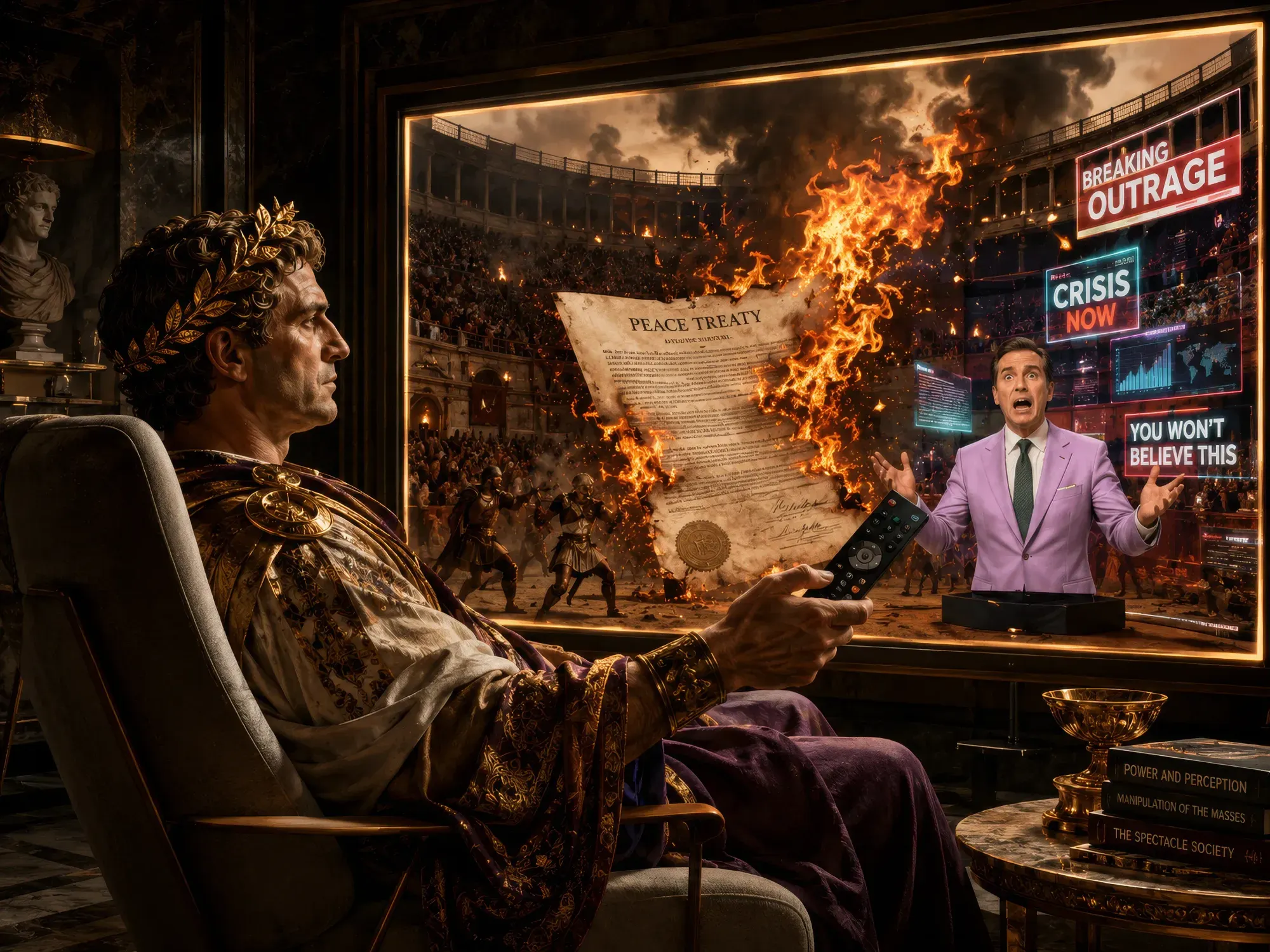
Like a magician, a news broadcaster needs an audience, and that audience has fingers and those fingers are poised above the clicker. So, more and more, that reporter’s first job is to stop the clicker with an irresistibly powerful image. And let’s face it, a slashed son, a grieving mother, a helicopter crashing in flames—all these look a lot more interesting than two politicians signing a treaty and shaking hands.
Now, it may sound cruel, but ultimately the helicopter crash is a mere accident, a tragedy for those involved, but with only a minuscule direct impact on the rest of our lives. On the other hand, the dull-looking treaty may radically change our whole world. But signing a treaty is not inherently photogenic—it doesn’t make the TV screen “a rectangle charged with emotion,” as Alfred Hitchcock poetically put it.
We live in one of the tamest eras of human history.
So instead of plain-looking substantive news, broadcasters now have to feed us a steady diet of insignificant-but-exciting calamities, sneaking in the news between bleeding babies, the way Shakespeare bracketed poetry with sword fights. There’s nothing intrinsically immoral about this tactic, but it has one unfortunate side-effect. When we form our impression about the world from such a barrage, we begin to believe that we live in unusually violent times, although the very opposite is true—we live in one of the tamest eras of human history. We just get to see more of its mayhem over our cornflakes. Those who will dominate the news in the 21st Century will overcome clickermania by less crude means—mainly, I think, by creating brands of news that fill particular needs. When I get to a hotel room, if I want the big picture for today, I just go straight to “Headline News”; I don’t browse. If I want evening drive-time education with nice music and a feminist bias, I don’t waste any time on local fare. I go straight to “All Things Considered” on National Public Radio.
And a big part of this branding depends on the intervals of reporting. When I was a boy, news was dispensed four times a day: the morning and evening newspaper, and the dinner time and late television news. For perspective I could buy a weekly news magazine like Time or U.S. News. Those were my options. The weekly news magazine still thrives, as has its television news equivalent in the refreshingly lucid “Washington Week in Review.”
But in the last five years the concept of “up to the minute” has gone hog-wild. Present-tense news is no longer confined to staged events like ball games and space launches. I can log onto the Associated Press 24 hours a day and read the stories even before they hit the hourly broadcast newsbreaks. I can turn on “Court TV” and see justice being dispensed as it happens. Was there anybody who didn’t notice something new about the way we watched the conflict in the Persian Gulf, the first war televised in real time? We were there with our dear family—Bernard Shaw, Peter Arnett and company—ducking the missiles like the heroic foreign correspondents of old. The nation was ONE, upholstered to its collective television couch. Present-tense news had arrived and was an instant hit.
Broadcasters haven’t missed the fact that news can satisfy a voracious programming appetite and get decent ratings far more cheaply than fiction (which requires money for creative writers, actors, set designers and so on). When TV executives see all America watching the O.J. Simpson proceedings—shot on a single camera in poor light—as avidly as it watches “Seinfeld,” it’s no surprise there’s a rush for “reality programming,” loosely defined as a melodrama masquerading as documentary and devoid of pesky ethics.
Signing a treaty is not inherently photogenic.
Get a camera in the right place at the right time, add music, editing, and an amiable host, and you own the airwaves for practically nothing—think of “America’s Funniest Home Videos” which is, in a cheesy way, reporting. The fact that technology is getting cheaper by the minute only speeds this trend.
A month ago I saw a box about the size of a picnic basket. It was made by NewTek, a little firm in Topeka, Kansas. The machine in the box can record video-camera input direct to disk. It enables one to shoot, edit and post-produce broadcast quality television in the field. The box costs $10,000, which sounds like a lot, until you realize that anyone who can afford the box and learn to use it can become virtually a TV production company, turning out news from his or her own moral (or immoral) perspective.
What should we do? Pine for the good old days when news sources were few, but conscientious and complemented by common (but now rare) sense? Or should we act, and demand that the Federal Communications Commission protect us from those who might corrupt the air waves? It would, after all, cost only a little of our freedom …
No. Let’s let nature take its course. In fact I suggest we reassign the staff of the FCC to some more urgent task than inhibiting the exercise of our First Amendment rights, say gardening at the White House. When I watch, read, or hear the news, I’m content to sift the diamonds from the dirt. I’ll choose eternal vigilance, thank you.
“The Clicker Culture” was written as part of a project of the Radio and Television News Directors’ Foundation on the future of broadcast news.