Conspiracy Inc.: The New Media Disorder
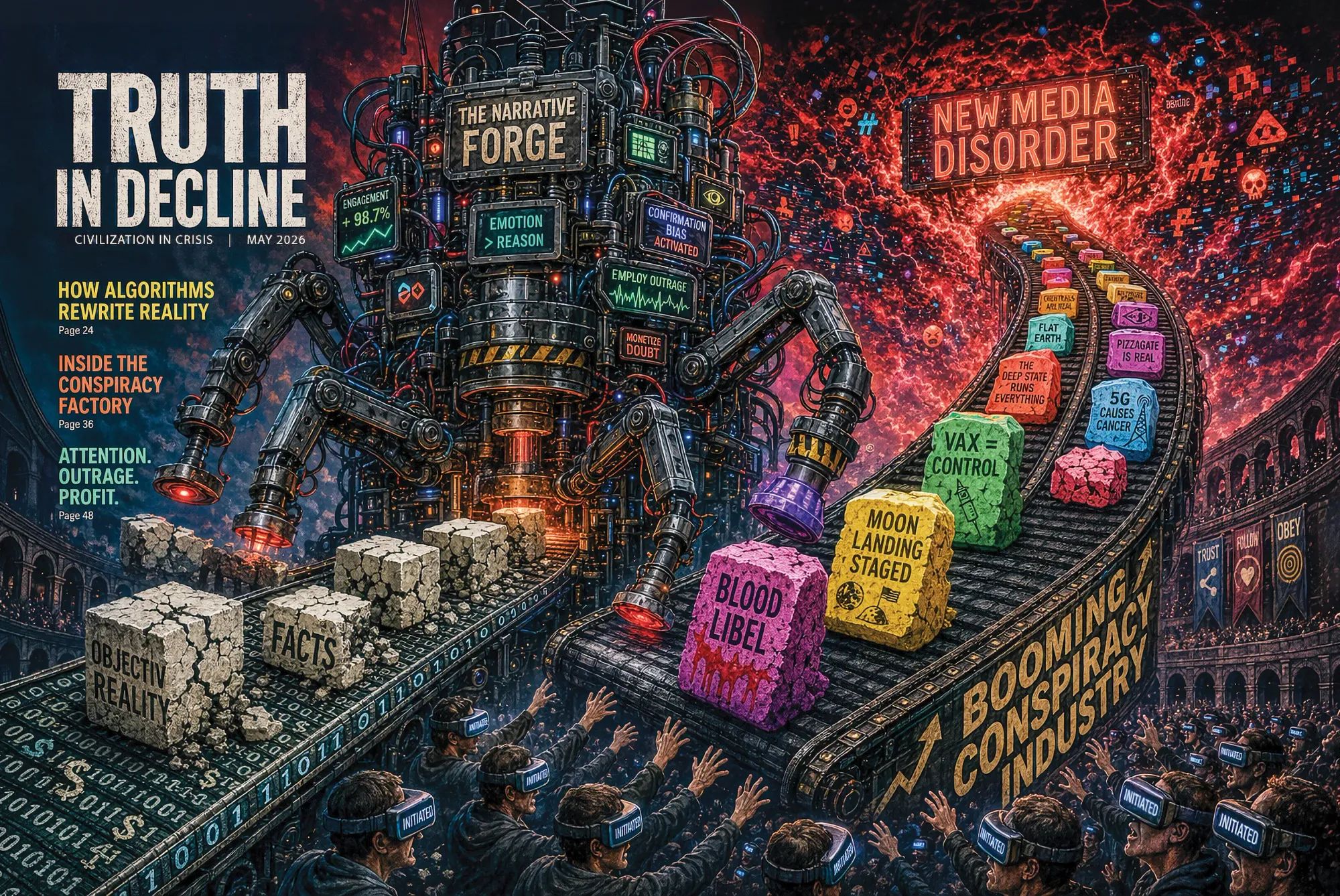
One of the most dramatic aspects of grand dreams of the human spirit is how quickly they come crashing down to gritty, grimy earth. This is nowhere more true than with the internet. What began as a promise of global connection and unlimited access to knowledge has become a hornet’s nest of hatred, distortion, and lies. Conspiracy theories, which blend all of those elements into novel shapes and patterns, are thriving in ways that would put to shame the architects of the most poisonous false narratives in history.
For the first time, conspiracy is not just a political or geopolitical tool, as it has been for centuries, but a booming industry. Conspiracy theories are now the blood sport of the 21st century; social media platforms that profit off them are the contemporary colosseum where the masses go to watch individuals, nations, religions, and ideas get ripped to shreds. It’s officially sanctioned barbarism. And the crowds love it.
Influencers like Candace Owens, Tucker Carlson, Alex Jones, Dave Smith, and Ian Carroll are gladiators of falsehood, deepening their fame and fortune with every next lie. But these are only the most high-profile examples. On streaming platforms, messaging apps, and social media sites, thousands more aspirants work daily—by the minute—to spin and re-spin false narratives. Some, like anti-Jewish blood libels, are as old as time. Others, including the idea that the moon landing was staged, that the Kennedy assassination was a conspiracy, and that commercial jets emit “chemtrails,” have persisted for decades. Still more, including the idea that vaccines are an instrument of social control, have come to the fore in recent years.
What separates our modern era of conspiracy theorizing from the long tradition behind it is the scale of the rewards and incentives. Recently, the leader of one of the internet’s most prominent and successful new media companies told me that, by his estimate, Candace Owens earns around $50 million annually from YouTube ads alone—not counting speaking engagements, merchandise, and other brand sponsorships. Whether or not this precise number is accurate, it’s clear that the correlation between financial gain and what we might call a largesse with the truth is tight.
In this bewildering flurry, it’s difficult to zoom out. Yet we have to ask: How did we get here? Where is this all going? And can we find a way back—or a way forward?
Only a few years ago, many people embraced the idea that the internet had ushered in a new dawn for information and communication. The media marveled that Twitter could be used by journalists as a tool to produce real-time reporting from far-flung corners of the world. Wikipedia offered a bottomless trove of free information on everything from big, broad concepts to the marginalia of unsung knowledge.
Facebook made “friends” out of strangers; Google made urban labyrinths now navigable and dynamic. E-commerce opened up entire new vistas of opportunity. Micro-loans, made possible by digital technology, would lift developing nations of endemic poverty. The vast, inscrutable world of the pre-digital era had magically become legible. We could discern truth from falsehood, fact from distorted fiction. The panacea was just on the horizon, burnishing the sky with hope.
Looking back, it now seems as if that bright glow was a conflagration—the deep tradition of Enlightenment thought in flames. While the fire has burned for years, a clearly defined break, a rupture in the epistemological chain, came in 2016, when the unthinkable took place in American politics: Donald Trump won the presidential election. There were many reasons for this, tied to the social and cultural dynamics of a country whose demographics and economics had been in flux for over two decades. But for the gatekeepers of American culture, the election represented such an upheaval, a kind of Copernican turn that upended everything they thought they knew about American society and politics.
As in so many instances in history, the response by the ruling elite was not to adapt their worldview to the newly born reality, but to mold reality to their existing worldview. Weeks after the election, Hillary Clinton declared a “fake news epidemic.” The thesis was painfully clear: The U.S. was under attack by its geopolitical adversaries, who were weaponizing social media platforms to sway electoral outcomes. Over the following years, this thesis would be unpacked over and over: The Trump campaign had worked with the Kremlin to stage a mass-scale campaign to distort public views, swinging the election in Trump’s favor.
How this could have been ascertained little more than days after the election was never explained. Nor was any evidence ever presented that activities on Facebook—the platform that was identified by the media as the primary vector for this attack—had succeeded in moving the needle. One of the few studies on this topic found that election-related false narratives on social media resulted in a shift of only a few hundreths of a percent.
But none of these very legitimate questions were raised. In fact, the narrative was deepened. The idea, deployed by the Clinton campaign in conjunction with the high-powered political PR firm FusionGPS, was that we had entered an era where information was so compromised that government intervention was urgently needed. In one of his final acts as president, Barack Obama pushed through an administrative determination that designated elections—and, by virtue of this, the information surrounding them—as critical infrastructure. Information now came under the purview of government action and control.
In retrospect, the epistemic bait-and-switch is breathtaking: In order to protect truth, Illing and others argued, journalism had to abandon its most fundamental tenets.
The media seemed to openly disavow the idea of neutrality and objectivity. Vox journalist Sean Illing made one of many such declarations. Illing wrote in 2020, just months before the November election, that,
The American media ecosystem has become saturated with misinformation and noise because the press remains committed to a set of norms that are ill-adapted to the digital age … the obsession with “objectivity” in particular has led to an obsession with “balance” or “fairness” that makes it easy for bad-faith actors to get away with pushing falsehoods.
In retrospect, the epistemic bait-and-switch is breathtaking: In order to protect truth, Illing and others argued, journalism had to abandon its most fundamental tenets. In this politically driven determination, they rejected not only neutrality—an idea debated for decades on the premise that journalists, as human beings, can never fully detach from their own perspective—but also objectivity—the idea that truth exists independently of the observer.
In a vacuum, this idea would have made for good copy, but little more. In reality, it was married to a social justice movement that operationalized it. Just a few weeks before the Vox piece, journalist Wesley Lowery published a wave-making op-ed in The New York Times that married the political rejection of objectivity and neutrality with the then emerging Black social justice movement. In his piece, “A Reckoning Over Objectivity, Led by Black Journalists,” Lowery opined that, “Black journalists are speaking out because one of the nation’s major political parties and the current presidential administration are providing refuge to white supremacist rhetoric and policies, and our industry’s gatekeepers are preoccupied with seeming balanced, even ordering up glossy profiles of complicit actors.”
One of the “glossy profiles of complicity actors” Lowery had in mind was an op-ed by Senator Tom Cotton (R) in The New York Times. The piece, which had been solicited by the paper’s opinion editor, called for National Guard troops to be called in to restore order in American cities rocked by Black Lives Matter protests that frequently devolved into riots.
Had Cotton issued this call on Fox News or the Washington Examiner, no one would have thought twice. But the fact that he was able to make this argument in the flagship news outlet of the center left was an outrage that demanded not just action—the op-ed prompted a mass walkout by NYT newsroom staff—but a public rethinking of the entire enterprise of journalism itself. The theory of new journalism built on a rejection of neutrality and objectivity would not be quietly embraced by journalists at legacy outlets, but trumpeted in the pages of news outlets across the country. It would become a cause célèbre of journalism in itself.
Lowery’s racially motivated rejection of objectivity was not new to The New York Times. The previous year, Nikole Hannah-Jones had published her 1619 Project, which argued in an entire edition of The New York Times Magazinededicated to the theme that Americans had been born not in liberty, but in slavery. That Hannah-Jones and The 1619 Project had been repudiated by virtually the entire field of American history, including historians at elite American universities, mattered little or not at all. The reason was exactly the one promulgated by Lowery and Illing: The subjective truths of the Black Lives Matter movement and the quest for racial equity powering not only outweighed the imperatives of truth-seeking, but negated them entirely.
By now, readers of this piece will have detected the core philosophical framework undergirding this shift. For decades, post-modernism had taught that there is no such thing as objective truth, but only social constructs built by those in power. In this case, the power was “white supremacy.” This served the movement remarkably well. With a wave of the collective hand, it could dismiss hard data about police shootings of Black Americans relative to the general population as racially biased and stigmatize those dared to raise questions around the data as full-blown racists.
Over subsequent years, the same template would be applied to whatever political cause was championed by the left at any given moment. The most prominent of these waves was the gender movement, which used this machinery to overwrite the science of biology with the social science of gender ideology. Those, like J.K. Rowling, who chose to debate the merits of these ideas were labeled anti-trans bigots, or, in Rowling’s case, Trans Exclusionary Radical Feminists, or TERFS.
With COVID, the argument shifted in the direction of near total enforcement of the science establishment orthodoxy on the issue. If you explored the idea that the virus may have originated from a lab that worked to enhance the virality of coronaviruses like SARS-CoV-2, you were branded a conspiracy theorist. If you questioned the efficacy of non-respirator masks, which the head of America’s pandemic response, Anthony Fauci, had only weeks before publicly claimed were not effective in stopping transmission, you were called not only anti-science, but a disease vector. Government, newly empowered by post-2016 election information policing powers, stepped in to censor inconvenient facts on social media.
The legacy media and its political allies had built a powerful trebuchet to beat political enemies into submission.
In the introduction to my book about The New York Times, I warned that although the bien pensant had managed to successfully pull off the great epistemological feat of the 21st century—using narrative machinery to reconstruct public truth—this feat would not go unnoticed. The legacy media and its political allies had built a powerful trebuchet to beat political enemies into submission. As with any war, however, the enemy defeated by a powerful new weapon inevitably learns to build and wield that weapon itself. The warfare that results becomes far more destructive.
Over the past five years, we have witnessed exactly this effect take hold of the American public consciousness. In the wake of the greatest clampdown on information, there has been a counter-weaponization of it. Accounts banned or “throttled” by Big Tech censors returned to platforms with a literal vengeance. Users that had been punished for questioning the efficacy of COVID vaccines would now build conspiratorial narratives about inoculation as an instrument of evil. People who were labeled racist for asking if BLM’s central claims withstood real scrutiny would turn to open race-baiting as a form of retribution.
It was at this exact moment that the world was plunged into geopolitical chaos. In February 2022, Russia invaded Ukraine. A year later, Hamas stormed into Israel, slaughtering 1,200 civilians, raping women, and dragging 200 hostages, including women, children, and even infants, into Gaza. In both cases, the major combatants—Russians under a leader trained by the KGB, the master-agency of propaganda, and the Muslim Brotherhood-inspired Islamists for whom psychological manipulation constitutes the essence of their war against the West—reached naturally, almost reflexively, for the dark arts.
On social media platforms, they found legions of willing soldiers. In the pre-digital era, propaganda required either building media infrastructure—creating newspapers, standing up broadcast channels—or infiltrating existing ones by recruiting or bribing journalists as assets. Both endeavors are expensive, time consuming, and carry significant risk. Today, every one of those factors has been inverted. The creation of bot networks is, for a state actor, a relatively trivial affair. Paying off top-tier influencers through shell companies or using advertising deals with inflated pricing is virtually impossible to detect.
The vast sums at stake make this kind of activity irresistible. In 2024, news reports identified influencer Lauren Chen and her husband, Liam Donovan, as two figures mentioned in an unsealed indictment against figures tied to Russian state media outlet Russia Today (RT). The indictment alleged that individuals working for RT paid Tenet Media, the company owned by Chen and Donovan, to distribute content produced by other influencers. Ultimately, neither Chen nor Donovan were charged.
For the first time, however, we were given a glimmer of insight into the amounts at stake. The company belonging to Chen, a mid-level influencer, was paid $10 million. For top-tier influencers, the numbers likely scale disproportionately higher.
Conspiracy theory is the most optimized format … it removes the most expensive, time-consuming constraint aspect of journalism—original reporting of corroborated facts.
All this has created the conditions for a perfect storm of propaganda. The demand is bottomless. All that is required is a ceaseless flow of content to feed the flywheel of social media engagement. In this maelstrom, conspiracy theory is the most optimized format. On the supply side, it removes the most expensive, time-consuming constraint aspect of journalism—original reporting of corroborated facts. Instead, the latest, zaniest, and most dangerous ideas that come to mind are instantly turned into “investigations” with dark portent. The material exists prepackaged: antisemitic tropes, tales of flying saucers and alien abductions, and alternative histories that discard established fact as their starting point. The only barriers are technical, and even then they are strikingly low—two or three cameras, a microphone, and a small production team.
On the other side of the market, the demand is bottomless. In the 1990s, when talk radio was on the rise, the content had to be heard in real time and could only be accessed on stations, and in regions, where it was available. Today, all podcasting—the modern equivalent of talk radio—is accessible at any time to every person on the planet. Hyper-specific niches open into mass audiences whose scale dwarfs that of pre-internet broadcast media. The economics scale at breakneck speed.
But there is another factor at work. In his book, How to Win an Information War, disinformation scholar Peter Pomerantsev makes a powerful point expressed in the title of the book’s first chapter: “Propaganda is the Remedy for Loneliness.” This notion traces back to French sociologist and philosopher Jacques Ellul, who wrote that modern man
feels the most violent need to be reintegrated into a community, to have a setting, to experience ideological and affective communication … That loneliness in which he can share nothing, talk to nobody, and expect nothing from anybody, leads to severe personality disturbances.
If loneliness had been a driving factor in the 1960s when Ellul was writing, today it’s more than even an “epidemic,” as it’s sometimes described. It is the very premise of digital life. The all-encompassing solution to it, the rectangular black holes into which we pour our loneliness, is both remedy and cause of the disease. The atomization of living life with heads bowed, eyes locked on the device of our hands, is total. The common culture defined by books and magazines is gone. And with it, the shared vocabulary of generally agreed upon fact—the moon landing was a triumph, safely administered vaccines keep populations healthy, biological reality exists, and a complex dynamic of politics and markets, not a shady cabal of uber-rich Jews, determines the course of nations—has been dispatched.
The one great hope lies in the very thing that the confluence of forces on the left and right have sought to dispense with: Objective reality exists.
Audiences, instead, walk through the doorways of conspiracy theory, where they can join a club of initiates given access to something hidden from the broader world. As Ellul put it:
For it, propaganda, encompassing human relations, is an incomparable remedy. It corresponds to the need to share, to be a member of a community, to lose oneself in a group, to embrace a collective ideology that will end loneliness. It also corresponds to deep and constant needs, more developed today, perhaps, than ever before: the need to believe and obey, to create and hear fables, to communicate in the language of myths.
This is the age of propaganda. The one great hope lies in the very thing that the confluence of forces on the left and right have sought to dispense with: Objective reality exists. It can be studied, measured, and theories about it can be tested. More than anything, in the final analysis, reality always asserts itself. Getting there is about acknowledging this basic fact—and agreeing that no single party or school of thought has a monopoly on the truth. Instead, we collaborate to build models that aim not to advance interests but get close to “the real thing,” whatever it might be.
The dialectic of theorizing, testing, and improving is painstaking. It’s not sexy, and it’s certainly not lucrative. But if there is any path forward, it is this one. It’s time for us to take it.