The “Curse” of King Tut and of the Princess-in-a-Box
A An almost unimaginable 33 centuries ago a boy-king ruled a country for only a few years and had little to no impact on the history of his civilization. That all changed in 1923 when the world was fascinated with news of the discovery of the tomb of the Egyptian pharaoh Tutankhamen. Remarkably, the tomb of the personage who came to be called King Tut was essentially intact—an exception indeed to the usual looted remains that archaeologists were accustomed to finding.
Immediately, the inevitable myths and sensationalistic stories began to appear in the press. The dreaded “Curse of the Pharaoh,” an invention of the popular media, was invoked, and ever since that time journalists and hack feature writers have been periodically resurrecting (excuse the pun!) the hoax.
Lists of those persons apparently felled in mysterious ways by the Curse have been developed, and are still being expanded upon to prove the truth of the claim. Not only those who actually were involved in the discovery and excavation of the mummy, but almost anyone even remotely connected with the event, has been dragged into consideration. The child of a secretary who was once employed by a scientist who had an opinion on Tut died suddenly and was trumpeted as the “latest victim” of the Curse. A workman at the Cairo Museum who had expressed doubt about the Curse was involved in a fatal auto accident and was said to have died muttering in ancient Egyptian. The press had a field day.
You don’t want to spoil a good bit of claptrap, after all.
Of course, an exotic locale tends to generate such fantasies, and Egypt has provided more than its share of nonsense. In 1968, another startling story began to be circulated in the popular press. It involved a dead Egyptian princess with the usual ancient curse and lots of disaster, all the ingredients needed to attract attention. U.K. author John Macklin wrote:
The Princess of Amen-Ra lived some 1,500 years before the birth of Christ. When she died, she was laid in an ornate wooden coffin and buried deep in a vault at Luxor, Egypt, on the banks of the Nile.
Macklin went on to describe how in the early 1900s “four rich young Englishmen” bought the mummy of the princess in Egypt, whereupon one of them promptly walked out into the desert and vanished. Another of the buyers had his arm shot off, yet another had his bank fail, and the last one went broke and “was reduced to selling matches in the street.” Wow!
But, says Macklin, the curse was only getting started at that point. The next owner had three of his family members injured in an accident and his house caught fire. He wisely gave the princess-in-a-box to the British Museum.
Things went wrong from the very first minute that the museum took possession of the lady. First, the vehicle delivering the mummy backed up and pinned a pedestrian. Then one of the two porters carrying the sarcophagus fell down the stairs and broke a leg; the other died mysteriously two days later of unknown causes. There’s more. Exhibits in the room where Princess Amen-Ra were displayed—once they got her and her box through the door—were thrown about at night. A spirit from the coffin tried to throw a night watchman down a delivery chute. The child of a worker who showed disrespect to the princess, died of measles.
We’re hardly finished. Macklin breathlessly related that one worker who had delivered the princess to the museum fell seriously ill and another was found dead at his desk. A photographer sent to record the artifact found that the face painted on the sarcophagus registered on his film as a “human—and horrific—face.” Apparently overcome by this repulsive result, he promptly locked himself up in his darkroom and blew his brains out, whatever there was of them.
It was 1912. Macklin declared that the British Museum, in its Anglican wisdom, now offered to sell this increasingly awkward object to anyone who dared to buy it. As anyone might expect, the brash, over-wealthy and enterprising American now came upon the scene, heedlessly offered to buy the boxed princess, snapped her up for a good price, and decided to ship her to New York “aboard a sparkling new White Star liner about to make its maiden voyage across the Atlantic Ocean to New York. On the night of April 14, amid scenes of unprecedented horror, the Princess Amen-Ra accompanied 1,500 passengers to their deaths at the bottom of the Atlantic. The name of the ship was the Titanic.”
Though this corny story has been circulated and recirculated, rewritten and enthusiastically enhanced, it is still just a story. The mummy never existed and the entire tale is a journalistic exercise in bad writing and witless sensationalism, a story that the British Museum is often called upon to deny. The museum even publishes an official denial which is sent to those who inquire. But the story will show up again, count on it.
First, the Curse would seem to be a beneficial one. The average life span of those involved was 73+ years.
And it will be believed.
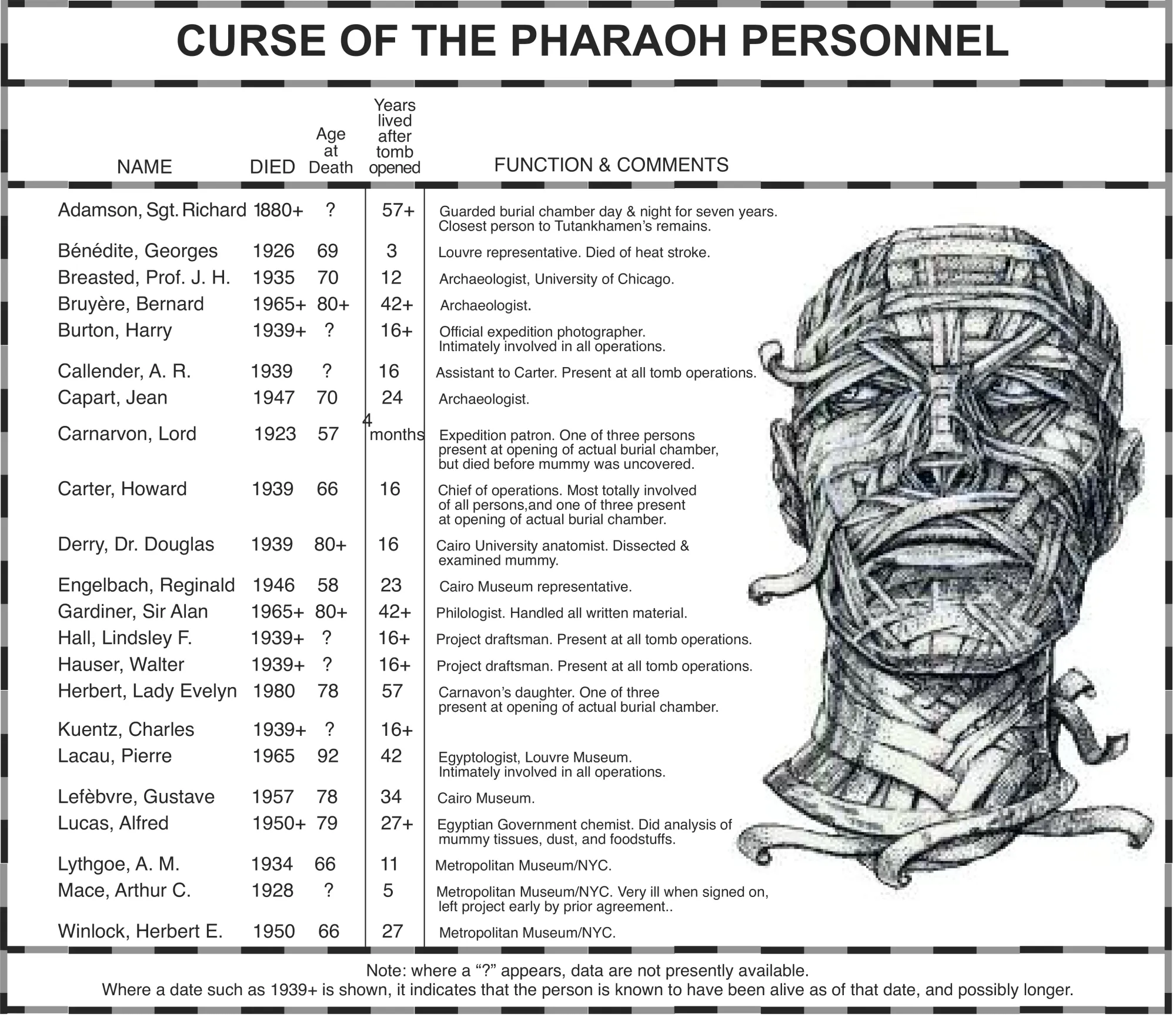
But back to the Tut tale. Since this is the daddy of all the Curse myths, I concentrated on it. I made a list of the 22 persons who could be expected to fall under the dreaded Curse. Forget the kid sister of the secretary to the accountant of the archaeologist, let’s look at the guys who actually dug him up. Included are those who unwrapped Tut, dissected the mummy, X-rayed it and in general messed about with the kid’s body. A study of these persons produces some very interesting data.
First, the Curse would seem to be a beneficial one. The average life span of those involved was 73+ years. This beats the life span expectation in actuarial tables for persons of that period and social class, by just one year.
The average duration of life for these persons, after the opening of the tomb, was 23+ years. Those who actually opened the burial chamber and removed and handled the remains lived an average of more than 26 years after their very intimate involvement with the mummy. One, the sergeant who actually guarded the mummy and slept in the tomb for seven years, died in his 80s, 57 years later!
Particularly interesting is the fact that Adamson, Carter, Burton, Derry, and Lucas—those who physically opened the burial chamber and removed and handled Tut, and were the literal violators of his repose—lived an average of more than 26 years after their very intimate involvement with the mummy.
Also note that those sensationalists who have analyzed the Curse have chosen to ignore the hundreds of Egyptian laborers who over a 10 year period were involved in the tomb operation (as if these persons were unimportant; after all, appears to be the reasoning, they’re only Egyptians). According to a tiny newspaper notice, one common laborer from the area died last year, 70 years after he helped open the tomb. Not surprisingly, his death was not reported by the cursewatchers as significant in the overall picture. You don’t want to spoil a good bit of claptrap, after all.
Here’s a rundown on the folks who were most involved in the violation of Tut’s final rest.