Flying Organisms, Not Flying Saucers: The Biological Case for UAPs
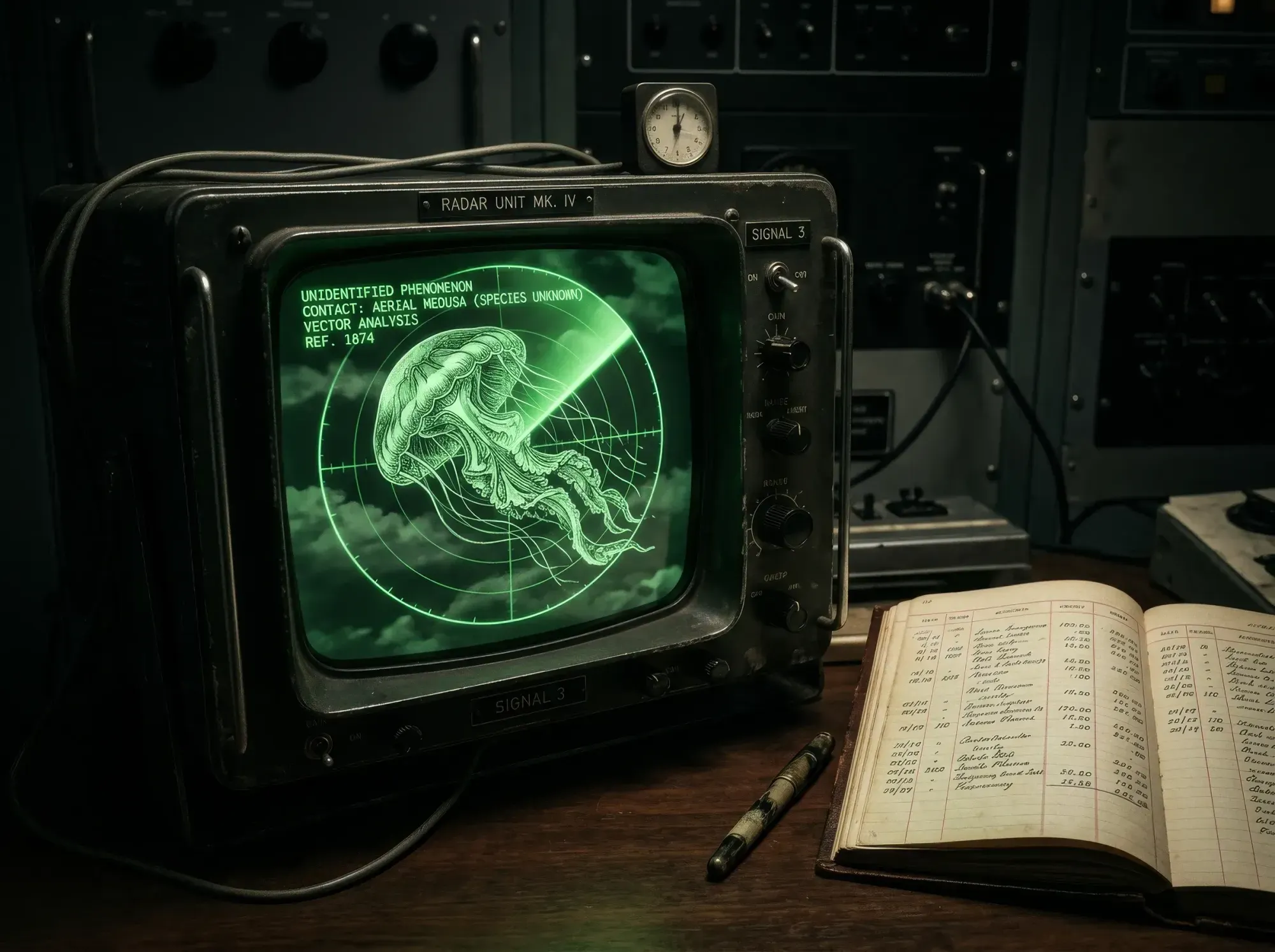
For generations, the mystery of Unidentified Anomalous Phenomena (UAPs) has been viewed through a narrow lens of mechanical engineering, split between fears of foreign espionage and fantasies of extraterrestrial invasion. By viewing these anomalies strictly as hardware, we ignore a far more grounded explanation: biology. This article explores the “Atmospheric Life” hypothesis, proposing that UAPs are not manufactured machines, but undiscovered, highly adapted biological entities native to Earth’s upper atmosphere. By examining their non-mechanical flight patterns, organic physical structures, sensor misinterpretations, and total lack of military retaliation, we can reframe a modern security panic as a groundbreaking frontier of natural science.
A Mystery Solved
For decades, the conversation around Unidentified Flying Objects (UFOs) and Unidentified Anomalous Phenomena (UAPs) has been dominated by two main theories: secret military technology or visitors from distant galaxies. However, a compelling alternative hypothesis looks downward instead of upward. What if these anomalous objects are actually undiscovered, highly adapted biological entities native to Earth’s atmosphere?
When we strip away the sci-fi assumptions, the erratic flight patterns, shapes, and behaviors of many documented UAPs look far more like organic wildlife than mechanical craft.
Avian and Insectoid Flight Mechanics
The most common piece of evidence cited for the technological nature of UAPs is their radical flight behavior. Witnesses and radar tracking often describe sudden changes in direction, instant acceleration, and erratic hovering.
While these movements may baffle aerospace engineers, they are entirely familiar to biologists. Watch a common housefly, a dragonfly, or a starling murmuration. These animals dart, pivot, change velocity instantly, and hover in ways that defy standard human aviation. The erratic “ping-pong” flight patterns often reported in UAP sightings strongly mirror the hunting and mating flights of insects or the chaotic, synchronized movements of birds.
Real-world animal behaviors perfectly mirror what we see in famous UAP footage. Rather than breaking the laws of physics with advanced technology, these objects may simply possess biological flight mechanisms that we do not yet understand.
Atmospheric Leviathans: The Cigar-Shaped Ocean Paradox
Beyond small, nimble UAPs, there are frequent reports of massive, cylindrical, or “cigar-shaped” objects hovering silently in the upper atmosphere. In a technological context, a craft of this size represents a massive logistical footprint or a looming mothership. In a biological context, it represents a giant apex predator or filter feeder.
Think of Earth’s oceans. Massive creatures like blue whales, whale sharks, and deep-sea siphonophores float effortlessly through a dense fluid medium. Earth’s atmosphere is also a fluid medium, just a less dense one. A large, slow-moving, cigar-shaped UAP behaves remarkably like a whale or a shark cruising through the deep ocean.
Concluding that UAPs are hostile or extra-planetary requires a massive leap of imagination.
These entities could be low-density, gas-filled biological organisms that spend their entire lifecycles drifting through the stratosphere, entirely indifferent to the human world below. Historical cryptozoology theories have long proposed the existence of such “atmospheric jellyfish” and sky-dwelling organisms.
The Misinterpretation of Biological Tissue
A major roadblock to the biological theory is our reliance on technology to detect these entities. Modern defense networks use radar, infrared camera arrays, and thermal sensors to scan the skies. When these systems register an object, we automatically assume it is made of metal, carbon fiber, or titanium.
However, radar and thermal sensors can easily misinterpret biological tissue. Dense flocks of birds and swarms of insects routinely create massive, solid-looking anomalies on radar screens. Furthermore, a creature with a highly reflective outer membrane, or one that generates its own bioluminescent heat signature, could trick infrared sensors into displaying a sharp, mechanical outline. We might be looking at skin, blubber, and organic defense mechanisms, but viewing them through sensors calibrated only to find hardware.
The Absence of Military Aggression
The prevailing geopolitical narrative frames UAPs as national security threats. This fear-based perspective assumes that anything unknown in our airspace must be a foreign adversary or an invading force. However, real-world data contradicts this assumption.
In recent years, modern militaries have actively tracked, engaged, and even shot down several unidentified objects. If these entities were part of a technologically superior, militarily organized foreign power or alien civilization, standard military doctrine dictating a counter-attack would apply. Yet, no such retaliation has ever occurred.
When a wasp nest is disturbed, or a bear is cornered, it defends itself violently. But when a deep-sea creature or a migrating bird is harmed by humans, the species as a whole does not organize a strategic military counter-offensive. The total lack of coordinated tactical retaliation from UAPs strongly suggests they lack military organization, strategic intent, or a concept of warfare. They react like wildlife—either fleeing or remaining entirely indifferent to human aggression.
Reclaiming the Phenomenon from Sci-Fi
Concluding that UAPs are hostile or extra-planetary requires a massive leap of imagination. It forces us to invent complex interstellar civilizations, vast government conspiracies, or foreign technologies centuries ahead of everyone else on Earth. These are all unlikely compared to the biological hypothesis, which provides a much more grounded and parsimonious explanation. Earth’s biosphere is incredibly resilient and adaptable.
Just as we are still discovering bizarre new lifeforms in the deepest trenches of our oceans, it is entirely possible that our upper atmosphere harbors its own unique ecosystem. By viewing UAPs through the lens of biology rather than warfare, we can strip away the unneeded fear and recognize these phenomena for what they likely are: just another undiscovered wonder of our natural world.