From Crucifixion to Resurrection: Deconstructing Christianity’s Central Dogma
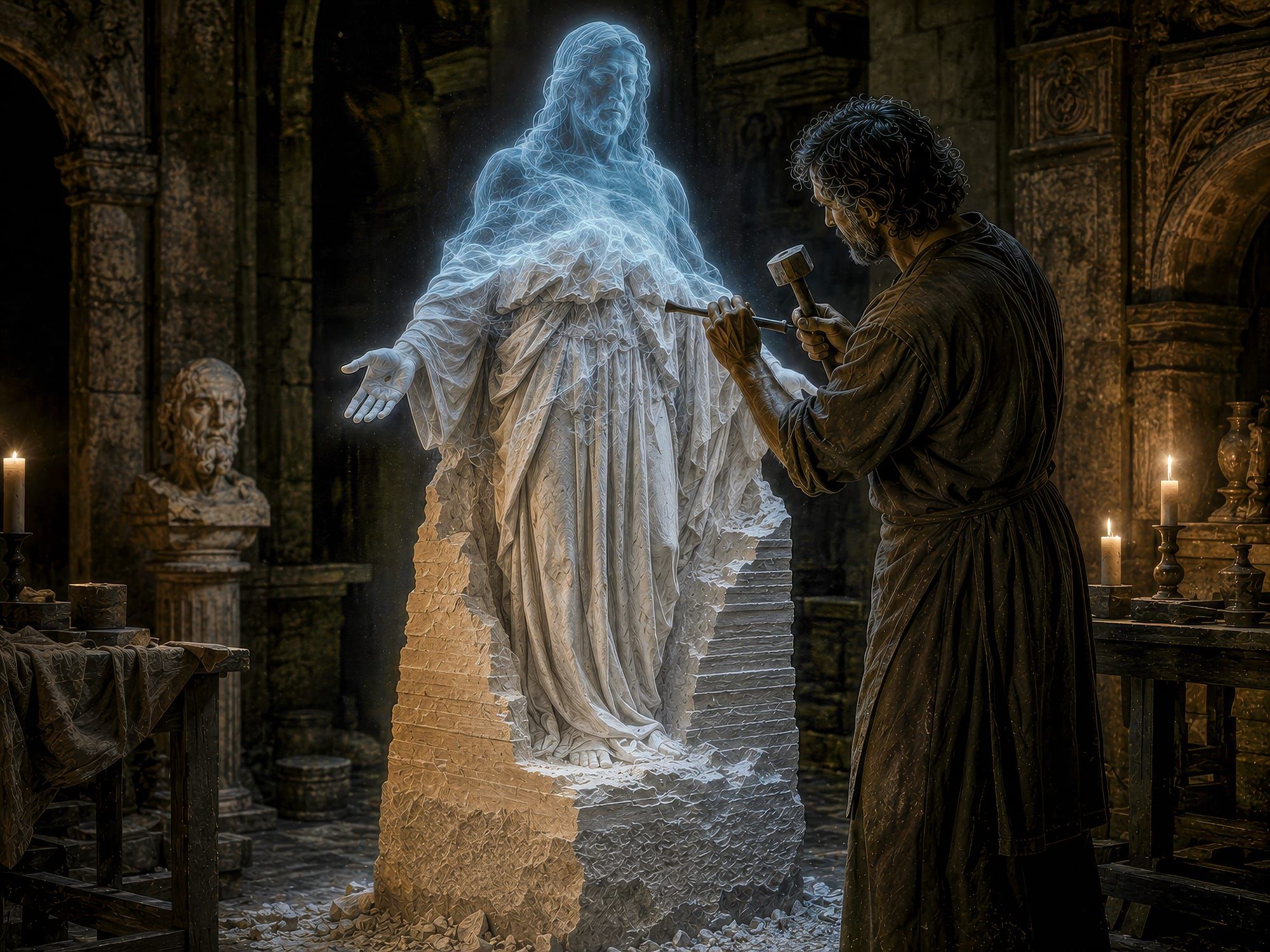
Most debates about the origins of Christianity fall into a culturally entrenched groove: the apologist marshals evidence for a physical resurrection of Jesus; the skeptic counters with naturalistic explanations against it. Both sides, however, share a fundamental error—they assume that “Resurrection” meant “Resuscitation” to the first Christians, treating the walking, talking, fish-eating corpse as the primary historical datum to be either defended or dismantled.
By examining the earliest recoverable evidence—specifically the letters of Paul—we discover that the real question is not “Did the physical resurrection of Jesus literally happen?” but “Did the original disciples even claim that it did?” When we shift the axis from metaphysical debate to source criticism, the traditional question doesn’t get answered—it dissolves.
The “Resurrection” began as a spiritual vision interpreted through an apocalyptic lens, and only later crystallized into a physical narrative to serve the institutional needs of a growing church. Understanding this evolution allows us to explain the rise of Christianity without recourse to the supernatural, relying instead on the well-documented mechanisms of human psychology, sociology, and history.
What follows is a chronological reconstruction: first, the historically probable circumstances of the crucifixion and burial; second, the acute psychological crisis this created for the disciples; and third—critically—an analysis of Paul’s earliest epistles to demonstrate that the original apostolic claim was entirely visionary in nature, before tracing how and why that spiritual claim was retroactively physicalized by later Gospel writers into the familiar empty-tomb narratives.
The Crucifixion: What We Can Be Confident About
Jesus of Nazareth was crucified under the reign of Pontius Pilate around 30 CE. This is one of the most historically secure facts about him, attested not only by Christian sources but by non-Christian historians: Tacitus, writing c. 115–117 CE, mentions that “Christus” was executed under Pilate; Josephus, writing around 93 CE, references the same event. Though scholars recognize that Christian scribes interpolated portions of the Josephus passage, the core reference to his execution under Pilate remains widely accepted. The crucifixion is simply not in historical doubt—nor is the death itself. The swoon theory—suggesting that Jesus didn’t actually die on the cross but fell into a comatose-like state and later appeared to his disciples—is rejected by virtually every serious scholar, including deeply skeptical ones. Roman executioners were professionals whose lives depended on their thoroughness.
What is less often appreciated is the specific theological catastrophe the crucifixion represented for the disciples. A crucified messiah was not a martyred hero awaiting vindication. Deuteronomy 21:23 was explicit: anyone hung on a tree is under God’s curse. The cross was, within the only theological framework these people possessed, formal proof that God had rejected Jesus. And the Messiah, in their tradition, had a specific job description: defeat the Romans, rebuild the Temple, and establish world peace. Jesus had done none of these things. He died the death of a failed revolutionary, leaving Israel still under occupation. This is why Jews do not accept Jesus as the Messiah. They were expecting a conquering warrior and witnessed only an executed preacher, crucified in between two common (one repentant, one unrepentant) thieves.
Thus, the Jewish disciples of Jesus were in freefall, searching desperately for any shred of meaning. The later Gospel claims that Jesus repeatedly predicted his resurrection are exposed as a literary invention by the simple fact of the disciples’ behavior. Had he foretold rising on the third day, his followers would not have hidden in terror, nor would the women have brought spices to anoint a permanent corpse. The disciples were not waiting for a promised victory. They were in a nosedive, searching desperately for any shred of meaning.
This silence is historically significant. Because Jesus apparently never framed his death as purposeful—as atonement, as apocalyptic necessity, as anything—his followers were forced into reactive, improvised theology after the fact. The varying theological emphases visible across the New Testament are the scars of a movement that spent its earliest years trying to retroactively make sense of a catastrophe their leader never prepared them for.
The Burial and the Empty Tomb
The earliest Christian writer, Paul, writing decades after the fact, never mentions an empty tomb, and his silence is telling. In 1 Corinthians 15, mounting a desperate evidential defense against resurrection skeptics, he lists every proof available: visionary appearances to Peter, the Twelve, five hundred people, James, all the apostles, himself, and finally to scripture. No tomb. No women. No burial site discovery. Even Paul’s mention of the resurrection of Jesus was described in 1 Corinthians (15:44) as a spiritual event rather than a literal one:
It is sown a natural body; it is raised a spiritual body. There is a natural body, and there is a spiritual body.
More than silence, Paul actively describes the resurrection in terms that exclude a resuscitated corpse: “flesh and blood cannot inherit the kingdom of God.” His seed analogy is explicit—the physical body remains in the ground while something entirely new emerges from it. This is not the language of a man who believed a corpse had walked out of a grave.
Even the now-famous “empty tomb” doesn’t appear in our written sources until Mark’s Gospel, composed around 70 CE, forty years after the events therein described. What the evidence does reliably establish is this: women went to find Jesus’s body Sunday morning and could not locate it—a detail that passes the criterion of embarrassment on multiple grounds. Women’s testimony was legally invalid in first-century Jewish culture; no one fabricating an apologetic story would make them its sole witnesses. Mark preserves their reaction with brutal honesty: “Trembling and bewildered, the women went out and fled … They said nothing to anyone, because they were afraid” (Mark 16:8). This is not the response you invent for a resurrection proof.
Most tellingly, Mary Magdalene’s first assumption was naturalistic: “They have taken the Lord, and we do not know where they have laid him” (John 20:2). The primary witness assumed relocation or theft, not miracle. Even enemy attestation confirms this: Matthew 28:13–15 preserves a Jewish counter-claim of body theft—significant not because it’s true, but because it confirms the body’s absence was not in dispute, only the explanation for its absence.
The most historically probable explanation for the empty tomb follows directly from Jewish law. Under Deuteronomy 21:22–23, executed criminals had to be buried before sundown to prevent ritual pollution. The Mishnah explicitly barred criminals from honorable family tombs, mandating designated unmarked graves instead (Sanhedrin 6:5). Jesus, crucified and explicitly cursed under Jewish law, was in all likelihood disposed of accordingly—hastily, without ceremony, in an unmarked criminal’s grave.
Crucially, even in the latest, most physically-oriented Gospel accounts, nobody actually touches Jesus. Luke has Jesus invite verification—“touch me and see”—but the text never records the disciples doing so. John constructs the entire Thomas scene to combat Docetism (the belief that Jesus’s physical body and early sufferings were an illusion), yet never narrates Thomas touching the wounds—only a confession of faith. What is entirely absent across all four Gospels is spontaneous physical affection: no one embraces Jesus, kisses him, or clings to him in tearful relief—the involuntary human response to reunion with someone beloved and lost. What we get instead are controlled, almost clinical encounters: invitations to touch wounds, prohibitions against holding, failures to recognize a familiar face. This is precisely what we would expect from visionary experiences of a spiritual presence. It is entirely inconsistent with physical reunions involving a tangible human body.
Reading the sources chronologically makes the tradition’s development unmistakable. Paul in the 50s CE: no tomb, only visions, explicitly spiritual resurrection language. Mark at 70 CE: women go to a burial site, but no identification of whose tomb, no appearance narratives, ending abruptly in terror and silence—the promise of a Galilean appearance made but never narrated. Matthew and Luke in the 80s CE: the tomb is now explicitly Joseph’s, guards and earthquakes appear, physical appearance narratives proliferate. John in the 90s CE: maximum specificity—a garden tomb, Thomas invited to probe wounds, the secret disciple motif fully developed.
The empty tomb was not the source of the resurrection claim. It was a later frame built around it—an ambiguous memory retroactively recruited as apologetic proof once the tradition had developed far enough to need it.
Across six decades the story moves from vague to specific, from confusion to certainty, from spiritual to physical.
The mechanism is straightforward. Once resurrection belief had formed through visionary experience in Galilee, the earlier memory of the women’s confusion was retrospectively read through that new framework. What had originally meant “we couldn’t find the body—we don’t know where they laid him” was recast as “we found the tomb empty, confirming physical resurrection.” The empty tomb was not the source of the resurrection claim. It was a later frame built around it—an ambiguous memory retroactively recruited as apologetic proof once the tradition had developed far enough to need it.
The Visions: The Psychological Heart of the Matter
Here the reconstruction reaches its most important point: where and how the resurrection belief actually originated.
After the crucifixion, the disciples fled Jerusalem—they were targets at risk of arrest—and retreated to Galilee, which created what we might call a verification vacuum. By the time the disciples had processed their grief and eventually returned to Jerusalem to preach the resurrection, weeks or months had elapsed. In the Judean climate, decomposition is rapid. Even if the authorities had cared enough to excavate a common criminal’s trench to refute a sect of Galilean fishermen, the body would have been unrecognizable. But this forensic reality is largely beside the point—because the original claim was not that a resuscitated corpse had vacated a tomb. It was that the exalted Lord had appeared in visions. No decomposing body could disprove a spiritual experience.
In Galilee, weeks after the crucifixion, Peter experienced a powerful event that the earliest texts describe purely as a vision or appearance (ōphthē). While we cannot psychoanalyze Peter across two millennia, the textual record is clear: he genuinely experienced something he could only interpret as Jesus being present and alive.
Let’s assume that Peter was not lying, not performing, and not part of a conspiracy, and that he genuinely experienced something he could only interpret as Jesus having returned to life. He had no concept of grief hallucination. He was an apocalyptic Jew who knew the women had gone looking for the body and found nothing. His worldview provided exactly one category for what he had experienced: resurrection. God had raised Jesus from the dead—vindicating him after the apparent curse of crucifixion, confirming him as the Messiah, and inaugurating the End Times resurrection that Jewish theology had long predicted and that Peter already believed was coming. When Peter experienced this powerful spiritual vision, his Jewish apocalyptic background provided exactly one category for what he had experienced: resurrection.
What “Resurrection” Originally Meant (and How It Changed)
This is one of the most important insights in understanding Christian origins, because it fundamentally reframes what we’re trying to explain.
Paul’s letters are the earliest Christian documents we have, written in the 50s CE—before any of the Gospels. When Paul describes the resurrection in 1 Corinthians 15, the language is strikingly different from what the later Gospels would say. He speaks of a “spiritual body” (soma pneumatikon) and explicitly says “flesh and blood cannot inherit the kingdom of God.” While many scholars rightly note that “flesh and blood” is a Hebrew idiom for mortal, corruptible human nature rather than a strict denial of all physicality, Paul’s choice to repeatedly emphasize spiritual transformation over fleshly continuity is revealing.
He applies the same word—ōphthē, meaning “appeared to”—uniformly to all resurrection witnesses: Peter, the Twelve, the five hundred, James, and himself. He draws no distinction between their experiences and his own Damascus Road encounter, which he describes elsewhere not as a physical meeting but as apokalypsis—revelation: in Galatians 1:12 and 1:16, Paul says God “revealed his Son in me,” the language of vision, not of encountering a body. Had the earlier appearances been physical while his was visionary, he would have been forced to explain why his experience constituted equally valid evidence. He conspicuously does not feel that need.
The standard objection inverts this inference: rather than Paul’s visionary experience pulling the others toward visionary status, the physical appearances pull his toward physical status—with Acts providing the dramatic corroboration. This objection, however, runs directly against the methodological principle this essay has consistently applied. Acts was written decades after Paul’s letters by someone other than Paul, and its physicalization of the Damascus Road contradicts Paul’s own account. Paul’s self-description governs.
Paul’s theology does not merely transform the physical body—it renders the physical remains entirely irrelevant to the resurrection claim. The husk stays in the soil because the original claim never concerned the husk.
His seed analogy (1 Cor 15:37) makes the structural case explicit. You bury a seed, it dies, and a different plant rises—the casing decomposes; it does not stand back up. This is not rhetorical accommodation to a Greek audience repulsed by resuscitation, though Paul was certainly writing to such an audience. The argument is structural: if Paul believed the physical husk itself had vacated the tomb, the analogy would be fundamentally broken. He reaches for precisely this metaphor because it describes what he understood the resurrection to be—not resuscitation, but the emergence of something qualitatively new from what was left behind. Paul’s theology does not merely transform the physical body—it renders the physical remains entirely irrelevant to the resurrection claim. The husk stays in the soil because the original claim never concerned the husk.
The exaltation claim—that God raised Jesus and seated him at the right hand of divine authority—fully satisfied everything the original crisis demanded. A resuscitated corpse answers a question the crisis never asked: not “has God vindicated Jesus?” but “what happened to the body?” The physicalization therefore cannot be explained as the natural outgrowth of the original experience. It requires its own explanation—one that lies, as we will see, in the later institutional pressures of a movement needing to anchor itself against both Docetism and the chaos of ongoing visionary claims.
This reading is reinforced by an ontological statement in the same chapter. In 1 Corinthians 15:45, Paul declares that “the last Adam became a life-giving spirit” (pneuma zōopoioun). This is not metaphor, and it is not accommodation to Greek sensibility—it is a direct claim about what the risen state is. A writer operating within a tradition of physical resuscitation does not describe the risen state of that body as spirit. That Paul does so, without qualification or apology, is the single most direct Pauline support for the exaltation reading and remains significantly underexploited in the literature.
There is a further argument embedded in Paul’s background. As a Pharisee, his starting point was the cultural belief in a physical resurrection. This makes his consistent silence on fleshly encounter historically significant. If the Jerusalem disciples had touched wounds or eaten fish with the risen Jesus, Paul would have been intimately aware of it through his direct consultations with Peter and James (Galatians 1:18). To a Pharisee, such evidence would have been the most persuasive argument available—direct confirmation of Jewish resurrection dogma. He would not have buried it in seed metaphors. Instead, he avoids the language of flesh entirely—and if his concern were purely rhetorical, he could easily have found Greek-compatible framing for a physical claim, as he demonstrably could reframe Jewish concepts for Gentile audiences throughout his letters.
Critically, this framework predates Paul. Philippians 2:6-11 is accepted across the theological spectrum as a pre-Pauline hymn—some of the earliest recoverable Christology. Its movement is from pre-existence through humiliation through death to a single culminating event: exaltation—“God exalted him to the highest place and gave him the name above every name.” There is no physical resuscitation language anywhere in it; the resurrection is absorbed entirely into the exaltation. Since this predates Paul, the exaltation-without-physicalization framework was not his theological invention but the tradition he received—which corroborates precisely what he claims in 1 Corinthians 15:3. Romans 1:3-4 and Philippians 3:20-21 run in the same direction, describing the resurrection as cosmic appointment and transformation into soma tēs doxēs—body of glory—the vocabulary of theophany rather than resuscitation.
Moreover, Paul is not inventing this theology in a vacuum. In 1 Corinthians 15:3, he explicitly states he is passing on a creed he “received”—technical language for a formal oral tradition transmitted to him by the original disciples during his Jerusalem visit around 35 CE. Scholars widely date this creed to within a few years of the crucifixion. The fact that the tradition was formalized so early and remained entirely visionary demonstrates that the spiritual interpretation preceded intergenerational oral drift by decades. Paul did not invent the “spiritual body” concept; he inherited it. The later shift to a physical corpse in the Gospels was therefore not merely a departure from Paul—it was a departure from Peter and James as well.
The physical resurrection narrative, in other words, has no apostolic anchor. This challenges the idea that Paul and the Jerusalem apostles were divided on the nature of the resurrection. It also directly dismantles the common apologetic claim that Paul preached idiosyncratic spiritual theology while the Jerusalem church independently preserved a tradition of physical resurrection. The creed he received from them suggests otherwise.
Finally, Paul never mentions Jesus eating food, nor anyone touching him. In 1 Corinthians 15, arguing strenuously against resurrection skeptics and marshaling every piece of evidence available, he fails to cite the single most powerful physical proof imaginable. His silence is deafening.
Therefore, the original claim was not “Jesus walked out of the tomb with a physical body, ate breakfast with us, and we touched his wounds.” It was “God raised Jesus from death—we encountered him as spiritually alive through powerful visionary experiences.” Resurrection, in its earliest documented form, then, was a spiritual and visionary claim, not a physical resuscitation claim. The physical resuscitation narrative came later.
Sincere Belief vs. Theological Construction
There is an apparent tension in this reconstruction that must be addressed: how can the original disciples be completely sincere while later Gospel writers invented physical narratives? The answer lies in the evolution of the movement and in ancient literary standards. The first generation experienced genuine, sincerely believed visionary encounters. Decades later, anonymous Gospel authors operating under Greco-Roman biographical conventions engaged in deliberate theological construction—shaping narratives, inventing dialogue, and dramatizing encounters to combat heresies like Docetism. In the ancient world, this was standard literary practice, not malicious fraud. They were writing theology, not modern history.
Reading the Gospels in the order they were written rather than the order they appear in our bibles, we can watch the resurrection tradition become progressively more physical across six decades. Mark, the earliest Gospel (c. 70 CE), provides the critical clue. Though the original manuscript ends abruptly at 16:8 without narrating an appearance, it contains a specific promise: the young man tells the women that Jesus “is going ahead of you into Galilee. There you will see him” (Mark 16:7). This confirms that the earliest tradition located the experiences in Galilee—precisely matching our reconstruction of the disciples returning home in defeat—rather than in Jerusalem.
But Mark offers no physical proofs whatsoever: no eating of fish, no touching of wounds, no tangible body. More tellingly, having announced a meeting in Galilee, he refuses to narrate it. If the disciples had encountered a resuscitated Jesus in the flesh, it is inconceivable that the earliest Gospel would gesture toward that meeting and then fall silent. Mark’s silence suggests that in 70 CE the tradition was still understood as a visionary encounter in Galilee—distinct from the physical legends Matthew, Luke, and John would later construct to prove he was not a ghost.
The Paradox of Physical Contact
Perhaps the most revealing pattern in the resurrection accounts operates through absence rather than presence. When we examine what these texts actually narrate about physical contact with the risen Jesus, we discover a systematic gap the Gospel writers themselves seem unable to resolve—and it constitutes powerful evidence that the original experiences were visionary rather than physical.
Even in the latest, most physically-oriented accounts, nobody actually touches Jesus. In Luke 24, Jesus explicitly invites verification—“touch me and see”—but the text never records the disciples doing so. In John 20, Mary Magdalene is told “do not hold on to me,” preventing contact before it occurs. Most significantly, in the Doubting Thomas scene, Jesus invites Thomas to put his hand into the wounds—but the text never narrates Thomas doing it. He simply responds with a confession of faith.
This omission is extraordinary. John wrote his Gospel in the 90s CE specifically to combat Docetism—the heresy claiming Jesus was a pure spirit. If any text needed explicit physical verification, this was it. Had Thomas actually plunged his hand into the wound, John would have narrated it in vivid detail: perhaps the most powerful proof of physical resurrection imaginable. The invitation is extended; the act remains unconfirmed. This suggests the author was constrained not merely by theological agenda, but by what the collective memory of his community actually preserved.
If the encounters had genuinely been physical, the tradition would have preserved either the touching itself or a consistent explanation for why it never occurred. It preserves neither—a double absence that exposes the fundamental tension John faced: despite overwhelming apologetic pressure to prove physicality, he could not narrate the one event that would have settled the matter, because the collective memory shaping his sources knew such contact had never happened.
This brings us to the deeper function of John’s “do not hold on to me” command. By the 90s CE, a glaring problem existed in the tradition: across all the reported appearances, no one had actually touched the risen Jesus, despite this being the most obvious and powerful form of verification. John’s solution is elegant—have Jesus himself prohibit contact, thereby transforming absence into explained prohibition.
The prohibition inadvertently confirms what it tries to conceal: the original experiences were visionary encounters without physical contact.
This is narrative damage control, a classic example of ancient theological construction. If touching had actually occurred, there would be no need to explain why it didn’t happen. The prohibition inadvertently confirms what it tries to conceal: the original experiences were visionary encounters without physical contact. John cannot narrate what the tradition doesn’t preserve, so instead he narrates why it didn’t happen, creating theological cover—“I have not yet ascended”—for a historical gap.
The Missing Human Response
This textual gap becomes even more devastating when we consider the human reality of what the later Gospels claim occurred. People who loved Jesus deeply—who had spent three years eating, traveling, and living with him—are suddenly reunited with him after watching him die in agony. The involuntary human response to such a reunion requires no theology, no instruction: you rush to embrace the person, weep, hold their hands, cling to them. It is what you might expect humans do when someone they love returns from the dead.
But this never happens in a single resurrection account across all four Gospels. Nobody embraces Jesus. Nobody kisses him or clings to him in tearful relief. Matthew’s isolated “clasped feet” is, as established, a liturgical gesture rather than a preserved human memory. What we get instead are controlled, almost clinical encounters—an invitation to touch wounds, a prohibition against holding, disciples failing to recognize the person standing in front of them. In John 21, the disciples who allegedly eat breakfast with Jesus on the beach sit in reverent silence, “none of them daring to ask ‘who are you?’”—a reaction that makes perfect psychological sense for a visionary encounter with an awe-inspiring spiritual presence, and no human sense whatsoever if their old friend was physically sitting among them passing grilled fish.
The reverent distance, the withheld recognition, the complete absence of spontaneous physical affection: all of this is precisely what we would expect from people encountering something they cannot quite process or fully comprehend. It is entirely inconsistent with people reunited with the physical body of someone they love.
The Complete Picture
Let us bring these elements together. Jesus was executed and buried hastily in an unmarked criminal grave before sundown Friday, as the law mandated. Women went Sunday morning to complete the burial rites but could not locate the body in the unmarked criminal burial area; genuinely confused and frightened, their disorientation preserved in the criterion-of-embarrassment details. Weeks or months later, in Galilee, Peter had a powerful visionary experience which, interpreted through his apocalyptic Jewish framework, became the source of resurrection belief. That belief spread through group psychology and additional visionary experiences.
This reconstruction requires no conspiracy, no fraud, no deliberate deception. Everyone involved was completely sincere.
Decades later, the authentic memory of the women’s confusion was retroactively reinterpreted as the discovery of physical proof. The empty tomb story developed from vague to specific across sixty years—Joseph’s new tomb, the physical details, the appearance narratives—each addition serving the evolving theological needs of a decentralized movement confronting philosophical heresies like Docetism, until anonymous Gospel writers, operating under accepted ancient literary conventions, had materialized the original spiritual visions into the flesh-and-bones narratives we read today.
This reconstruction requires no conspiracy, no fraud, no deliberate deception. Everyone involved was completely sincere. It requires only documented human phenomena: routine burial practices; grief hallucinations; well-documented group religious psychology; oral tradition evolving over six decades as it does in every culture. Every element is a known, documented aspect of human psychology, sociology, history, or medicine. Nothing unprecedented is required.
Is this reconstruction certain? No—history rarely offers certainty about events so long ago, preserved in limited sources. But it is coherent, it accounts for all the available evidence, and it requires no violations of natural law. It shows how a world-changing religious movement could arise from the intersection of human psychology, cultural context, and the natural evolution of tradition—all operating according to patterns we can fully observe and understand.