God Didn’t Do This, so Why Do You?

About a month ago, a woman in Egypt was harassed on a public bus (she will go unnamed to protect what privacy and dignity she still has left). She recorded the man who was targeting her, and when she confronted him, he responded not with shame but with escalation: he mocked her appearance, called her trash, and insulted her by saying she looked like a nonbeliever.
When the video went viral, the public response was revealing. Before many people asked what had happened to her, they wanted to know something else: Was she Christian or Muslim?
If she were Christian, the matter was to be treated as an internal issue for the Church. Once it became known that she was Muslim, however, the urgency evaporated. No serious solidarity emerged. No meaningful protection appeared. Instead, what followed was rationalization, skepticism toward the victim, and the suggestion that she herself was somehow the problem. At one point, the alleged harasser was even welcomed onto a television program!
Meanwhile, the woman at the center of the incident was left to absorb the consequences alone. She lost her job. She spent substantial money pursuing the case in court. More profoundly, she lost a basic sense of personal safety. People found her social media accounts and sent threats of harassment and death. In effect, she paid a steep price simply for insisting on two elementary rights: the right to exist in public and the right to travel without being assaulted.
Morality that depends on who you are, rather than what was done to you, is no morality at all.
Yet, this is often the same culture that speaks most loudly about morality. But what does “morality” mean if it does not include the willingness to stand beside a victim? What is moral seriousness worth if a woman’s right to dignity and protection is treated as secondary to sectarian identity? Moral standards are not being applied universally. They are being applied conditionally. And morality that depends on who you are, rather than what was done to you, is no morality at all.
And so, I ask: isn’t it a mockery of us as human beings, with all our complexity, our differences, our layered identities to be reduced to a single question: What is your religion?
It should not matter whether I am Muslim, Christian, or neither. I am exhausted by the inevitability of this question, by the way it is the sole lens through which people are judged.
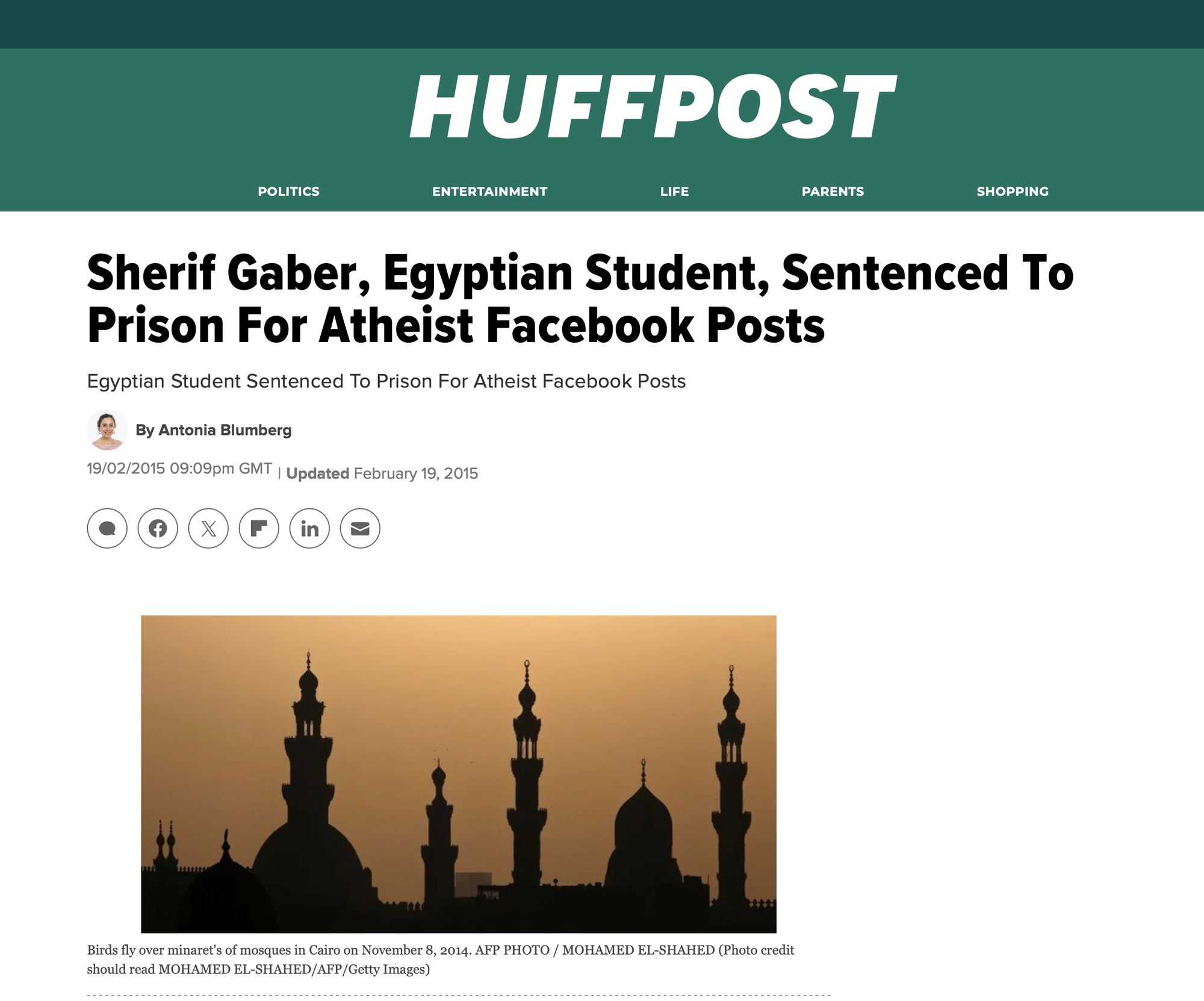
What I want to consider is what it means to have your identity stripped away, to be left alone in a society that believes your position on religion is enough to judge you as morally deficient—and even to justify your imprisonment if your beliefs are revealed—as in the case of Sherif Gaber, a young Egyptian atheist who has faced years of legal persecution for expressing his beliefs online. Gaber was accused under Egypt’s laws, specifically charges related to “contempt of religion” for content he published on social media platforms. Since 2015, he has been arrested, detained, and subjected to ongoing legal pressure. With multiple cases brought against him the total sentence is at least six years in prison.
Think about that: for writing commentary on religion no different from what you read in the pages of Skeptic and other publications, in Egypt you could end up in prison. This is the consequences of a legal framework in which individuals are prosecuted for expressing beliefs that go against socially accepted religion.
After publicly criticizing religious ideology, a fatwa calling for his death was issued in Egypt, forcing him into hiding under security protection.
The German author Hamed Abdel-Samad represents another form of skeptical consequence. After publicly criticizing religious ideology, a fatwa calling for his death was issued in Egypt, forcing him into hiding under security protection.
Exact statistics on the number of atheists or even such cases are difficult to obtain due to fear and underreporting, but human rights organizations have repeatedly documented the use of laws to silence dissenting religious views. Deviation in belief is not merely debated—it is punished—and public opinion in such cases leads toward support a death sentence for religious skeptics, seeing dissenters as a threat to social and religious order, further reinforcing a climate in which legal punishment is not only tolerated, but sometimes socially demanded.
Why have religious institutions become so deeply entrenched in power? If debate fails, is prison or the threat of death really the answer? Is it not enough to believe that nonbelievers or followers of other religions will be punished in the afterlife? Apparently not.
The Suffering of Being the Exception
I remember asking a friend twice my age whether he had any friends from his generation who shared his non-belief. It took him a full five minutes to answer. For a moment, it was like he was begging his own mind to offer a single name. But, ultimately, his answer was “No.”
After that, I let my thoughts wonder. When he was my age, did he wish to find someone like him? Not even necessarily when it comes to shared views on religious belief, but in thinking that a person should not be judged by their faith or lack thereof? Was he rejected by his family for refusing to conform to their beliefs? Was he threatened, punished, as I have been? Was he forced into religious practices he did not believe in? And does he now perform them merely to avoid the headache?
These questions are not abstract or hypothetical to me.
These questions are not abstract or hypothetical to me. I have seen the answers in my own life. At times, the answer is you will be on the receiving end of open aggression, but sometimes it also takes quieter forms like shaming and an unwillingness to accept even the act of questioning.
People like my friend are rarely visible, not because they do not exist but because visibility comes at a cost. In my experience, disbelief is often met with rejection and violence. Families will expel you, and they’ll attempt to reshape you by forcing some sort of conversion therapy with clerics, guilting, or constant reminders of what you should be.
Silence becomes the safer option. Many learn early on to separate what they think from what they say, to perform belief rather than risk confrontation. Others choose distance: emotional, social, or even geographical. Emigration, when possible, becomes less about seeking new professional opportunities and more about survival.
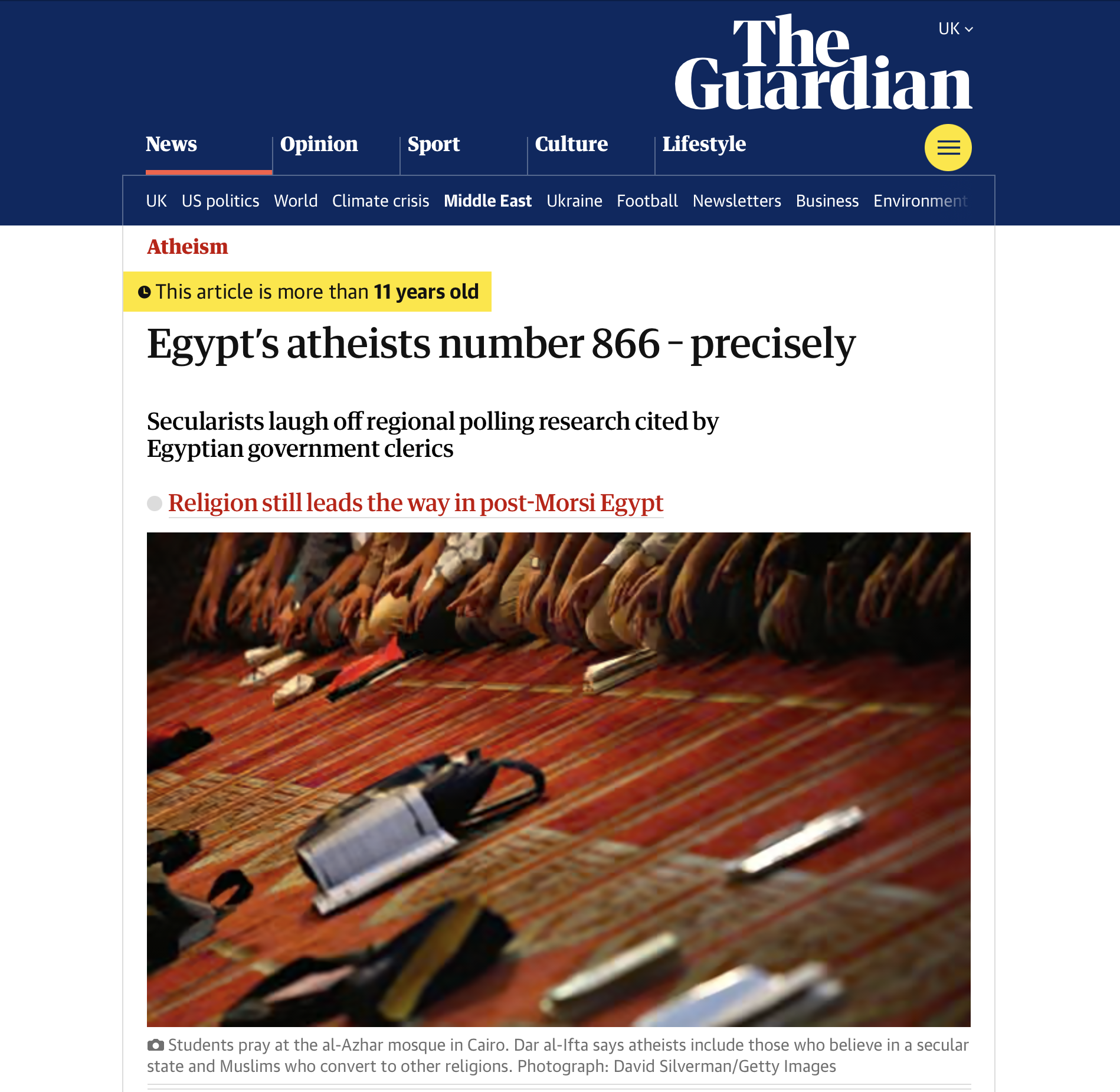
In 2014, Egypt’s official religious authority, Dar al-Ifta, claimed that there were exactly 866 atheists in the country, roughly 0.001% of the population. This number was widely mocked, not only for its precision, but for its detachment from lived reality. Even at the time, many argued that the figure was far too low, with some suggesting that there were likely more nonbelievers in a single university than the officially reported national number. While statistics remain difficult to obtain, some surveys suggest that around 11% of Egyptians identify as “not religious,” with the percentage rising to nearly 20% among younger generations.
Nonbelievers often conceal their views to avoid social ostracism.
The lack of reliable figures on atheism itself is not incidental. It reflects a climate in which many individuals choose silence over exposure. Reports consistently note that nonbelievers in Egypt often conceal their views to avoid social ostracism, legal consequences, or even threats to their safety. At the same time, most of the population still identifies as religious, creating a social environment in which deviation from dominant beliefs is often stigmatized.
So, while I can’t speak for my friend directly, I recognize the pattern. It is not one story or anecdote but a shared condition.
To be the exception in this country is to be destined for suffering. Rejection, when it comes from loved ones and family, is often justified as fear for your fate in the afterlife. But at a societal level, the consequences can escalate to imprisonment or even death like the case of Farag Foda, an Egyptian intellectual assassinated in 1992 after publicly criticizing religious extremism, who remains one of the most striking examples of how dissenting ideas can provoke violent responses beyond the law.
Between the cases of Foda (silenced by bullets), and Sherif Gaber (pursued through courts), exclusion and the belittling of your mind and your difference are considered as the “gentler” responses.
And at times, even families may resort to threats of violence—this happened to me when my uncle decided that I must get a session about the hijab with a sheikh that was 20 years old and whose education stopped at elementary school. This sheikh was younger than me! Here’s what he said:
You must wear the hijab because our messenger Mohamed said that. You should wear it and you get hit for not wearing it, and others have the right to harass you.
In response, I started to laugh at this nonsense. Then my uncle started to shout at me saying “I’m 30 years older than him yet I respect him” and then he started to hit me.
I got my arm twisted and my bones almost broken, and he hit my head on a wooden chair! Yet, my own mother saw what he did as right and blamed me for the incident. The police didn’t do anything. Why? In upper Egypt, such violence is called discipline.
I do not betray. I do not lie. I do not gossip about others’ right to live as they choose. I do not harass. I do not steal. I do not submit to tyranny or dictators. I am not a misogynist. I do not compromise when it comes to justice. Even the most outwardly devout struggle to uphold many of these virtues. And yet, in this society, because I am labelled as a disbeliever, I am ostracized. My words are attacked, my freedom of belief is confiscated, and I watch others suffer the same fate simply for their intellectual stance on religion.
What harm is there in my choice to not wear the hijab?
What harm is there in my choice to not wear the hijab? What harm is there in choosing whether or not to pray or fast? There is far more violence rooted in these questions than most are willing to see. So, I do not blame those who hide who they are. Because in a society that imposes identity upon you the alternative is to lose everything.
Imposed Identity
We all live complex lives. I have my work as an architect. I have my intellectual and cultural space, my identity, my way of thinking. But then there is my family, who reject my very existence based on my decision not to wear the hijab or not to have children.
In my dealings with people, I have noticed that anyone who rejects the type of “corrective” violence I describe here is met with extreme violence in response. Whoever refuses to be violated is punished by society. Whoever refuses to be beaten faces something worse. Whoever asks for the bare minimum of dignity risks losing everything to obtain it.
We are all expected to bow. And if you refuse, then you must accept a different reality of being rejected, threatened, and hunted. Even if your only “crime” is a word, writing an article, speaking in a café, or simply attempting to express your identity to those closest to you.
I often think of my childhood friend. We were raised together in strict religiosity, grew up side by side for 18 years, and even her father, before he passed, urged her to never let go of our friendship. But with age came socialization—she began to see my thoughts as a threat to her rigid faith. She urged me to stop questioning and stop overthinking. And when I didn’t, she chose to walk away.
Isolation is a personal condition that is reproduced across generations, shaped by accumulated histories, beliefs, and constraints.
Perhaps that was, in a way, a form of liberation. I was no longer confined by her worldview, no longer afraid of being alone. It was painful to lose her, but I was not the one who refused to accept the other.
The phrase “One Hundred Years of Solitude,” borrowed from Gabriel García Márquez’s novel, is not a literary exaggeration, but a logical outcome of living in a society such as this. In the novel, isolation is a personal condition that is reproduced across generations, shaped by accumulated histories, beliefs, and constraints.

In a similar sense, the solitude I describe here is not simply emotional or self-imposed. It emerges from a social environment that penalizes deviation and narrows the space for intellectual and personal autonomy. This isolation is produced through sustained pressure to conform, and the consequences of refusing to do so. We are all, to varying degrees, the product of long accumulations of inherited fears, ideas, and habits we did not choose. We simply find ourselves born into one place or another in the world, and yet it shapes us. But understanding this does not erase the impact of harm, nor does it make its possibility easier to endure.
I meet dozens of people every day, yet I know almost with certainty that only a few will truly understand—or even try to—what it means to choose your own thoughts. I rarely see anyone disturbed in the way I am when women are dehumanized in inherited religious discourse, when oppression is justified in the name of faith, or when entire populations are reduced to arrogant narratives that erase their humanity.
Because of this, the world often feels harsher to me than it does to others. And holding on to the bare minimum of humanity begins to look like an extreme position. I remain in a state of constant alert around others not out of fear, but out of a need to protect myself from disappointment.
I carry repeated disappointments from family, friends, and those closest to me. Not necessarily because they are bad people, but because they are, like everyone else, shaped by the same accumulations that reproduce fear of difference, superficial religiosity, and daily moral tribunals disguised as faith.
What exhausts me most, however, is the persistent sense of isolation and the awareness that I am surrounded by people who do not respect their own freedom. So, how could they respect mine?
And so, solitude is no longer merely a feeling. It has become a way to protect what remains of me.