Hagioptasia: The Feeling You've Never Had a Word For
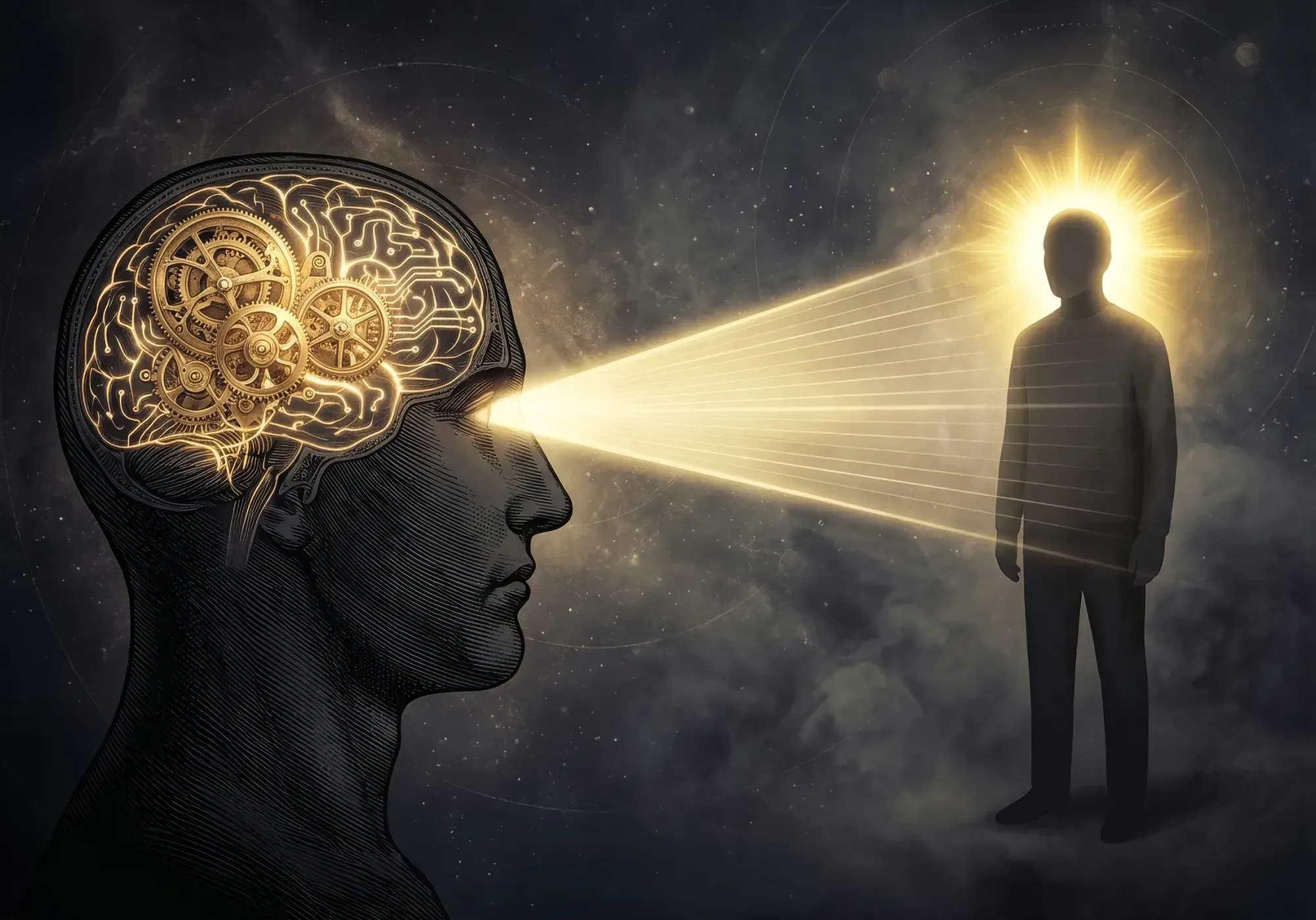
Stand at the edge of the Grand Canyon and something happens in your chest that a photograph can never capture. See a celebrity in person and they seem lit from within, even when you know better. Fall in love and the other person briefly stops being a person and becomes a kind of doorway. Walk into an old cathedral, or a stadium before kickoff, and the atmosphere seems to change.
We reach for tired words to describe this phenomenon: Awe. Magic. Aura. The sacred. None of them quite lands, because none names the thing precisely—the sense that a particular person, place, or object carries a special weight, a significance that seems to radiate from it, as if it contained something the ordinary world does not.
The claim worth examining is that the weight is not out there. It is in us. It is a response the brain generates and then projects onto the object, in a manner so convincing that we experience it as a property of the thing itself.
There is now a candidate word for this: hagioptasia, from the Greek for “sacred appearance.” It is not yet an established term in psychology, and the theory behind it is young. But it names something real, and once you have the word, you begin to see the thing everywhere—including in places that are actively lying to you.
The Same Organ, Elaborated
The framing we find most useful comes from evolutionary biology. Our brains were assembled by natural selection for life in small foraging bands, and a great deal of what confuses us about modern life follows from running that old equipment in an environment it was never designed for. Hagioptasia is a good example, and possibly a very old one.
The claim worth examining is that the weight is not out there. It is in us.
Consider the eye, which varies across species not merely in sophistication but in the specific adaptive problem it evolved to solve, while remaining recognizably the same organ from a scallop to a hawk. Hagioptasia may work the same way. The primitive version would be a differential response to certain stimuli as though they carry a weight out of all proportion to their physical substance—a peahen transfixed by a tail that does nothing but exist, a bowerbird drawn to a bachelor's carefully arranged pile of blue, or a dog gazing up at its owner with what looks like reverence. The human version layers culture, narrative, and self-awareness on top of that same basic mechanism, and out come glamour, holy sites, romantic idealization, the mystique of art, or the seductive notion of glory in war. The same organ, at vastly different levels of elaboration.
If that is right, hagioptasia is something selection has been building on for a very long time—which would help explain why the experience feels so deep and timeless when it arrives, and why it precedes and outruns our capacity to reason about it. The feeling comes first. The explanation, when we bother to supply one, arrives afterward and tends to ratify whatever the feeling already decided.
This is where a skeptic should apply the appropriate caution. Adaptationist stories are easy to tell and hard to test; the literature is littered with plausible narratives that dissolved under scrutiny. Hagioptasia is presently a hypothesis with a measurement instrument attached, not a settled finding. What makes it more than armchair speculation is that its originators did the unglamorous next step: they tried to measure it.
Origin of the Hagioptasia Idea
Hagioptasia was developed by Daniel Laidler, in England, who worked out the theory while holding down a day job in a factory—with no academic post and no institutional backing. The idea eventually reached John A. Johnson, an evolutionary psychologist and Professor Emeritus of Psychology at Penn State, who took it seriously enough to help give it empirical legs. Together they constructed a scale to measure individual differences in the disposition and published the initial validation in 2020.1 Laidler first presented the theory at the Human Behavior and Evolution Society’s annual conference in Aarhus, Denmark, in 2024, and in October 2025 was invited by Constantine Sedikides to present it to his research group at the University of Southampton, where the core reasoning held up under detailed questioning. The concept has drawn further engagement—Rory Sutherland, the famed British advertising executive and author, has been an active correspondent.
The feeling comes first. The explanation, when we bother to supply one, arrives afterward and tends to ratify whatever the feeling already decided.
We mention the provenance partly because it is a good story and partly because it is on-theme. The instinct to trust an idea only once it arrives wearing the right robes—a title, an affiliation, a prestigious address—is itself a mild case of hagioptasia. We let the aura of the institution stand in for the quality of the argument. Laidler’s idea had to travel from a factory floor to a professor’s desk before most people would give it a hearing, though the idea itself did not change. The small resistance a reader may feel toward an unaffiliated theorist is precisely the mechanism under discussion, operating in real time.
None of which makes the theory correct. It makes it testable, which is the only thing that ultimately matters.
The Counterfeit
Hagioptasia activates in the presence of real things: genuine natural grandeur, genuine social rank, a genuine mate. But the mechanism of activation cannot tell you whether the weight it assigns is earned. It simply activates, and we experience the result as a property of the object. That gap—between the feeling of significance and the actual worth of the thing—is a door exploited by advertising.
Advertising is hagioptasia for hire. A luxury brand sells aura—the implied promise that specialness will transfer from the object to the owner. Celebrity culture is an industrial-scale apparatus for manufacturing that inner glow and then charging admission to stand near it. The glow is real, in the sense that people genuinely feel it. It is false, in the sense that there need be nothing behind it—and even where there is something, a genuinely great musician, a genuinely beautiful place, the glow is not that merit. It is a separate signal, and it fires as readily for the empty as for the earned. The luminous quality you perceive in the famous face is your own response, sold back to you, rather than something inherently true about that person.
The machinery has since been automated. Recommendation algorithms discovered that human attention snags on the glamorous and the sacred-seeming. They now serve a diet optimized to keep the response firing. Politics runs on the same current: the leader who seems to carry a light, the movement that feels like a cause larger than the self.
Advertising is hagioptasia for hire.
There is a further implication that should interest anyone tracking the sociology of secularization. As traditional religion recedes across the developed world, the machinery for perceiving the sacred does not recede with it. If hagioptasia is a stable feature of the evolved mind, the response remains, still active, still scanning for something worthy of reverence. When the old altar empties, the mechanism looks for a new object and attaches to whatever is available: a brand, a politician, a celebrity, an ideology, a wellness regimen, a fandom. This is a testable prediction, not merely a rhetorical flourish—it implies measurable displacement of hagioptasic response from declining religious contexts toward secular ones.
Use of the Word and Concept
No one stands outside of such concepts. I feel the pull at monuments and inside cathedrals I do not believe in, and, more embarrassingly, in proximity to fame. Knowing the name of the mechanism confers no immunity from it; that is not how the mind works. What knowing the word and understanding the concept offers is a beat of delay: a moment, when the weight descends, in which it becomes possible to ask a question that was previously unavailable.
Is this significance coming from the object, or from the observer—and who benefits if one fails to tell the difference?
The response is old—older than language, older than religion, older than reason. What is new is a marketplace full of people who understand it better than we do, and who aim it, on purpose, at whatever they would prefer we revere or fear next. A word for the mechanism will not disarm it. But you cannot examine what you cannot name, and a skeptic's first loyalty is to seeing the machinery clearly, including the machinery running such concepts.
Hagioptasia was originated by Daniel Laidler and validated empirically in collaboration with John A. Johnson, Professor Emeritus of Psychology at Penn State, with whom he co-authored the 2020 paper establishing a measurement scale for it. This article was a collaboration among the three authors.