The Hard Problem of Consciousness Is an Insoluble One
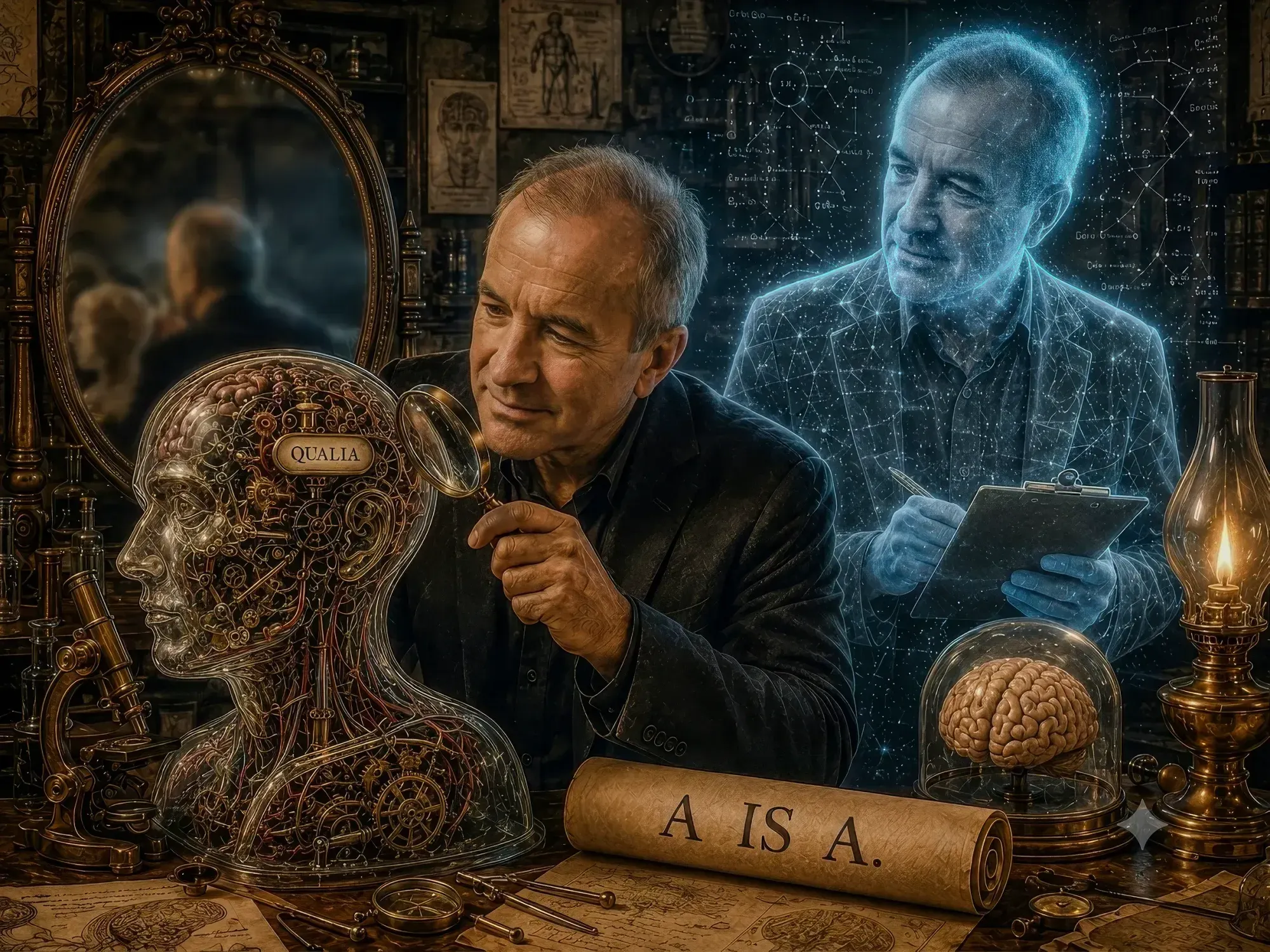
Consciousness is often defined as “what it’s like to be something,” inspired by the philosopher Thomas Nagel’s 1974 classic paper, “What Is It Like to Be a Bat?” As he explained the problem: “An organism has conscious mental states if and only if there is something that it is like to be that organism—something that it is like for the organism.”1 Let’s make dolphins our subject of inquiry. If I added echolocation to my sensory systems, perhaps I would be able to “see” the shapes of things with sound waves, and that would nudge me a bit closer to dolphin-ness. Strapping on one of those giant monofins to my feet to serve as a tail would allow me to feel what it’s like to power through a viscous aquatic medium, which would be made all the smoother if I donned one of those rubbery Olympic full-body swimsuits to mimic the dolphin’s sleek, smooth, rubbery skin texture. Adding a snorkel that serves as a blowhole for breathing, an appetite for squid (sushi, anyone?), and the ability to make clicks and whistle sounds might nudge me further along the dolphin-ness scale.
But the only way to have the full-on qualitative experience of dolphin-ness is to actually be a dolphin with all that entails anatomically, physiologically, neurologically, and cognitively. In that case, then, I would no longer be a human wondering what it’s like to be a dolphin. I’d just be a dolphin, and very likely not asking what it’s like to be a human. This is what is called the hard problem of consciousness.
As first proposed by the philosopher David Chalmers, the problem is trying to explain how we are able to experience the world from inside a wet neurochemical brain machine.2 The easy problem of consciousness would be to explain how, for example, the color red is processed in the retina of the eye and then transduced into neurochemical processes back to the visual cortex of the brain. The hard problem is explaining how it is that we can experience “redness.”
That qualitative experience is called qualia, and in the history of philosophy, this is also known as the mind-body problem—how nonmaterial mind emerges from material body. As Nagel reflected, “Without consciousness the mind-body problem would be much less interesting. With consciousness it seems hopeless.”3 The neuroscientist Christof Koch put it this way:
How can activity in the brain trigger feelings? It’s just squishy stuff. How can mere meat, as cyberpunk novels dismissively refer to the body, engender sentience? Putting it more generally, how can anything physical give rise to something nonphysical, to subjective states?4
The hard problem is not only hard for all these anatomical, physiological, neurological, and cognitive reasons, I put it into the category of a known unknowable because it is logically impossible to solve for the simple reason that it would violate Aristotle’s Law of Identity—A is A. Thus: A cannot also be non-A.
You cannot at one and the same time be one thing (a human) and another thing (a dolphin). If I were able to shape-shift from human to dolphin, I would not retain my humanness while inside the body and brain of a dolphin. I would just be a dolphin, full stop. Put another way, asking what it’s like to be one thing precludes one from knowing what it’s like to be a different thing. It’s conceptually contradictory. Understanding how the brain machinery works is different from experiencing the brain machinery itself.
The hard problem’s thought experiment of wondering what it’s like to be something is also conceptually flawed in that it implies a form of dualism, in which my soul or homunculus or mini-me transports into the body of a dolphin to experience its physical and mental state of being. This is not possible because there is no ghost in the machine, no soul in the body, and no mind in the brain, as if these are different entities that can separate and travel elsewhere.
This essentialism about the self, as it is called, leads us to intuitively feel like we have a soul or mind, separate from the body and brain. So we get the humor of films like All of Me, in which the gendered soul of Steve Martin’s character switches places with that of Lili Tomlin so that each knows what it’s like to be the other sex (with all the gender bending comedy that follows), or the film Freaky Friday, in which the teenage essence of Lindsay Lohan swaps places with the middle-aged mom essence of Jamie Lee Curtis, and hilarity ensues as the middle-aged mom is suddenly filled with teenage angst mingling with her youthful peers, and the immature teenager suddenly finds herself in adult situations for which she is ill-equipped.
Novelists have explored similar themes. In Franz Kafka’s Metamorphosis, a man falls asleep and wakes up as a cockroach, while his human personality remains intact inside the insect. But that is not what would happen. After the metamorphosis from human to arthropod, the essence of humanness would simply dissolve away while the essence of cockroach takes its place. Yet, such Gedankenexperiments fill us with imaginative worlds we can never experience in real life. Here is how the psychologist Paul Bloom explains the process:
In fact most people around the world believe that an even more radical transformation actually takes place. Most people believe that when the body is destroyed, the soul lives on. It might ascend to heaven, or descend to hell, go off into some sort of parallel world, or occupy some other body, human or animal. Even those of us who do not hold such views have no problems understanding them. But they are only coherent if we see people as separate from their bodies.5
Here, the distinction in worldviews is that between dualism and monism. Dualists believe that we consist of two substances—body and soul, brain and mind (called “substance dualism”). Monists contend that there is just one substance—a body and a brain—from which consciousness is an emergent property; “mind” is just the term we use to describe what the brain is doing, and the soul is just the pattern of information that represents our thoughts, memories, and personalities.
As such, monists hold that the death of the body—the disintegration of the material body and the degradation of memory patterns in the brain—means the death of the soul. By contrast, dualists assert that the soul, like the mind, is a separate entity from the body, so even after the death of the body, our sense is that the soul will continue.
Most people are dualists because dualism is intuitive—it just feels like there is something else inside of us, in the same way that the thoughts floating around up there in our skulls feel like our mind is separate from our brain. Thus, Bloom calls us “natural-born dualists,” as reflected in our language when we use phrases such as “my body aches” (rather than “I ache”) or “my mind is muddled” (rather than “I am muddled”), as if “my” and “body” and “mind” are separate things.6
Understanding how the brain machinery works is different from experiencing the brain machinery itself.
Not everyone agrees that the hard problem of consciousness is an insoluble one, and there are at present at least 22 theories of consciousness as documented by Anil Seth and Tim Bayne in their review article of the subject, including (to name but a few):
Higher-order theory (HOT), Self-organizing meta-representational theory, Global workspace theories (GWTs), Integrated information theory (IIT), Information closure theory, Dynamic core theory, Neural Darwinism, Predictive processing, Neuro-representationalism, Active inference, Attention schema theory, Electromagnetic field theory, Orchestrated objective reduction theory.7
The psychiatrist Ralph Lewis has pruned the 22 theories of consciousness down to four he thinks have the best chance of succeeding:
Higher-Order Theories (HOT): thoughts become conscious when basic perceptions (“lower-order” representations) become re-represented as higher-order representations at higher levels of the brain, specifically in the prefrontal cortex.
Global Workspace Theories (GWT): perceptions, thoughts, emotions, etc. become conscious when they gain access to a “workspace,” or to apply another analogy, when they make it into the “spotlight”—as if the mind were a theater where conscious thought is the activity in the spotlight on the stage at a given moment.
Integrated Information Theory (IIT): how parts of a brain interact to create a unified experience. Consciousness is theorized to be related to how much information is integrated among the different parts of the brain. IIT tries to mathematically measure this. The more information that is connected and integrated, the more conscious the system is thought to be. The theory suggests that not just brains but any complex system with the right level of interconnectedness and integration of information could exhibit consciousness, with simpler systems manifesting only an insignificant modicum of consciousness. IIT attempts to explain the quality of conscious experience, suggesting that the unique pattern of relationships between the elements of the system is what defines a particular conscious experience.
Re-Entry and Predictive Processing Theories: conscious mental states are associated with top-down signaling. Top-down signaling refers to the process by which higher-level brain regions send information, expectations, or context to lower-level brain regions. This communication helps shape how the brain perceives and interprets bottom-up information received via its sense organs from the world around it.8
Which of the 22 (or 4) theories are likeliest to be true? Lewis cautions that “it would be unrealistic for us to expect to have been completely solved at this early stage in the still-young science of consciousness,” and he may be right. Then again, Lewis identifies a conceptual problem in the entire enterprise, that is, a problem with the concept of consciousness itself, when he notes that “as soon as the first cell evolved there was an inside and an outside, and therefore the beginnings of a subjective-objective divide between the body and the outside world.”9 That is, how can something or someone outside of something or someone know what it’s like inside that system?
The Weak Consciousness Principle vs. the Strong Consciousness Principle
Here is how Deepak Chopra described consciousness in his 2017 book You Are the Universe:
Consciousness is fundamental and without cause. It is the ground state of existence. As conscious beings, humans cannot experience, measure, or conceive of a reality devoid of consciousness.10
Since you have to be conscious to experience anything, when Chopra proposes that consciousness and the universe are equivalent, in the sense that it is an “undeniable fact that any universe is only knowable through the human mind’s ability to perceive reality,” he is stating the obvious. Call this the Weak Consciousness Principle (WCP): you have to be conscious to experience consciousness.
But Deepak goes further than this when he says, “if all human knowledge is rooted in consciousness, perhaps we are viewing not the real universe based on limitations of the brain” and “that the apparent evolution of the cosmos since the Big Bang has been totally dependent upon human consciousness.” That’s reversing the causal arrow, from perception to determination, from being consciously aware of the universe and trying to understand it, to our own consciousness bringing about the universe. Call this the Strong Consciousness Principle (SCP). Which one is right?
In my understanding of the neural correlates of consciousness, the hypothesis that the brain creates consciousness has vastly more evidence for it than the hypothesis that consciousness creates the brain. Damage to the fusiform gyrus of the temporal lobe, for example, causes prosopagnosia, or face blindness, and stimulation of this same area causes people to see faces spontaneously. Stroke-caused damage to the visual cortex region called V1 leads to loss of conscious visual perception. Changes in conscious experience can be directly measured by fMRI, EEG, and single-neuron recordings. Neuroscientists can predict human choices from brain scan activity before the subject is even consciously aware of the decisions made. Using brain scans alone, neuroscientists have even been able to reconstruct on a computer screen what someone is seeing.11
In other words, brain activity = conscious experience.
Thousands of lab experiments, in conjunction with naturally occurring experiments in the form of brain tumors, strokes, accidents, and injuries, confirm the hypothesis that neurochemical processes produce subjective experiences.
In other words, neural activity = qualia.
In the end, I agree with Steven Pinker’s final assessment of the hard problem of consciousness, which he articulated in his 2018 book Enlightenment Now:
Our best science tells us that consciousness consists of a global workspace representing our current goals, memories, and surroundings, implemented in synchronized neural firing in fronto-parietal circuitry. But the last dollop in the theory—that it subjectively feels like something to be such circuitry—may have to be stipulated as a fact about reality where explanation stops.12
With all these facts in mind—themselves part of the answer to the easy problem of consciousness, for which neuroscientists have made great progress—the hard problem is asking us a question that is impossible to answer: what’s it like to be the neural wiring? That is, what’s it like to be you? How should I know? I’m not you and never can be. I can imagine what it’s like to be you, and I can apply the Copernican Principle that we’re not special to myself—I’m not special and reasonably infer that your internal states are similar to mine if I see in your actions and emotions patterns similar to those that I express. But the final step of knowing what it’s actually like to be you—or a dolphin or bat or anything is one thought too many. Only you can experience you. A is A.
In my assessment of the hard problem, then, consciousness is a known unknown that is very likely unknowable, at least as the concept is conceived of at present.